What is Just-in-Time (JIT) Manufacturing and How does it Reduce Waste?
In today’s highly competitive manufacturing environment, companies are constantly looking for ways to produce high-quality products faster, reduce operating costs, and respond more effectively to customer demand. One approach that has transformed manufacturing operations worldwide is Just-in-Time (JIT) Manufacturing. Rather than relying on large inventories and excess stock, JIT focuses on creating a smoother, more efficient production flow where resources are available exactly when they are needed.

Just-in-Time (JIT) manufacturing is an approach designed to keep production closely connected to real demand. Instead of producing large quantities in advance, businesses aim to make the right product, in the required quantity, at the right time. This reduces the resources tied up in items that are not currently needed and makes delays, defects, and process inefficiencies easier to notice.
History of Just-in-Time Manufacturing
The history of Just-in-Time (JIT) Manufacturing is closely connected with the evolution of modern manufacturing and the search for better ways to use limited resources. What we now know as JIT did not emerge as a complete production system overnight. It developed gradually as manufacturers faced changing markets, resource constraints, and the need to produce more efficiently without relying on large stocks of materials and finished products.
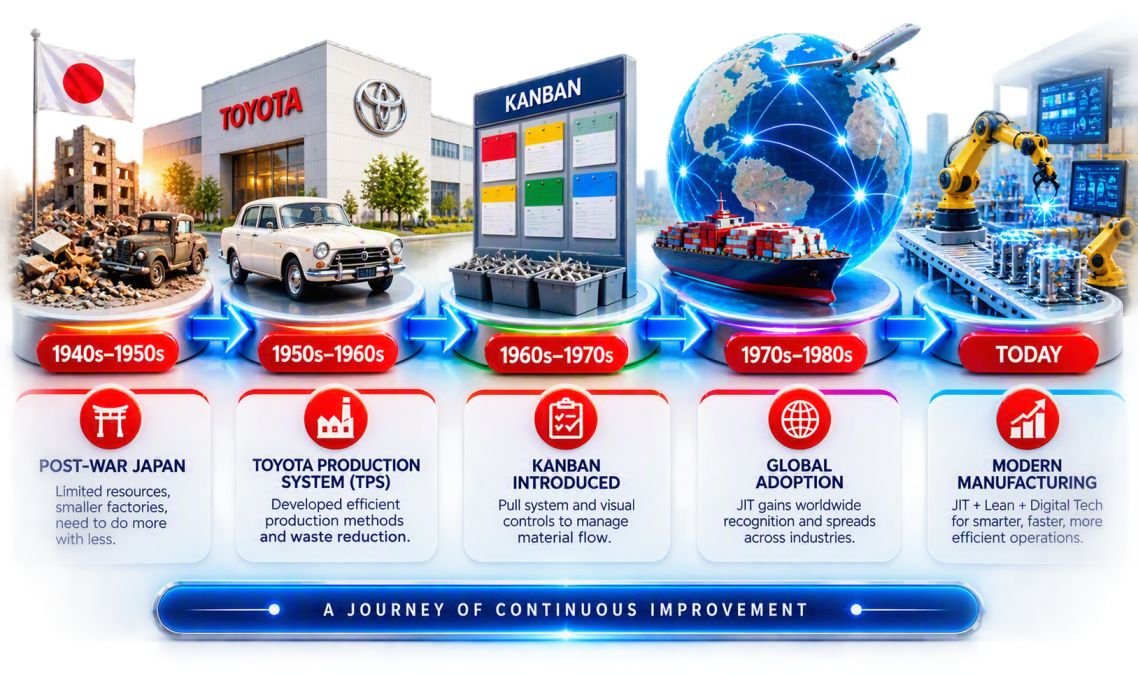
The development of JIT is particularly associated with Japan in the years following World War II. Japanese manufacturers were working in an environment where capital, factory space, materials, and customer demand were relatively limited. The traditional approach of producing large quantities in advance and keeping substantial inventory was not always practical. Manufacturers therefore needed a different way to organize production—one that could respond more closely to actual demand while making better use of available resources.
This is where the history of JIT connects naturally with several Lean concepts covered on Digital E-Learning. For example, my guide on What is Kanban? explains how visual signals can help control workflow and replenishment. The broader philosophy is also easier to understand through What is Lean Manufacturing?, which explains how Lean focuses on improving flow and removing activities that do not create customer value.
One of the most interesting influences on Ohno’s thinking came from an unexpected place: the supermarket. He observed that customers take products from shelves as they need them and that the store replenishes what has been consumed. This offered a simple way to think about manufacturing. Rather than automatically pushing large quantities of materials through the factory, a downstream operation could create a signal for what was actually needed. This way of thinking contributed to the development of the pull-based production system associated with Toyota.
The success and growing international recognition of Japanese manufacturers during the 1970s and 1980s brought much greater attention to these practices. Researchers, manufacturers, and operations professionals outside Japan began studying the Toyota Production System and related manufacturing methods. JIT soon became widely discussed in Western manufacturing and was increasingly connected with the broader concept of Lean Manufacturing.
For a broader understanding, see our related guides on Lean Manufacturing, Kanban, 8 Wastes of Lean Manufacturing, and Value Stream Mapping
Why is it called “Just-in-Time”?
The name Just-in-Time (JIT) comes from a simple idea: something should be available when it is needed—not unnecessarily early and not too late. In manufacturing, this applies to materials, components, and products. Rather than holding large quantities “just in case,” the focus is on having what is required at the appropriate time and in the required quantity.
A simple everyday example is cooking a meal. You want the ingredients available when you start preparing the dish. Getting them far too early may create unnecessary storage or spoilage, while getting them too late delays the meal. JIT Manufacturing applies the same basic thinking to production.
The term became strongly associated with the Toyota Production System (TPS) and its approach to coordinating production with actual requirements. Over time, the phrase “Just-in-Time” came to represent more than inventory timing—it became a widely recognized concept within Lean Manufacturing.
This connection is worth understanding because JIT is one part of a much broader Lean philosophy. Our guide on What is Lean Manufacturing? explains the bigger picture and how Lean thinking has changed modern manufacturing.
In my experience, JIT is often misunderstood as simply “keeping less inventory.” That misses the real meaning of the term. The important part is the timing and coordination—having the required resource available when it is actually needed, without creating unnecessary excess.
The same thinking also connects naturally with Kanban, another important Lean concept used to support controlled flow and replenishment.
So, the name Just-in-Time is quite literal: the right requirement, at the right time, without unnecessary delay or excess. That simple idea is the foundation behind the term and explains why it became such an important concept in modern manufacturing.
How Just-in-Time Manufacturing Works
Just-in-Time (JIT) Manufacturing works by closely aligning production with actual demand. Instead of making large quantities in advance and storing them until they are needed, materials and components move through the production process according to the requirements of the next stage. The aim is simple: keep production moving without creating unnecessary piles of inventory between processes.
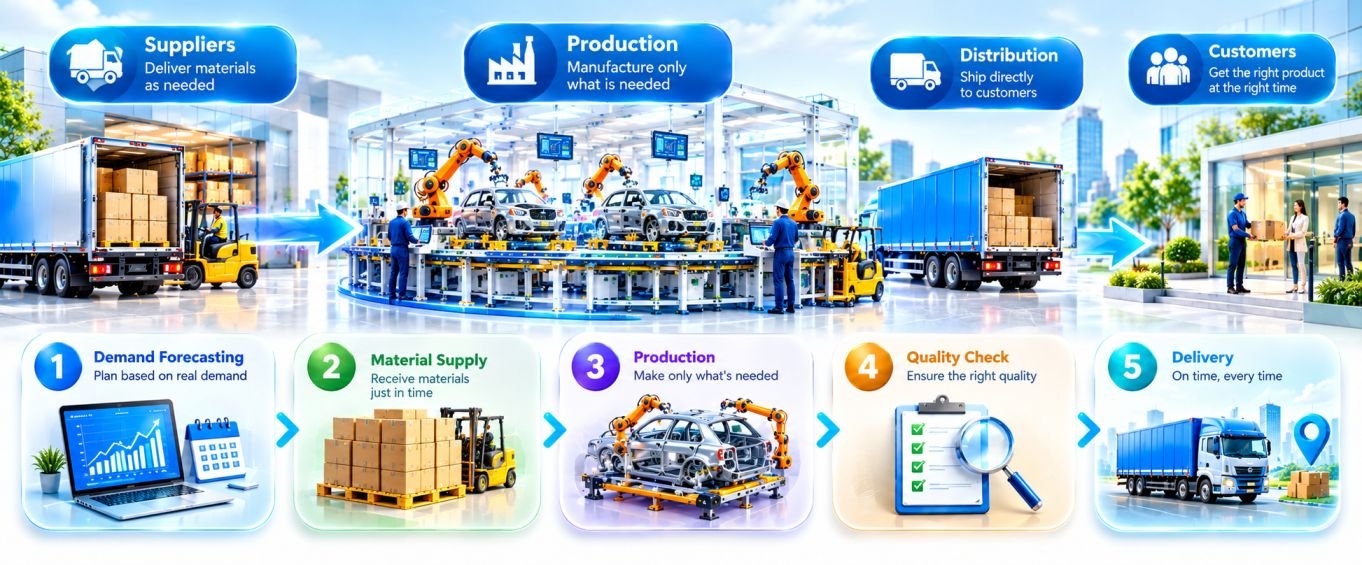
A useful way to picture JIT is as a relay race. Each runner moves when it is time to pass the baton. In the same way, one manufacturing process provides what the next process needs, when it is needed. This keeps the flow connected and avoids producing far more than the operation can use.
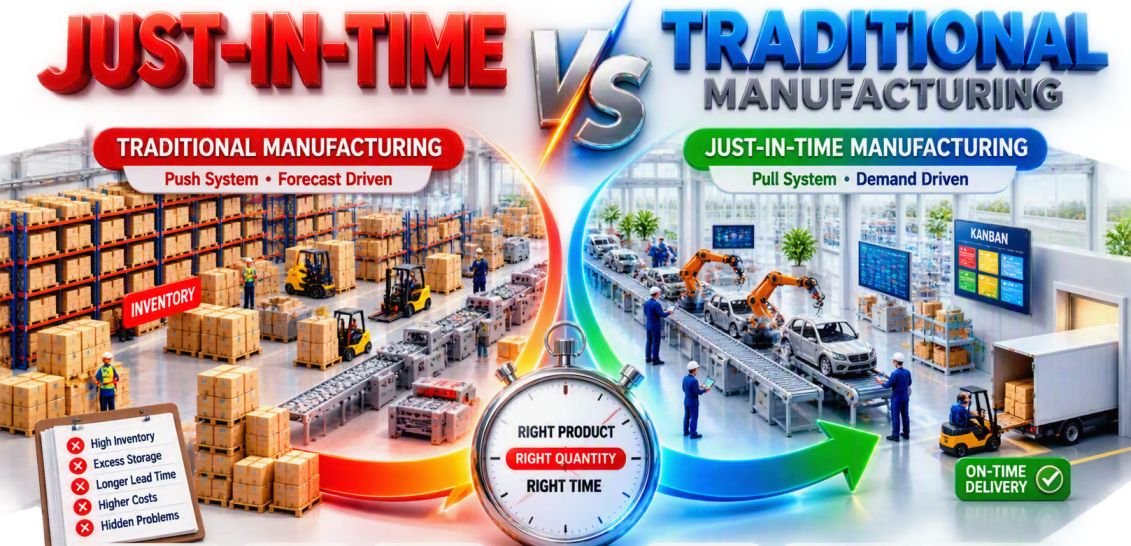
In a conventional production system, manufacturers may produce according to forecasts and maintain extra inventory to protect against uncertainty. JIT takes a more demand-driven view. When the need changes, production and material supply can adjust rather than continuing to build stock simply because capacity is available.JIT is closely connected with other Lean practices. For example, Kanban can help signal when materials need to be replenished, while Value Stream Mapping provides a broader view of material and information flow. For the bigger Lean context, see our guide to Lean Manufacturing.
Ultimately, JIT works by creating a coordinated flow in which production responds to actual requirements rather than building unnecessary inventory ahead of demand. When that flow is well managed, materials spend less time waiting, work moves more smoothly, and the operation becomes easier to monitor and improve.
🎓 Top-Rated Courses & Certifications
Try changing your filters or searching for another course.
Just-in-Time vs Traditional Manufacturing
Just-in-Time (JIT) Manufacturing works by coordinating production with actual demand so that materials and components are available when they are needed. Instead of building up large quantities between production stages, each process is expected to supply the next step according to its requirements. The result is a more controlled flow of materials through the factory.
A simple way to visualize JIT is a relay race. One runner does not hand over the baton long before the next runner is ready. The handoff happens at the right moment. Manufacturing works in a similar way: materials move from one process to another when there is a genuine need for them.
This approach makes production flow an important part of JIT. When material moves through the process at the right pace, there is less unnecessary waiting, accumulation, and handling. Tools such as Kanban can be used to provide replenishment signals, while Value Stream Mapping helps teams visualize where material and information flow may be interrupted.
Another important point is visibility. When excessive inventory is not being used as a cushion, problems are easier to notice. Delays, equipment issues, quality problems, and process interruptions can become visible much sooner, creating an opportunity to investigate and improve the underlying process.
From my experience, this is one of the most valuable aspects of JIT: inventory can sometimes hide process problems rather than solve them. A large stock of material may keep production moving temporarily, but it can also make underlying weaknesses less obvious. JIT encourages teams to pay closer attention to why those problems occur.
This connects naturally with 8 Wastes of Lean Manufacturing, particularly waste associated with excess inventory and waiting, and with the broader philosophy of Lean Manufacturing.
In simple terms, JIT creates a demand-driven flow where materials move through production when they are needed, helping the operation use space, time, and resources more deliberately.
Core Principles of Just-in-Time Manufacturing
At first glance, Just-in-Time (JIT) Manufacturing may look like an inventory-control strategy. In practice, it is a broader approach to managing production around demand, flow, waste, quality, and continuous improvement. The objective is not simply to hold less stock, but to create a process that can operate efficiently without depending on excessive inventory.
1. Produce What Is Needed, When It Is Needed
A fundamental JIT principle is to align production as closely as possible with actual requirements. Producing too early or in excessive quantities can create unnecessary inventory and tie up valuable space, cash, and resources.
This thinking is closely connected to Lean Manufacturing, where the focus is on creating customer value while minimizing activities that do not contribute to it.
2. Maintain a Smooth Production Flow
JIT emphasizes smooth and uninterrupted flow. Materials should not spend unnecessary time waiting between processes, and work should move through the operation with minimal delays.
Value Stream Mapping is particularly useful for visualizing the movement of materials and information and identifying areas where waiting or excess inventory may exist.
3. Eliminate Unnecessary Waste
JIT encourages teams to continually identify activities that consume time, space, effort, or money without adding customer value. Common examples include overproduction, excess inventory, waiting, unnecessary movement, defects, and rework.
Our guide to 8 Wastes of Lean Manufacturing explores these sources of waste in greater detail.
4. Build Quality Into the Process
JIT depends on reliable processes. When defects move from one operation to the next, they can quickly disrupt production and create additional work.
The focus is therefore on identifying problems early and preventing them at the source rather than relying only on final inspection. Tools such as Poka-Yoke can support this approach.
5. Improve Continuously
JIT is not a one-time initiative. Processes need to be reviewed and improved as operating conditions change.
This continuous-improvement mindset is closely associated with Kaizen and the PDCA Cycle, which provide structured ways to identify and implement improvements.
6. Maintain Reliable Processes and Equipment
A JIT system needs dependable equipment and stable processes. Frequent breakdowns, unpredictable cycle times, or inconsistent output can quickly interrupt production flow.
Practices such as Total Productive Maintenance (TPM) and Overall Equipment Effectiveness (OEE) can help organizations monitor and improve equipment performance.
From my experience, one of the biggest misunderstandings about JIT is treating it as simply a “reduce inventory” program. Inventory can sometimes hide weaknesses in a process. When inventory is reduced, those weaknesses become easier to see—and that creates an opportunity to fix the underlying problem rather than simply adding more stock.
Taken together, these principles create the foundation of Just-in-Time Manufacturing: production responds to demand, materials flow with less unnecessary waiting, waste is challenged, quality is built into the process, and improvement becomes part of everyday operations.
For this reason, organizations often invest in maintaining reliable equipment and standardized processes. Approaches such as Total Productive Maintenance (TPM) and monitoring metrics like Overall Equipment Effectiveness (OEE) help ensure that operations remain predictable and efficient.
How to Implement Just-in-Time Manufacturing Successfully
Implementing Just-in-Time (JIT) Manufacturing is not about cutting inventory overnight. The real goal is to build a production system that can consistently meet customer demand without relying on large stock buffers to compensate for process problems.
In my experience, one of the biggest mistakes organizations make is reducing inventory before understanding why that inventory exists in the first place. Excess inventory often hides deeper issues such as equipment downtime, quality problems, supplier delays, or inefficient workflows. Removing the inventory without fixing those root causes usually creates more problems than it solves.
Understand the Current Process First
Before making any changes, take time to understand how materials and information move through the operation. Identify bottlenecks, excessive waiting, rework loops, and areas where inventory accumulates unnecessarily.
A useful starting point is Value Stream Mapping, which helps visualize the entire process and highlights opportunities to improve flow.
Stabilize Processes Before Reducing Inventory
JIT works best when processes are predictable and reliable. Frequent breakdowns, inconsistent cycle times, and quality issues can quickly disrupt production flow.
Organizations often use tools such as Statistical Process Control (SPC), Total Productive Maintenance (TPM), and Overall Equipment Effectiveness (OEE) to create more stable and controlled operations.
Create a Demand-Driven Flow
Once processes are stable, production can be aligned more closely with actual customer demand rather than forecasts.
Many companies use Kanban systems to provide clear signals for replenishment, helping materials move through the production process only when needed.
Eliminate Waste and Improve Flow
Successful JIT environments focus on removing activities that do not add value to the customer. Excess transportation, waiting, overproduction, and unnecessary inventory can all slow down operations.
Related reading:
Build Strong Supplier Partnerships
JIT depends heavily on reliable suppliers. Materials need to arrive in the right quantity, at the right time, and with the expected quality. Strong communication and collaboration with suppliers are therefore critical to maintaining smooth operations.
Focus on Quality at the Source
Quality issues can quickly disrupt a JIT system because there is less inventory available to absorb defects.
Techniques such as Poka-Yoke, 5 Why Analysis, and FMEA help organizations identify and prevent problems before they affect production.
Start Small and Improve Continuously
Rather than transforming an entire facility at once, begin with a pilot area, learn from the results, and expand gradually. Continuous improvement is essential for long-term success.
Tools such as Kaizen and the PDCA Cycle provide structured approaches for ongoing improvement.
Final Thoughts
Successful JIT implementation is less about reducing inventory and more about creating a stable, efficient, and demand-driven production system. When processes are reliable, quality is built into the workflow, and suppliers are aligned with operational needs, lower inventory becomes a natural result rather than the primary objective.
📚 Recommended Books for Professionals
Try removing one or more filters.
Challenges in Implementing Just In Time
While Just-in-Time (JIT) Manufacturing can improve production flow and reduce excess inventory, it also leaves less room for error. With smaller inventory buffers, problems that once remained hidden can quickly disrupt operations.
In my experience, the biggest misconception about JIT is that lower inventory automatically means success. Inventory often acts as a cushion for deeper issues. Removing that cushion exposes the problems, but it doesn't solve them.
Supplier and Supply Chain Reliability
JIT depends on receiving the right materials, in the right quantity, at the right time. Late deliveries, quality issues, transportation delays, or supplier shortages can quickly impact production schedules.
Successful JIT systems rely on strong supplier partnerships, reliable communication, and realistic inventory strategies based on business risk, not simply a "zero inventory" mindset.
Process Instability and Equipment Downtime
When equipment fails or processes become inconsistent, production flow can stop quickly. Because JIT operates with less work-in-process inventory, even a small disruption can affect downstream operations.
Organizations often strengthen process reliability through Total Productive Maintenance (TPM) and by tracking Overall Equipment Effectiveness (OEE) to identify losses that affect performance.
Demand Fluctuations
JIT works best when customer demand is reasonably predictable. Sudden order spikes, seasonal demand changes, or inaccurate forecasts can make production planning more challenging. The goal is to remain responsive without constantly changing schedules or rebuilding excess inventory that JIT is designed to eliminate.
Quality Problems
Defects can have a much larger impact in a JIT environment because there is little extra inventory available to absorb mistakes. A single recurring quality issue can interrupt production flow and create delays across multiple operations. Preventive approaches such as Poka-Yoke, FMEA, and 5 Why Analysis can help identify and address potential problems before they affect customers.
Resistance to Change
JIT often requires a significant shift in mindset. Employees and managers who are accustomed to large inventory buffers may initially see lower inventory levels as risky. Continuous improvement methods such as Kaizen and the PDCA Cycle can help teams adopt new ways of working while building confidence in the system.
Limited Process Visibility
It is difficult to improve what you cannot see. Many organizations struggle with JIT because bottlenecks, waiting time, and information delays are not clearly visible. Tools such as Value Stream Mapping help identify process constraints, while Kanban improves visibility of material flow and replenishment needs.
Benefits of Just-in-Time Manufacturing
| Benefit | How JIT Helps |
|---|---|
| Lower Inventory Costs | Reduces storage, handling, and excess stock expenses. |
| Improved Production Flow | Materials move through the process with fewer delays and bottlenecks. |
| Better Product Quality | Problems become visible sooner, enabling faster corrective action. |
| Reduced Waste | Minimizes overproduction, waiting time, unnecessary movement, and excess inventory. |
| Faster Response to Demand | Helps organizations adapt more quickly to changing customer requirements. |
| Improved Cash Flow | Less money is tied up in inventory, freeing capital for other business needs. |
| Better Use of Space | Reduces warehouse requirements and improves workplace organization. |
| Greater Process Visibility | Makes equipment, quality, and workflow issues easier to identify and solve. |
Related Reading:
JIT Manufacturing Examples
The best way to understand Just-in-Time (JIT) Manufacturing is to look at how successful organizations have applied it in real-world operations. While every company uses JIT differently, the common objective is the same: improve flow, reduce unnecessary inventory, and produce closer to actual demand.
Toyota: The Benchmark for JIT
When people talk about JIT, Toyota is usually the first example that comes to mind. After World War II, Toyota faced resource constraints and could not afford to carry the large inventories common in many Western factories. Instead, the company developed the Toyota Production System (TPS), which focused on producing only what was needed, when it was needed, and in the quantity required.
Toyota later introduced Kanban to help control material replenishment and maintain production flow. These concepts became the foundation of modern Lean Manufacturing and continue to influence manufacturers worldwide.
Dell: Build-to-Order Manufacturing
Dell demonstrated that JIT principles were not limited to automotive manufacturing. Rather than building large quantities of computers and waiting for customers to buy them, Dell adopted a build-to-order approach. Components were sourced and assembled based on actual customer orders, helping the company reduce inventory costs, avoid obsolete parts, and respond quickly to changing technology trends.
Harley-Davidson: Manufacturing Transformation
Harley-Davidson is often cited as a successful JIT case study because of its broader manufacturing transformation. The company combined JIT practices with employee involvement, quality improvement initiatives, and process control methods to improve productivity and reduce manufacturing inefficiencies. The result was a more responsive production system with improved operational performance.
Key Lesson from These Case Studies
Looking at Toyota, Dell, and Harley-Davidson, one lesson stands out. In my view, successful JIT implementations are rarely about inventory reduction alone. The companies that benefit most from JIT focus on improving the entire system, including material flow, supplier coordination, process stability, and waste reduction.
That's why tools such as Value Stream Mapping and understanding the 8 Wastes of Lean Manufacturing are so valuable. They help organizations identify where flow is being interrupted and where improvement efforts should be focused.
Ultimately, JIT succeeds when it becomes part of a broader operational strategy rather than simply a method for carrying less inventory.
Frequently Asked Questions (FAQ)
Q: What is Just-in-Time (JIT) Manufacturing?
JIT is a production approach where materials and products are made or delivered close to the time they are actually needed.
Q: What is the main goal of JIT Manufacturing?
The goal is to improve production flow while reducing unnecessary inventory, waiting, and other forms of waste.
Q: What is an example of JIT Manufacturing?
Toyota is the most recognized example, with JIT forming an important part of the Toyota Production System.
Q: How does JIT reduce inventory?
JIT aligns material replenishment with actual requirements, reducing the need to store excessive quantities.
Q: Is JIT the same as Lean Manufacturing?
No. JIT is an important part of Lean Manufacturing, while Lean covers a much broader improvement philosophy.
Q: What role does Kanban play in JIT?
Kanban uses visual signals to indicate when materials or products need to be replenished.
Q: What are the main benefits of JIT?
Key benefits can include lower inventory costs, better space utilization, improved flow, reduced waste, and greater responsiveness to demand.
Q: What are the biggest challenges of JIT?
Common challenges include supplier disruptions, demand changes, equipment downtime, process instability, and quality problems.
Q: Can JIT be used outside manufacturing?
Yes. JIT principles can also be applied in areas such as healthcare, logistics, retail, and service operations.
Q: Does JIT mean zero inventory?
No. JIT does not necessarily mean zero inventory; it focuses on maintaining appropriate inventory based on actual operational needs.
Conclusion
Just-in-Time (JIT) Manufacturing is not simply about carrying less inventory. At its core, JIT is about creating a production system that delivers the right product at the right time while minimizing waste and improving flow.
What makes JIT powerful is that it forces organizations to address the root causes of inefficiency rather than hiding them behind large inventory buffers. When processes become more reliable and better connected, inventory naturally decreases as a result of improvement, not as the primary objective.
In my view, the biggest lesson from JIT is that inventory should support the process, not compensate for its weaknesses. Companies that focus only on reducing stock often struggle, while those that improve process stability, supplier collaboration, quality, and workflow visibility are far more likely to achieve long-term success.
JIT also works best when combined with proven continuous improvement tools such as Lean Manufacturing, Kanban, Value Stream Mapping, Kaizen, and TPM. Together, these approaches help organizations build more efficient, responsive, and customer-focused operations.
Ultimately, successful JIT implementation is not measured by how little inventory a company carries. It is measured by how effectively the organization delivers value to customers through stable processes, efficient resource utilization, and a culture of continuous improvement.

Lean Six Sigma • Six Sigma • Statistics • Project Management • Artificial Intelligence (AI) • Operations Management • Quality Management
Continue Your Learning Journey
Learning is a continuous process. Explore related topics, practical guides, tools, calculators, templates, and learning resources to expand your knowledge and develop new skills.
Choose a category below to explore practical tutorials, tools, calculators, templates, case studies, and learning resources.
Recommended Learning Resources
Expert-led courses to build practical skills, earn credentials, and advance your career.
Recommended professional books, certification guides, and practical study resources.
Ready-to-use templates, checklists, guides, and workbooks for practical applications.
Interactive calculators for statistics, quality, engineering, analysis, and decision-making.
Interactive Z, t, Chi-Square, and F tables with critical values and distribution curves.
Discover practical tutorials, case studies, and professional resources across Quality, Lean Six Sigma, Project Management, Statistics, AI, and Data Analytics.
Published: September 21, 2026
Last Updated: September 21, 2026