What is Poka-Yoke? The Error-Proofing Method That Prevents Defects Before They Happen
No process is completely free from human error. Even the most experienced operators, engineers, and professionals can make mistakes. The challenge is not eliminating human error altogether, but designing processes that prevent those mistakes from turning into defects, rework, delays, or customer complaints.
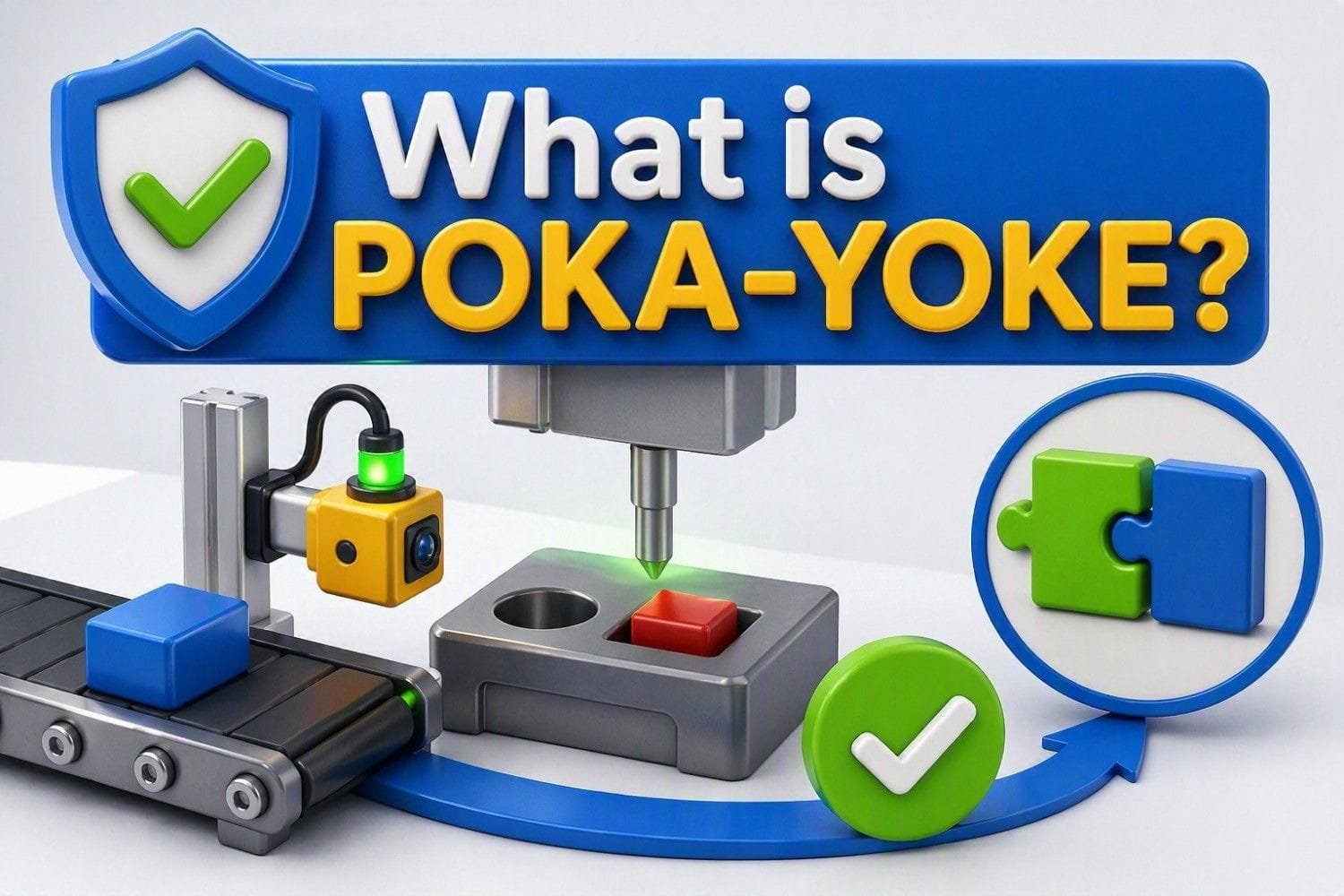
Poka-Yoke is a simple yet powerful approach that focuses on building quality into a process rather than relying on inspection to find problems afterward. By making errors impossible, difficult, or immediately visible, organizations can prevent defects before they occur and create more reliable, efficient, and customer-focused processes.
Today, Poka-Yoke is widely used across manufacturing, healthcare, software development, and service industries as a practical way to improve quality, reduce costs, and support a culture of continuous improvement.
Introduction: Why Do Small Mistakes Cause Big Problems?
Human beings make mistakes. Even highly trained professionals, experienced operators, skilled engineers, surgeons, pilots, and software developers are capable of errors. Most manufacturing problems don’t begin with a major failure—they start with a small, seemingly harmless mistake. A missing screw, a connector assembled in the wrong orientation, a skipped inspection, or an incorrect process setting may not look serious at the time. However, as the product moves through production, that small error can quickly grow into rework, scrap, customer complaints, production delays, or even a product recall. In highly regulated industries such as medical devices, the consequences can extend far beyond cost, affecting compliance and, more importantly, patient safety.
Throughout my career in manufacturing and medical device quality engineering, I’ve learned that the root cause is rarely careless operators. More often, the process itself allows mistakes to happen. During New Product Introduction (NPI) projects, design reviews, and process validations, I’ve seen simple improvements—such as redesigning a fixture, adding a locating pin, introducing a sensor, or improving visual guidance—eliminate potential defects before production even began. Those experiences reinforced an important lesson: the most effective quality improvement isn’t finding defects faster; it’s preventing them from occurring in the first place.
This is the philosophy behind Poka-Yoke, a Japanese mistake-proofing technique that focuses on building quality into the process rather than inspecting it afterward. Instead of asking, “How can we detect defects?”, Poka-Yoke encourages a more powerful question: “How can we design the process so the mistake cannot happen?” That simple shift in thinking has helped world-class manufacturers improve quality, reduce costs, and create more reliable processes across industries.
In this guide, I’ll combine practical manufacturing experience with proven Lean and Six Sigma principles to show you how Poka-Yoke works, why it is so effective, and how you can apply it to design error-proof processes in real-world manufacturing environments. This isn’t just another definition of Poka-Yoke—it’s a practical guide based on lessons learned from solving real quality challenges.
What is Poka-Yoke?
Poka-Yoke (pronounced Poh-kah Yoh-kay) is a Japanese term that means mistake-proofing or error prevention. Developed by Japanese industrial engineer Shigeo Shingo as part of the Toyota Production System, it is based on a simple but powerful idea: design products, tools, and processes so that mistakes either cannot happen or are detected immediately before they become defects. Instead of depending on inspections to catch problems after they occur, Poka-Yoke builds quality directly into the process by making the correct action the easiest—and often the only—action possible.
The term comes from:
- “Poka” = inadvertent mistake
- “Yoke” = prevention
Together, it translates to “mistake-proofing” or “error prevention.
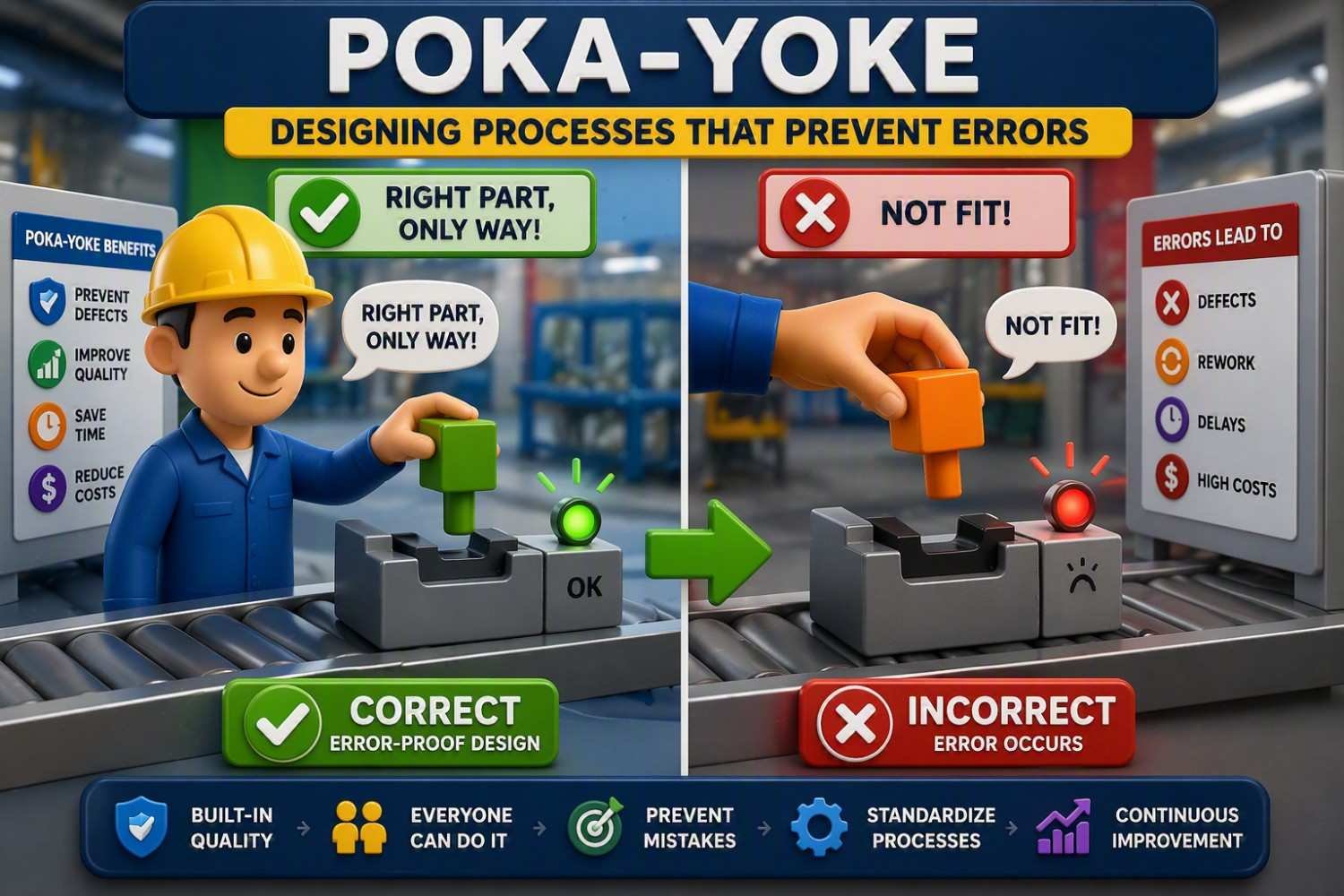
What makes Poka-Yoke so effective is its mindset. It accepts that people are human and occasional mistakes are inevitable, especially during repetitive work, time-critical operations, or complex assembly tasks. Rather than expecting operators to be perfect
One of the biggest misconceptions about Poka-Yoke is that it requires sophisticated sensors, automation, or expensive technology. Throughout my career in automotive, manufacturing, and medical device quality engineering, I’ve found the opposite to be true. Some of the most effective mistake-proofing solutions have been remarkably simple. During New Product Introduction (NPI) projects and process validations, I’ve seen small design changes—such as adding a locating pin, redesigning a fixture, introducing color coding, or creating a simple visual guide—completely eliminate recurring assembly errors. These improvements required more thoughtful engineering than additional investment, yet they prevented defects, reduced rework, and improved process reliability.
Today, companies across automotive, medical devices, aerospace, pharmaceuticals, electronics, software, logistics, food processing, and healthcare rely on mistake-proofing techniques to improve safety, reduce rework, lower costs, and increase customer satisfaction.
In simple words:
Poka Yoke means designing processes or systems so that mistakes are either impossible or immediately visible.
🎓 Top-Rated Courses & Certifications
Try changing your filters or searching for another course.
Evolution from “Baka-Yoke” to “Poka-Yoke”
The story behind Poka-Yoke reflects an important shift in quality thinking. When Japanese industrial engineer Shigeo Shingo introduced the concept in the 1960s as part of the Toyota Production System, he originally called it “Baka-Yoke,” meaning fool-proofing. However, many operators felt the term implied that people were at fault. To promote a more respectful culture, it was renamed “Poka-Yoke,” meaning mistake-proofing, shifting the focus from blaming people to improving the process.
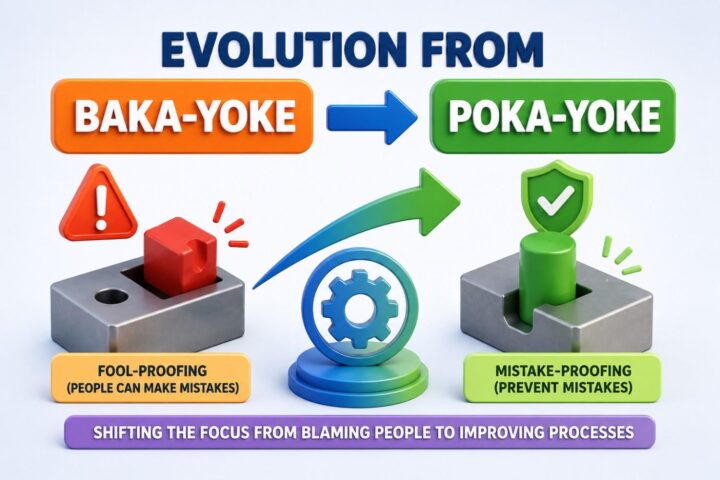
Although the name changed, the philosophy remained the same: people make mistakes, but well-designed processes can prevent those mistakes from becoming defects. Throughout my career in manufacturing and medical device quality engineering, I’ve found that recurring quality issues are rarely caused by careless employees. More often, they result from processes that rely too much on memory, unclear instructions, or poor design. The best teams I’ve worked with don’t ask, “Who made the mistake?” They ask, “How can we improve the process so it doesn’t happen again?”
Today, Poka-Yoke is used across industries—from automotive and medical devices to aerospace, electronics, healthcare, and software. Whether it’s a fixture that prevents incorrect assembly or software that blocks incomplete data entry, the principle remains the same: design processes that make the right action easy and the wrong action difficult. More than six decades later, this simple idea continues to help organizations improve quality, reduce defects, and build a culture of continuous improvement instead of blame.
Why Poka-Yoke Works: The Science Behind Mistake-Proofing
Poka-Yoke works because it is built on a simple but powerful principle: human error is inevitable, but defects are not. Even the most experienced employees can forget a step, misread an instruction, or install the wrong component when working under pressure, performing repetitive tasks, or dealing with distractions. Instead of expecting people to be perfect, Poka-Yoke redesigns the process so that mistakes are either impossible to make or are detected before they become defects. It doesn’t try to change human behavior—it improves the system.
Throughout my career in manufacturing and medical device quality engineering, I’ve seen organizations respond to recurring quality issues by conducting more training or reminding operators to “be more careful.” While those actions may provide a temporary improvement, the same problems often return because the process hasn’t changed. The real breakthrough comes when the process itself is redesigned. In one project, a simple fixture modification prevented components from being assembled in the wrong orientation. The recurring defect disappeared almost immediately—not because operators became more skilled, but because the opportunity to make the mistake no longer existed.
This is the science behind Poka-Yoke. By reducing reliance on memory, judgment, and individual attention, it minimizes process variation and builds quality into the process itself. Whether it’s a fixture that only accepts a part in the correct orientation, a barcode scan that prevents the wrong product from being shipped, or a software form that won’t allow incomplete information to be submitted, the principle remains the same: make the right action easy and the wrong action difficult—or impossible.
That’s why Poka-Yoke has become a cornerstone of Lean Manufacturing, Six Sigma, FMEA, and modern quality engineering. The earlier a mistake is prevented, the lower the cost of correcting it and the lower the risk to the customer. Simply put, the best defect is the one that never happens.
Types of Poka-Yoke
Not every mistake-proofing solution works the same way. Depending on the process and the level of risk, a Poka-Yoke system can either prevent an error from occurring or detect it immediately before it becomes a defect. Both approaches have the same objective—building quality into the process rather than relying on inspection to catch problems later.
Throughout my career in manufacturing and medical device quality engineering, I’ve used both types of Poka-Yoke. Whenever feasible, the preferred approach is prevention, because the most effective defect is the one that never occurs. However, there are situations where completely eliminating the possibility of human error isn’t practical. In those cases, detection-based Poka-Yoke provides an additional safeguard by identifying the mistake early, allowing it to be corrected before it affects product quality or reaches the customer.
Poka-Yoke systems are therefore broadly classified into two main types:
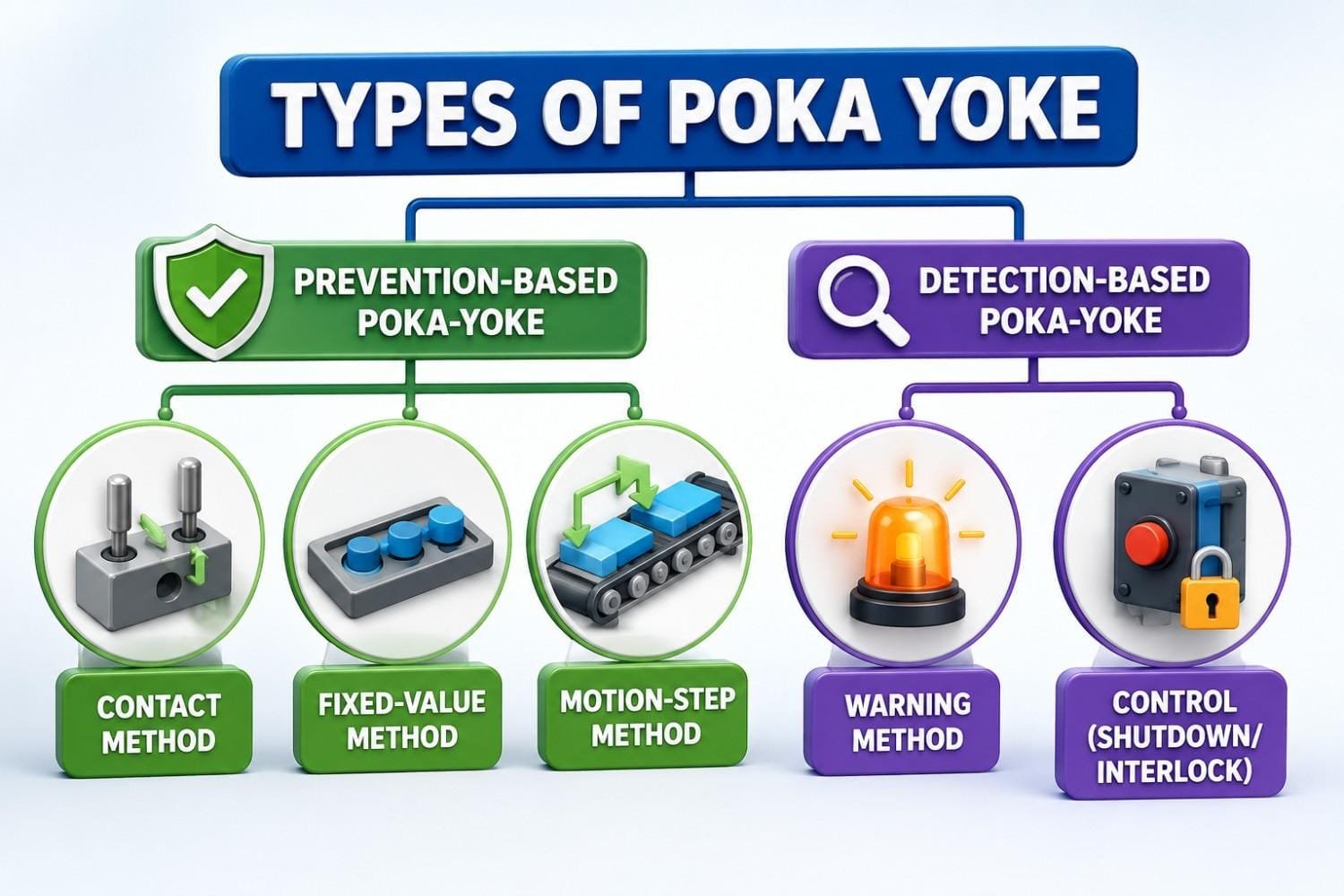
1. Prevention-Based Poka-Yoke
Prevention-Based Poka-Yoke is designed to eliminate the possibility of an error by making the incorrect action impossible or physically difficult to perform. Examples include keyed fixtures, locating pins, interlocks, and components that fit only in the correct orientation. This is the most effective form of mistake-proofing because it prevents defects at their source.
Contact Method :
The Contact Method is one of the most widely used poka-yoke techniques. This method detects errors by checking the physical characteristics of a product, part, or component. It works by verifying features such as size, shape, color, weight, or dimension to make sure the correct item is being used or assembled. If something does not match the required standard, the process stops or gives a warning. This method is especially useful in manufacturing, where even a small variation in part size or shape can lead to defects in the final product.
Fixed-Value Method :
The Fixed-Value Method ensures that a process step is completed a specific number of times or that a certain quantity is used before the operation can continue. This approach is useful when quality depends on repeating an action correctly and consistently. If the required count is not met, the system alerts the operator or stops the process. This method is especially effective in assembly, packaging, and inspection tasks where missing even one item can create a defect
Motion-Step Method:
The Motion-Step Method focuses on ensuring that the correct process steps occur in the proper sequence. It is used when the order of activities is critical to achieving the desired outcome. If a step is skipped, repeated incorrectly, or performed in the wrong order, the system identifies the problem and either prevents the next step or alerts the operator. This method is common in both manufacturing and service processes because many errors happen not because people do not know the task, but because they accidentally miss a step.
2. Detection-Based Poka-Yoke
Detection-Based Poka-Yoke does not stop the mistake from occurring but identifies it immediately through visual indicators, sensors, alarms, counters, or automated inspections. The system then alerts the operator or stops the process, ensuring the error is corrected before it moves to the next operation or reaches the customer.
While both approaches improve quality, prevention is always the preferred choice whenever it is technically and economically feasible. Detection should be viewed as the next best option when complete prevention isn’t possible. In the following sections, we’ll explore each type in detail, along with practical manufacturing examples and the design methods used to implement them effectively.
Warning Method (Alert Poka-Yoke):
The Warning Method detects an abnormal condition and immediately alerts the operator through lights, buzzers, alarms, messages, or visual indicators. The process itself continues to operate, but the operator is notified so corrective action can be taken before the defect progresses further.
This method is most effective when the operator can quickly identify and correct the problem without stopping production.
Control Method (Shutdown / Interlock Poka-Yoke):
The Control Method goes one step further. Instead of simply warning the operator, it automatically stops the process or prevents the next operation from starting until the problem has been corrected. This eliminates the possibility of a known error continuing through the production process.
In my experience, this is the preferred detection approach for critical quality and safety characteristics, particularly in medical device manufacturing, where allowing a defective product to move forward can have serious consequences. Whenever the risk is high, relying solely on an operator to respond to a warning may not be sufficient. An automatic interlock provides a much more robust solution.
📚 Recommended Books for Professionals
Try removing one or more filters.
Poka-Yoke Design Principles
Effective Poka-Yoke is not about adding expensive sensors, alarms, or automation—it's about designing the process so the right action happens naturally and the wrong action becomes difficult or impossible. The best mistake-proofing solutions are often the simplest. Instead of relying on operator memory, experience, or repeated inspections, they build quality directly into the product, tooling, or process.
One lesson I've learned throughout my career in manufacturing and medical device quality engineering is that the most successful Poka-Yoke solutions are rarely the most complex. I've seen recurring defects eliminated by simple changes such as adding a locating pin to prevent incorrect assembly, introducing color-coded components to avoid mix-ups, or using a go/no-go gauge to verify critical dimensions. These low-cost improvements delivered far greater results than additional training or inspections because they removed the opportunity for error rather than asking people to be more careful. Good Poka-Yoke is driven by smart design—not high cost.
Regardless of the application, every effective Poka-Yoke follows a few common principles. It should prevent errors whenever possible rather than detect them later, remain simple and intuitive for the operator, provide immediate feedback if something goes wrong, and become a natural part of the workflow instead of adding extra inspection steps. Most importantly, it should deliver consistent results regardless of who performs the task, the production shift, or the operating conditions.
Ultimately, the goal of Poka-Yoke is not to make people work harder—it's to make doing the right thing the easiest thing. When these principles are applied during product and process design, organizations reduce defects, improve productivity, lower quality costs, and build reliable processes that consistently deliver high-quality products. That's why Poka-Yoke remains one of the most practical and impactful techniques in Lean Manufacturing, Six Sigma, and modern quality engineering.

Lean Six Sigma • Six Sigma • Statistics • Project Management • Artificial Intelligence (AI) • Operations Management • Quality Management
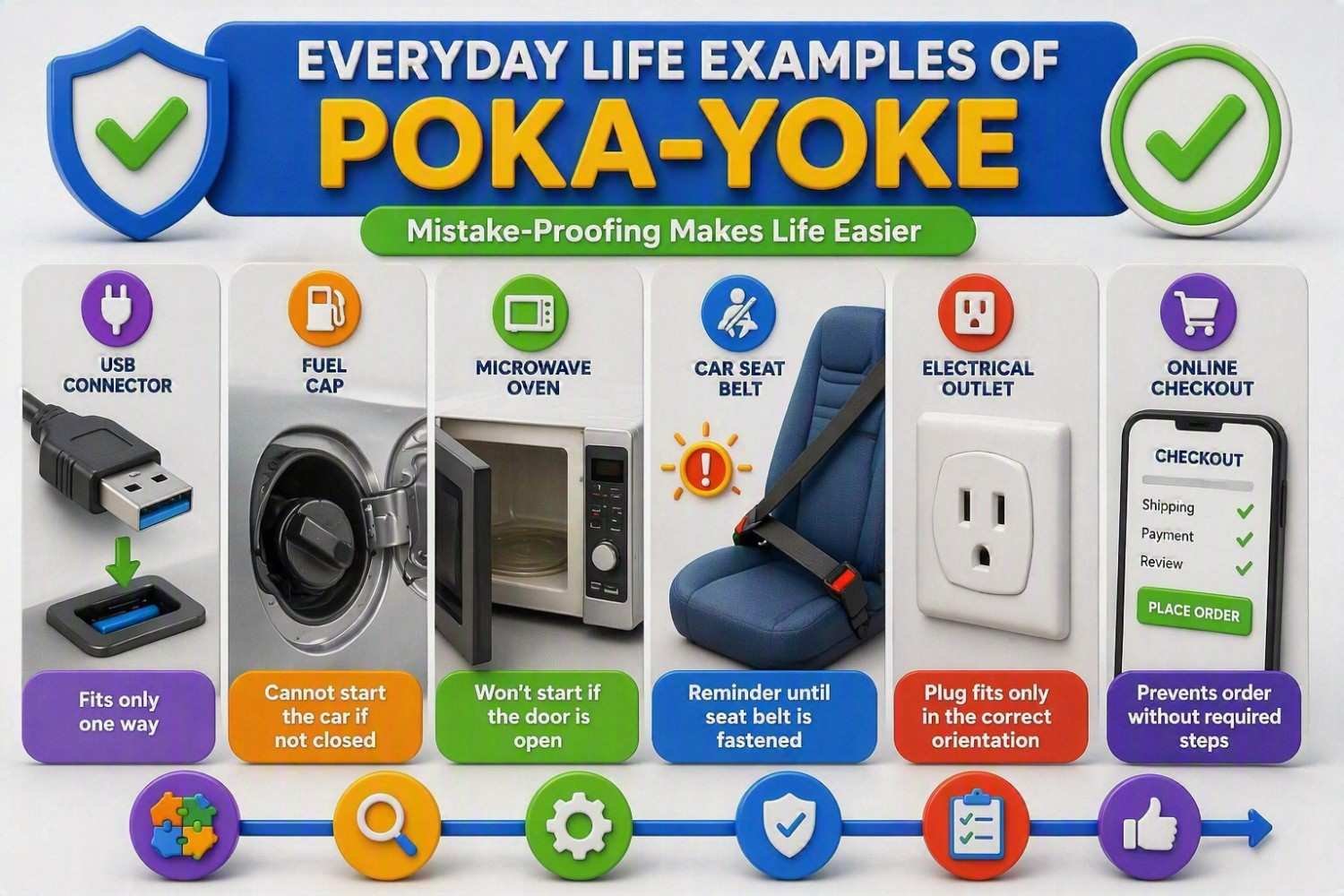
Everyday Life Examples of Poka-Yoke
One of the reasons Poka-Yoke is such a powerful concept is that you encounter it every day—even if you've never heard the term before. Mistake-proofing isn't limited to factories or production lines; it's built into many of the products and services we use because good design anticipates human error. Rather than expecting people to be perfect, these designs make the correct action easy and help prevent common mistakes before they cause problems.
When I explain Poka-Yoke during training sessions, I rarely start with manufacturing examples. Instead, I ask people to think about the products they use every day. Almost everyone has experienced mistake-proofing without realizing it. Once you recognize these examples, you begin to see the same design philosophy everywhere—from household appliances to banking apps and modern vehicles.
Downloadable Poka-Yoke Implementation Template and Checklist
These practical resources are based on real-world quality, Lean Manufacturing, and Six Sigma applications. Use the Excel implementation checklist to manage Poka-Yoke projects from concept to deployment, and the PDF design checklist to evaluate mistake-proofing opportunities before they reach production. Both templates can be adapted for manufacturing, healthcare, service, engineering, and business processes.
- Download this editable Excel template to assess Poka-Yoke readiness, verify mistake-proofing effectiveness, assign actions, track implementation progress, and ensure long-term defect prevention.
✅ Poka-Yoke Implementation Checklist (.xlsx) - Use this printable checklist to review error-proofing designs, validate prevention controls, identify implementation gaps, and build quality into your processes before defects occur.
✅ Mistake-Proofing Design Checklist (.pdf)
Common Mistakes When Designing Poka-Yoke
A poorly designed Poka-Yoke can create almost as many problems as having no mistake-proofing at all. The objective isn't to add more sensors, alarms, or inspection steps—it's to make the process simpler, more reliable, and naturally error-resistant. Over the years, I've found that the most successful Poka-Yoke solutions were usually the simplest. The least successful ones were often overengineered, expensive, or difficult for operators to use.
One mistake I frequently see is treating inspection as Poka-Yoke. Inspection helps detect defects after they occur, whereas true Poka-Yoke is designed to prevent the mistake from happening in the first place. Another common error is relying too heavily on training or operator memory. Training is essential, but people can still forget steps, become distracted, or make mistakes under pressure. A well-designed process should not depend solely on someone remembering to do the right thing.
Another challenge is adding unnecessary complexity. I've seen projects where teams proposed cameras, sensors, and sophisticated automation when a simple locating pin, keyed fixture, or color-coded component could solve the problem more effectively. In my experience, the best Poka-Yoke is often the simplest one—easy to understand, inexpensive to maintain, and reliable over thousands of production cycles.
It's also important to involve the people who perform the work every day. Some mistake-proofing devices look great on paper but create unnecessary delays or make the job harder for operators. When frontline employees are included during design and testing, they often identify practical improvements that engineers might overlook. I've found that the most sustainable Poka-Yoke solutions are those that operators willingly adopt because they make the job easier, not more complicated.
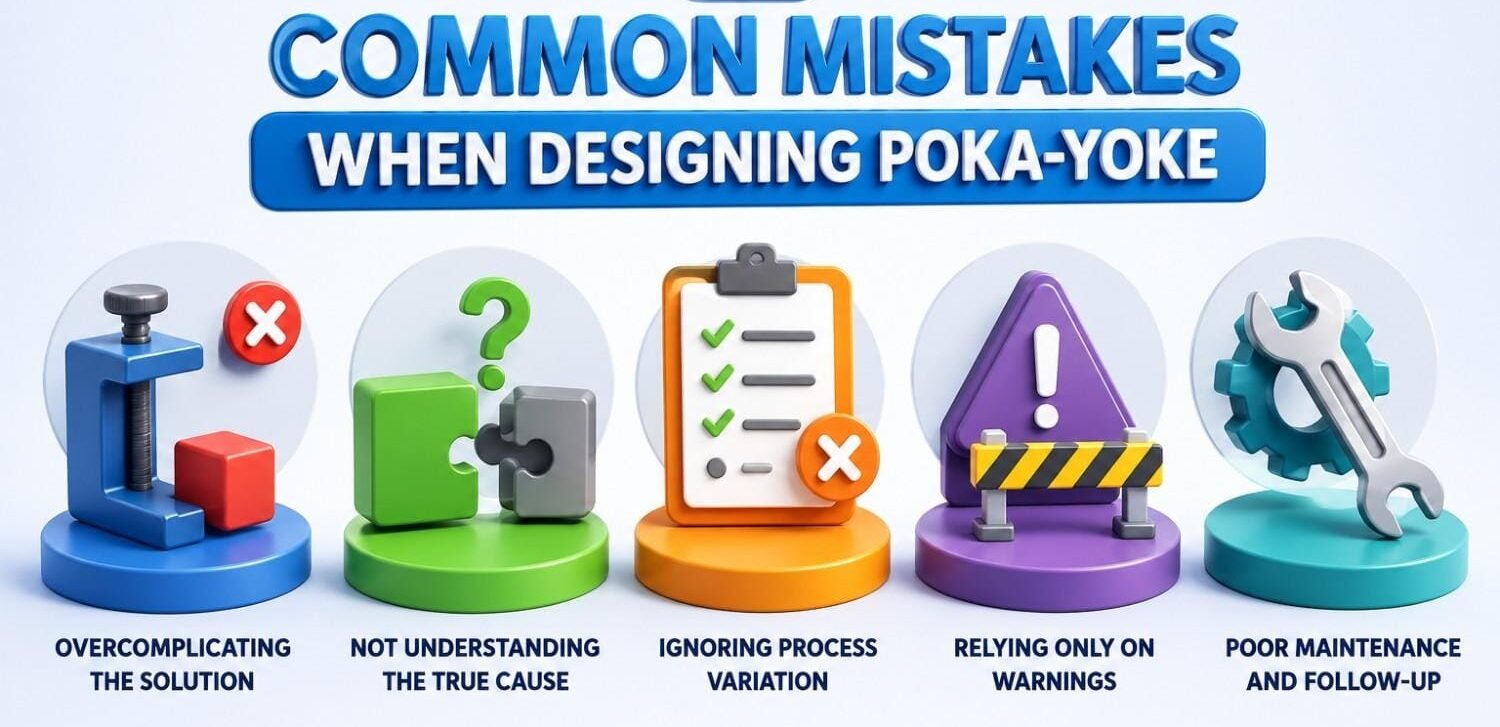
Finally, avoid implementing a Poka-Yoke and assuming the job is finished. Like any process improvement, mistake-proofing should be validated, monitored, and continuously improved. Production conditions change, new products are introduced, and processes evolve. Periodic reviews ensure that the Poka-Yoke continues to prevent the intended error without creating new problems.
Ultimately, successful Poka-Yoke isn't measured by how advanced the technology is—it's measured by how effectively it prevents defects while making the process simpler, safer, and more reliable. That's the principle I've consistently seen deliver the best long-term results across manufacturing and medical device quality engineering.
Real Manufacturing Case Studies and Practical Examples
The real value of Poka-Yoke becomes clear when you see it solving actual manufacturing problems. Throughout my career in automotive and medical device quality engineering, I've learned that many recurring defects weren't caused by complex technical failures—they were caused by simple human errors that the process failed to prevent. Whether the issue involved incorrect assembly, a missing component, wrong labeling, or an overlooked inspection step, the most effective solution was rarely additional training or inspection. Instead, it was redesigning the process so the mistake simply couldn't happen.
Case Study 1: Incorrect Component Orientation
During a New Product Introduction (NPI) project, one assembly component could be installed in two orientations, but only one was correct. Although operators were trained and visual work instructions were available, occasional assembly errors still occurred. Instead of adding another inspection step, the fixture was redesigned with a locating feature that accepted the component only in the correct orientation. The assembly error was eliminated because the process itself prevented the mistake rather than relying on operator attention.
Poka-Yoke Used: Contact Method (Prevention-Based)
Result: Incorrect assembly eliminated, rework reduced, and operator confidence improved.
Case Study 2: Missing Component Detection
In another production process, operators occasionally forgot to install a small component before moving the product to the next station. Since the missing part wasn't always visible during final inspection, the issue could have reached the customer. A simple sensor was added to verify component presence before the cycle could be completed. If the part was missing, the machine stopped automatically until the issue was corrected.
Poka-Yoke Used: Control Method (Detection-Based)
Result: Missing-component defects were detected immediately, preventing escapes to downstream operations.
Case Study 3: Wrong Label, Right Product
One of the most common manufacturing risks isn't the product itself—it's applying the wrong label. During packaging operations, two similar products shared nearly identical packaging, increasing the chance of mix-ups. By introducing barcode verification before printing and applying the label, the packaging line automatically confirmed that the product and label matched. If they didn't, the system prevented the operation from continuing.
Poka-Yoke Used: Barcode Verification + Interlock
Result: Labeling errors were virtually eliminated, reducing compliance and customer risks.
Case Study 4: Torque Verification During Assembly
Critical fasteners often require tightening within a specified torque range. In one assembly process, manual torque recording created the possibility of missed or incorrect tightening. Replacing the conventional tool with a digital torque wrench that provided visual and audible confirmation ensured every fastener met the required specification before the product moved forward.
Poka-Yoke Used: Warning/Control Method
Result: Improved process consistency, reduced assembly variation, and strengthened traceability.
Where Poka-Yoke is Used Across Industries
Although Poka-Yoke was developed within the Toyota Production System, its principles are now used in almost every industry where quality, safety, and reliability matter. Anywhere people perform repetitive tasks, follow standard procedures, or make decisions under time pressure, there is an opportunity to apply mistake-proofing. While the tools may differ, the objective remains the same: prevent human errors from becoming defects.
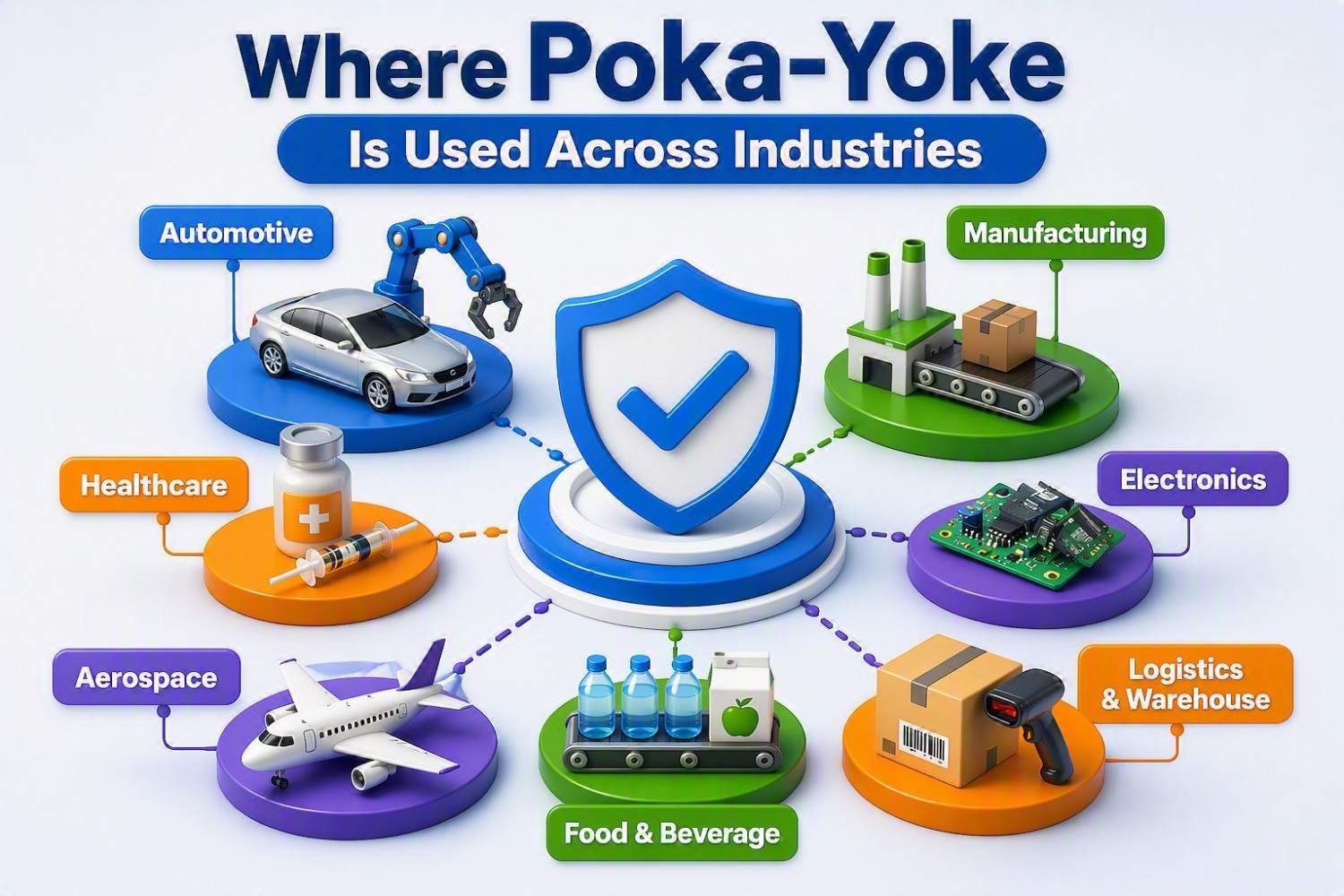
Throughout my career in automotive, manufacturing, and medical device quality engineering, I've seen Poka-Yoke evolve from a simple assembly aid into a core design philosophy. During New Product Introduction (NPI) projects, mistake-proofing wasn't limited to the production floor. It influenced product design, manufacturing fixtures, inspection methods, packaging, labeling, and even documentation. In many cases, a simple design change implemented during development eliminated quality issues that would have been far more expensive to fix after product launch. Those experiences reinforced an important lesson: the earlier Poka-Yoke is applied, the greater its impact on quality, cost, and customer satisfaction.
Frequently Asked Questions (FAQ)
Where is Poka Yoke used?
Poka Yoke is used in manufacturing, healthcare, software, and daily life processes.
What is a simple example of Poka Yoke?
A microwave that won’t start when the door is open is a Poka Yoke example.
What is control vs warning Poka Yoke?
Control stops the process when errors occur, while warning alerts the user.
Can Poka Yoke be applied outside manufacturing?
Yes, Poka Yoke can be applied in everyday life, services, and digital systems.
Is Poka Yoke part of Lean Six Sigma?
Yes, Poka Yoke is a key tool used in Lean and Six Sigma for error prevention and quality improvement.
Can Poka Yoke reduce costs?
Yes, it reduces costs by minimizing defects, rework, and wasted materials.
What is a real-life electronic example of Poka Yoke?
USB drives and chargers are designed to fit only one way, preventing incorrect use.
Does Poka Yoke eliminate human error completely?
It does not eliminate human error entirely but ensures errors do not turn into defects.
Lean Six Sigma • Six Sigma • Statistics • Project Management • Artificial Intelligence (AI) • Operations Management • Quality Management
Conclusion: Building a Culture of Error-Proof Quality
Poka-Yoke is more than a quality tool—it is a mindset. Instead of asking people to be more careful, it focuses on designing processes that make mistakes difficult or impossible to make. The result is fewer defects, less rework, lower costs, and better customer satisfaction.
Poka Yoke teaches us a powerful lesson:
Don’t try to fix people—fix processes.
Throughout my career in automotive, manufacturing, and medical device industries, I have found that the most effective improvements were often the simplest. A redesigned fixture, a sensor, a visual cue, or a sequence lock frequently solved problems that training and inspections could not. When the opportunity for error is removed, the problem stops coming back.
Ultimately, world-class quality is not achieved by expecting perfection from people. It is achieved by building processes that anticipate human error and prevent defects before they happen. That simple principle is what makes Poka-Yoke one of the most powerful tools in Lean Manufacturing, Six Sigma, and continuous improvement.
Continue Your Learning Journey
Learning is a continuous process. Explore related topics, practical guides, tools, calculators, templates, and learning resources to expand your knowledge and develop new skills.
Choose a category below to explore practical tutorials, tools, calculators, templates, case studies, and learning resources.
Recommended Learning Resources
Expert-led courses to build practical skills, earn credentials, and advance your career.
Recommended professional books, certification guides, and practical study resources.
Ready-to-use templates, checklists, guides, and workbooks for practical applications.
Interactive calculators for statistics, quality, engineering, analysis, and decision-making.
Interactive Z, t, Chi-Square, and F tables with critical values and distribution curves.
Discover practical tutorials, case studies, and professional resources across Quality, Lean Six Sigma, Project Management, Statistics, AI, and Data Analytics.
Published: May 10, 2026
Last Updated: September 18, 2026