
What is 8D Problem Solving: Complete Guide with Real Engineering Examples and Practical Lessons
When a problem keeps returning despite multiple corrective actions, the issue is often deeper than it first appears. Temporary fixes may contain the problem, but they rarely eliminate the underlying causes that allow it to happen again. Organizations that consistently solve complex quality and operational issues use structured problem-solving methods rather than relying on assumptions or quick fixes.
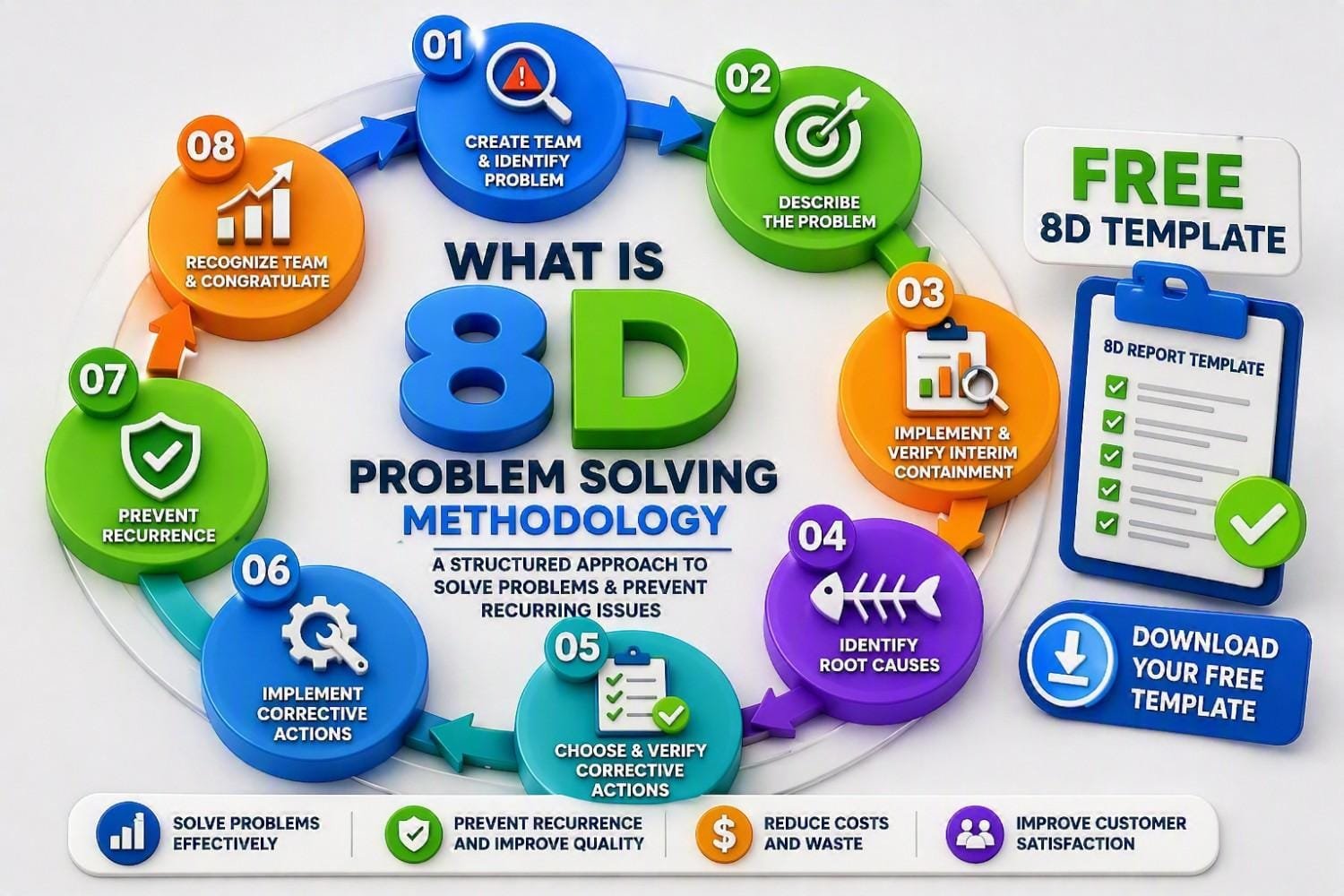
What makes 8D particularly effective is its disciplined approach. It combines containment, root cause analysis, corrective action, verification, and organizational learning into a single framework, helping teams move beyond symptom-fixing and achieve sustainable problem resolution. Through real engineering examples and practical lessons, this guide explains how the 8D process helps transform recurring problems into long-term improvement opportunities.
What is 8D Problem Solving
If you ask me what changed the way I think about quality engineering, it wasn’t a training course or a certification. It was seeing the same problem come back after everyone believed it had already been fixed. I still remember sitting in one investigation meeting where the team was convinced we had solved the issue. We had sorted the affected parts, updated the inspection process, retrained the operators, and everyone walked away feeling confident. For a few weeks, everything looked fine. Then the same defect showed up again. That was frustrating—not because the defect had returned, but because of how much effort had already gone into fixing it. We had spent hours in meetings, reviewed production records, and implemented corrective actions. Yet we were right back where we started. Looking back, I realize we never really solved the problem. We only removed its symptoms.
That experience stayed with me because I later saw the same pattern in other investigations. Whenever production was under pressure or a customer was waiting for parts, the natural reaction was to restore normal operations as quickly as possible. We would replace components, rework products, increase inspections, or introduce temporary checks. Those actions were necessary at the time, but they were rarely enough to stop the problem from returning.
One thing I’ve learned over the years is that recurring defects are usually telling you something. They’re often a sign that the process, not the product, needs closer attention. If the same issue keeps appearing, there’s a good chance the real cause is still hiding somewhere in the system. I also made mistakes early in my career. There were times when I was more interested in finding a solution than fully understanding the problem. It felt satisfying to leave a meeting with an action plan, but I eventually realized that a well-executed solution is useless if it’s solving the wrong problem. That lesson changed the way I approach every investigation today.
This is where the 8D Problem Solving methodology has been particularly valuable in my work. Instead of encouraging teams to make assumptions or jump straight into corrective actions, it forces everyone to slow down, collect evidence, ask difficult questions, and understand exactly why the problem occurred. More importantly, it asks another question that is often overlooked: why didn’t our existing controls detect the problem before it reached the customer?
That second question is just as important as finding the root cause. In many of the investigations I’ve been involved in, we discovered that the process failure and the detection failure were two different issues. Solving only one of them meant the problem could easily return.
The 8D methodology was originally developed by Ford Motor Company in the 1980s to improve supplier quality and address recurring manufacturing problems. Since then, it has been adopted across industries including automotive, aerospace, healthcare, electronics, industrial manufacturing, and medical devices because the underlying principle is universal: temporary fixes may solve today’s problem, but only a thorough investigation can prevent tomorrow’s.
In my own work on Quality and New Product Introduction (NPI) projects, I have never seen a successful 8D investigation completed by one person working alone. The best investigations happened when Manufacturing Engineers, Design Engineers, Supplier Quality Engineers, Production Supervisors, Regulatory teams, and Quality Engineers all looked at the same problem from different angles. More than once, the breakthrough came from someone asking a simple question that nobody else had considered.
That is probably what I appreciate most about the 8D approach. It isn’t just a document to complete or another quality requirement to satisfy. It creates a structured conversation where data carries more weight than assumptions, and where every department has an opportunity to contribute to the final solution.
After participating in numerous investigations, I’ve also stopped measuring success by how quickly an 8D report is closed. A report isn’t successful because every section has been completed or every signature has been collected. It’s successful when the issue never comes back. Sometimes you don’t know whether your investigation was truly effective until months later, when the product continues to perform as expected and the customer never reports the same issue again.
In the following sections, I’ll explain each of the eight disciplines using examples, practical observations, and lessons that have influenced the way I approach quality investigations today. My intention isn’t simply to describe the 8D methodology, but to share how it can be applied in a way that leads to lasting improvements rather than temporary fixes.
🎓 Top-Rated Courses & Certifications
Try changing your filters or searching for another course.
Step-by-Step Explanation of 8D (With Practical Examples)
Let’s go deep into each step with easy explanations and relatable examples.
D1 – Establish the Team
The first discipline of the 8D Problem Solving methodology is Establish the Team. Before attempting to solve any complex problem, it is essential to bring together the right people with the necessary knowledge, skills, and authority. A single person rarely has all the expertise required to investigate every aspect of a problem. Selecting the right team is just as important as selecting the right solution. Team members should have clearly defined roles, sufficient time to participate in the investigation, and the authority to make decisions within their area of responsibility. Therefore, 8D emphasizes the importance of forming a cross-functional team that can analyze the issue from multiple perspectives.

From my experience, the most successful problem-solving efforts have always involved collaboration across different functions. I have seen situations where Manufacturing initially believed the issue was process-related, while Design Engineering identified a design weakness, and the Quality team uncovered gaps in inspection methods. Only after everyone shared their expertise did the team discover the actual root cause. This reinforced an important lesson: complex problems require collective thinking rather than individual assumptions.
Simply put, the quality of the solution often depends on the quality of the team solving the problem.
D2 – Describe the Problem Clearly
Once the right team has been established, the next step is to describe the problem clearly and accurately. There is a famous saying in quality management: “A problem well defined is a problem half solved.” I have found this statement to be true throughout my career. The more accurately you define the problem at the beginning, the faster and more effectively you can identify its true root cause. Before searching for the root cause or discussing possible solutions, everyone involved must have the same understanding of what the actual problem is. A poorly defined problem can send the investigation in the wrong direction.
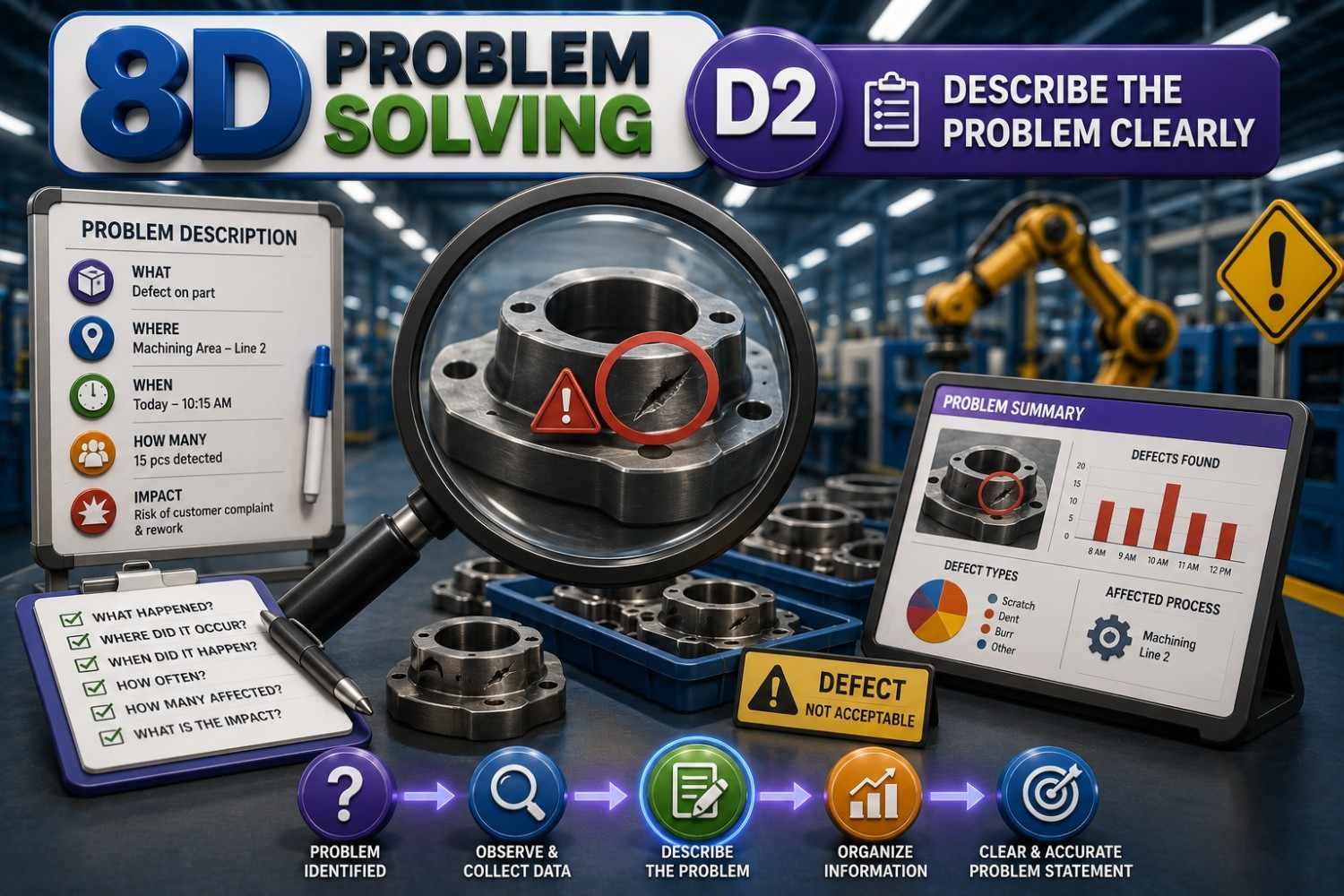
During one of our New Product Introduction (NPI) projects, a dimensional non-conformance was detected during final inspection. The initial reaction from several team members was that the manufacturing process was unstable. However, before reaching any conclusions, our team took the time to define the problem using facts and data. We reviewed inspection reports, compared measurements across multiple production lots, examined the design specifications, and looked for common patterns. As the investigation progressed, we discovered that the issue was not caused by the manufacturing process at all. Instead, the variation originated from a supplier component that was still meeting its own specification but was contributing to an assembly tolerance stack-up. Had we rushed into solving what we thought was the problem, we would have spent considerable time improving a process that wasn’t actually responsible for the defect.
That experience reinforced an important lesson for me: never investigate assumptions—investigate facts.
D3 – Interim Containment Actions (ICA)
Once the problem has been clearly defined, the next priority is to protect the customer while the investigation continues. Identifying the true root cause and implementing a permanent corrective action can take several days or even weeks. However, customers cannot wait for the investigation to be completed before receiving safe and conforming products. This is why D3 – Interim Containment Actions (ICA) is one of the most critical disciplines in the 8D Problem Solving methodology.The objective of Interim Containment Actions is not to eliminate the root cause, but to immediately control the situation and prevent defective or potentially non-conforming products from reaching the customer
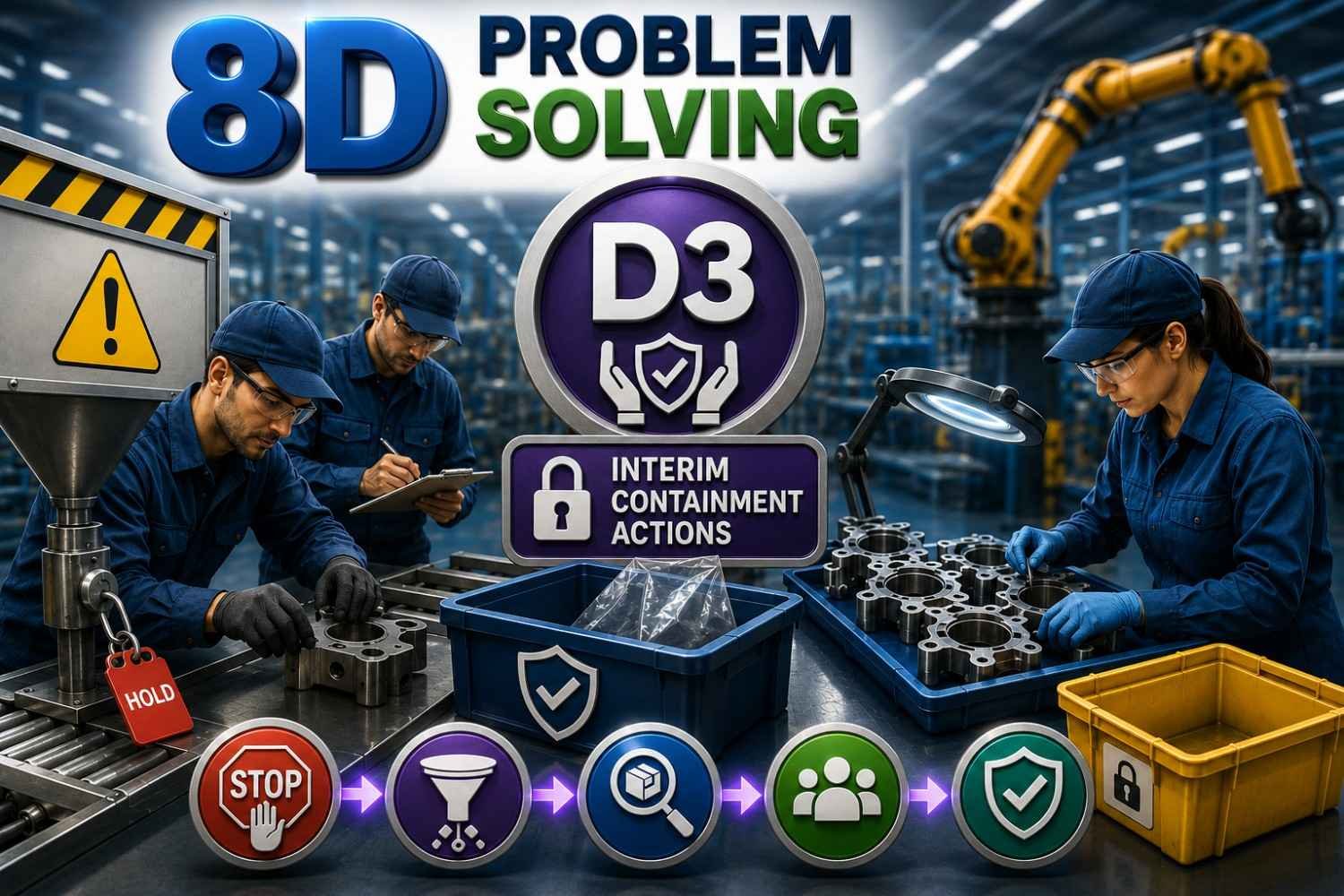
I have been involved in several quality investigations where the first question was never “What is the root cause?” Instead, the immediate question was “Is the customer at risk?” If there was even a small possibility that a defective product could reach a hospital or healthcare professional, containment actions had to be implemented immediately. Patient safety always took priority over production schedules.
I still remember one investigation where a dimensional issue was identified during routine inspection. At that point, we did not know whether it was caused by the manufacturing process, incoming material, or the product design. Rather than waiting for the investigation to be completed, the cross-functional team immediately stopped shipments, quarantined all affected inventory, and introduced 100% inspection for subsequent production lots. Although these actions required additional time and resources, they ensured that no non-conforming products reached the customer while we worked to identify the actual root cause. Looking back, those temporary actions protected both our customers and the company’s reputation.
D4 – Root Cause Analysis (RCA)
Once the problem has been contained, the next step is to determine why it happened in the first place. This is the most critical discipline of the entire 8D Problem Solving methodology because every decision that follows depends on correctly identifying the root cause. If the root cause is misunderstood or overlooked, even the best corrective actions will only provide temporary relief, and the problem is likely to return.
The primary objective of Root Cause Analysis (RCA) is to answer two important questions:
- Why did the problem occur?
- Why was the problem not detected before it reached the next process or the customer?
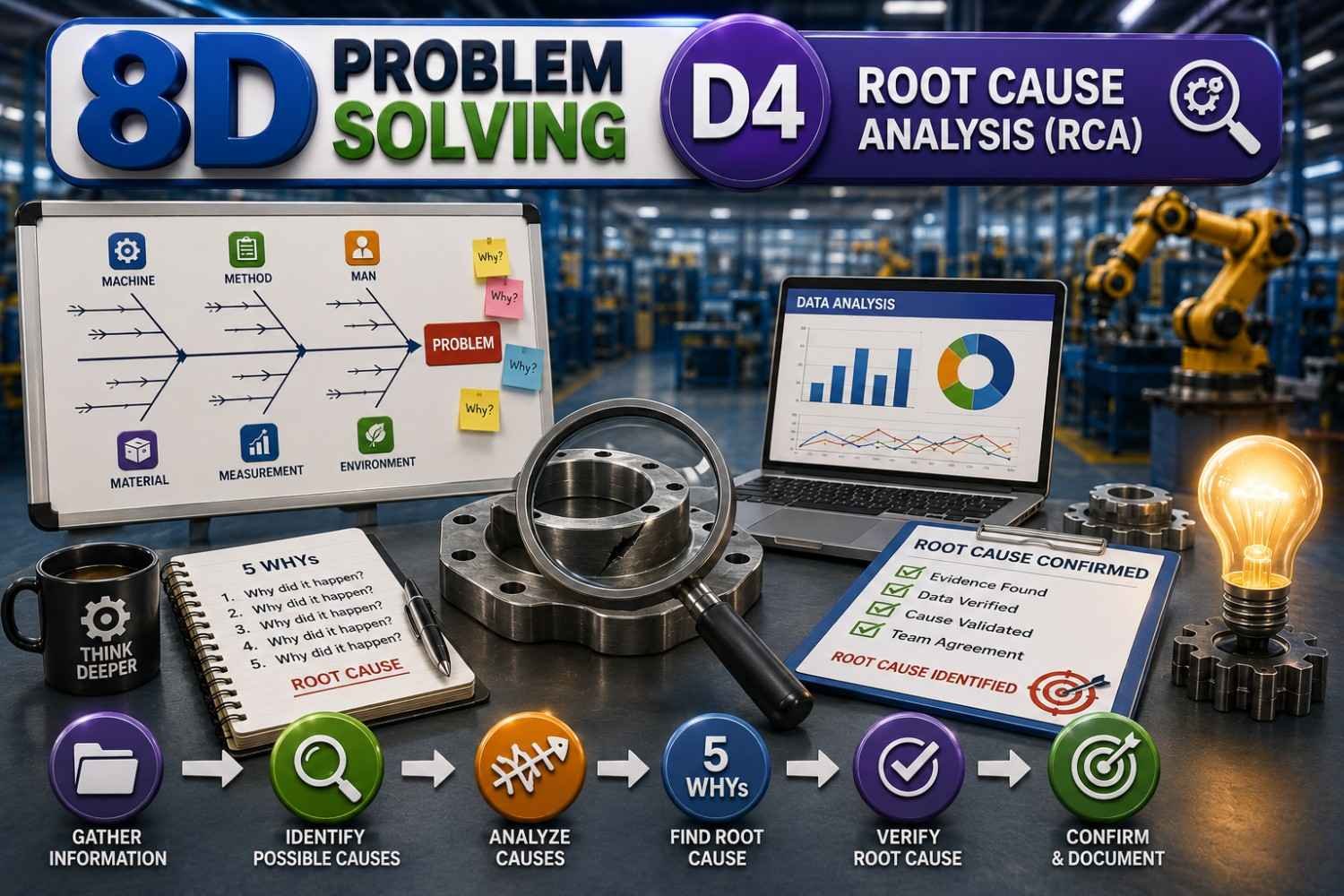
I have seen that identifying the true root cause is rarely as straightforward as it first appears. During one product investigation, the initial assumption was that a manufacturing process was causing repeated dimensional failures. Several team members were convinced that adjusting the machining parameters would solve the issue. However, rather than relying on assumptions, we performed a structured Root Cause Analysis using data, process observations, and cross-functional discussions. As we continued investigating, we discovered that the machining process was performing exactly as intended. The actual issue was an incorrect tolerance interpretation during the design transfer phase, which resulted in an inspection method that could not consistently identify borderline parts. In other words, the manufacturing process wasn’t creating the problem—the system used to define and inspect the product was. Had we acted on our initial assumptions, we would have invested considerable time and effort improving a process that was never responsible for the defect.
That experience reinforced one of the most valuable lessons of my career: the first suspected cause is not always the true root cause. Effective problem solving requires patience, objective thinking, and evidence—not assumptions or opinions.
D5 – Define Corrective Actions
After completing the Root Cause Analysis, the team should have a clear understanding of why the problem occurred and why it was not detected before reaching the customer or the next process. However, identifying the root cause alone does not solve the problem. Knowledge without action creates no improvement. The next step is to develop Permanent Corrective Actions (PCAs) that eliminate the root cause and prevent the problem from occurring again. The objective of D5 is to identify, evaluate, and select corrective actions that address the root cause rather than simply treating the symptoms. Unlike the temporary containment actions implemented in D3, which were intended to protect the customer while the investigation was ongoing, the corrective actions in D5 are designed to permanently remove the conditions that allowed the problem to exist in the first place.
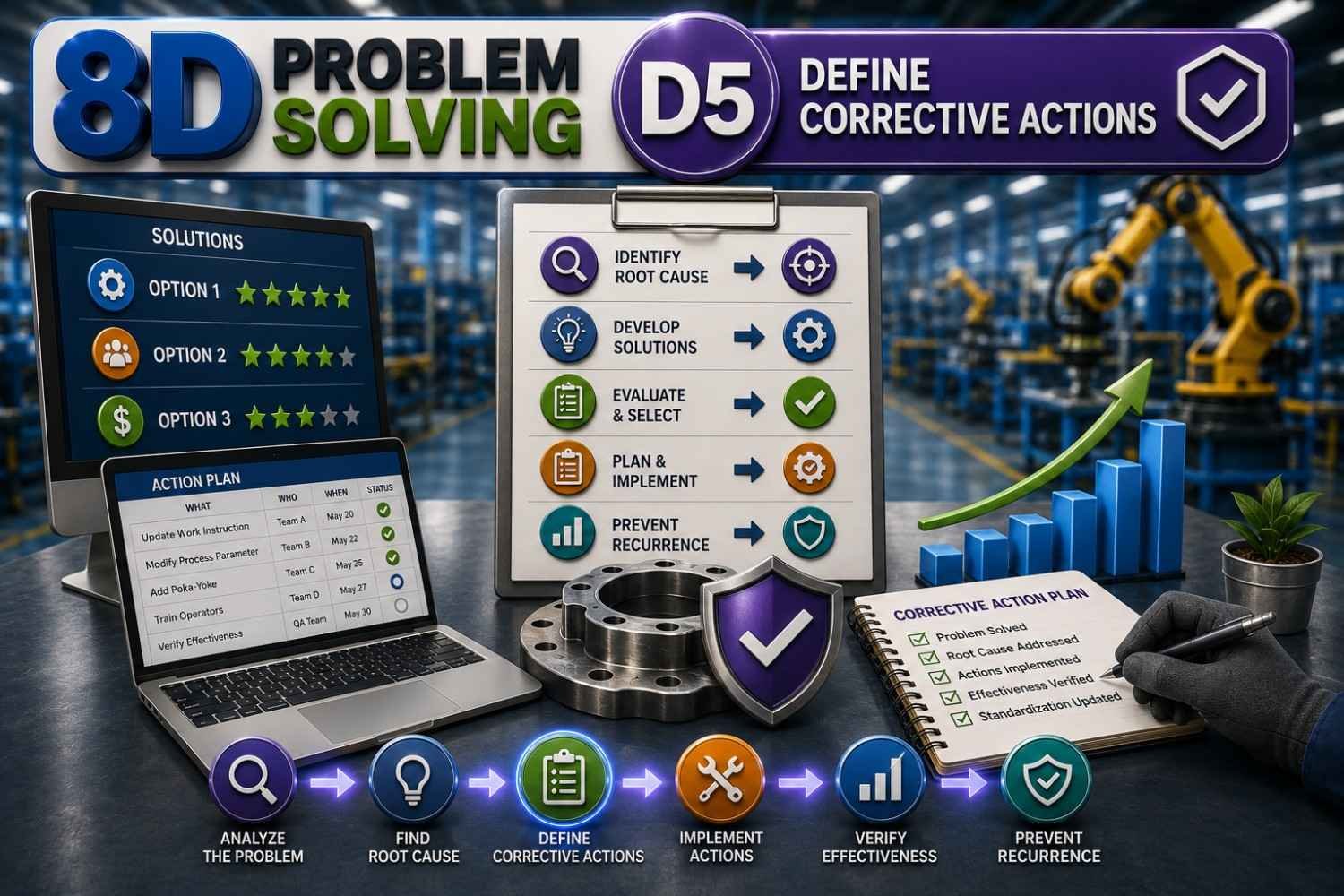
One lesson I have learned throughout my career is that implementing a corrective action simply because it is the easiest or quickest option is rarely the best approach. During one investigation in a New Product Introduction (NPI) project, our team identified that repeated dimensional failures were linked to variation in an assembly process. One proposed solution was to increase the inspection frequency and perform 100% inspection. Although this would have prevented defective products from reaching the customer, it would not have eliminated the source of the variation. Instead, after evaluating several alternatives, we redesigned the assembly fixture and standardized the work instructions. Once these changes were implemented, the process became much more consistent, and the additional inspections were no longer necessary.
That experience taught me an important principle: a good corrective action eliminates the cause of the problem, not just the evidence of the problem. One mistake I have occasionally observed is organizations replacing permanent corrective actions with additional inspections. While inspection can help detect defects, it does not prevent them from being produced. True quality improvement comes from improving the process itself so that defects are either eliminated or significantly reduced at their source
D6 – Implement and Validate Corrective Actions
Once the permanent corrective actions have been identified in D5, the next step is to implement them and verify that they actually solve the problem. This may sound straightforward, but implementing a solution is only half the job. The real question is: Did the corrective action eliminate the root cause and prevent the problem from recurring? If the answer is yes, then the corrective action has been successfully validated.
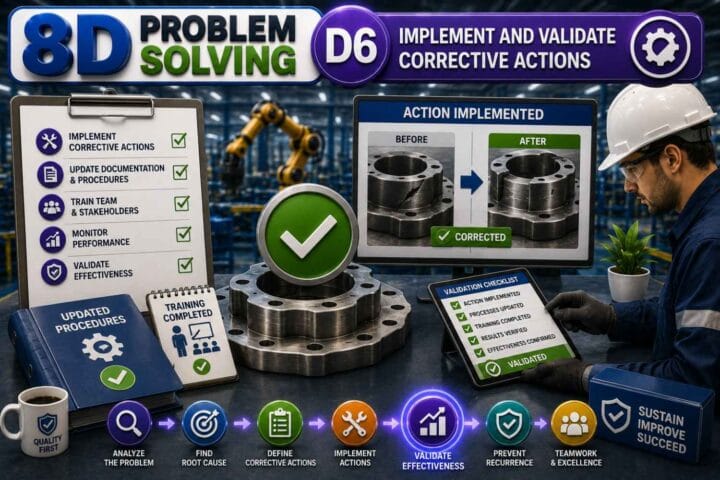
From my experience, I have seen organizations celebrate the implementation of corrective actions too early. In one particular investigation, our team introduced a process modification that appeared to eliminate a recurring dimensional defect. Initially, the results looked promising, and everyone was confident that the issue had been resolved. However, instead of immediately closing the investigation, we continued monitoring the process over multiple production lots. A few weeks later, we noticed that although the defect rate had significantly decreased, a small number of non-conforming parts were still being produced under specific operating conditions. This prompted us to conduct additional analysis, which revealed another contributing factor that had not been considered during the initial investigation. Had we closed the 8D report immediately after implementation, the problem would likely have returned. That experience taught me an important lesson: implementing a corrective action does not prove it is effective—only validation can do that.
D7 – Prevent Recurrence
By the time the team reaches D7, the problem has already been investigated, the root cause has been identified, and the corrective actions have been implemented and validated. However, the 8D process does not end there. The next challenge is to ensure that the same problem—or a similar one—does not occur again in the future. One of the biggest lessons I have learned during my career in the medical device industry is that every quality issue is an opportunity to strengthen the Quality Management System (QMS)
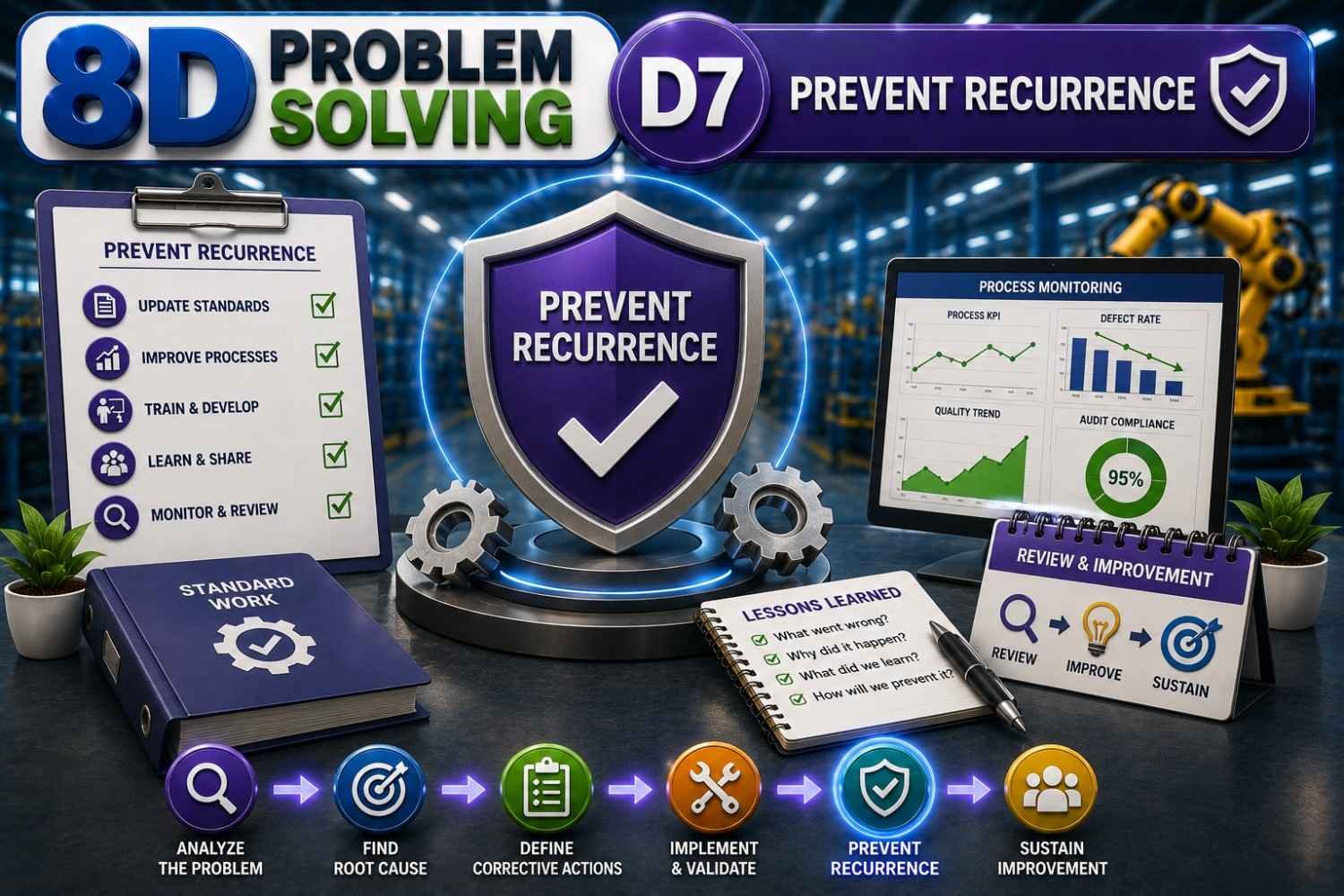
I have seen investigations where the immediate problem was successfully resolved, but because the related procedures, work instructions, training materials, and risk assessments were never updated, the same type of issue appeared again months later in a different product line. Although the root cause was different, the weakness in the system remained unchanged.
I remember one project where our team successfully eliminated a recurring assembly issue through a design improvement. Initially, everyone considered the investigation complete. However, during the final review, we realized that the design guideline used for future projects had not been updated. Had we stopped there, another engineering team could have unknowingly repeated the same mistake in a new product. We revised the design standards, updated the Design Failure Mode and Effects Analysis (DFMEA), modified the engineering checklist, and shared the lessons learned with other project teams. That experience showed me that the most valuable outcome of an 8D investigation is not just solving today’s problem—it is preventing tomorrow’s problem.
Depending on the nature of the issue, preventing recurrence may involve updating standard operating procedures (SOPs), work instructions, design guidelines, inspection methods, control plans, PFMEAs, DFMEAs, risk management files, training programs, supplier requirements, engineering specifications, or quality management processes. The goal is to ensure that the knowledge gained during the investigation becomes part of the organization’s standard way of working.
D8 – Recognize the Team
The final discipline of the 8D Problem Solving methodology is Recognize the Team. Although the technical investigation is complete and the problem has been permanently resolved, the 8D process is not truly finished until the people who made it possible are acknowledged for their efforts.
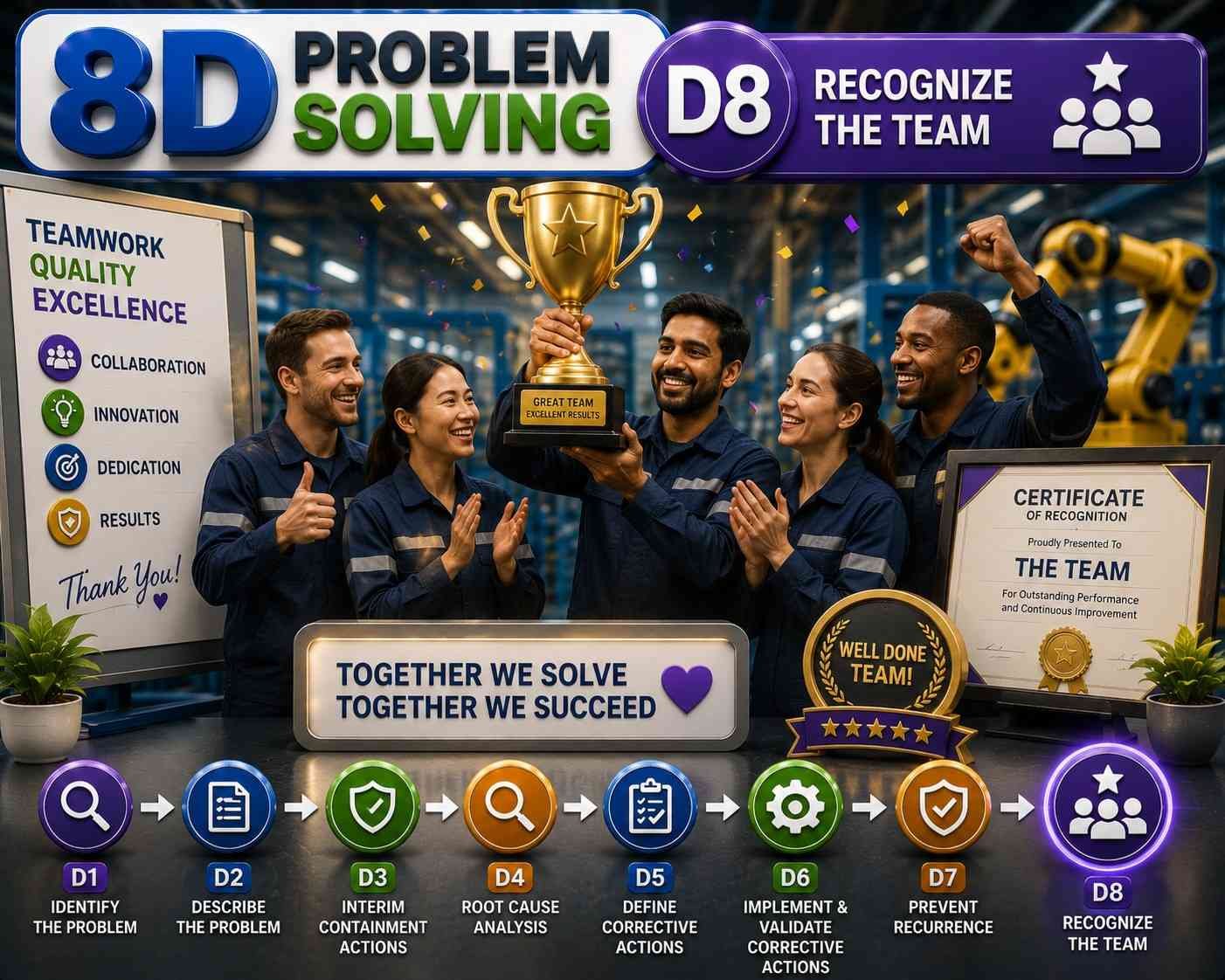
I have had the opportunity to work with talented cross-functional teams involving Design Engineering, Manufacturing, Quality, Regulatory Affairs, Supply Chain, and Operations. One thing I have consistently observed is that the most successful teams are not necessarily those with the smartest individuals—they are the teams where every member feels that their contribution is valued. I have seen engineers stay late to collect additional data, production operators suggest practical improvements based on their daily experience, and quality engineers patiently analyze hundreds of inspection records to identify hidden trends. Many of these efforts happen behind the scenes and often go unnoticed unless someone takes the time to acknowledge them.
I still remember one investigation where a recurring production issue had frustrated the team for several weeks. After identifying the root cause and successfully implementing the corrective actions, our project leader took a few minutes during the team meeting to thank everyone individually and explain how each person’s contribution had helped solve the problem. It wasn’t a formal award or a financial incentive—just genuine appreciation. Surprisingly, that simple gesture had a lasting impact on team morale. People felt proud of what they had accomplished together, and they were even more willing to participate in future problem-solving activities. That experience taught me that recognition is not just about celebrating success—it is about building a culture where people are motivated to solve the next challenge.
📚 Recommended Books for Professionals
Try removing one or more filters.
🎁 Free Download: 8D Template
Whether you're investigating a customer complaint, supplier quality issue, production defect, or process failure, having the right documentation can save valuable time. That's why I've created a Free Professional 8D Problem Solving Toolkit, packed with practical templates that I wish I had when I first started working in Design Quality.
The toolkit includes editable 8D report templates, 5 Whys worksheets, Root Cause Analysis templates, action trackers, investigation checklists, and other quality engineering resources.
📥 Download the FREE Digital E-Learning Professional 8D template : 👉 Download the Toolkit

Lean Six Sigma • Six Sigma • Statistics • Project Management • Artificial Intelligence (AI) • Operations Management • Quality Management
My Perspective on 8D Problem Solving
After working for 25 yrs in Design & Quality, I have come to realize that the biggest challenge in problem solving is rarely finding a solution—it's identifying the right problem to solve. In many investigations I've participated in, the initial assumptions turned out to be incorrect. What first appeared to be an operator issue, a supplier problem, or a design defect often had a completely different root cause once we analyzed the data objectively.
One lesson that has stayed with me is that successful 8D investigations require patience. Teams naturally want to move quickly to corrective actions, especially when customers are waiting for answers. However, I've learned that investing extra time in understanding the problem almost always saves much more time later. A well-defined problem and a thorough root cause analysis lead to stronger corrective actions and fewer recurring issues.
I've also found that the best 8D reports are never the result of one person's effort. Every successful investigation I've been involved in required collaboration between Design Engineers, Manufacturing Engineers, Quality Engineers, Supplier Quality teams, Production personnel, and sometimes Regulatory Affairs. Each function contributed a different perspective, and many of our most valuable findings came from discussions where team members challenged assumptions using facts and data.
If I could offer one piece of advice to anyone learning the 8D methodology, it would be this: don't treat it as a document that needs to be completed—treat it as a way of thinking. The real value of 8D isn't in filling out eight sections of a report; it's in developing a disciplined approach to solving problems permanently. In my experience, organizations that embrace this mindset don't just solve individual quality issues—they continuously improve their processes and build greater confidence among both customers and employees.
Lean Six Sigma • Six Sigma • Statistics • Project Management • Artificial Intelligence (AI) • Operations Management • Quality Management
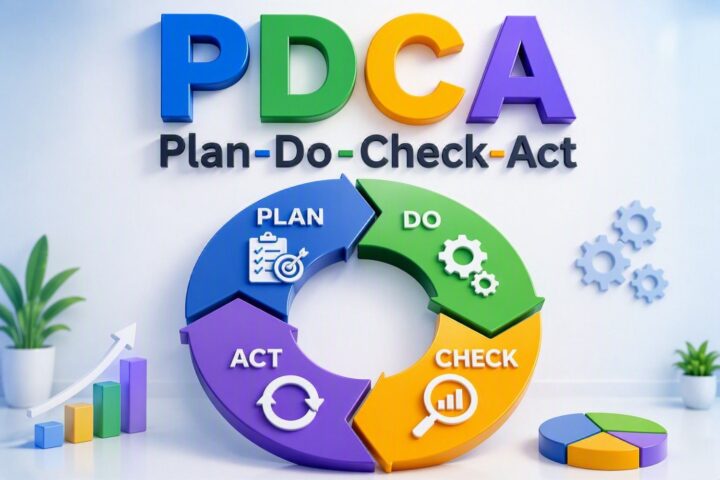
If you're building a complete Problem Solving Tools toolkit, 5W1H works exceptionally well alongside other proven methodologies. Techniques such as 5 Whys Root Cause Analysis, Fishbone (Ishikawa), 8D Problem Solving, and the PDCA Cycle can help teams dig deeper into causes, implement effective corrective actions, and sustain long-term improvements. I've covered each of these tools in detail in separate articles on my blog.
Frequently Asked Questions (FAQs)
1. What is 8D Problem Solving?
8D Problem Solving is a structured methodology used to identify the root cause of recurring problems, implement permanent corrective actions, and prevent the issue from happening again. It focuses on long-term solutions rather than temporary fixes.
2. When should you use the 8D methodology?
Use 8D for recurring defects, customer complaints, supplier quality issues, process failures, warranty claims, or complex problems that require a cross-functional team to identify and eliminate the root cause.
3. What are the eight disciplines of 8D?
The eight disciplines are: Establish the Team, Describe the Problem, Interim Containment, Root Cause Analysis, Corrective Actions, Implementation & Validation, Prevent Recurrence, and Recognize the Team.
4. Who developed the 8D methodology?
The 8D methodology was developed by Ford Motor Company in the 1980s to improve supplier quality and solve recurring manufacturing problems. Today, it is used across many industries worldwide.
5. What is the main objective of an 8D report?
The primary objective of an 8D report is to identify the true root cause of a problem, implement permanent corrective actions, and ensure the issue does not recur.
6. Which quality tools are commonly used in 8D?
Common tools include the 5 Whys, Fishbone Diagram, Pareto Chart, Process Flow Diagram, FMEA, and Control Charts. These tools help teams make data-driven decisions.
7. Is 8D Problem Solving only for the automotive industry?
No. Although it originated in the automotive industry, 8D is now widely used in aerospace, healthcare, medical devices, electronics, manufacturing, and many other industries.
8. Why is Root Cause Analysis important in 8D?
Root Cause Analysis identifies the actual reason a problem occurred. Without finding the true root cause, corrective actions may only address the symptoms, allowing the problem to return.
9. How long does an 8D investigation take?
The duration depends on the complexity of the issue. Simple investigations may take a few days, while complex problems involving suppliers or validation activities can take several weeks.
10. What are the benefits of using 8D Problem Solving?
The 8D methodology improves product quality, reduces recurring defects, strengthens teamwork, increases customer satisfaction, lowers quality costs, and promotes continuous improvement.
I hope this blog helped in understanding the basic concept in a simplified manner, watch out for more such stuff in the future.
Continue Your Learning Journey
Learning is a continuous process. Explore related topics, practical guides, tools, calculators, templates, and learning resources to expand your knowledge and develop new skills.
Choose a category below to explore practical tutorials, tools, calculators, templates, case studies, and learning resources.
Recommended Learning Resources
Expert-led courses to build practical skills, earn credentials, and advance your career.
Recommended professional books, certification guides, and practical study resources.
Ready-to-use templates, checklists, guides, and workbooks for practical applications.
Interactive calculators for statistics, quality, engineering, analysis, and decision-making.
Interactive Z, t, Chi-Square, and F tables with critical values and distribution curves.
Discover practical tutorials, case studies, and professional resources across Quality, Lean Six Sigma, Project Management, Statistics, AI, and Data Analytics.
Published: March 19, 2026
Last Updated: September 18, 2026
Can i book a training?
Yes you can book