What is Value Add vs. Non-Value Add Activities in Lean : Finding Hidden Waste
Every process consists of a series of activities, but not every activity contributes equally to the final outcome. Some tasks directly support customer requirements and business objectives, while others consume time, effort, and resources without improving the result. Distinguishing between these activities is one of the most important steps in process improvement and operational excellence.
Organizations often focus on improving individual tasks without first understanding whether those tasks should exist at all. As a result, teams may optimize inefficient processes instead of eliminating unnecessary work. Developing the ability to evaluate activities from a value perspective helps organizations make smarter improvement decisions and focus resources where they create the greatest impact.
This concept plays a central role in Lean Manufacturing, Lean Six Sigma, business process improvement, healthcare, service industries, software development, and project management. By systematically analyzing how work flows through a process, organizations can improve efficiency, reduce lead times, increase productivity, and strengthen customer satisfaction.
What is Value and Why does it Matter?
In Lean Manufacturing, value is defined by the customer—not by the organization. An activity creates value only if it transforms a product, service, or information into something the customer needs and is willing to pay for. Any activity that consumes time or resources without improving the final outcome should be challenged, simplified, or eliminated.
Understanding value is the foundation of Lean thinking because it helps organizations separate productive work from waste. During my experience in quality engineering and new product development, I have often seen teams invest significant effort in approvals, duplicate reviews, and unnecessary documentation that added complexity but little customer benefit. Asking a simple question—“Would the customer pay for this step?”—often revealed opportunities to streamline the process without compromising quality or compliance.
This principle applies far beyond manufacturing. Whether delivering a product, processing an invoice, writing software, or providing healthcare, customers value the final result—not the internal delays, rework, or administrative effort behind it. By focusing on activities that genuinely create customer value, organizations can reduce waste, shorten lead times, improve quality, and deliver a better customer experience.
Before distinguishing between Value-Added (VA), Business Value-Added (BVA), and Non-Value-Added (NVA) activities, it is essential to understand what value means from the customer’s perspective. This single concept forms the basis of every successful Lean improvement initiative.
What are Value Add Activities?
Value-Added (VA) activities are process steps that transform a product, service, or information in a way that the customer values and is willing to pay for. In Lean, an activity adds value only if it improves the final outcome, meets customer requirements, and is completed correctly the first time. The amount of effort involved is irrelevant—what matters is the value created for the customer.
A simple way to identify a value-added activity is to ask three questions: Does it transform the product or service? Does the customer value that change? Is it done right the first time? If the answer to all three is yes, the activity is value-added.
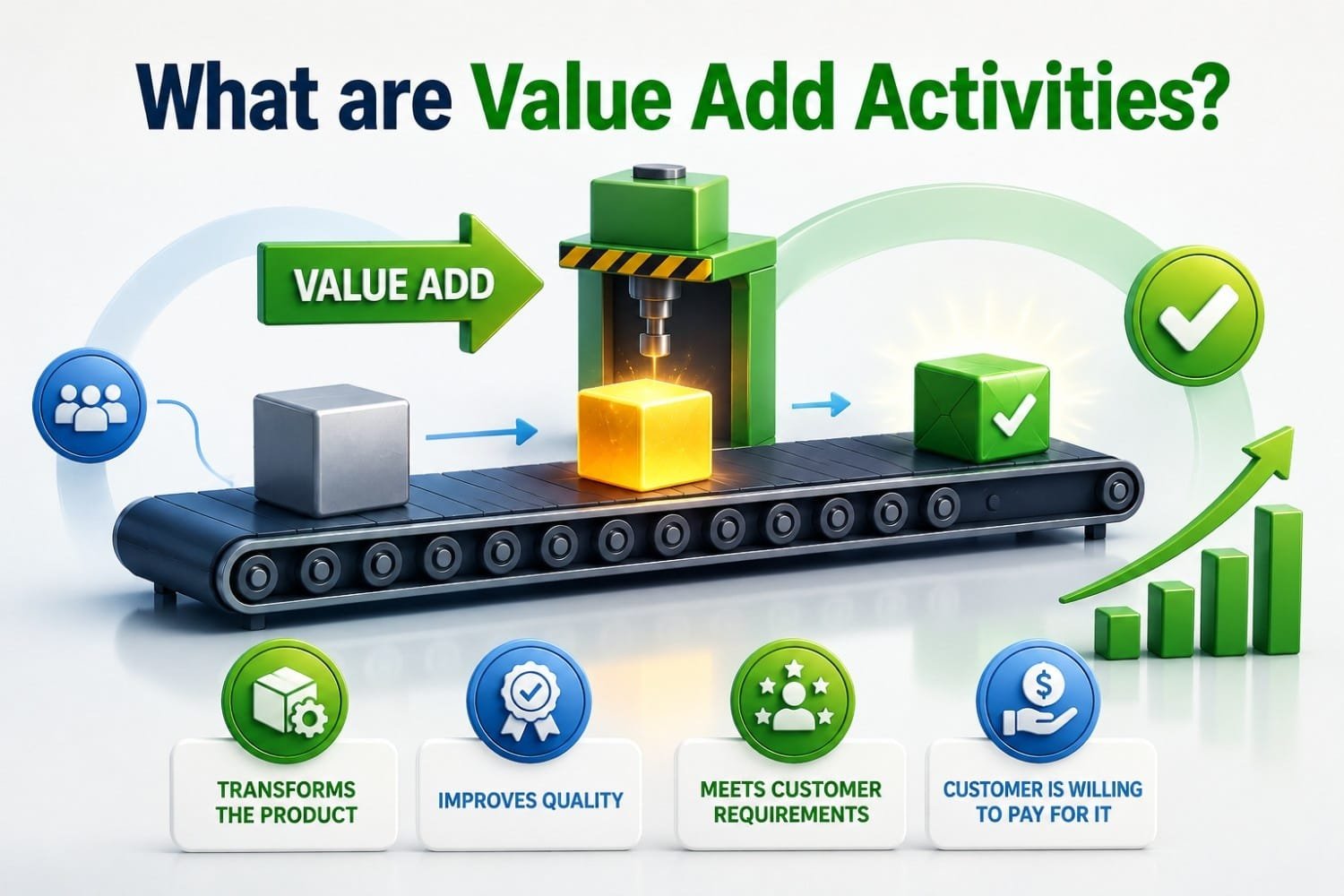
From my experience in quality engineering and new product development, one of the most common misconceptions is assuming that every necessary task adds value. Activities such as machining a component to its required dimensions or assembling a product correctly clearly create value because they move the product closer to customer expectations. In contrast, waiting for approvals, searching for tools, correcting defects, or re-entering data may consume significant time, but they do not improve the product or service from the customer’s perspective.
The goal of Lean is to maximize value-added work while reducing activities that consume resources without creating customer value. Identifying these high-value steps is the first step toward improving productivity, reducing lead time, lowering costs, and delivering better outcomes.
What are Non-Value Add Activities?
Non-Value-Added (NVA) activities are process steps that consume time, effort, or resources without improving the product or service from the customer’s perspective. These activities do not change the form, fit, function, or quality of the final output, so customers would not willingly pay for them. Although they often become part of everyday operations, they increase lead time, operating costs, and process complexity.
In my experience leading Lean and quality improvement initiatives, the largest opportunities rarely come from fixing one major problem. They come from identifying routine activities that everyone accepts as “normal”—waiting for approvals, searching for information, moving materials, duplicate data entry, unnecessary inspections, or correcting avoidable errors. These tasks keep work moving internally, but they do not create additional value for the customer.
A simple question helps expose non-value-added work: “If this activity disappeared tomorrow, would the customer notice any difference in the final product or service?” If the answer is no, the activity deserves closer evaluation. Some non-value-added activities are unavoidable because of regulatory, safety, or business requirements, while others are pure waste that should be reduced or eliminated.
Recognizing non-value-added activities is the first step toward Lean improvement. By removing unnecessary work and simplifying essential processes, organizations can improve flow, reduce costs, shorten lead times, and focus more time on activities that truly create customer value.
🎓 Top-Rated Courses & Certifications
Try changing your filters or searching for another course.
Value Add vs. Non-Value Add Activities: Key Differences
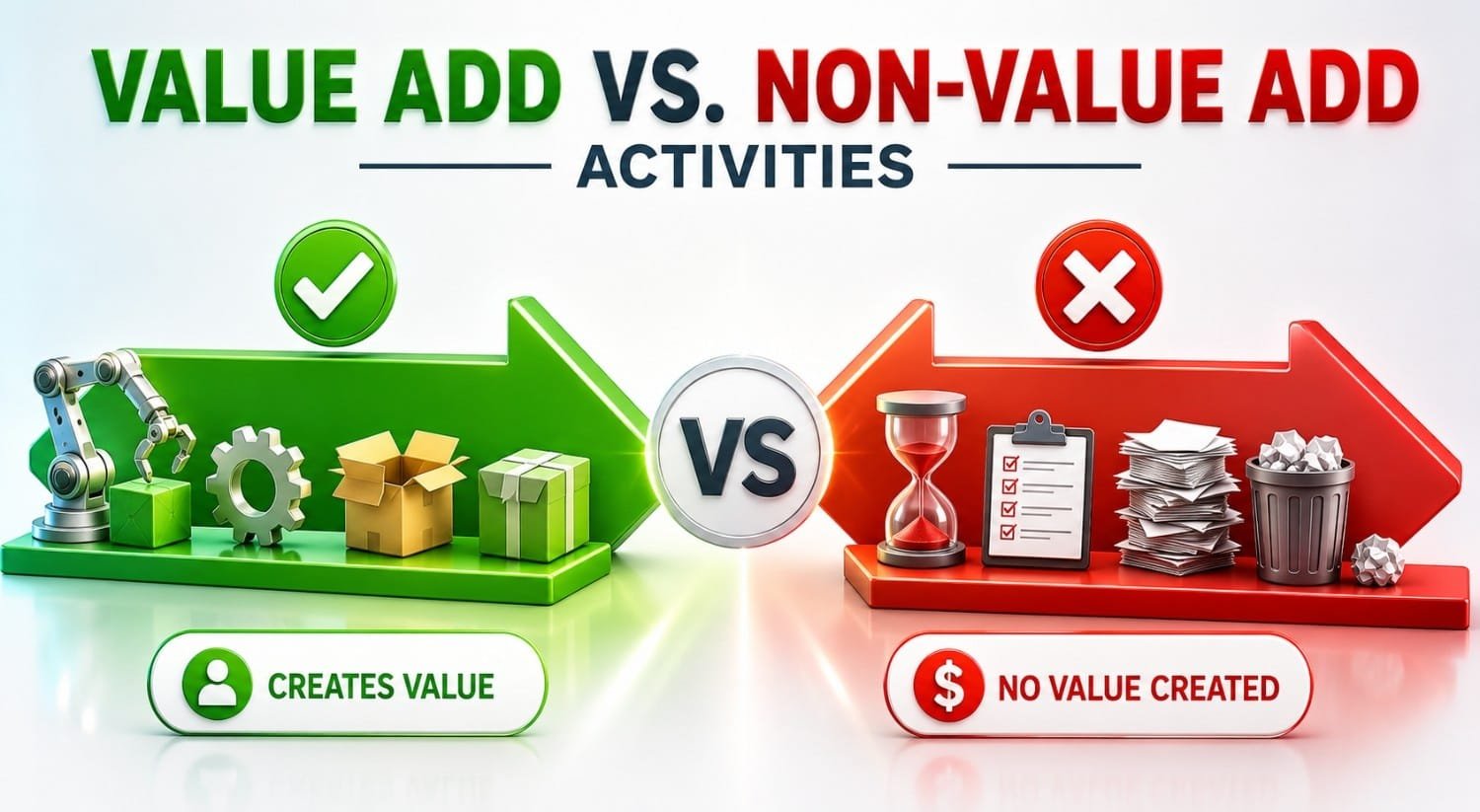
The key difference between Value-Added (VA) and Non-Value-Added (NVA) activities lies in one question: Does this step create value for the customer? If an activity transforms a product, service, or information in a way the customer needs and is willing to pay for, it is value-added. If it only consumes time, effort, or resources without improving the final outcome, it is non-value-added.
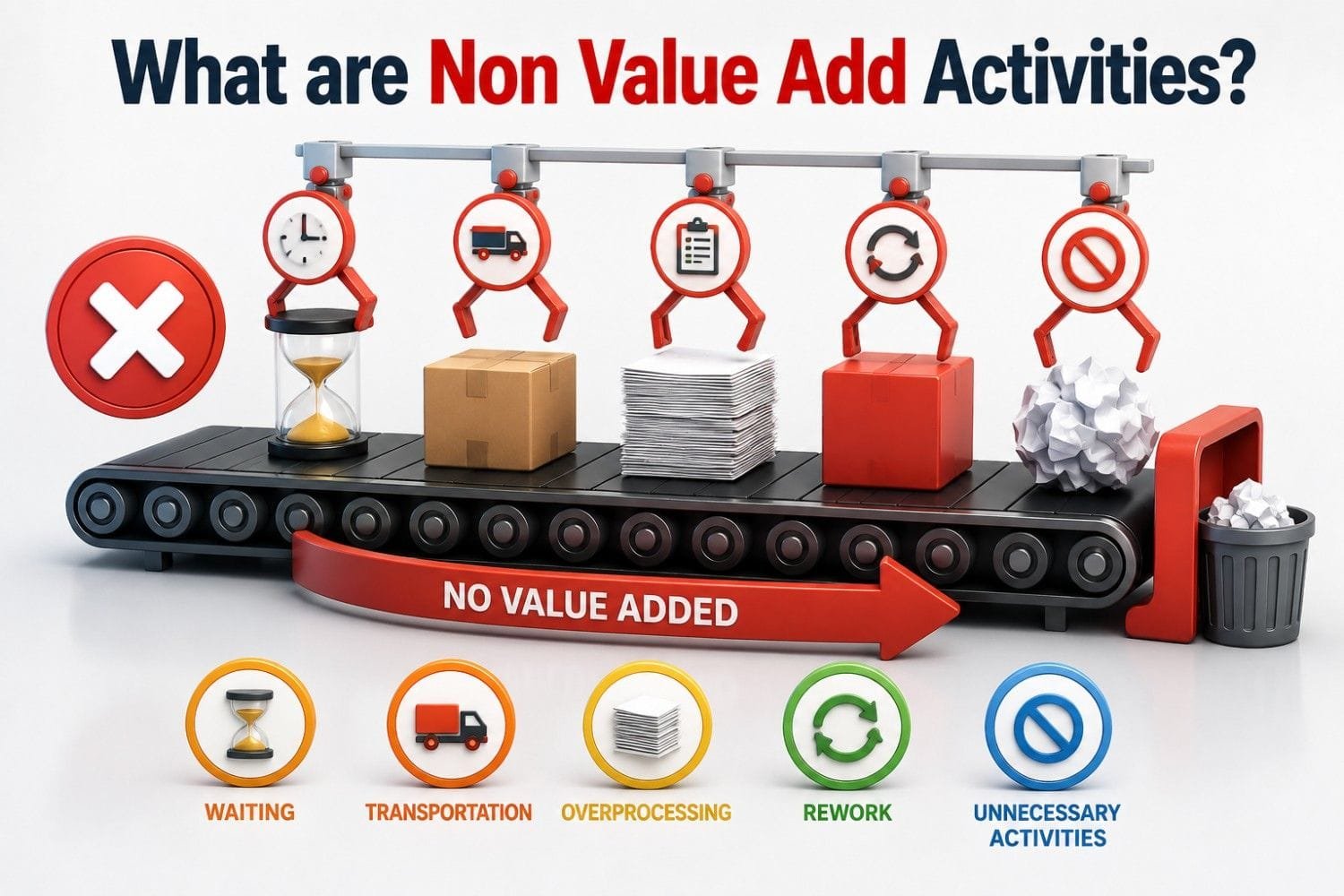
During my work in quality engineering and Lean improvement projects, I have found that the greatest opportunities for improvement are rarely hidden in complex technical problems. More often, they are buried in everyday activities such as waiting for approvals, duplicate documentation, rework, unnecessary movement, or repeated data entry. These tasks keep people busy but do not improve what the customer ultimately receives.
A practical way to distinguish between VA and NVA activities is to view every process through the customer’s perspective. Ask yourself, “If this step were removed, would the customer notice a loss in value?” If the answer is yes, it is likely value-added. If the answer is no, the activity should be reviewed, simplified, automated, or eliminated wherever possible.
Organizations that consistently increase value-added work while reducing non-value-added activities achieve shorter lead times, lower costs, better quality, and a more efficient process. This simple distinction is the foundation of Lean thinking and continuous improvement.
Types of Non-Value Add Activities
One of the biggest misconceptions in Lean is that every Non-Value-Added (NVA) activity should be eliminated. In my experience leading quality and process improvement initiatives, this approach often creates more problems than it solves. Some activities may not add direct customer value, but they are essential for regulatory compliance, safety, quality assurance, or business operations. Others exist only because of inefficient processes and offer no benefit to either the customer or the organization.
For this reason, Lean classifies non-value-added activities into two categories: Necessary Non-Value-Added (NNVA) Activities and Pure Waste. NNVA activities are required to meet legal, regulatory, safety, or operational requirements and should be simplified or automated wherever possible. Pure Waste, however, adds no customer or business value and should be systematically reduced or eliminated.
Understanding this distinction helps organizations focus improvement efforts where they deliver the greatest impact. Rather than removing every non-value-added step, Lean encourages teams to streamline what is necessary and eliminate what is truly wasteful—improving efficiency without compromising quality, compliance, or customer satisfaction.
How Lean Classifies Process Activities
In Lean, every process activity can be classified into three categories based on the value it creates for the customer. This simple framework helps teams identify where to focus their improvement efforts.
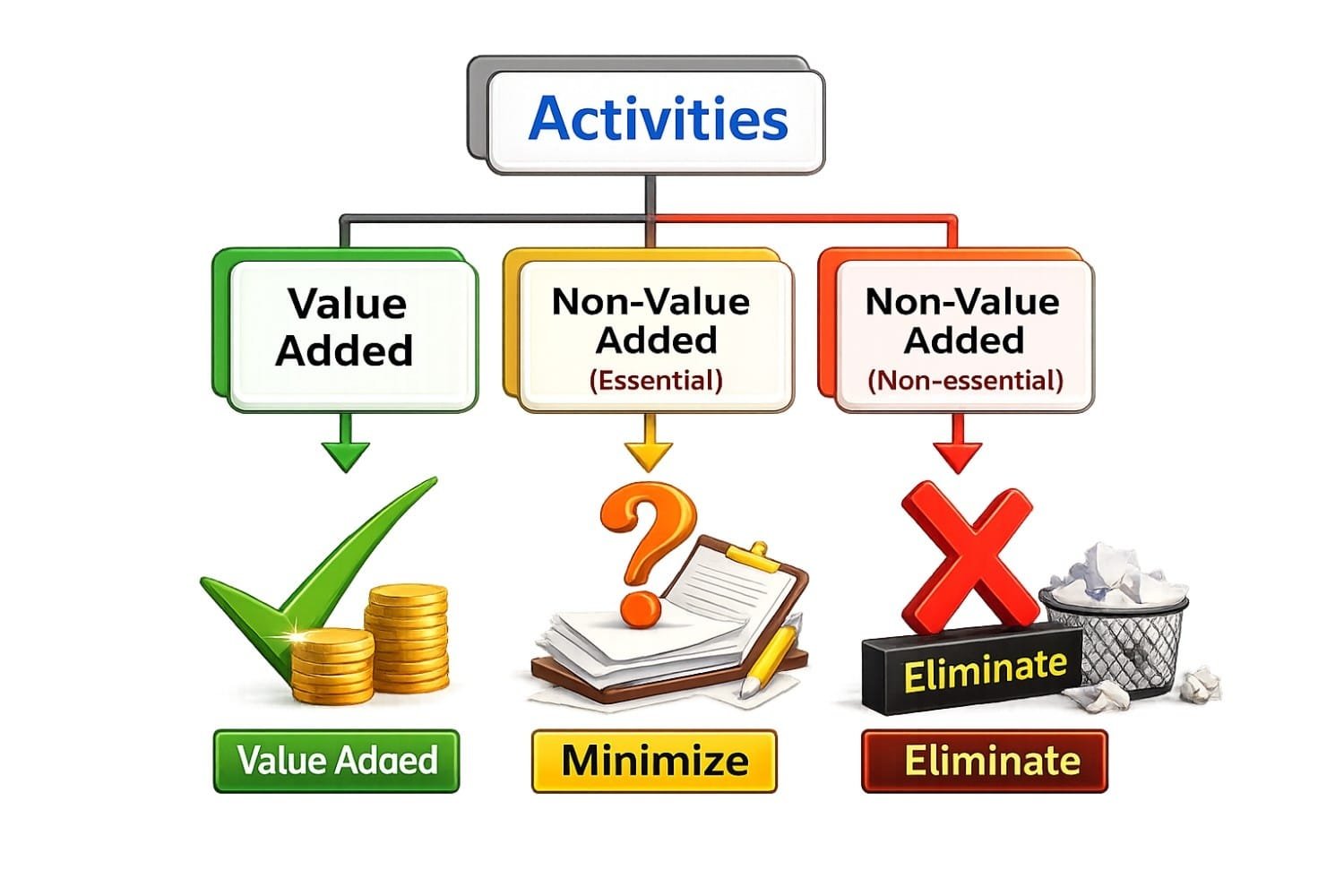
1. Value-Added (VA) Activities
These activities directly transform a product, service, or information in a way that the customer values and is willing to pay for. They improve the final outcome and move the process closer to meeting customer requirements.
2. Necessary Non-Value-Added (NNVA) Activities
These activities do not create direct customer value, but they are currently required for legal, regulatory, safety, quality, or business reasons. Examples include compliance documentation, quality inspections, audits, purchasing activities, risk assessments, and mandatory testing. Although customers would not choose to pay for them, they cannot simply be eliminated. The Lean objective is to simplify, standardize, or automate these activities wherever possible.
3. Pure Waste (Non-Essential Non-Value-Added) Activities
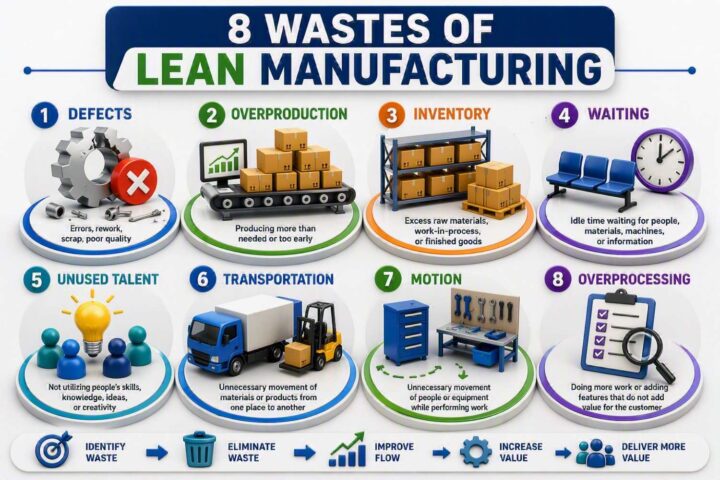
These activities create no customer value and serve no legitimate business purpose. Examples include waiting, unnecessary transportation, excessive movement, duplicate data entry, rework, overprocessing, unnecessary approvals, and excess inventory. These activities increase cost and lead time without improving the final product or service. They should be reduced or eliminated as part of continuous improvement.
How to Identify Hidden Waste in a Process
Hidden waste is rarely obvious. In my experience leading Lean and quality improvement projects, it is usually embedded in everyday activities that teams no longer question. Waiting for approvals, duplicate data entry, searching for information, unnecessary movement, repeated inspections, and rework often become accepted as “normal,” even though they add no customer value.
The most effective way to uncover hidden waste is to observe the process where the work actually happens and evaluate every step from the customer’s perspective. Ask simple questions: Does this activity create value? Would the customer pay for it? What would happen if this step were removed? If the customer sees no difference, the activity is a strong candidate for improvement.
Another proven technique is process mapping. By mapping each step and classifying it as Value-Added (VA) or Non-Value-Added (NVA), teams can quickly identify bottlenecks, unnecessary handoffs, waiting time, and redundant activities. In several improvement workshops, I found that administrative delays—not the actual work—were responsible for most of the total lead time.
Identifying hidden waste is not about blaming people; it is about improving the process. Organizations that continuously challenge unnecessary work can reduce lead times, lower costs, improve quality, and create more time for activities that truly deliver customer value.
📚 Recommended Books for Professionals
Try removing one or more filters.
How to Reduce Non-Value Add Activities
Reducing Non-Value-Added (NVA) activities starts with challenging the process—not the people. In my experience leading Lean and quality improvement projects, the biggest productivity gains rarely came from working harder or investing in new technology. They came from questioning routine tasks that had become part of the process without anyone asking whether they were still necessary.
The first step is to map the process and classify each activity as Value-Added (VA), Necessary Non-Value-Added (NNVA), or Pure Waste. Activities that provide no customer or business value should be eliminated, while necessary activities should be simplified, standardized, or automated to minimize their impact.
One question has consistently helped my teams uncover improvement opportunities: "If this step were removed, what risk would it create for the customer or the business?" If there is no meaningful risk, the activity is usually a candidate for removal. During one improvement project, we discovered that multiple versions of the same status report were being maintained for different stakeholders. Consolidating them into a single report saved hours of work each month without affecting decisions or customer outcomes.
The most successful Lean organizations continuously remove unnecessary approvals, duplicate work, rework, and delays while improving process flow. By focusing time and resources on activities that genuinely create customer value, they achieve lower costs, shorter lead times, higher quality, and a better customer experience.
Common Mistakes When Identifying Value Add Activities
Correctly identifying Value-Added (VA) activities is often more difficult than it appears. From my experience leading Lean and process improvement projects, the most common mistake is assuming that every necessary task adds value. In reality, activities such as compliance reviews, inspections, or documentation may be essential for the business, but they do not directly increase customer value. Failing to distinguish between Value-Added (VA), Necessary Non-Value-Added (NNVA), and Pure Waste can lead teams to prioritize the wrong improvements.
Another common mistake is viewing the process from the organization's perspective instead of the customer's. Long approval chains, duplicate reports, repeated inspections, and unnecessary meetings often become accepted as standard practice. A question I frequently ask during workshops is, "Would the customer willingly pay for this activity?" If the answer is no, the activity should be challenged, even if it has existed for years.
Finally, avoid confusing effort with value. A task may require significant time or expertise, but that does not make it value-added. What matters is whether it improves the product or service in a way the customer recognizes and values. Organizations that evaluate every process step through the customer's eyes make better decisions, uncover hidden waste, and focus their improvement efforts where they deliver the greatest impact.
Customer is least interested in 95% of all the activities that we do behind the scene and only 5% of all the activities are worth it in the eyes of customer.
💼 Case Study : How to Calculate Value Added and Non Value Added Activities :
Let's follow John's journey to the bank and analyze each activity from the customer's perspective.
John needs to visit the bank to complete a cash transaction. Since the bank is crowded, he must wait in a long queue before entering. At first glance, every step appears to be necessary because John cannot complete the transaction without traveling to the bank, waiting his turn, and filling out the required paperwork. However, Lean thinking encourages us to ask a different question: Which activity actually creates value for John, and which activities simply consume time?
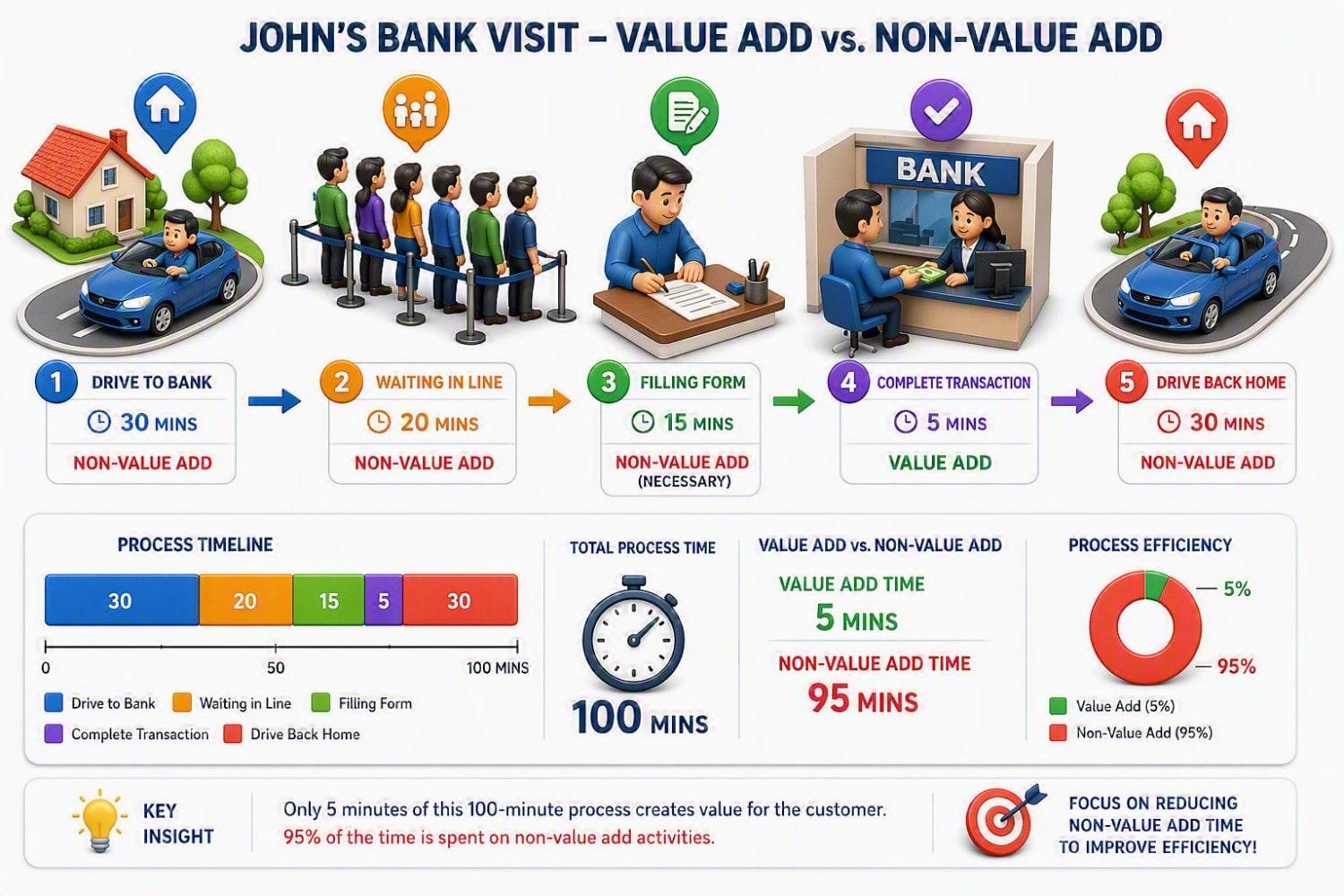
The process consists of the following steps:
From John's perspective, the only reason for visiting the bank is to complete the cash transaction. The 5 minutes spent conducting the transaction directly fulfills his need and delivers the outcome he wants. Therefore, this is the Value Added Activity.
The remaining activities do not directly create value. Driving to the bank and driving back home are transportation activities. Waiting in the queue is time during which no value is being created. Completing the bank form may be required by banking procedures, but it does not provide additional value to John. Therefore, it is classified as a Necessary Non-Value Add Activity rather than a value-added activity.
Calculating Value Added and Non-Value Added Time :
Value Added Time (VA) = Cash Transaction Time = 5 Minutes
Non-Value Added Time (NVA) = = Travel Time + Waiting Time + Form Filling Time + Return Travel Time
= 30 + 20 + 15 + 30 = 95 Minutes
Process Efficiency Calculation
One of the simplest Lean metrics is Process Efficiency.
Process Efficiency (%) = (Value Added Time ÷ Total Process Time) × 100
= (5 ÷ 100) × 100 = = 5%
What Does This Mean?
Although John spent 100 minutes completing the process, only 5 minutes actually created value. In other words, 95% of the total process time was spent on activities that did not directly contribute to the desired outcome.
This might seem surprising, but during many Lean improvement projects I have participated in, similar patterns frequently emerge. Whether in manufacturing, healthcare, software development, or office processes, the actual value-creating work often represents only a small fraction of total lead time. Most delays occur because of waiting, transportation, approvals, handoffs, searching for information, rework, or administrative activities.
The goal of Lean is not necessarily to make the 5-minute transaction faster. Instead, the biggest improvement opportunity lies in reducing or eliminating the 95 minutes of non-value-added time surrounding the transaction. Solutions such as online banking, electronic forms, appointment scheduling, or dedicated service counters can dramatically reduce waste while improving the customer experience.
Lean Insight: Customers pay for results, not for waiting, traveling, searching, or filling out paperwork. The fastest way to improve a process is often to remove waste rather than trying to make people work faster.

Lean Six Sigma • Six Sigma • Statistics • Project Management • Artificial Intelligence (AI) • Operations Management • Quality Management
Frequently Asked Questions (FAQ)
- What are value add activities?
Value add activities directly transform a product or service in a way that customers are willing to pay for. - What are non-value add activities?
Non-value add activities consume time, effort, or resources without increasing customer value. - What is the difference between value add and non-value add activities?
Value add activities create customer value, while non-value add activities create waste or unnecessary costs. - What are examples of value add activities?
Examples include assembling a product, performing surgery, developing software features, or processing customer orders. - What are examples of non-value add activities?
Examples include waiting, rework, unnecessary transportation, duplicate data entry, and excess inventory. - What are necessary non-value add activities?
These activities do not add customer value but are required for compliance, safety, legal, or business reasons. - How can you identify value add activities?
Ask whether the activity changes the product or service and if the customer would willingly pay for it. - How can you identify non-value add activities?
Look for delays, inspections, handoffs, rework, and other process steps that do not create customer value. - Why are non-value add activities considered waste?
They increase costs, extend lead times, and consume resources without improving customer outcomes. - What are value add and non-value add activities in Lean?
Lean focuses on maximizing value add activities while minimizing or eliminating non-value add activities. - What are common non-value add activities in manufacturing?
Waiting, moving materials, overproduction, defects, excess inventory, and unnecessary inspections are common examples. - What are common non-value add activities in service industries?
Duplicate paperwork, excessive approvals, waiting for responses, and unnecessary meetings are common forms of waste. - Can inspection be considered a value add activity?
No. Inspection is typically classified as a necessary non-value add activity because it does not transform the product. - How do organizations reduce non-value add activities?
Organizations use Lean tools such as Value Stream Mapping, Kaizen, and process improvement initiatives to eliminate waste. - What are the 7 wastes related to non-value add activities?
The 7 wastes are Transportation, Inventory, Motion, Waiting, Overproduction, Overprocessing, and Defects.
Conclusion
In conclusion, understanding the difference between value-added and non-value-added activities is essential for businesses seeking to thrive in a competitive marketplace. Value-added activities directly contribute to improving the end product or service, aligning with customer needs and enhancing their experience. In contrast, non-value-added activities do not add value to the final output, leading to inefficiencies and wasted resources.
By identifying and eliminating non-value-added activities, businesses can optimize their processes, improve efficiency, and allocate resources more effectively. This focus on value-added activities ultimately leads to enhanced customer satisfaction, increased competitiveness, and sustainable growth in the long run. Embracing a culture of continuous improvement and value optimization is the key to success in today's dynamic business landscape.
The biggest mindset shift is this:
Not all work is valuable — and that’s okay… if you recognize it
Continue Your Learning Journey
Learning is a continuous process. Explore related topics, practical guides, tools, calculators, templates, and learning resources to expand your knowledge and develop new skills.
Choose a category below to explore practical tutorials, tools, calculators, templates, case studies, and learning resources.
Recommended Learning Resources
Expert-led courses to build practical skills, earn credentials, and advance your career.
Recommended professional books, certification guides, and practical study resources.
Ready-to-use templates, checklists, guides, and workbooks for practical applications.
Interactive calculators for statistics, quality, engineering, analysis, and decision-making.
Interactive Z, t, Chi-Square, and F tables with critical values and distribution curves.
Discover practical tutorials, case studies, and professional resources across Quality, Lean Six Sigma, Project Management, Statistics, AI, and Data Analytics.
Published: May 2, 2021
Last Updated: September 18, 2026