What is SMED? How Single-Minute Exchange of Die Reduces Changeover Time
In many manufacturing environments, improving productivity is often associated with faster machines, additional automation, or new equipment investments. While these initiatives can certainly help, some of the biggest performance gains come from addressing a less obvious problem: the time lost between production runs.
In my experience, valuable production capacity is frequently consumed during equipment changeovers rather than during actual production. Tasks such as preparing tools, making adjustments, or setting up the next job may seem routine, but they can significantly impact efficiency when repeated throughout the day. This is one reason SMED has become such an important concept in Lean Manufacturing. By challenging traditional approaches to changeovers, organizations can uncover hidden improvement opportunities, increase flexibility, and make better use of existing resources without major capital investment.
Whether you’re a manufacturing engineer, quality professional, Lean practitioner, operations manager, or student, understanding SMED can help you view productivity improvement from a completely different perspective.
Understanding SMED: Definition, Purpose, and Origins
SMED, short for Single-Minute Exchange of Die, is a Lean Manufacturing methodology focused on reducing the time required to switch a machine, production line, or process from one product to another. The term single-minute doesn’t mean every changeover takes exactly one minute. Instead, it refers to the goal of completing changeovers in a single-digit number of minutes, typically less than ten.
The concept was developed by Shigeo Shingo, one of the key contributors to the Toyota Production System. His work challenged the long-standing belief that lengthy changeovers were simply part of manufacturing life. Instead of accepting hours of downtime as unavoidable, he demonstrated that many changeover activities could be simplified, reorganized, or performed differently to dramatically reduce production interruptions.
What makes SMED so powerful is that it changes how teams think about changeovers. Rather than viewing them as necessary downtime, SMED encourages manufacturers to see them as improvement opportunities. When every activity is carefully examined, it often becomes clear that many delays are caused by outdated practices, unnecessary movement, waiting, searching for tools, or performing tasks in an inefficient sequence.
In my experience, this mindset shift is what makes SMED truly valuable. I’ve seen teams spend significant time discussing machine speeds, capacity constraints, or equipment upgrades while overlooking the hours lost during routine product changeovers. Once a changeover process is observed closely, it’s surprising how many small inefficiencies become visible. Fixing those issues often delivers meaningful productivity gains without the cost and complexity of major equipment investments.
As a core Lean tool, SMED also complements other continuous improvement practices such as 5S Lean Manufacturing, Kaizen, and Value Stream Mapping, which help identify and eliminate non-value-added activities throughout the production process.
Today, SMED is used across a wide range of industries, including automotive, medical devices, electronics, packaging, food manufacturing, and consumer goods. Its primary purpose is simple: help organizations become more flexible, responsive, and efficient by minimizing the disruption caused when moving from one production run to the next.
How is Changeover Time Measured in SMED?
Reducing changeover time starts with measuring it accurately. While many teams rely on estimates or historical assumptions, effective SMED implementation requires direct observation and real data.
In SMED, changeover time is measured from the last good product of the current production run to the first good product of the next run produced at normal operating conditions. This approach captures the true period when production is unavailable and provides a reliable baseline for improvement.
A common mistake is viewing a changeover as a single activity. In reality, it is a series of tasks that may include tool preparation, equipment adjustments, material handling, inspections, quality checks, and operator setup activities. Small delays in these steps can accumulate and significantly extend total downtime.
Accurate measurement helps uncover inefficiencies that often go unnoticed, such as waiting for materials, searching for tools, unnecessary movement, or repeated adjustments. By breaking the changeover into individual tasks and timing each one, teams can identify where time is being lost and prioritize the improvements that will deliver the greatest impact.
Many organizations combine SMED with tools such as Value Stream Mappingto visualize process delays and Overall Equipment Effectiveness (OEE) to quantify the impact of changeovers on equipment productivity. Together, these methods provide a clearer understanding of where improvement opportunities exist.
The key principle is simple: measure first, improve second. When decisions are based on facts rather than assumptions, changeover reduction efforts become faster, more focused, and far more effective.
The calculation is straightforward:
📏 SMED Changeover Time Formula
Changeover Time=
Time of First Good Part − Time of Last Good Part
The clock starts when the last good part of the current production run is completed and stops when the first good part of the next production run is produced under normal operating conditions.
For example, imagine a machine finishes Product A at 10:00 AM. After the changeover activities, the first acceptable Product B comes off the machine at 10:38 AM.
⏱️ Changeover Time = 10:38 AM − 10:00 AM = 38 Minutes
The key point is that the measurement ends when the process produces a good part, not simply when the new tooling has been installed or the machine has been switched back on.
Why Changeover Time Matters in Manufacturing
In manufacturing, every minute of downtime has a cost. When equipment is stopped for a product changeover, it is not producing parts, generating revenue, or creating customer value. That’s why changeover time is a critical performance metric in Lean Manufacturing.
Many organizations focus heavily on improving machine speed, yet a significant amount of lost capacity is often hidden in lengthy setup and changeover activities. What appears to be a short interruption on a production report can add up to hours of lost production time over the course of a week or month.
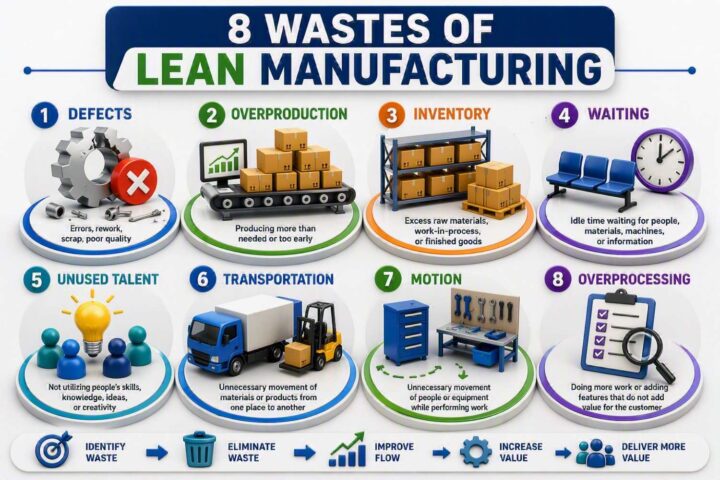
One of the biggest benefits of reducing changeover time is increased flexibility. Faster changeovers make it easier to run smaller batches, respond to changing customer demand, reduce inventory levels, and improve delivery performance. These are key objectives of modern Lean Manufacturing systems. To understand how changeovers impact overall flow, it can be helpful to explore Value Stream Mapping and the 8 Wastes of Lean Manufacturing.
Long changeovers also directly affect equipment utilization. Even highly productive machines cannot achieve their full potential if they spend excessive time being adjusted, cleaned, inspected, or prepared between production runs. This is why changeover reduction is closely linked to improving Overall Equipment Effectiveness (OEE).
The key takeaway is simple: every minute spent on unnecessary changeover activities is a minute that could have been used to produce value. By reducing setup time, manufacturers can increase capacity, improve responsiveness, and gain more output from existing equipment without major capital investment.
If a machine has four changeovers per day and each takes 45 minutes:
4 × 45 = 180 minutes
That is 3 hours of potential production time lost each day.
Even a small reduction can make a noticeable difference when repeated across multiple changeovers, machines, and shifts.
Every minute spent on a changeover is a minute that equipment is unavailable for production. The faster and more consistent the transition, the greater the opportunity to improve operational performance using existing resources.
What does “Single-Minute” Mean in SMED?
One of the most common misunderstandings about SMED (Single-Minute Exchange of Die) is that every changeover must be completed in exactly one minute. That is not what “single-minute” means.
“Single-minute” means a changeover measured in single-digit minutes—not necessarily a one-minute changeover.
The broader goal is to make product transitions faster, more consistent, and less disruptive to production. In SMED, single-minute means reducing the changeover to a single-digit number of minutes—typically less than 10 minutes. So, a changeover reduced from 60 minutes to 8 minutes would meet the single-minute objective.
When I first learned about SMED, I also assumed the goal was a literal one-minute setup. It sounded almost unrealistic. What I later appreciated is that the real value of SMED is the mindset it creates: instead of accepting long changeovers as unavoidable, teams start asking how much of that time can realistically be removed.
The number 10 minutes is a target, not a rule that applies to every process. Equipment complexity, safety requirements, product design, and process controls can all affect what is achievable.
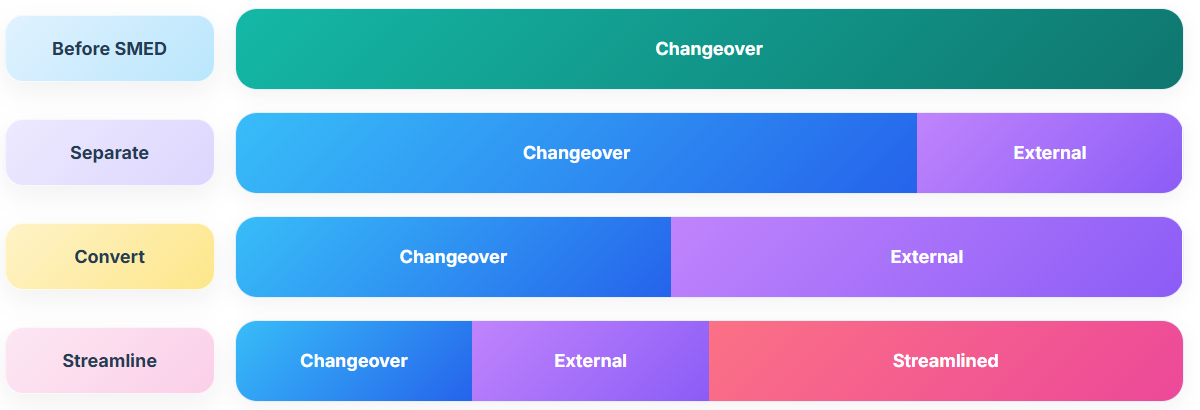
Three major phases of SMED
One of the strengths of SMED (Single-Minute Exchange of Die) is its simple, structured approach to reducing changeover time. Rather than treating a long setup as unavoidable, SMED breaks the improvement effort into three practical phases.
What I particularly like about this framework is that it encourages teams to rethink the way a changeover is performed before assuming that new equipment or major investment is required.
SMED in Three Words
Separate
→
Convert
→
Streamline
1. Separate Internal and External Setup
The first phase is to identify which activities require the machine to be stopped and which can be performed while it is still operating. This creates a clear picture of where changeover time is actually being spent and can reveal activities that have traditionally been performed during downtime unnecessarily.
2. Convert Internal Setup to External Setup
The next phase focuses on moving suitable activities outside the machine-stop period.
The key question is simple: Does this activity really need to happen while the equipment is stopped?
Every task that can be completed beforehand reduces the amount of time the machine needs to remain unavailable for production.
3. Streamline the Remaining Setup
After separating and converting activities, some tasks will still require the equipment to be stopped. The final phase focuses on making those remaining activities simpler, faster, and more consistent. The aim is to remove unnecessary effort and reduce variation in the changeover process.
From my experience in continuous improvement, this three-phase approach changes the conversation from “How can we work faster?” to “Why does this activity take so long in the first place?”
🎓 Top-Rated Courses & Certifications
⚙
Find the right course
Showing
14
of 14 courses
Course Provider
Course Categories
Curated professional learning resources
🔎
No courses found
Try changing your filters or searching for another course.
Seven Stages of SMED Implementation
The Seven Stages at a Glance
Observe
→
Measure
→
Separate
→
Convert
→
Streamline
→
Standardize
→
Improve
Understanding the three phases of SMED (Single-Minute Exchange of Die) gives you the framework. The seven-stage approach takes that framework onto the shop floor and turns it into a practical improvement cycle.
From my experience in continuous improvement, the biggest mistake is trying to fix the changeover before understanding it. A good SMED project starts with observation and data, then builds improvements step by step.
1. Observe the Current Changeover
Watch the complete changeover from start to finish. Record what actually happens rather than relying on assumptions or memory.
2. Measure Each Activity
Break the changeover into individual tasks and record their duration. This creates a clear baseline and shows where the available time is being consumed.
3. Separate Internal and External Activities
Classify each task based on whether it requires the machine to be stopped or can be performed while production is running.
4. Convert Internal to External
Review the activities currently performed during downtime and identify those that can be completed outside the machine-stop period.
5. Streamline the Remaining Setup
Focus on the activities that still require downtime and simplify them to make the changeover faster and more consistent.
6. Standardize the New Method
Document the improved sequence and establish a consistent way to perform the changeover. This helps sustain the improvement across operators and shifts.
7. Repeat and Improve
Measure the revised changeover, identify further opportunities, and continue the cycle. SMED is an ongoing improvement process rather than a one-time exercise.
Internal vs. External Setup Activities Explained
One of the most important concepts in SMED (Single-Minute Exchange of Die) is separating internal setup activities from external setup activities. The basic idea is simple:
Internal setup = the machine must be stopped. External setup = the work can be done while the machine is running.
It sounds obvious, but in practice, this is where teams often uncover some of their easiest changeover improvement opportunities.
Internal setup activities are tasks that require the equipment to be stopped before they can be performed.
Typical examples include:
Removing or installing dies, tools, or fixtures
Replacing machine components
Performing adjustments that require equipment shutdown
Carrying out tasks that require safe access to stopped equipment
Because these activities keep the machine unavailable for production, they directly contribute to changeover downtime.
External setup activities can be completed before the machine stops or while production is still running.
Examples include:
Preparing tools and fixtures
Bringing materials to the machine
Checking required settings or dimensions
Reviewing work instructions
Pre-staging the next tooling or materials
These activities do not have to consume machine downtime when they are prepared at the right time.
When analyzing a changeover, ask one question:
“Does this activity really require the machine to be stopped?”
If the answer is yes, it is internal setup. If the answer is no, it may be external setup.
Understanding this difference gives teams a clear picture of which activities consume actual machine downtime and provides the basis for the next stage of SMED changeover reduction.
SMED Tools and Techniques for Faster Changeovers
After identifying where time is being lost, the next step is applying the right SMED tools and techniques to eliminate unnecessary delays. The goal is simple: make changeovers faster, easier, and more repeatable without increasing operator workload.
One of the most effective SMED practices is converting internal setup activities (tasks performed while equipment is stopped) into external setup activities (tasks completed while the machine is still running). Preparing tools, materials, fixtures, and documentation in advance can significantly reduce downtime during the actual changeover.
Another common technique is standardization. Standard work instructions, setup checklists, and visual controls help operators follow a consistent process every time, reducing variation and preventing avoidable delays. Simple equipment improvements can also make a major difference. Quick-release clamps, locating pins, modular tooling, and preset fixtures eliminate time-consuming adjustments and reduce the need for repeated fine-tuning during setup.
SMED delivers even better results when combined with other Lean tools. For example, 5S Lean Manufacturing ensures tools and materials are organized and immediately available, while Poka-Yoke helps prevent setup errors that lead to rework or extended adjustments. Before implementing improvements, tools such as the Fishbone Diagram and 5 Why Analysis can help identify the root causes of lengthy changeovers.
Many successful SMED projects also use principles from Lean Manufacturingto remove non-value-added activities and improve process flow. The biggest gains often come from eliminating wasted motion, waiting, searching, and unnecessary adjustments rather than making operators work faster.
Ultimately, the best SMED tools are those that simplify the process, reduce variability, and allow teams to achieve consistent, predictable changeovers every time.
01Quick-release fasteners
Use clamps, levers, pins, or cam locks instead of
time-consuming bolts where practical.
02Standardized settings
Use preset dimensions, reference marks, stops, and visual
indicators to reduce trial and error.
03Parallel operations
Perform suitable changeover tasks simultaneously when
multiple operators are available.
04Organized tools and materials
Keep everything clearly identified and readily accessible.
Setup carts can help reduce searching and unnecessary movement.
05Reduced adjustments
Use preset tooling, fixed locating points, and standardized
dimensions to minimize repeated fine-tuning.
06Visual controls
Apply alignment marks, color coding, setup guides, and position
indicators to make the correct setup obvious.
07Poka-yoke
Use simple error-proofing features such as guide pins, keyed
connections, or dedicated fixtures to prevent setup mistakes.
SMED vs Traditional Changeover Methods
The main difference between SMED and traditional changeover methods is how the setup process is approached.
Traditional changeovers often rely on established routines: stop the machine, prepare the next setup, make adjustments, run trials, and restart production. The process may work, but teams can become accustomed to the downtime and treat it as unavoidable.
SMED takes a different approach. It looks at the entire changeover and asks which activities can be simplified, reorganized, or performed more efficiently to reduce the time equipment is unavailable.
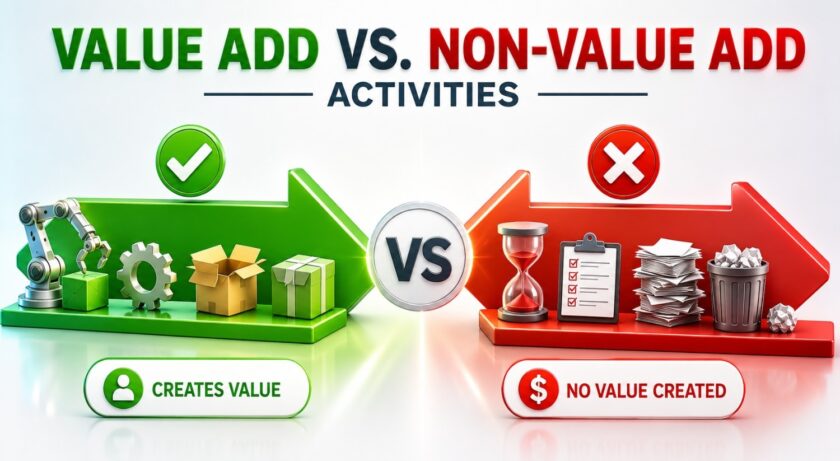
This approach aligns closely with Lean principles that emphasize eliminating waste and improving process flow. Tools such as Value Add vs. Non-Value Add Activities, 5S Lean Manufacturing, and Kaizen are often used alongside SMED to identify and remove inefficiencies that extend setup duration.
Ultimately, traditional changeovers ask, “How do we perform this setup?” SMED asks, “How can we perform this setup with the least possible downtime?” That shift in thinking is what enables faster changeovers, greater production flexibility, and higher equipment utilization.
Traditional Changeover
SMED Approach
Relies heavily on existing routines
Uses a structured improvement approach
Longer, less predictable setups
Shorter and more consistent setups
More operator-dependent
Greater use of standard work
Adjustments may rely on trial and error
Greater use of preset conditions
Changeover improvements may be reactive
Continuous, data-based improvement
From my experience in continuous improvement, the biggest difference is often the mindset. A traditional approach may ask, “How do we perform this setup?” SMED encourages the team to ask, “Why does this setup take so long?” That shift can uncover opportunities that are easy to miss when a changeover has simply become part of the daily routine.
In simple terms: Traditional methods accept the existing changeover; SMED challenges it and looks for ways to make it faster, simpler, and more repeatable.
Step-by-Step Guide to Implementing SMED
Implementing SMED (Single-Minute Exchange of Die) is most effective when you start with the actual changeover rather than jumping straight to solutions. From my experience in continuous improvement, teams tend to get better results when they observe the process, involve the people doing the work, and use real data to guide improvements.
Select a target changeover: Choose a machine, line, or process where changeovers are frequent, lengthy, or causing noticeable production losses.
Observe the actual changeover: Watch the process from start to finish and record what really happens, including waiting, searching, walking, adjustments, and interruptions. Video recording can be especially useful for capturing details that are easy to miss.
Break the changeover into tasks: List each activity and record its duration. This makes it easier to see where time is being spent and where delays are occurring.
Analyze the activities: Review each task and determine whether it genuinely needs to occur during the changeover. Challenge steps that have simply become part of the routine.
Develop and test improvements: Work with operators and relevant teams to identify practical changes and test them on the shop floor rather than relying only on assumptions.
Establish the improved process: Once the changes are proven, define a clear and repeatable sequence so the improved method can be followed consistently.
Measure and sustain the results: Compare the new changeover time with the original baseline and continue monitoring performance. This helps prevent the process from gradually returning to its previous state.
From my experience, the people who perform changeovers every day are often the best source of improvement ideas. They know exactly where the small delays and frustrations occur—many of which never appear in a written procedure.
In simple terms: observe the real process, measure it, improve it with the team, and make the improved method the new standard.
How to Standardize and Sustain SMED Improvements
Reducing changeover time is only half the job. The real challenge is making sure the improvement lasts.
I’ve seen teams achieve impressive results during a SMED (Single-Minute Exchange of Die) workshop, only to see changeover times gradually increase again a few months later. In most cases, the issue was not the improvement itself—it was the lack of standardization and follow-up.
Once a better changeover method has been established, it should become the new standard way of working. This means documenting the process clearly, making sure operators understand it, and regularly checking whether the expected performance is being maintained.
A practical approach includes:
Document the improved method: Create clear standard work for the changeover sequence, key settings, and responsibilities.
Train operators: Ensure everyone involved understands and follows the same process.
Use visual standards: Simple checklists, photographs, markings, and setup guides can make the correct method easier to follow.
Monitor performance: Track changeover time regularly and compare it with the established baseline.
Review deviations: When performance slips, identify what changed instead of simply accepting the longer setup time.
Keep improving: Operator feedback can reveal new delays and opportunities after the initial SMED project is complete.
From my experience, standardization is what turns a one-time improvement into a sustainable manufacturing result. A changeover that is faster once is a success; one that remains faster across different operators, shifts, and production conditions is a lasting improvement.
The goal is simple: make the improved method the normal method, measure the results, and protect the gains.
Common Challenges in SMED Implementation
SMED (Single-Minute Exchange of Die) can deliver significant improvements, but implementation is not always straightforward. The biggest obstacles are often related to habits, process variation, and inconsistent execution rather than the changeover itself.
From my experience in continuous improvement, teams can make good progress initially and still struggle to sustain it when these practical challenges are overlooked.
1
Resistance to change from operators and supervisors.
2
Lack of accurate changeover data or baseline measurements.
3
Poor understanding of the existing process.
4
Different changeover methods across operators or shifts.
5
Inadequate preparation of tools, materials, and fixtures.
6
Frequent machine adjustments and trial-and-error setups.
7
Poor workplace organization causing searching and unnecessary movement.
8
Equipment or tooling limitations that restrict improvement opportunities.
9
Insufficient operator training on the improved changeover process.
10
Lack of management support and adequate resources.
11
Failure to standardize improved changeover procedures.
12
Difficulty sustaining improvements over time.
13
Safety or quality requirements limiting possible process changes.
14
Production pressure making teams reluctant to stop and analyze the process.
📚 Recommended Books for Professionals
🇮🇳India:
Use India|International:
Use 🌐 Global
✦
Find the right book
Showing 0 of 0 books
Categories
Recommendations
My Books
📚
No matching books found
Try removing one or more filters.
SMED Examples and Success Stories
One of the easiest ways to understand SMED (Single-Minute Exchange of Die) is to look at Formula 1. An F1 pit stop is not a manufacturing changeover, but the underlying thinking is remarkably similar. A team has only a few seconds to transition the car, and every movement, tool, and responsibility is carefully planned.
A great example is McLaren’s 1.80-second pit stop at the 2023 Qatar Grand Prix, which set an F1 pit-stop world record at the time.
What makes this interesting from a Lean and SMED perspective is not just the speed. The entire operation is designed around standardized roles, preparation, precise positioning, specialized tools, and simultaneous work. F1 teams also spend extensive time practicing pit stops and reviewing performance to improve consistency.
From my experience in continuous improvement, this is exactly the lesson worth taking from Formula 1: speed is usually the result of good process design, preparation, and repeatability—not simply asking people to work faster.
Benefits of SMED
The main purpose of SMED (Single-Minute Exchange of Die) is to reduce changeover time, but the benefits go beyond faster setups. When product transitions become shorter and more consistent, manufacturers can improve how they use equipment, people, and production capacity.
SMED is often implemented as part of a broader Lean Manufacturing strategy rather than as a standalone initiative. Organizations frequently combine SMED with tools such as 5S, Kaizen, Value Stream Mapping, and Poka-Yoke to eliminate waste, improve flow, and sustain long-term performance improvements. Together, these methodologies create a more efficient and responsive production system.
✓
Reduced changeover time:
Less time is lost when switching between products.
✓
Higher machine availability:
Equipment spends more time producing and less time in setup.
✓
Greater production flexibility:
Teams can respond more easily to changes in product mix and demand.
✓
Smaller batch sizes:
Faster changeovers make shorter production runs more practical.
✓
Lower inventory:
Smaller batches can help reduce unnecessary work-in-process and finished goods.
✓
Improved productivity:
Available equipment and labor can be used more effectively.
✓
Lower operating costs:
Reduced downtime can decrease the resources consumed during changeovers.
✓
Better schedule performance:
More predictable setups can make production planning easier.
✓
Improved consistency:
Standardized changeovers help reduce variation between operators and shifts.
✓
Better use of existing capacity:
SMED can unlock capacity from equipment already on the shop floor.
Frequently Asked Questions (FAQs)
Q: What does SMED stand for?
SMED stands for Single-Minute Exchange of Die, a Lean methodology focused on reducing setup and changeover times.
Q: What is the primary goal of SMED?
The goal is to minimize downtime between production runs, enabling faster and more efficient changeovers.
Q: Does SMED require changeovers to be completed in one minute?
No. SMED aims for a single-digit number of minutes, typically less than ten.
Q: Who developed the SMED methodology?
SMED was developed by Shigeo Shingo as part of the Toyota Production System.
Q: Why is changeover time important in manufacturing?
Long changeovers reduce capacity, increase costs, and limit production flexibility.
Q: How is changeover time measured?
It is measured from the last good part of the current run to the first good part of the next run produced under normal operating conditions.
Q: What are internal setup activities?
These are setup tasks that can only be performed while the equipment is stopped.
Q: What are external setup activities?
These are tasks completed before or after the machine stops, helping reduce downtime.
Q: What is the most important principle of SMED?
Converting as many internal setup activities as possible into external activities.
Q: How does SMED support Lean Manufacturing?
SMED eliminates waste, improves flow, and increases operational flexibility. Learn more about Lean Manufacturing.
SMED (Single-Minute Exchange of Die) is one of the most effective Lean Manufacturing techniques for reducing changeover time and minimizing production downtime. By analyzing the setup process, separating internal and external activities, and eliminating unnecessary delays, organizations can significantly improve productivity without investing in new equipment.
The true value of SMED goes beyond faster changeovers. It enables smaller batch sizes, improves production flexibility, reduces inventory, and helps manufacturers respond more quickly to changing customer demand. These benefits make SMED a key component of modern Lean Manufacturing and continuous improvement initiatives.
Successful SMED implementation starts with accurate measurement, identifying non-value-added activities, and standardizing the setup process. Organizations often achieve the best results by combining SMED with complementary Lean tools such as 5S Lean Manufacturing, Kaizen, Poka-Yoke, and Value Stream Mapping.
Ultimately, SMED helps manufacturers maximize equipment utilization, improve Overall Equipment Effectiveness (OEE), reduce operational waste, and create a more agile production environment. In highly competitive industries, even a few minutes saved during every changeover can translate into substantial gains in capacity, efficiency, and customer service.
Written by Aman — Founder, Digital E-Learning
Helping professionals master
Quality, Lean Six Sigma, Statistics, and
Continuous Improvement
through practical learning resources.
🏆 25+ Years Industry Experience
•
🎓 125K+ Learners Worldwide
•
🌍 Serving 100+ Countries Worldwide
Continue Your Learning Journey
Learning is a continuous process. Explore related topics, practical guides, tools, calculators, templates, and learning resources to expand your knowledge and develop new skills.
⭐
Explore Learning Topics
Choose a category below to explore practical tutorials, tools,
calculators, templates, case studies, and learning resources.
Discover practical tutorials, case studies, and professional resources across Quality, Lean Six Sigma, Project Management, Statistics, AI, and Data Analytics.