What Are the 8 Wastes of Lean Manufacturing? How to Identify and Eliminate Waste
Have you ever finished a busy day at work and wondered where the time went? The production line was running, employees were constantly occupied, materials kept moving, and meetings filled the schedule—yet the overall results barely improved. Throughout my experience working on quality engineering and continuous improvement projects, I’ve seen this happen repeatedly. The issue is rarely a lack of effort. More often, it’s the result of hidden waste embedded within everyday processes.
Lean Manufacturing teaches us that being busy is not the same as creating value. Many routine activities consume time, materials, labor, and money without improving the product or service from the customer’s perspective. Whether it’s waiting for approvals, transporting materials unnecessarily, producing excess inventory, or correcting avoidable defects, these hidden inefficiencies quietly increase costs, extend lead times, and reduce productivity.
In this guide, you’ll learn what Lean Manufacturing Waste is, understand each of the 8 Wastes (TIMWOODS) through practical examples, discover effective ways to identify and eliminate waste, and explore Lean tools, checklists, calculators, and real-world case studies that can help improve operational performance and deliver greater value to customers.
What is Waste in Lean Manufacturing ?
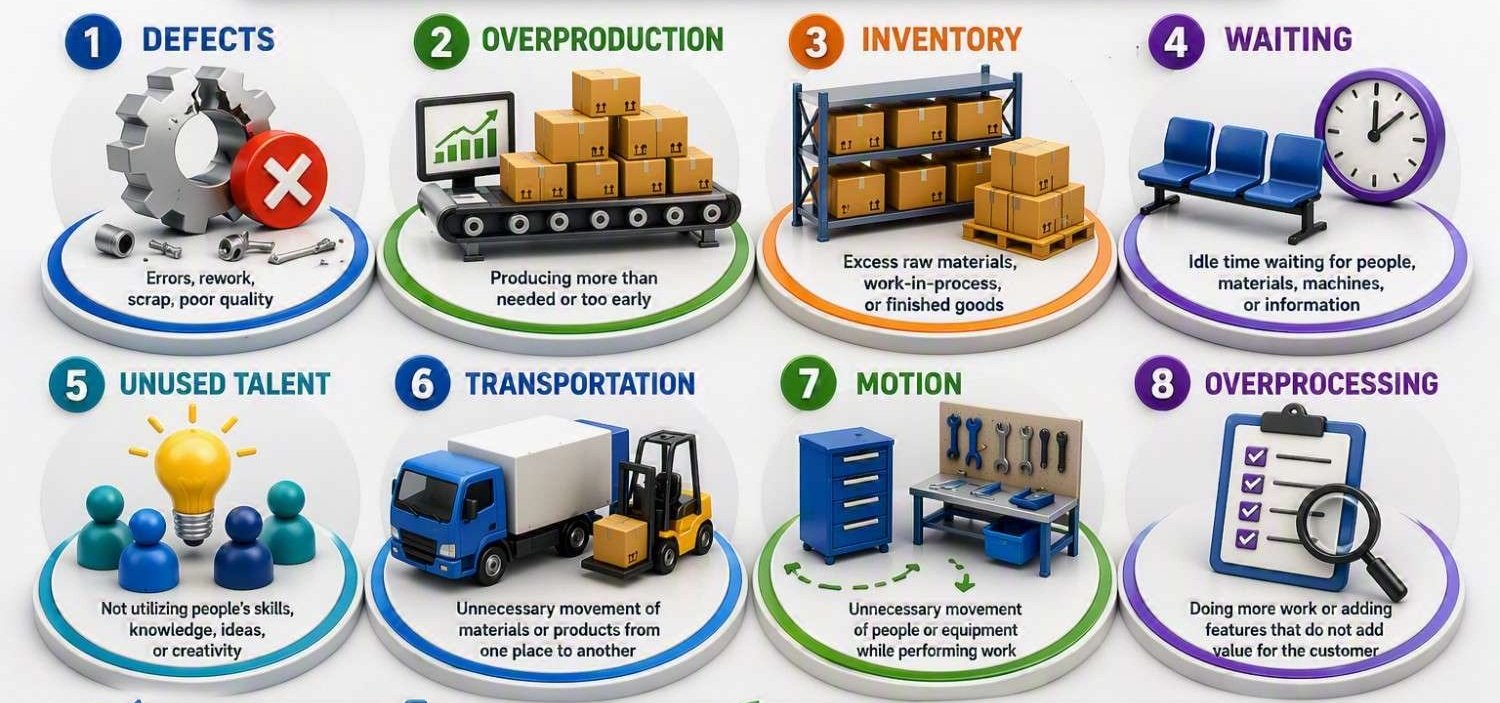
The strength of Lean Manufacturing lies in making waste visible. Once waste is identified, it can be measured, analyzed, and systematically eliminated using proven continuous improvement methods. Small process improvements, applied consistently, often deliver far greater results than expensive equipment upgrades or large-scale process changes.
Waste is any activity that consumes time, money, or effort but does not create value. Think of it like this – if you are waiting in a long queue at a bank, that waiting time adds no value to you. That is waste.
One of the most valuable lessons I’ve learned while working on New Product Introduction (NPI), Design Quality, and continuous improvement projects is that busy processes are not always efficient processes. A production line may be running at full capacity, employees may be working continuously, and materials may be moving from one workstation to another, yet overall performance may still fall short of expectations. In many cases, the real obstacle isn’t a lack of effort—it’s the presence of waste hidden within everyday operations.
In Lean Manufacturing, waste refers to any activity that consumes time, materials, labor, energy, equipment, or other resources without adding value from the customer’s perspective. If an activity doesn’t improve the product or service in a way the customer is willing to pay for, it should be questioned. Lean isn’t about making people work faster; it’s about removing unnecessary work so people can focus on activities that genuinely create value.
This principle originated with the Toyota Production System (TPS), which transformed manufacturing by focusing on process flow rather than simply increasing output. Instead of asking, “How can we produce more?” Lean asks a more important question: “Which activities truly create value, and which exist only because they’ve always been part of the process?” That shift in thinking is the foundation of continuous improvement.
In practice, waste is rarely obvious. It often hides in routine activities that have gradually become accepted as normal. During improvement initiatives, I’ve seen operators spend valuable time walking long distances to collect tools, engineers search for the latest drawing revision, products wait unnecessarily between operations, and teams invest hours reworking defects that could have been prevented. Individually, these activities seem minor, but when repeated every day across an organization, they quietly increase costs, extend lead times, reduce productivity, and delay customer delivery.
Eliminating Lean Manufacturing wastes from System was suggested by the founding fathers of Lean manufacturing, Taiichi Ohno. Initially Taiichi Ohno identified 7 types of wastes, later on 8th waste of Unutilized skills was added to this list. The ultimate aim of Lean is to reduce waste from process. So before we deep dive in to what are these 8 deadly wastes of Lean manufacturing, lets first understand what is “Waste” which is also referred to as Muda.
Whether you’re working in manufacturing, healthcare, logistics, construction, software development, or a service organization, the underlying question remains the same:
If the customer wouldn’t pay for this activity, why does it exist?
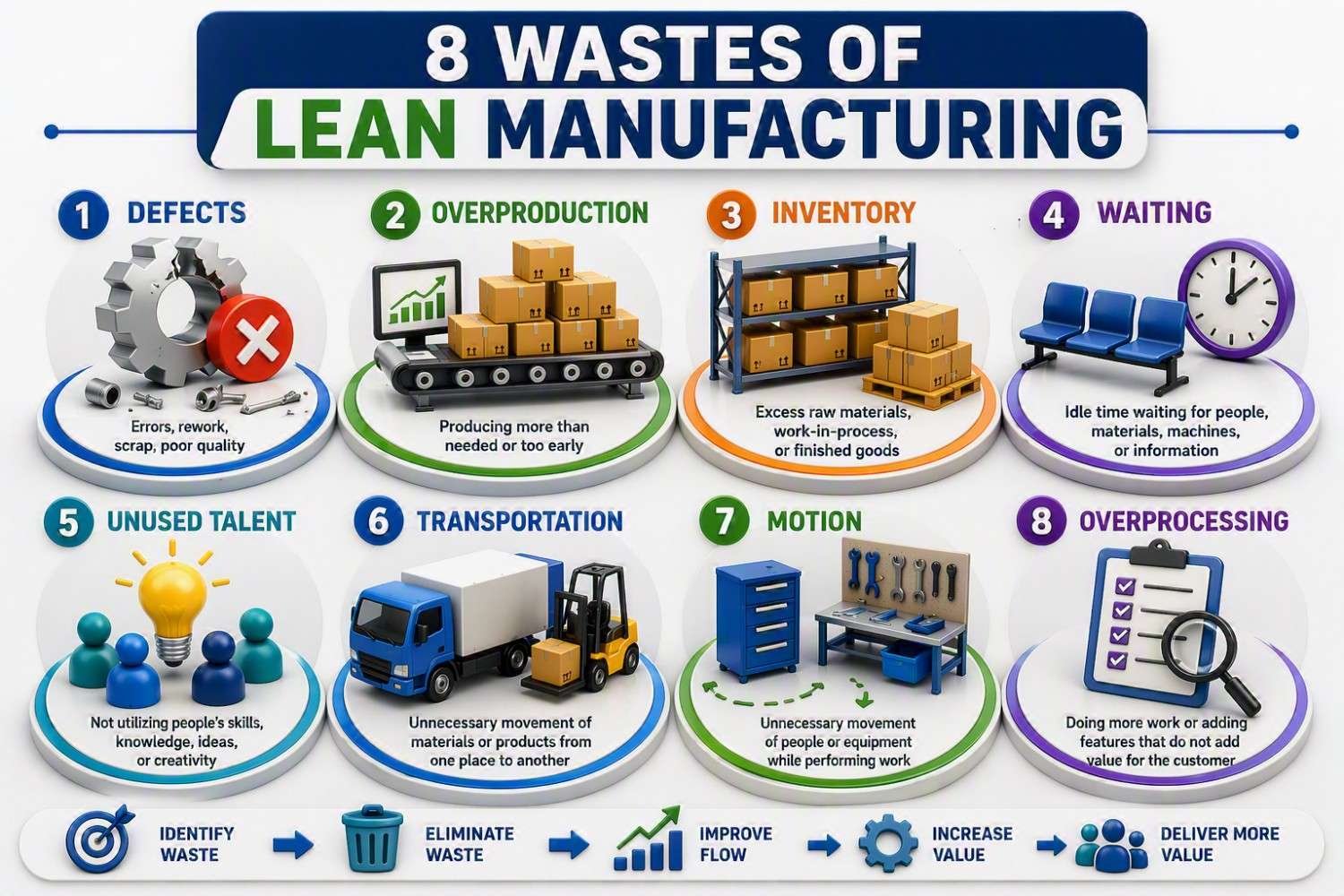
To help organizations recognize these hidden losses, Lean Manufacturing groups waste into eight categories, remembered by the acronym TIMWOODS: Transportation, Inventory, Motion, Waiting, Overproduction, Overprocessing, Defects, and Skills (Unused Talent). These categories provide a practical framework for evaluating any process and uncovering opportunities to improve quality, reduce costs, shorten lead times, and increase customer value.
Understanding waste is the starting point of every successful Lean journey. Once you begin looking at processes through the customer’s perspective instead of relying on long-established habits, improvement opportunities become much easier to recognize. The sections that follow explain each of the 8 Wastes of Lean Manufacturing in detail, along with practical examples, warning signs, and proven strategies for identifying and eliminating waste in real-world operations.
Why Eliminating Waste is Critical for Business Success
Eliminating waste is about much more than reducing costs—it’s about improving the way an organization operates. Throughout my experience in quality engineering and continuous improvement projects, I’ve found that many performance challenges are caused not by a lack of effort, but by inefficient processes. Waiting for materials, unnecessary movement, excess inventory, repeated inspections, and avoidable rework may seem like minor issues individually, yet together they consume valuable time, increase operating costs, and slow down delivery without creating additional value for the customer.
One lesson I’ve learned is that meaningful improvements don’t always require major investments. In many cases, the biggest gains come from identifying and removing everyday activities that have quietly become part of the routine. Even small changes—such as simplifying a workflow, reducing unnecessary movement, or preventing defects at the source can significantly improve productivity, quality, and lead time.
Organizations that consistently eliminate waste are better positioned to deliver high-quality products faster, use resources more efficiently, and respond quickly to changing customer demands. More importantly, waste reduction allows employees to spend less time overcoming process obstacles and more time creating value. This mindset is the foundation of Lean Manufacturing and a key driver of long-term operational excellence.
🎓 Top-Rated Courses & Certifications
Try changing your filters or searching for another course.
What Are the 8 Wastes of Lean Manufacturing (TIMWOODS)?
One of the reasons Lean Manufacturing has remained relevant for decades is its ability to reveal inefficiencies that gradually become accepted as normal. Throughout my work on quality and process improvement projects, I’ve found that many organizations don’t lack skilled people or modern equipment—they struggle because everyday processes contain unnecessary activities that quietly reduce performance.
To help identify these inefficiencies, the Toyota Production System (TPS) groups non-value-added activities into eight categories, known as the 8 Wastes of Lean Manufacturing. Rather than viewing problems in isolation, this framework provides a practical way to evaluate any process and pinpoint where time, materials, effort, and resources are being lost.
What I enjoy most during Lean workshops is watching the moment when teams begin seeing their own processes differently. Suddenly, long walks to retrieve materials, piles of excess inventory, repeated approvals, avoidable waiting, and recurring quality issues are no longer considered “the way we’ve always done it.” They become clear opportunities for improvement.
These eight waste categories are remembered using the acronym TIMWOODS—Transportation, Inventory, Motion, Waiting, Overproduction, Overprocessing, Defects, and Skills (Unused Talent). Each waste affects business performance in a different way, but they all share one characteristic: they consume resources without creating value for the customer.
In the following sections, we’ll examine each of the 8 Wastes of Lean Manufacturing with practical examples, common warning signs, and proven strategies to identify and eliminate them.
TIMWOODS vs. DOWNTIME: Are They Different?
You may come across two acronyms when learning Lean Manufacturing: TIMWOODS and DOWNTIME. Both describe the same waste categories—they simply present them in a different order to make them easier to remember. Whether you use TIMWOODS or DOWNTIME, the objective remains the same: identify activities that consume resources without creating value and systematically eliminate them through continuous improvement.
You may also notice that some references discuss the 7 Wastes of Lean Manufacturing, while others refer to the 8 Wastes. The original Toyota Production System identified seven wastes. Over time, Lean practitioners recognized that underutilizing employees’ knowledge, creativity, and problem-solving skills was another significant source of lost potential. As a result, Unused Talent (or Skills) was added as the eighth waste, making the 8 Wastes of Lean Manufacturing the most widely accepted framework today.
At its core, Lean encourages organizations to evaluate every activity by placing it into one of two categories:
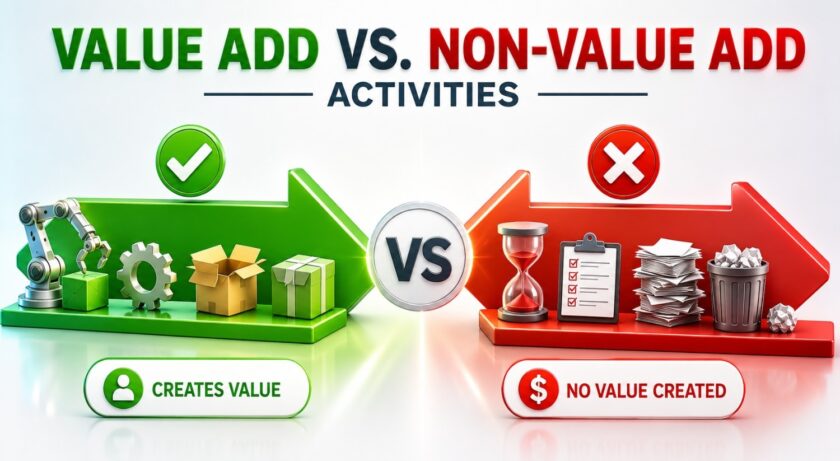
- Value-Added (VA): Activities that transform the product or service in a way the customer is willing to pay for.
- Non-Value-Added (NVA): Activities that consume time or resources without increasing customer value and should be reduced or eliminated wherever possible.
This simple distinction helps teams focus their improvement efforts on work that truly matters. Now, let’s take a look one by one. Starting from defect.
❌Defect Waste
1st type of waste is Defect: Defect Waste occurs whenever a product, component, or service fails to meet the required specifications or customer expectations the first time. Defect can be an abnormality that is not fit for use or is rejected by Customer. Instead of moving smoothly to the next step, defective work requires additional inspection, repair, rework, replacement, or, in the worst case, must be scrapped entirely. It will result in re-work which ultimately leads to increase cost to the company.
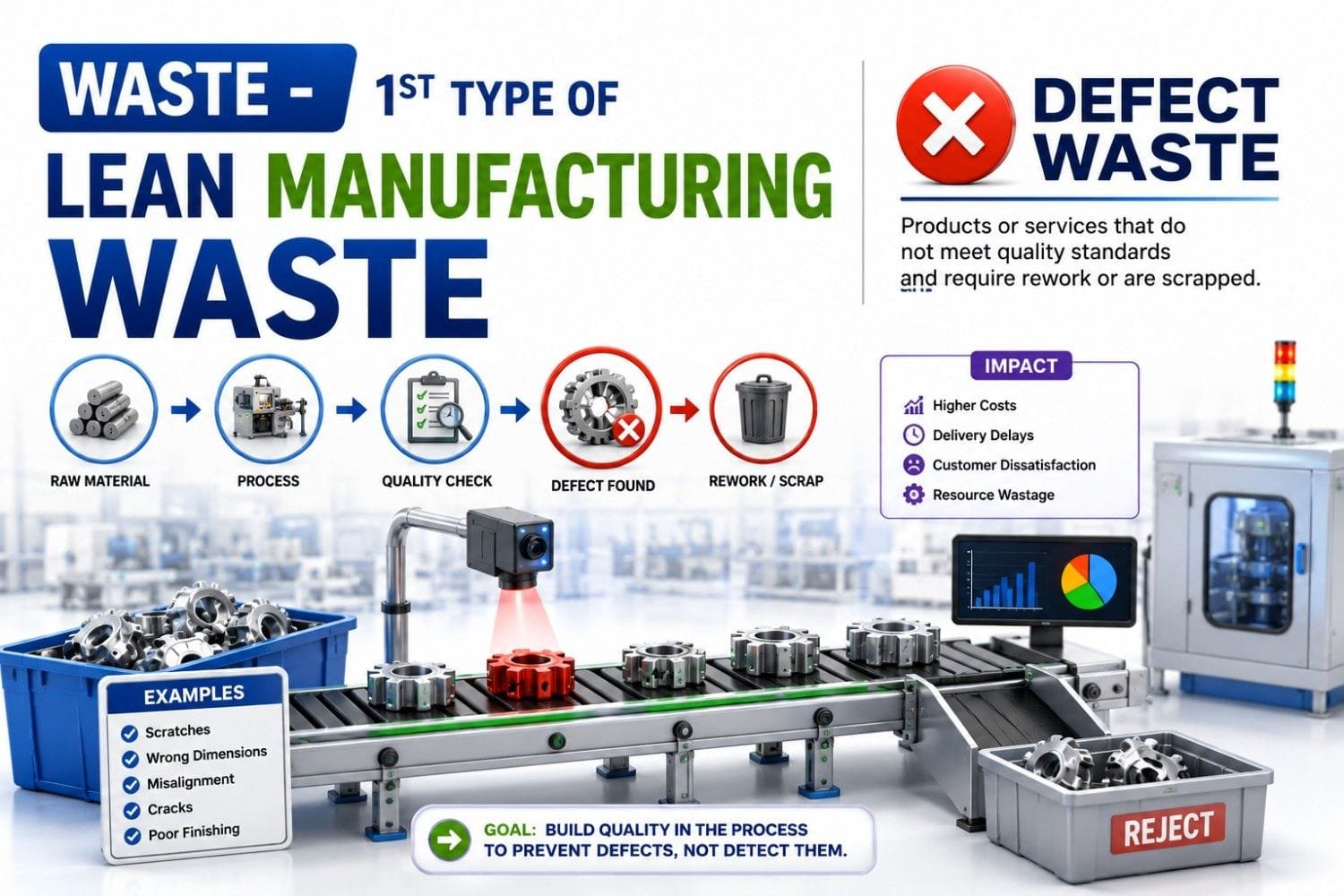
These defect can be internal or external. Some of these defects can be reworked while others are scraped. So if defects are there in the system or process, then it can lead to additional space, time, logistics, and even manpower to deal with it. Example: Cooking a dish incorrectly and having to redo it.
I’ve learned during quality improvement projects is that the visible defect is rarely the biggest cost. The hidden impact is often much greater. A minor defect discovered during final inspection may trigger a chain of additional activities—investigation, rework, repeat inspections, documentation updates, production delays, and sometimes customer complaints. By the time the issue is resolved, the same product may have been handled multiple times, consuming resources that could have been used to produce new value instead.
The most effective way to reduce defect waste is to prevent errors rather than correct them later. Standardized work, mistake-proofing (Poka-Yoke), robust process controls, operator training, and identifying root causes early are far more effective than relying on inspection to catch problems after they occur. As the saying in quality management goes, quality should be built into the process—not inspected into the product.
Common Examples of Defect Waste
- Parts failing final inspection and requiring rework
- Incorrect assembly or missing components
- Software defects discovered during testing
- Data entry errors requiring correction
- Customer returns or warranty claims
- Scrap caused by out-of-specification products
Key Insight: Every defect means the same work is performed twice—once to create the product and again to correct the mistake. Preventing defects at the source is always less expensive than fixing them later.
📤Over Production Waste
2nd type of waste: Overproduction Waste occurs when products are manufactured earlier, faster, or in greater quantities than the customer actually needs. In Lean Manufacturing, this is often considered the most harmful waste because it creates a chain reaction of other wastes, including excess inventory, additional storage, unnecessary transportation, increased handling, and a higher risk of defects becoming hidden until much later.
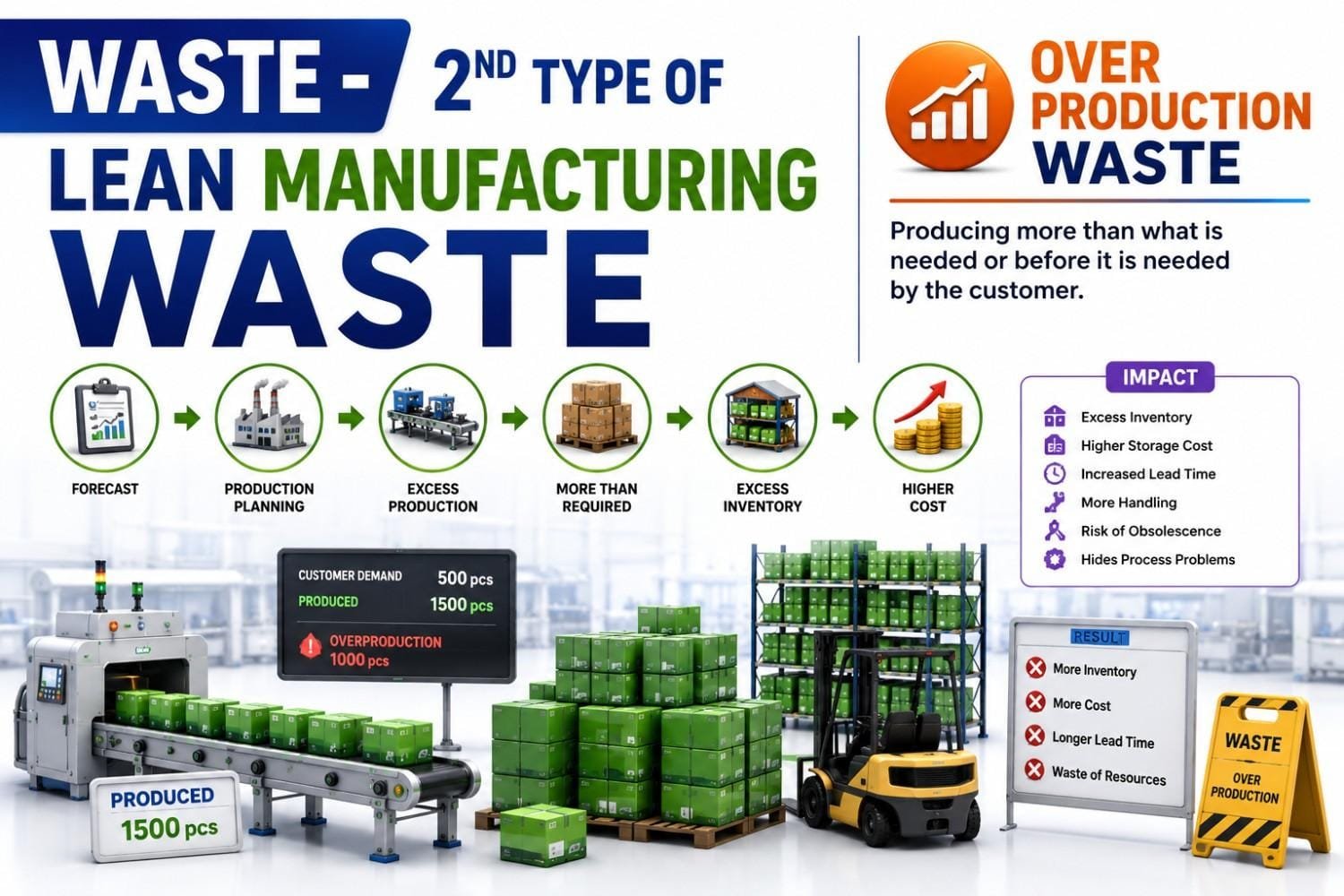
I’ve seen that overproduction is rarely intentional. It usually happens because of inaccurate demand forecasting, large batch production, long machine setup times, or the belief that producing extra units “just in case” will prevent future shortages. While this approach may appear to improve efficiency in the short term, it often ties up cash in unsold inventory, occupies valuable warehouse space, and reduces an organization’s ability to respond quickly to changing customer demand.
The most effective way to reduce overproduction is to produce only what is needed, when it is needed, and in the quantity required. Lean practices such as Pull Systems, Kanban, Heijunka (Production Leveling), and accurate production planning help organizations align production with actual customer demand instead of forecasts or assumptions.
Common Examples of Overproduction Waste
- Producing extra parts for safety stock without confirmed demand
- Manufacturing large batches to maximize machine utilization
- Finished goods remaining in storage for weeks or months before shipment
- Printing reports or documents that are never used
- Building products ahead of customer orders
Key Insight: Producing more than the customer needs doesn’t create value—it simply converts cash into inventory. In Lean Manufacturing, the goal is to produce the right product, at the right time, in the right quantity.
📦Inventory Waste
3rd type of waste is Inventory which means storing raw materials, work in process or finish goods beyond that is immediate need. Inventory Waste occurs when an organization stores more raw materials, work-in-progress (WIP), or finished goods than is needed to meet current customer demand. While inventory is often viewed as a safety net, excess inventory ties up cash, consumes valuable warehouse space, increases storage costs, and can hide underlying process problems that would otherwise need to be addressed.
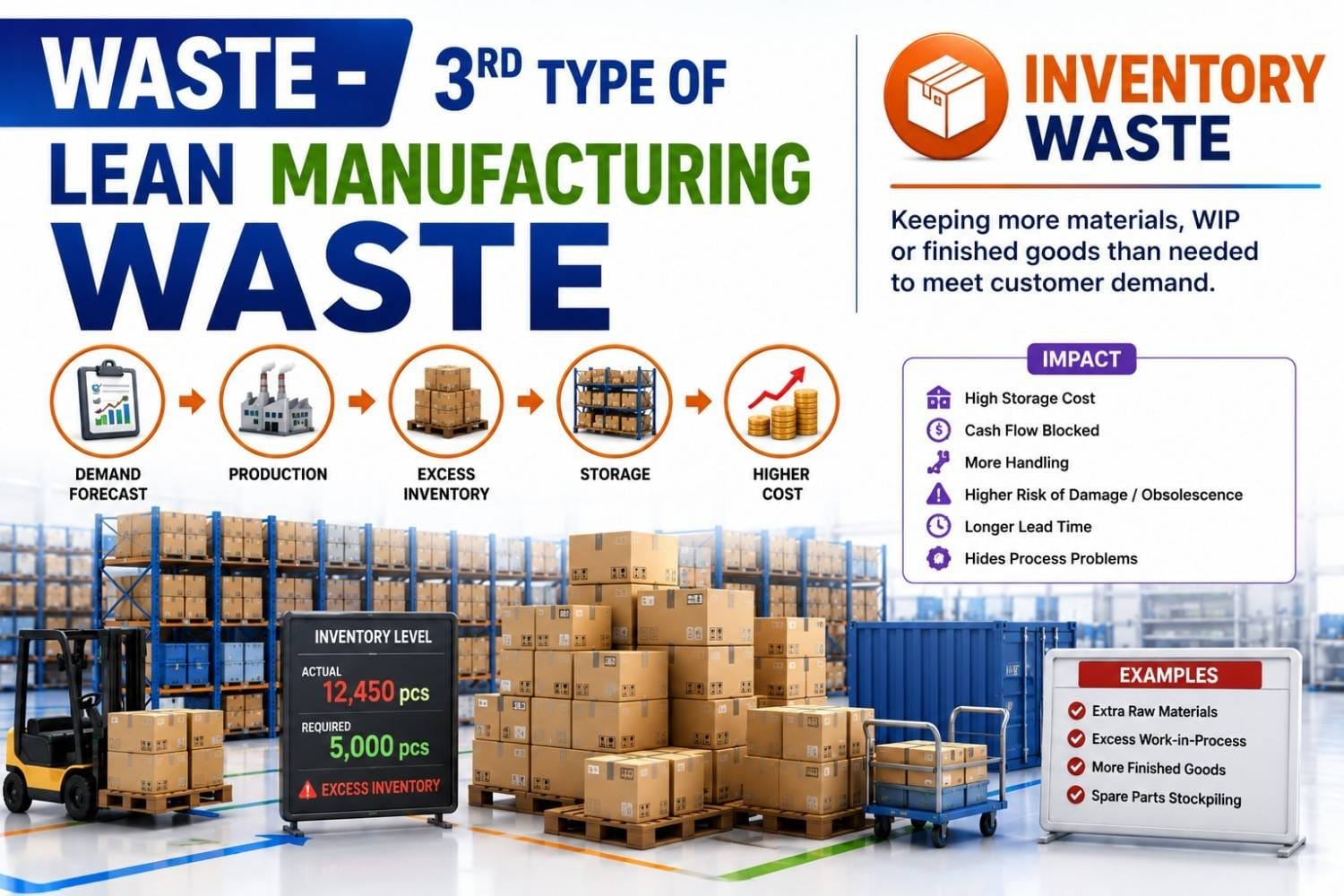
One observation I’ve made during Lean improvement projects is that high inventory often creates a false sense of security. Large stock levels may prevent production from stopping temporarily, but they also make it harder to identify issues such as poor production planning, quality defects, equipment downtime, or unreliable supplier performance. Instead of solving these problems, organizations often compensate by holding even more inventory.
A simple everyday example is buying more groceries than your family can use before they expire. Although everything was purchased with good intentions, unused food eventually becomes waste. The same principle applies in manufacturing. Keeping ten days of raw material instead of two, or allowing work-in-progress to accumulate between processes, doesn’t increase customer value—it simply locks resources into inventory that may sit untouched for days or even weeks.
Common Examples of Inventory Waste
- Raw materials stocked far beyond production requirements
- Excess work-in-progress (WIP) waiting between operations
- Finished goods stored without confirmed customer demand
- Obsolete or slow-moving inventory occupying warehouse space
- Overstocking spare parts that are rarely used
Key Insight: Inventory doesn’t solve process problems—it often hides them. In Lean Manufacturing, excess inventory is viewed as a symptom of inefficiency rather than a sign of operational strength.
⏳Waiting Waste
4th type of waste is Waiting. Waiting Waste occurs whenever people, machines, materials, or information remain idle because the next step in the process cannot begin. Every minute spent waiting extends lead time without adding any value to the product. Unlike defects or excess inventory, waiting is often less obvious because it appears as “doing nothing,” yet it silently reduces productivity and increases operating costs.
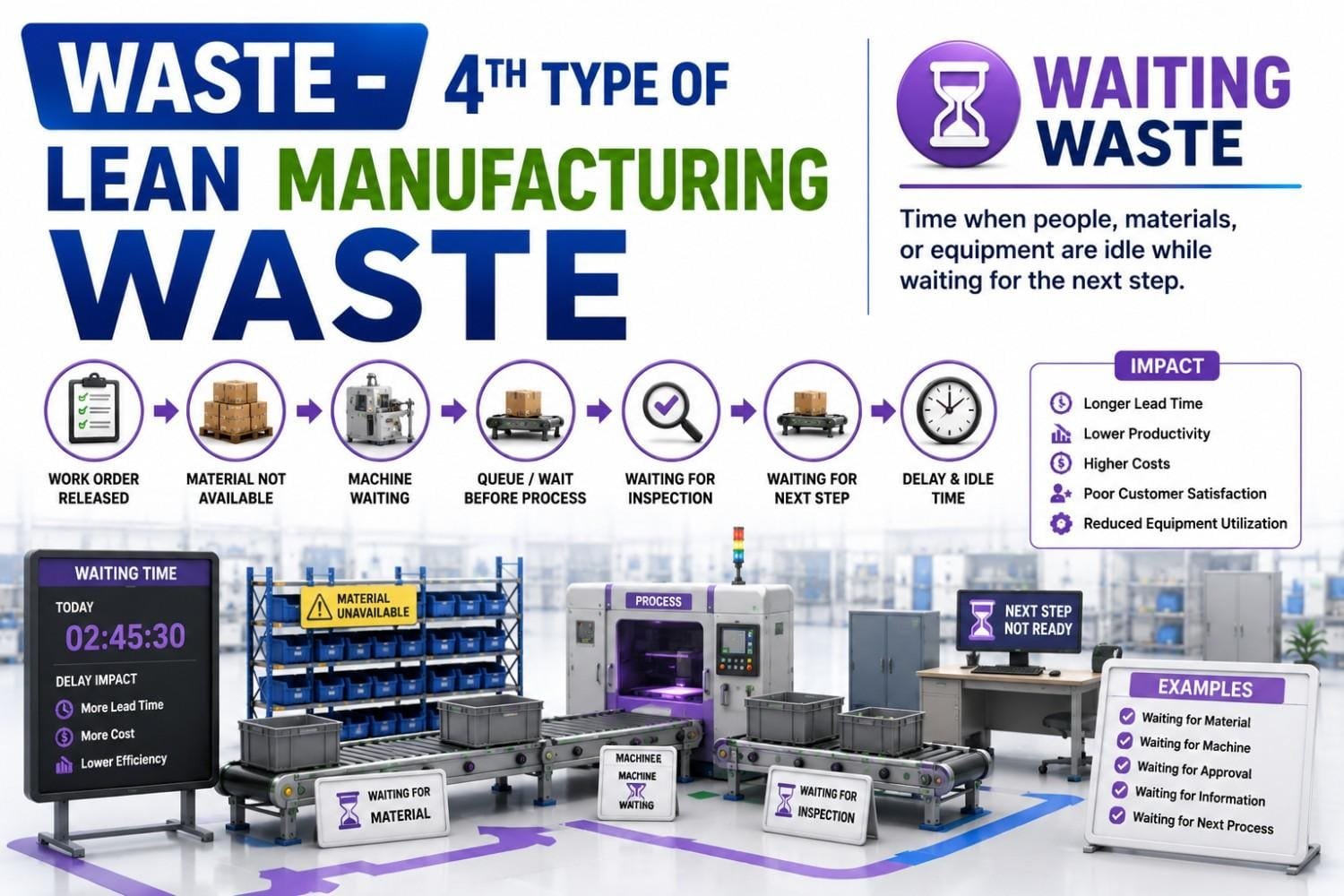
From my experience in manufacturing improvement projects, waiting is usually a symptom rather than the root cause. It often results from unbalanced production lines, delayed material availability, equipment downtime, lengthy approvals, quality inspection bottlenecks, or poor coordination between upstream and downstream processes. I’ve seen situations where operators were ready to assemble products, but production stopped because they were waiting for inspection clearance or the next batch of components. The machines were available, the workforce was ready, but the process simply wasn’t flowing.
Reducing waiting waste requires improving process flow rather than simply increasing production speed. Techniques such as How to balance a assembly line. TTPM (Total Productive Maintenance)to reduce equipment downtime, SMED (Single Minute Exchange Dies) to shorten changeover times, and better production scheduling help keep work moving smoothly from one operation to the next.
Common Examples of Waiting Waste
- Operators waiting for quality inspection approval
- Machines idle because the next batch of material is unavailable
- Production delayed due to equipment breakdowns
- Employees waiting for approvals, drawings, or work instructions
- Work-in-progress queued between operations
Key Insight: Waiting doesn’t just waste time—it interrupts process flow. In Lean Manufacturing, improving flow is often more valuable than simply increasing production speed.
🧠Unused Talent (Skill) Waste
5th type of waste is Not utilizing 100 % resources. Unused Talent, also known as Skills Waste, occurs when an organization fails to fully utilize the knowledge, experience, creativity, and problem-solving abilities of its employees. Unlike the other Lean wastes, this one doesn’t involve materials or machines—it represents the lost potential of people. When skilled employees spend most of their time on repetitive, low-value tasks or their improvement ideas are ignored, organizations miss valuable opportunities to innovate and improve.
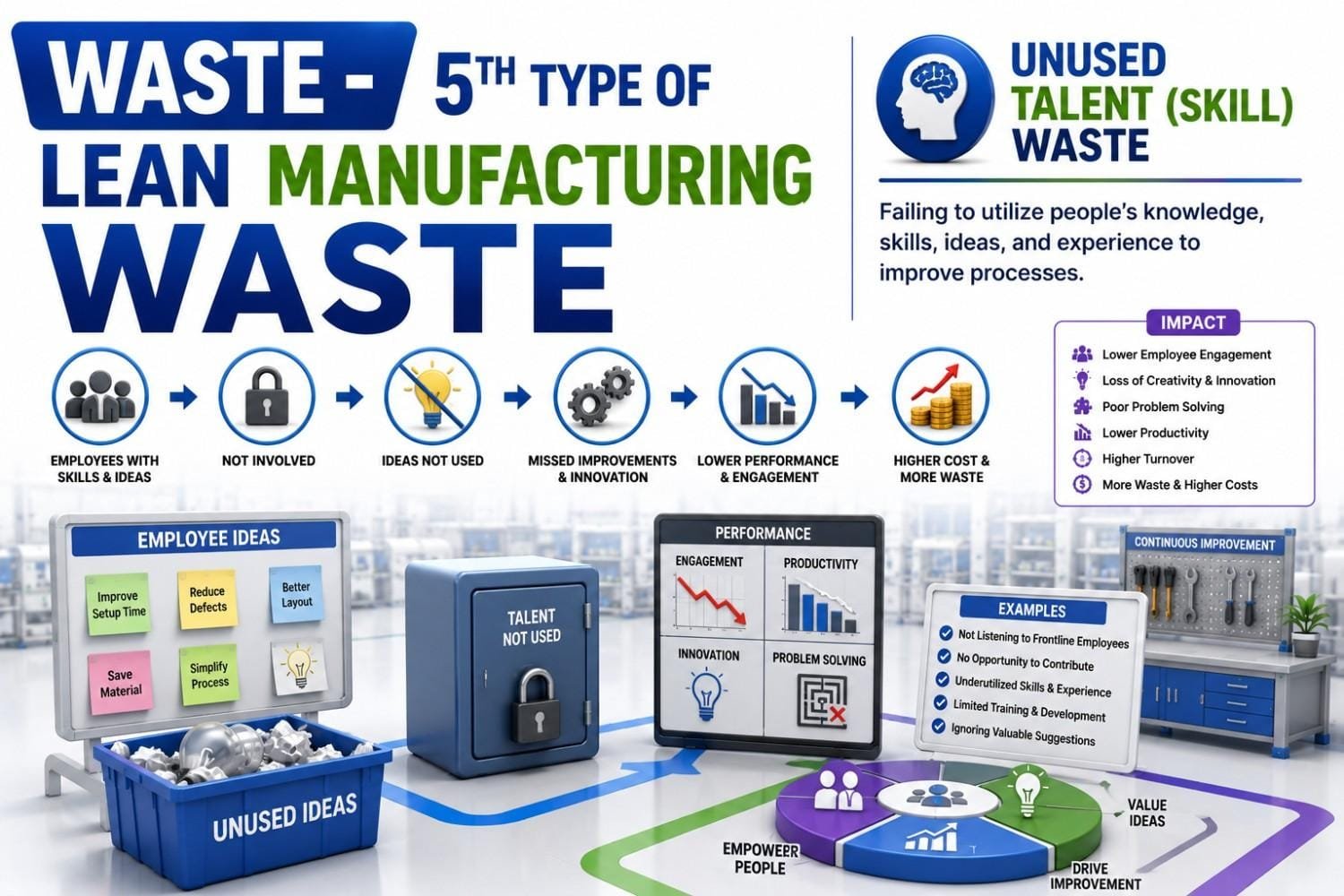
My experience in quality and continuous improvement projects, I’ve often found that the best process improvement ideas come from the people doing the work every day. Operators, technicians, and engineers usually understand the challenges within a process better than anyone else. Unfortunately, many organizations focus only on completing daily production targets and never create a system for employees to share or implement their ideas.
Lean Manufacturing encourages organizations to build a culture where employees are empowered to identify problems, suggest improvements, and participate in continuous improvement activities. Regular Kaizen events, suggestion programs, cross-training, and employee involvement in problem-solving not only reduce waste but also improve engagement, innovation, and overall business performance.
Common Examples of Unused Talent Waste
- Skilled operators performing routine manual loading or repetitive tasks
- Employee improvement ideas that are never reviewed or implemented
- Limited training or cross-functional development opportunities
- Excluding frontline employees from problem-solving discussions
- Assigning highly qualified staff to work that doesn’t require their expertise
Key Insight: People are an organization’s greatest asset. Lean Manufacturing isn’t just about improving processes—it’s about creating an environment where every employee has the opportunity to contribute, innovate, and add value.
🚛Transportation Waste
6th type of waste is Transportation. Transportation Waste refers to the unnecessary movement of raw materials, work-in-progress (WIP), finished goods, tools, equipment, or even information between locations without adding value to the product. While moving materials is sometimes unavoidable, every extra transfer increases handling time, labor costs, the risk of damage, and overall lead time without improving what the customer receives.
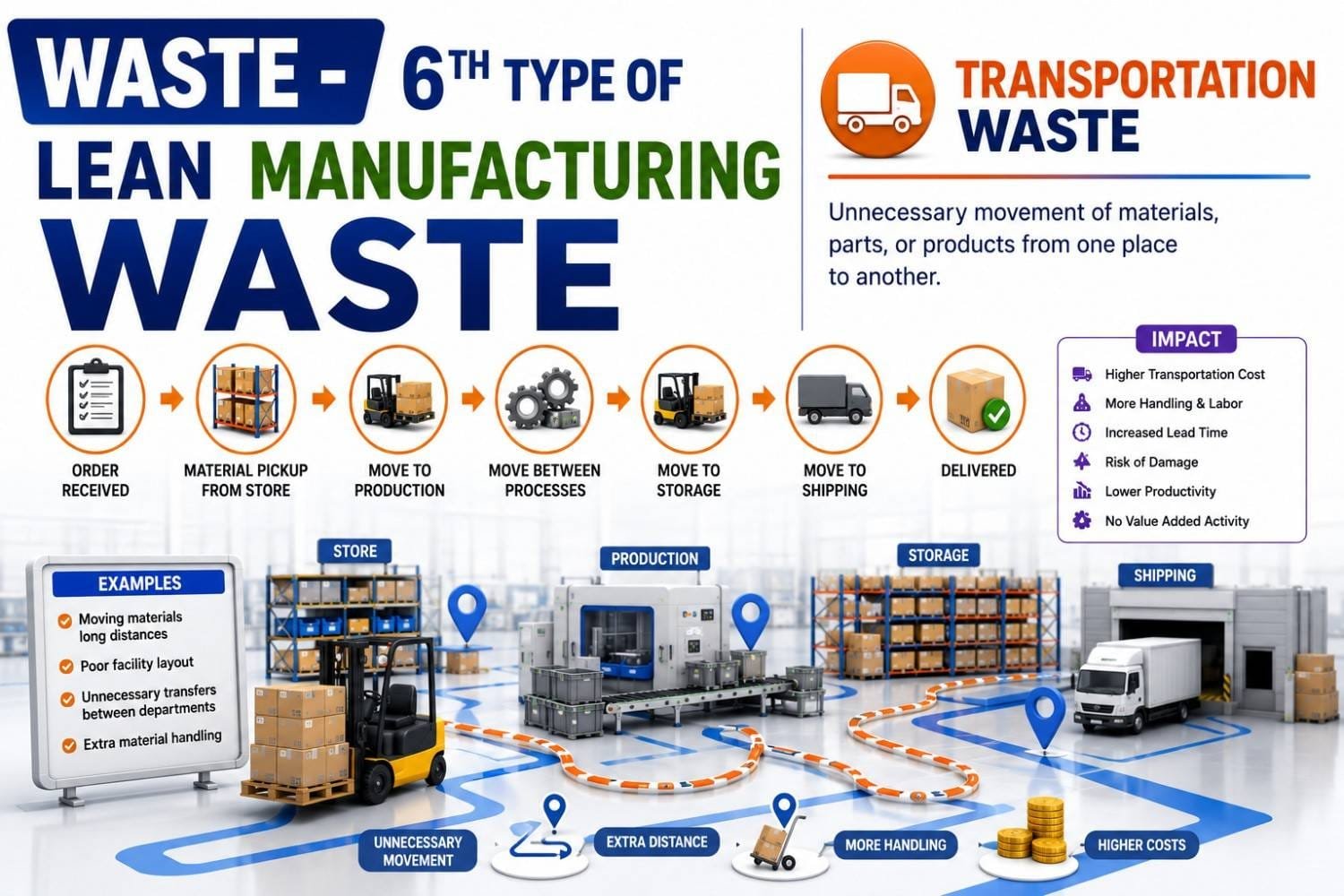
In manufacturing improvement projects, I’ve found that transportation waste is often a sign of poor factory layout or inefficient process design rather than an employee performance issue. I’ve seen materials travel back and forth between departments, operators walk long distances to collect parts, and finished products moved multiple times before shipment. In many cases, the process was working exactly as designed—the layout itself was creating unnecessary waste.
Lean Manufacturing aims to keep materials flowing through the shortest, safest, and most direct path. Optimizing plant layouts, creating cellular workstations, placing materials closer to the point of use, and improving process flow can significantly reduce transportation waste while shortening lead times.
Common Examples of Transportation Waste
- Materials moved multiple times between departments
- Repeated trips between the warehouse and production line
- Long travel distances due to poor factory layout
- Moving work-in-progress between distant workstations
- Excessive handling during storage and shipping
Key Insight: Transportation changes a product’s location—not its value. Every unnecessary movement adds cost, increases handling risk, and extends lead time without benefiting the customer.
🚶Motion Waste
7th type of waste is Motion: Motion Waste refers to the unnecessary movement of people, tools, or equipment while performing a task without adding value to the product or service. Unlike transportation waste, which involves moving materials, motion waste focuses on the extra physical effort required to complete the work. Every unnecessary step, reach, bend, or search increases fatigue, reduces productivity, and extends cycle time.
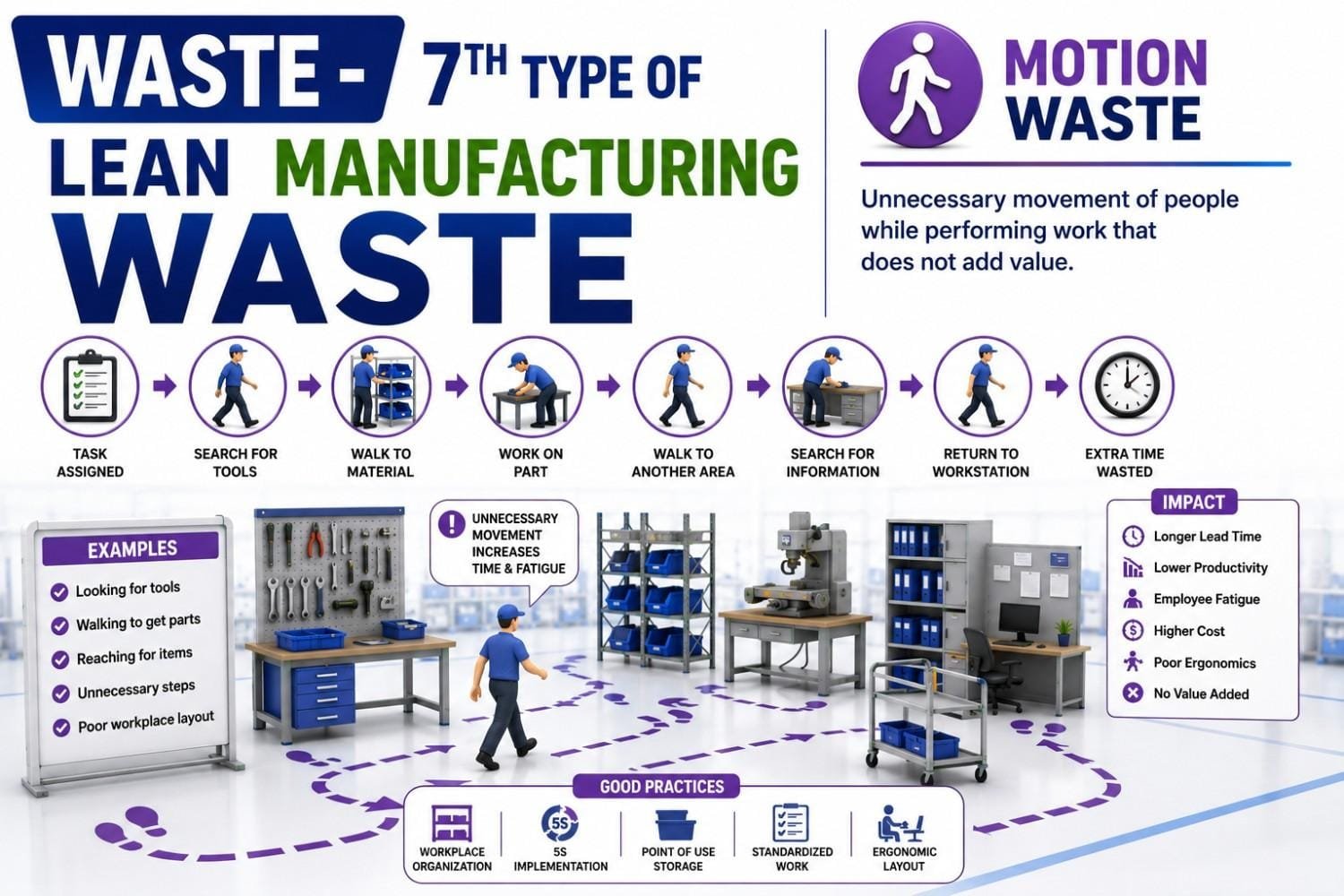
During process observations is that motion waste often goes unnoticed because employees become accustomed to it. Operators repeatedly walking to collect tools, bending to pick up parts, or searching for equipment may seem like small inconveniences, but when these actions are repeated hundreds of times each shift, they consume a surprising amount of time and energy without improving the product.
A simple everyday example is searching for your phone several times a day because it doesn’t have a designated place. The phone hasn’t changed, but you’ve spent extra time and effort finding it. The same principle applies in manufacturing when operators walk 10–15 meters to retrieve tools, frequently reach for components, or work at poorly designed workstations.
Common Examples of Motion Waste
- Operators repeatedly walking long distances to retrieve tools or materials
- Frequent bending, stretching, or reaching for parts
- Searching for misplaced tools or documents
- Poor workstation layout causing unnecessary movement
- Repeated manual adjustments due to inefficient work methods
Key Insight: Motion doesn’t improve the product—it only consumes time and energy. Well-designed workstations reduce unnecessary movement, improve productivity, and make work safer and less physically demanding.
⚙️Over processing Waste
8th type of waste is Over Processing: Overprocessing Waste occurs when more work is performed than is necessary to meet customer requirements. This includes adding unnecessary process steps, excessive inspections, overly tight tolerances, duplicate approvals, or product features that customers neither need nor value. Although the intention is often to improve quality, overprocessing usually increases cost, consumes additional resources, and extends lead time without improving the final product.
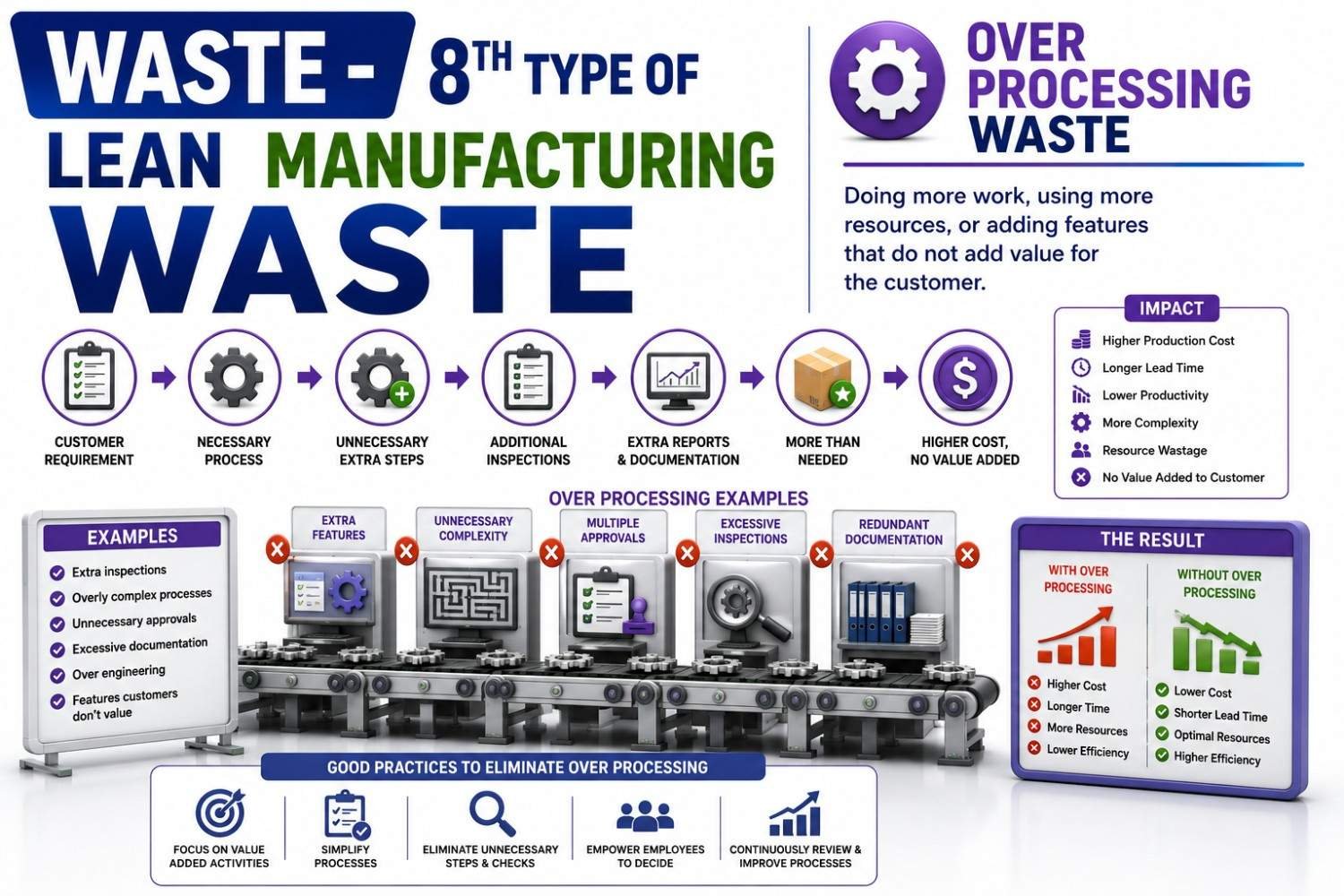
During process improvement initiatives is that overprocessing often develops gradually. Teams add extra checks, additional documentation, or unnecessary processing “just to be safe,” and over time these activities become standard practice. Instead of improving quality, they create longer workflows, increase complexity, and reduce overall efficiency.
Lean Manufacturing encourages organizations to perform only the work that is necessary to meet customer requirements. Techniques such as Value Stream Mapping (VSM), process standardization, design simplification, and regular review of non-value-added activities help eliminate unnecessary steps while maintaining product quality.
Common Examples of Overprocessing Waste
- Performing duplicate inspections or approvals
- Machining parts to tighter tolerances than specified
- Creating reports that no one reviews or uses
- Adding product features that customers do not require
- Re-entering the same information into multiple systems
Key Insight: More work doesn’t always mean more value. In Lean Manufacturing, the goal is to deliver exactly what the customer needs—no less and no more.
📚 Recommended Books for Professionals
Try removing one or more filters.
How to Identify Lean Manufacturing Waste
Identifying waste is often the hardest part of any Lean initiative because inefficient practices gradually become part of everyday work. Throughout my experience in quality and process improvement projects, I've found that many teams don't recognize waste until they step back and observe the process from the customer's perspective. Activities such as waiting for approvals, searching for tools, moving materials multiple times, or building excess inventory often feel "normal," even though they add no value.
The most effective way to identify waste is to go where the work happens (Gemba) and observe the entire process from start to finish. Instead of asking whether people are busy, ask a more meaningful question:
"If I were the customer, would I be willing to pay for this activity?"
If the answer is no, you've likely identified a non-value-added activity that deserves further investigation.
Another lesson I've learned is that reports rarely tell the whole story. Some of the best improvement opportunities become visible only by watching the process, following the flow of materials and information, and talking to the people who perform the work every day. Operators and technicians often know exactly where delays, unnecessary movement, repeated work, or bottlenecks occur because they experience them firsthand.
Finally, support your observations with data. Metrics such as cycle time, lead time, work-in-progress (WIP), inventory levels, defect rates, equipment downtime, and waiting time help confirm where waste exists and which problems should be addressed first.
Practical Checklist for Identifying Lean Waste
- Visit the workplace (Go to Gemba) and observe the process firsthand.
- View every activity from the customer's perspective.
- Follow the flow of materials, information, and people.
- Look for delays, queues, unnecessary movement, excess inventory, and rework.
- Ask frontline employees where they lose the most time or effort.
- Measure key process metrics to validate observations.
Key Insight: Waste isn't difficult to find—it often becomes invisible because people have learned to work around it. Lean begins by questioning activities that no longer deserve to be part of the process.
How to Eliminate Lean Manufacturing Waste
Identifying waste is only the beginning—the real value comes from eliminating it. Throughout my experience in quality engineering and process improvement projects, I've found that the best results rarely come from working harder or investing in expensive equipment. They come from simplifying the process and removing activities that don't create customer value.
The first step is to understand the root cause, not just the symptom. For example, recurring defects may indicate an unstable process, frequent waiting could point to poor production planning, and excess inventory often hides deeper problems such as unbalanced workflows or unreliable suppliers. Solving these underlying issues prevents the same waste from returning.
Another lesson I've learned is that the best improvement ideas usually come from the people closest to the work. Operators and technicians see process inefficiencies every day and often know exactly where time, effort, and resources are being wasted. Encouraging employee involvement and acting on their suggestions creates a culture of continuous improvement rather than one-time fixes.
Finally, remember that Lean is a journey, not a single project. Standardizing successful processes, reviewing performance regularly, and making small improvements every day are far more effective than waiting for major breakthrough initiatives. Over time, these incremental changes lead to lower costs, better quality, shorter lead times, and a more efficient operation.
Best Practices for Eliminating Lean Waste
- Identify and eliminate the root cause, not just the symptom.
- Involve frontline employees in improvement activities.
- Simplify process flow and remove unnecessary steps.
- Standardize successful methods to sustain improvements.
- Continuously measure and improve quality, cost, delivery, and productivity.
Key Insight: Lean Manufacturing is not about making people work harder—it's about making the work smarter. Eliminating waste allows organizations to deliver more value with the same resources, creating lasting benefits for both customers and employees.
Lean Tools Used to Eliminate Waste
Identifying waste is only half of the Lean journey. The next step is selecting the right improvement tool to eliminate its root cause. These tools provide the foundation for eliminating waste, improving flow, increasing quality, and building a culture of continuous improvement.
- 5S – Workplace organization and visual control
- Kaizen – Continuous improvement through small incremental changes
- Value Stream Mapping (VSM) – Visualization of end-to-end process flow
- Kanban – Demand-driven production and inventory control
- Poka-Yoke – Mistake-proofing to prevent defects
- Standard Work – Consistent and repeatable best practices
- Visual Management – Clear communication of process status and performance
- SMED – Reduction of equipment setup and changeover time
Lean Manufacturing Waste Checklist
📥 Download the Lean Manufacturing Waste Identification Checklist and start identifying hidden waste in your processes using a practical, step-by-step Lean assessment format.

Lean Six Sigma • Six Sigma • Statistics • Project Management • Artificial Intelligence (AI) • Operations Management • Quality Management
📊 Simple calculator used to measure Lean Waste
Estimate your Lean Waste Score, monthly waste cost, lost hours, and potential savings by assessing the 8 Wastes of Lean Manufacturing.
Use 0 = Not Present and 5 = Severe Waste.
Enter realistic values from your production area, office process, or improvement project.
Enter your values and click calculate to see your Lean Waste assessment.
Frequently Asked Question (FAQ)
What are the 8 wastes of Lean?
The 8 wastes are Transport, Inventory, Motion, Waiting, Overproduction, Overprocessing, Defects, and Skills.
Why are they called deadly wastes?
Because they reduce efficiency and increase costs.
What does TIMWOODS stand for?
It represents the 8 wastes of Lean.
What is the biggest waste?
Overproduction is often considered the worst.
How can I identify waste?
Observe activities that do not add value.
Can Lean be used outside manufacturing?
Yes, it applies to all industries.
What is value in Lean?
Anything the customer is willing to pay for.
What is motion waste?
Unnecessary movement of people or machines.
What is waiting waste?
Idle time when no work is happening.
What is overprocessing?
Doing more than necessary.
What is skills waste?
Not using people’s full potential.
How does Lean reduce cost?
By eliminating waste.
What is defect waste?
Errors that require correction.
Is Lean easy to implement?
Yes, if done step by step.
What is the goal of Lean?
To maximize value and minimize waste.
Conclusion
The 8 deadly wastes are everywhere, in factories, offices, and even daily life. Once you start seeing them, you cannot ignore them. Lean is not just a method; it is a mindset. It teaches us to focus on value and eliminate everything else. Start small. Improve daily. That is the true power of Lean.
Continue Your Learning Journey
Learning is a continuous process. Explore related topics, practical guides, tools, calculators, templates, and learning resources to expand your knowledge and develop new skills.
Choose a category below to explore practical tutorials, tools, calculators, templates, case studies, and learning resources.
Recommended Learning Resources
Expert-led courses to build practical skills, earn credentials, and advance your career.
Recommended professional books, certification guides, and practical study resources.
Ready-to-use templates, checklists, guides, and workbooks for practical applications.
Interactive calculators for statistics, quality, engineering, analysis, and decision-making.
Interactive Z, t, Chi-Square, and F tables with critical values and distribution curves.
Discover practical tutorials, case studies, and professional resources across Quality, Lean Six Sigma, Project Management, Statistics, AI, and Data Analytics.
Published: October 3, 2021
Last Updated: September 18, 2026