What is 5 Why Root Cause Analysis: The Simple Way to Find the Real Root Cause of a Problem
Problems rarely occur because of a single event. In many cases, what appears to be the root cause is actually just a symptom of a deeper issue. The challenge is knowing how to move beyond the obvious and uncover what is truly driving the problem.
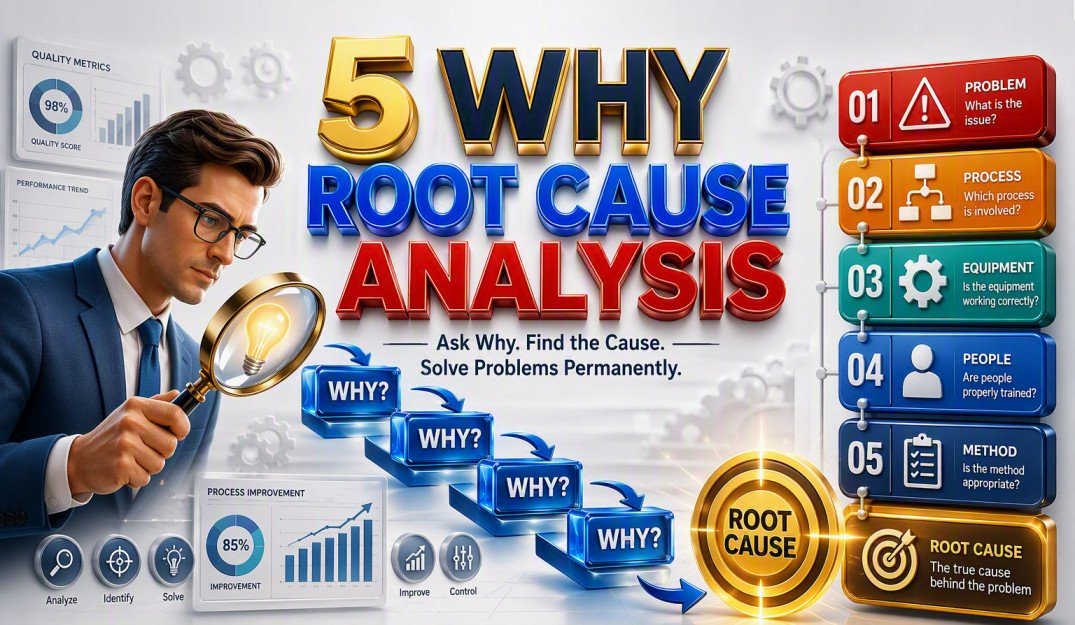
5 Why Root Cause Analysis is a simple yet powerful problem-solving technique that helps teams identify the underlying cause of an issue by repeatedly asking the question “Why?”. Instead of stopping at the first explanation, the method encourages deeper investigation until the true root cause is revealed.
What is 5 Why Root Cause Analysis?
In my experience, one of the biggest reasons problems keep coming back is that teams often fix the symptom instead of understanding the cause. The immediate issue gets resolved, everyone moves on, and then the same problem reappears weeks or months later. That is exactly where 5 Why Root Cause Analysis can make a difference.
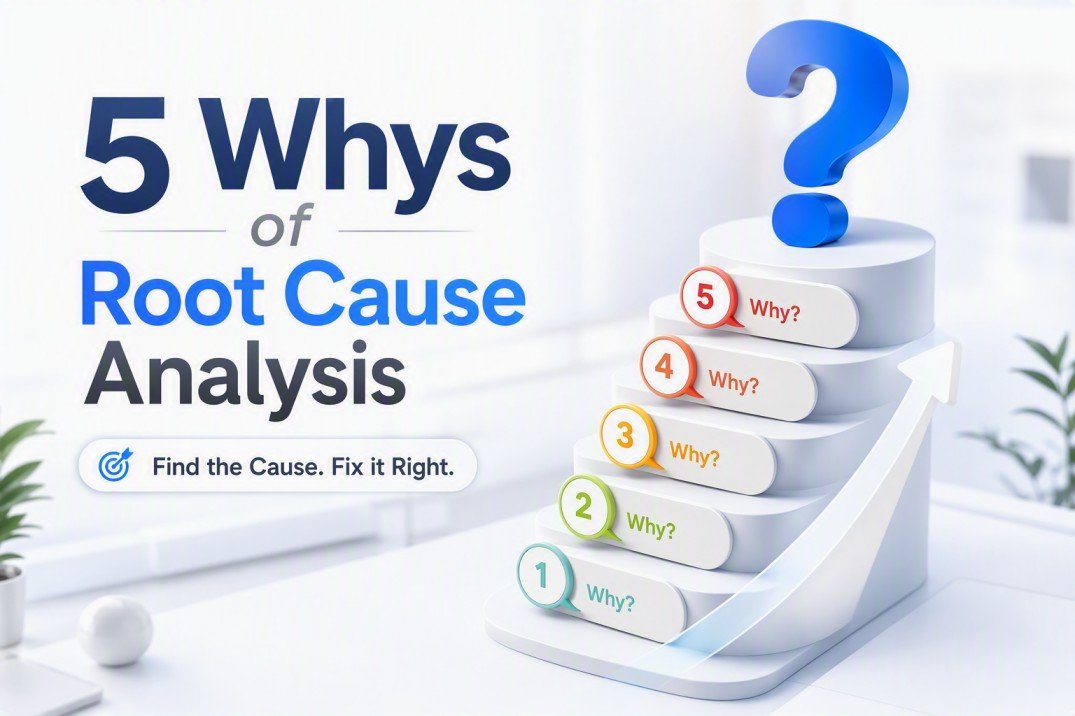
At its core, 5 Why Root Cause Analysis is a simple questioning technique that helps uncover the reason a problem occurred in the first place. Rather than accepting the first explanation, you keep asking “Why?” until you reach a cause that can be meaningfully addressed. Despite its name, there is no requirement to ask exactly five questions. Some problems may require three questions, while others may require more. The objective is not to reach a specific number but to understand what is truly driving the problem.
What I appreciate most about this method is its simplicity. It does not require complex software, advanced statistics, or specialized training. It simply encourages teams to slow down, challenge assumptions, and follow the chain of cause and effect. Over the years, I have found that many issues initially blamed on people eventually trace back to unclear processes, weak controls, missing information, or gaps in the system itself. A good 5 Why analysis helps shift the conversation from “Who made the mistake?” to “Why did the process allow the mistake to happen?” That small change in perspective often leads to stronger corrective actions and more sustainable improvements.
Simply put, 5 Why Root Cause Analysis is a practical problem-solving technique used to identify the underlying cause of a problem by repeatedly asking “Why?” until the real cause is understood and can be addressed effectively.
Key Takeaway: 5 Why Analysis is not about asking “Why?” five times. It is about digging beyond the obvious answer to find a cause that, when addressed, helps prevent the problem from happening again.
History of the 5 Whys Technique
The 5 Whys Technique is most commonly associated with Sakichi Toyoda, whose problem-solving philosophy later influenced the Toyota Production System. What I find most interesting about its history is that it was never intended to be a complex quality tool. The idea was surprisingly simple: when a problem occurs, don’t stop at the first explanation. Keep digging until you understand what really caused it.
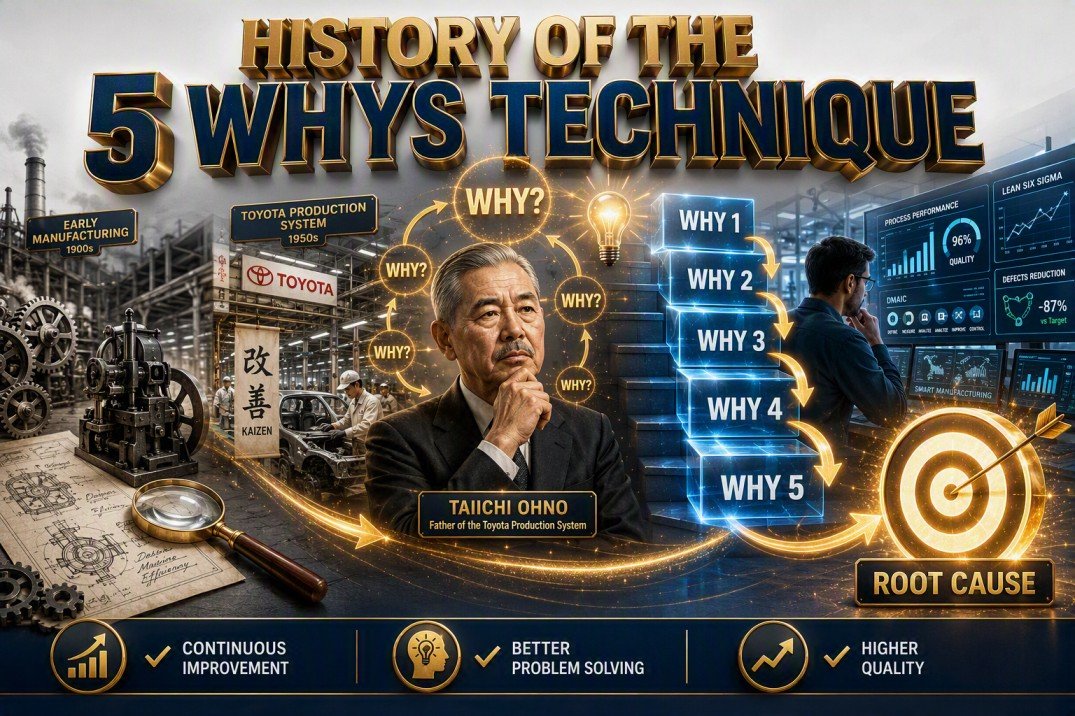
From my experience in quality and engineering, that lesson is still as relevant today as it was decades ago. Teams are often under pressure to restore production, close a complaint, or implement a corrective action quickly. In those situations, it is easy to fix what is visible and move on. The Toyota approach challenged that mindset by encouraging people to understand the underlying reason a problem existed in the first place.
As Toyota’s problem-solving culture gained recognition around the world, the 5 Whys method spread far beyond manufacturing. Today, it is widely used in Lean Six Sigma, quality management, healthcare, engineering, IT, and business process improvement. The industries may be different, but the principle remains the same: effective solutions start with a clear understanding of the cause, not just the symptom.
That is why the 5 Whys has remained relevant for so long. It is not the number of questions that makes the method powerful. It is the habit of looking beyond the obvious answer before deciding how to fix a problem.
Key Takeaway: The 5 Whys Technique originated from Toyota’s problem-solving philosophy and continues to be widely used because it encourages teams to understand the real cause of a problem before implementing a solution.
What Are the 5 Whys of Root Cause Analysis?
The 5 Whys of Root Cause Analysis are a series of questions used to move from a problem that has been observed to the underlying cause that needs to be addressed. The method is simple: start with a clearly defined problem, ask “Why did this happen?”, use the answer to ask the next “Why?”, and continue until the investigation reaches a cause that is supported by evidence and can be effectively addressed.

The important point is that the five questions are connected. Each answer becomes the basis for the next question. You are not asking five unrelated questions, and you are not simply filling five boxes on a form. You are following a cause-and-effect chain.
A useful way to think about it is this: Problem → Why? → Cause → Why? → Deeper Cause → Why? → Underlying Cause → Corrective Action
The purpose is to gradually move away from what you can immediately see and toward what allowed the problem to occur. In practice, each answer becomes the starting point for the next question. For example:
Problem: Customer received the wrong product.
- Why? The wrong item was picked from the warehouse.
- Why? The product labels looked similar.
- Why? The labeling standard was unclear.
- Why? There was no review process for label design.
- Why? Responsibilities for label approval were not defined.
Notice how the investigation moves from the mistake itself to a weakness in the process. That is where the real value of 5 Why Analysis lies.
From my experience, effective problem solving begins when teams stop asking “Who made the mistake?” and start asking “What allowed the mistake to happen?”. Whether the issue is a product defect, missed inspection, delayed shipment, or equipment breakdown, the objective is the same: understand the chain of events well enough to prevent the problem from happening again.
A Simple Way to view the 5 Whys : Problem → Immediate Cause → Deeper Cause → Process Gap → Root Cause → Corrective Action
The First Why: What Happened?
The first “Why” starts with the problem statement. Suppose a manufacturing process produces a product with an incorrect dimension. The first question might be:
Why did the product have an incorrect dimension?
The investigation may reveal that the machining parameter was set incorrectly. That gives us our first answer, but we should not immediately label it the root cause. We have only identified a more specific cause of the problem. This is where a disciplined investigation differs from simply looking for someone or something to blame.
The Second Why: Why Did That Cause Occur?
Now we take the first answer and ask why it happened. Why was the machining parameter set incorrectly? Perhaps the operator used an outdated setup instruction. Again, we have moved one level deeper. But we still have another question to ask.
The Third Why: What Allowed the Condition to Exist?
Now we ask: Why was an outdated setup instruction being used?
Perhaps the old instruction was still available at the workstation and there was no effective control preventing its use. At this point, the investigation is beginning to move away from the immediate human action and toward the process that allowed the condition to exist. That shift is extremely important in root cause analysis.
The Fourth Why: Why Was the Process Not Controlling the Problem?
We can continue: Why was the outdated instruction still available at the workstation?
Perhaps the document-control process required updated documents to be issued, but there was no defined verification step to ensure obsolete copies had actually been removed from the point of use. Now we are looking at a process weakness rather than simply saying that someone “used the wrong document.”
The Fifth Why: What Is the Underlying Cause?
The next question might be: Why was there no verification that obsolete instructions had been removed?
The answer could be that the document-control process did not define ownership and verification responsibilities for removing obsolete documents from production areas. At this stage, we may have reached a much more actionable cause.
🎓 Top-Rated Courses & Certifications
Try changing your filters or searching for another course.
How Does the 5 Why Analysis Method Work?
The 5 Why Analysis method works by following a cause-and-effect chain from a clearly defined problem toward an underlying cause. You start with what actually happened, ask why it happened, use the answer to form the next question, and continue investigating until you reach a cause that is both supported by evidence and practical to address.
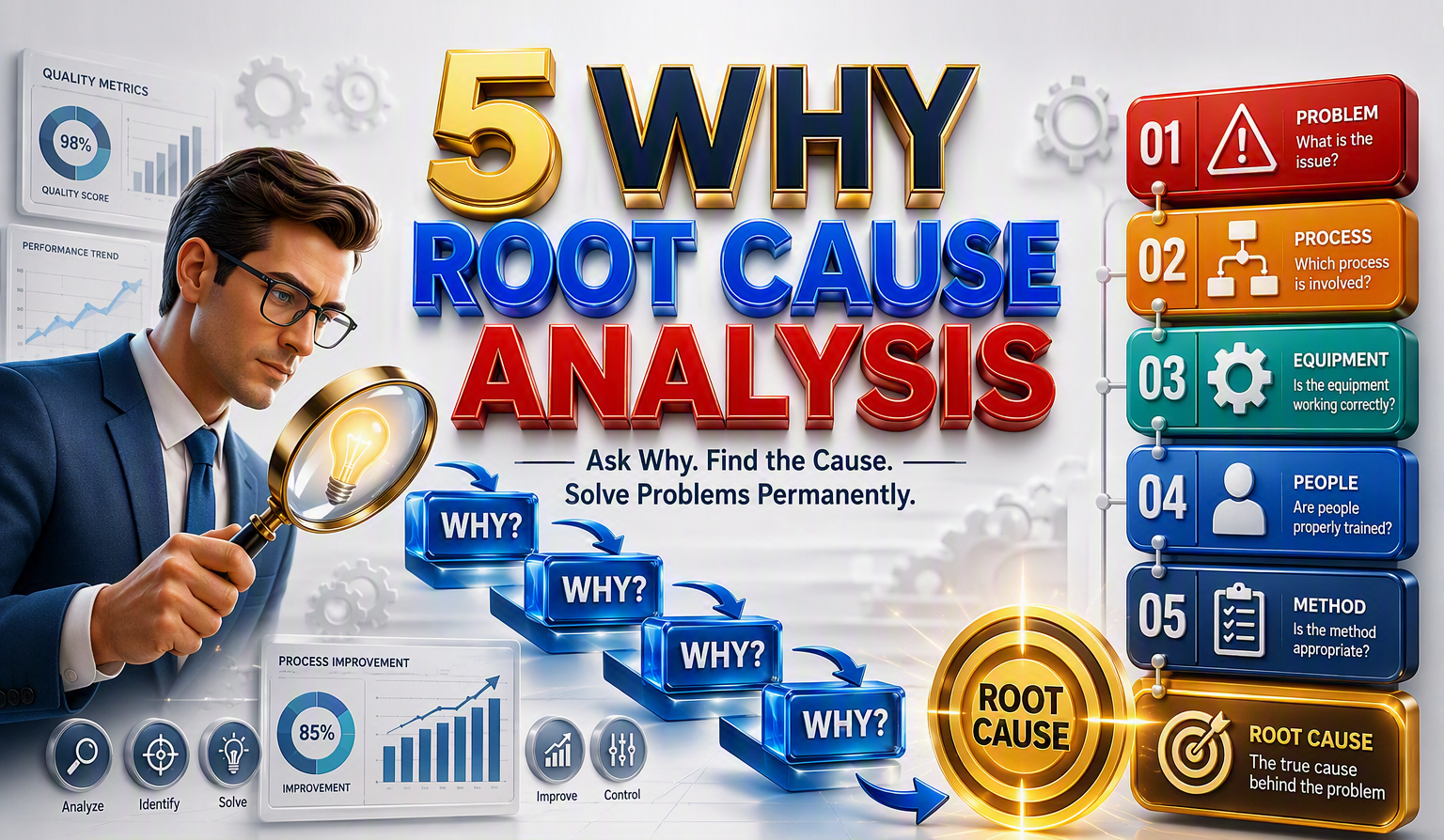
In my experience, the 5 Why Analysis method works best when it is treated as a conversation rather than a form-filling exercise. The process starts with a clearly defined problem. From there, you ask “Why did this happen?”, use the answer to ask the next “Why?”, and continue until you uncover a cause that can be addressed to prevent the problem from recurring. What makes the method effective is that each answer builds on the previous one. Instead of stopping at the first reasonable explanation, you follow the chain of cause and effect until you reach a deeper understanding of what allowed the problem to occur.
The Five Whys Do Not Represent Five Fixed Levels
It is tempting to think of the method as five predetermined steps:
Why 1 → Why 2 → Why 3 → Why 4 → Why 5 → Stop.
That is not how I recommend using it. The number five is a guideline, not a stopping rule. If the third “Why” takes you to a well-supported underlying cause and additional questioning would only produce speculation, you may stop. On the other hand, if you reach the fifth question and the answer is still only another symptom, keep investigating.
The goal is not to complete five questions but to understand the causal chain well enough to determine an effective action.
The 5 Whys Should Be Based on Evidence
This is where many 5 Whys investigations become weak.
It is very easy for a team to create a logical-sounding chain of answers in a meeting:
Why did the problem occur?
“Because the operator made a mistake.”
Why did the operator make a mistake?
“Because they were not careful enough.”
Why were they not careful enough?
“Because they were under pressure.”
That may sound like an explanation, but it is not necessarily a verified root cause. A stronger investigation would ask what actually happened and look for evidence. Was the instruction clear? Was the operator trained? Was the required control available? Was the process designed to detect the error? Was the equipment functioning correctly? Do records or observations support the proposed cause?
From my perspective, this is one of the biggest differences between a 5 Whys worksheet and a good root cause investigation. The worksheet can organize your thinking, but it cannot replace investigation and evidence.
How to Conduct a 5 Whys Analysis: Step-by-Step
A good 5 Whys analysis does not start with five questions. It starts with a well-defined problem. From my experience with quality and problem-solving, most weak 5 Whys investigations go off track because the team starts asking “Why?” before agreeing on what actually happened.
Here is the practical approach I use.
1. Define the Problem Clearly
Start with a specific, factual problem statement. Instead of:
“There was a quality issue.”
Write:
“Three units failed final inspection because a critical dimension exceeded the specification limit.”
A good problem statement gives the team a clear starting point and prevents the discussion from becoming too broad.
2. Collect the Facts
Before forming conclusions, look at the available evidence — inspection results, process records, equipment history, work instructions, maintenance records, interviews, or direct observations. You do not need to investigate everything. You simply need enough information to separate what you know from what you assume.
This is one of the habits I find most important in root cause analysis: never build the Why chain around an assumption just because it sounds logical.
3. Ask the First “Why?”
Now ask: Why did the problem occur?
For example:
Problem: Three units failed final inspection.
Why? → The machining parameter was set incorrectly.
That is a useful answer, but it is not necessarily the root cause. Continue from there.
4. Follow the Cause With Another “Why?”
Take the previous answer and question it. Why was the machining parameter set incorrectly?
Suppose the answer is: An outdated setup instruction was used.
Then ask: Why was an outdated instruction being used?
Perhaps the obsolete document was still available at the workstation. Continue until the cause becomes clear and actionable. The chain might look like:
❌ Product failed inspection
⚙️ Parameter was incorrect
📄 Outdated instruction was used
📌 Obsolete instruction remained at the workstation
🔍 Removal of obsolete documents was not verified
🎯 The document-control process lacked effective point-of-use verification
Now the investigation is looking beyond the immediate mistake and into the process that allowed it to happen.
5. Validate the Root Cause
This is where I would slow down.
Ask: “How do we know this answer is true?”
If the team says, “The operator was not careful,” that may be an assumption rather than a root cause. Look for evidence. Was the instruction unclear? Was the correct document available? Was the process difficult to follow? Was a required control missing?
A strong 5 Whys analysis should be based on evidence, not a convenient explanation.
6. Correct the Cause — Not Just the Symptom
Once the cause is understood, determine what needs to change. For example, simply retraining the operator may not be enough if the real issue is that the process allows obsolete instructions to remain at the point of use. Depending on the situation, the better action might involve document control, process controls, mistake-proofing, automation, inspection, or another system-level improvement. The question I always come back to is:
“What can we change so this problem is less likely to happen again?”
7. Verify That the Problem Stayed Solved
Finally, check whether the corrective action actually worked. Look at subsequent production, inspection results, process data, audits, or other appropriate evidence.
A corrective action being implemented does not automatically mean it is effective.
My Practical Rule for 5 Whys : Do not stop because you have reached the fifth “Why.” Stop when you have reached a well-supported cause that explains the problem and can be meaningfully addressed. Sometimes that takes three questions. Sometimes it takes six.
The number five is only the name of the method. Finding and addressing the real cause is the objective.
📚 Recommended Books for Professionals
Try removing one or more filters.
When Should You Use 5 Why Analysis?
One question I often get is: Should 5 Why Analysis be used for every problem? My answer is no.
In my experience, 5 Whys works best when you have a specific problem, a reasonably clear cause-and-effect relationship, and a need to understand why it happened rather than simply fix the immediate issue.
I commonly use it for situations such as:
- Recurring quality problems — the same defect keeps coming back despite previous corrective actions.
- Customer complaints — you need to understand what went wrong and prevent a repeat.
- Equipment failures — instead of simply replacing a failed component, you investigate what caused the failure.
- Process deviations — a process did not produce the expected result and the underlying reason needs to be understood.
- Nonconformances and CAPA investigations — the team needs to identify a cause that can be effectively addressed.
- Production or delivery problems — a delay, missed step, or process breakdown needs to be traced back to its cause.
What I particularly like about 5 Whys is its simplicity. You can bring together the people who know the process, put the problem on the table, and work through the cause-and-effect chain without needing sophisticated software or statistical analysis.
When 5 Whys May Not Be Enough
Not every problem has one straightforward chain of causes. For example, a product defect might involve material variation, machine settings, operator practices, environmental conditions, and inspection controls at the same time. Trying to force all of those factors into one 5 Why chain can oversimplify the investigation.
In those situations, I would usually start with a Fishbone Diagram or another RCA method to explore the possible causes, and then use 5 Whys to investigate specific causal paths in greater depth.
The Simple Rule I Use I ask myself:
“Can I reasonably follow the cause-and-effect chain from this problem to an actionable cause?”
If yes, 5 Whys is usually a good place to start. If there are multiple competing causes or the problem requires significant data analysis, I would use 5 Whys alongside other tools rather than force everything into one chain.
The objective is not to use 5 Whys. The objective is to understand the cause well enough to prevent the problem from coming back.

Lean Six Sigma • Six Sigma • Statistics • Project Management • Artificial Intelligence (AI) • Operations Management • Quality Management
5 Whys Analysis vs. Root Cause Analysis
One question I frequently hear is: “Is 5 Whys Analysis the same as Root Cause Analysis (RCA)?”
No. They are closely related, but they are not the same thing. From my experience in quality and problem-solving, I think of Root Cause Analysis as the overall investigation, while 5 Whys is one of the tools you can use during that investigation. A simple way to remember it is:
RCA is the overall approach. 5 Whys is one method used to find the cause.
For a straightforward problem, such as a recurring defect, missed inspection, equipment failure, or process deviation, 5 Whys may be all you need. You follow the cause-and-effect chain by asking “Why?” until you reach a well-supported and actionable cause.

But not every problem is that simple.
If a product defect could be influenced by machine settings, material variation, operator practices, measurement systems, and process controls, following one chain of “Why?” questions may not give you the complete picture. In that situation, I would use a broader RCA approach and consider tools such as a Fishbone Diagram, Pareto Analysis, Fault Tree Analysis, Process Mapping, or data analysis.
The Difference in Practice
5 Whys Analysis is:
- Focused on following a cause-and-effect chain
- Simple and quick to apply
- Particularly useful for relatively straightforward problems
- One specific RCA technique
Root Cause Analysis is:
- Broader in scope
- Used to understand why a problem occurred and how to prevent recurrence
- Flexible enough to use different investigation methods
- Applicable to simple as well as complex problems
In practice, I often start with 5 Whys and see where the investigation takes me. If the answers form a clear chain, I can usually work through the problem efficiently. If I start seeing several independent or interacting causes, that is my signal to step back and use a broader RCA approach.
So, if someone asks me: “Should I use 5 Whys or Root Cause Analysis?”
My answer is: “Use Root Cause Analysis as your overall approach, and use 5 Whys when it is the right tool for the problem.”
The goal is not to complete a 5 Whys worksheet. The goal is to understand the cause well enough to take effective action and prevent the problem from coming back.
5 Why Analysis Examples: Real-World Applications
Understanding the concept is important, but in my experience, 5 Why Analysis becomes much easier once you see it applied to real problems. Whether you work in manufacturing, quality, engineering, healthcare, or service industries, the goal remains the same: move beyond the symptom and uncover the reason the issue occurred in the first place.
The examples below show how a simple chain of questions can reveal causes that are often overlooked when teams rush toward corrective action.
🏭 Example 1: Manufacturing Defect
Applying the 5 Why Root Cause Analysis Method
❌ A product failed final inspection because a critical dimension was out of specification.
⚙️ The machining parameter was incorrect.
📄 The operator used an outdated setup instruction.
📌 An obsolete version was still available at the workstation.
🔍 Obsolete documents were not routinely removed.
📋 The document control process lacked a verification step.
🎯 Weak document control and inadequate verification of obsolete documentation.
✅ Improve document control processes and establish verification checks for obsolete documents.
5 Whys Analysis Template (Free Download)
📥 Download the FREE 5 Why Analysis Excel Template to document problems, identify root causes, track each "Why" step, and develop effective corrective actions that help prevent recurrence.
⬇️ Download Template
Conclusion
After working through the method, examples, and practical applications, the biggest lesson I would leave you with is this: 5 Whys is simple, but good 5 Whys analysis requires disciplined thinking. The objective is not to ask “Why?” exactly five times or to fill out a worksheet. It is to move beyond the obvious symptom, validate what actually caused the problem, and take action that reduces the chance of recurrence.
From my experience in quality and problem-solving, the strongest investigations avoid jumping to conclusions such as “operator error” or “the process was not followed.” Instead, they ask a more useful question:
“What allowed this problem to happen in the first place?”
Remember, the goal is not to ask "Why?" exactly five times. The goal is to uncover a cause that can be meaningfully addressed and prevent the problem from recurring. Whether you are investigating a quality issue, customer complaint, equipment failure, or process deviation, the 5 Whys provides a practical framework for finding lasting solutions.
Ultimately, 5 Why Analysis is more than a root cause analysis tool. It is a mindset that helps teams move from quick fixes to continuous improvement, one question at a time.
If you're building a complete Problem Solving Tools toolkit, 5W1H works exceptionally well alongside other proven methodologies. Techniques such as 5 Whys Root Cause Analysis, Fishbone (Ishikawa), 8D Problem Solving, and the PDCA Cycle can help teams dig deeper into causes, implement effective corrective actions, and sustain long-term improvements. I've covered each of these tools in detail in separate articles on my blog.
Frequently Asked Questions (FAQs)
Q) What is 5 Why Analysis?
5 Why Analysis is a simple root cause analysis technique that helps identify why a problem occurred by repeatedly asking “Why?” until the underlying cause is found.
Q) Why is it called the 5 Whys?
The number five is a guideline, not a rule. Some problems require fewer questions, while others may require more.
Q) What is the main purpose of 5 Why Analysis?
Its purpose is to identify the root cause of a problem so that effective corrective actions can be implemented.
Q) Is 5 Why Analysis the same as Root Cause Analysis?
No. Root Cause Analysis (RCA) is the overall investigation process, while 5 Why Analysis is one tool used within RCA.
Q) When should you use 5 Why Analysis?
It is commonly used for quality issues, customer complaints, equipment failures, process deviations, and recurring problems.
Q) What is the biggest mistake in 5 Why Analysis?
Stopping at the first reasonable answer instead of continuing to investigate and verify the actual cause.
Q) Do you always need to ask five questions?
No. The goal is to find the root cause, not to reach a specific number of questions.
Q) Can 5 Why Analysis be used outside manufacturing?
Yes. It is widely used in healthcare, engineering, IT, project management, customer service, and many other industries.
Q) What makes a good 5 Why Analysis?
A clear problem statement, fact-based questioning, evidence-backed answers, and corrective actions that address the root cause.
Q) What are the limitations of 5 Why Analysis?
It may oversimplify complex problems with multiple causes. In such cases, tools like a Fishbone Diagram can be used alongside it
Continue Your Learning Journey
Learning is a continuous process. Explore related topics, practical guides, tools, calculators, templates, and learning resources to expand your knowledge and develop new skills.
Choose a category below to explore practical tutorials, tools, calculators, templates, case studies, and learning resources.
Recommended Learning Resources
Expert-led courses to build practical skills, earn credentials, and advance your career.
Recommended professional books, certification guides, and practical study resources.
Ready-to-use templates, checklists, guides, and workbooks for practical applications.
Interactive calculators for statistics, quality, engineering, analysis, and decision-making.
Interactive Z, t, Chi-Square, and F tables with critical values and distribution curves.
Discover practical tutorials, case studies, and professional resources across Quality, Lean Six Sigma, Project Management, Statistics, AI, and Data Analytics.
Published: August 12, 2026
Last Updated: September 18, 2026