ISO 9001:2026 Quality Management Systems (QMS): Key Changes, Requirements, and Transition Guide
ISO 9001:2026 is the upcoming revision of the internationally recognized Quality Management System (QMS) standard used by more than one million organizations worldwide. Expected to replace ISO 9001:2015, the new edition aims to strengthen quality management practices by addressing modern business challenges such as risk management, organizational resilience, quality culture, digital transformation, and sustainability considerations. ISO currently lists the standard as under publication, with release scheduled for September 2026.
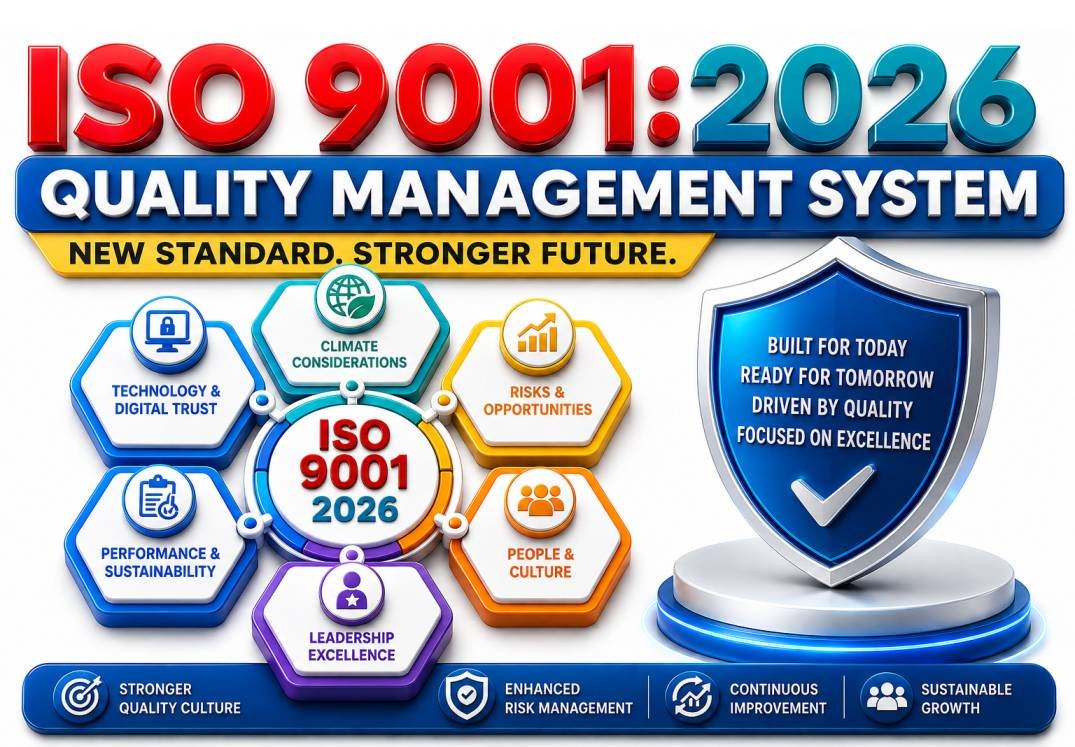
In this guide, you’ll learn the anticipated requirements, major changes from ISO 9001:2015, transition planning strategies, and how organizations can prepare for successful implementation
Introduction to ISO 9001:2026
In my experience with quality management systems, the strongest QMS is not the one with the most procedures—it is the one that actually helps people make better decisions and deliver consistent results.
The revision keeps the familiar foundation of ISO 9001 while responding to how organizations operate today. It provides a framework for establishing, maintaining, and continually improving a QMS, with greater attention to the realities that influence quality and business performance. For organizations already using ISO 9001:2015, I see this revision less as a complete rebuild and more as an opportunity to challenge the effectiveness of the existing QMS—what works, what has become outdated, and where quality can be better connected to everyday business decisions.
What is a Quality Management System (QMS)?
From my experience, a Quality Management System (QMS) works best when it is part of how the business operates—not a collection of documents maintained for an audit. At its core, a QMS connects people, processes, controls, and performance so an organization can consistently meet customer requirements and improve how work is done. Rather than focusing solely on product inspection, a QMS takes a process-based approach to managing quality across the entire organization.
It helps organizations identify customer needs, standardize operations, manage risks, monitor performance, address nonconformities, and drive continual improvement. The ultimate objective is to enhance customer satisfaction while improving operational efficiency and business performance.
Customer Needs → Process → Control → Measure → Improve
ISO 9001 provides the framework, but the system should be tailored to the organization’s products, services, risks, and processes. The real test of a QMS is simple: Does it help the organization prevent problems, solve them effectively, and deliver better results?
A strong QMS is not built around passing audits; it is built around producing consistent quality.
Why ISO 9001 revision history
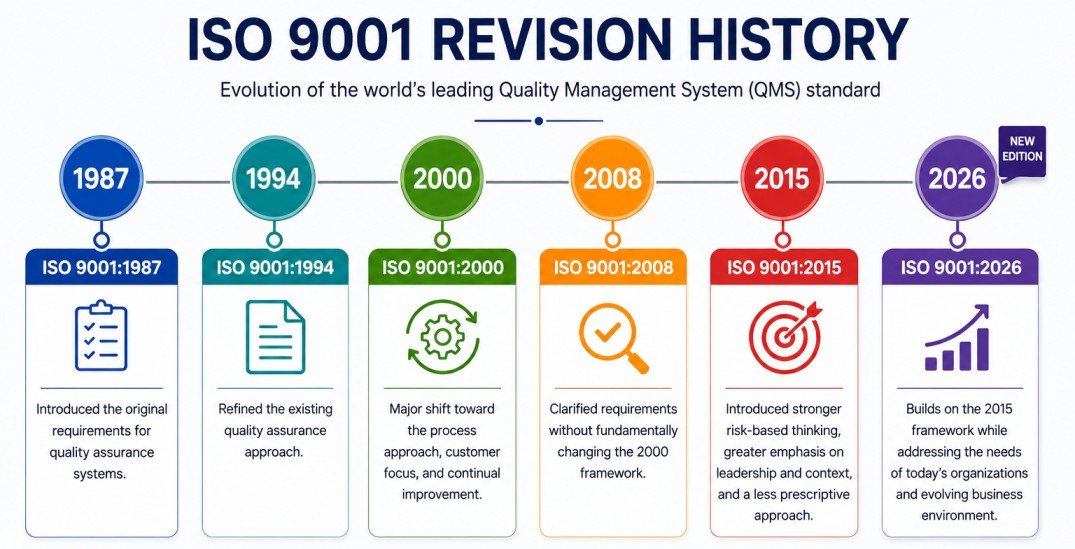
ISO 9001 has evolved significantly since its first edition in 1987. In my experience, looking at this history is useful because each revision reflects how organizations were managing quality at the time—not simply changes to wording or documentation. ISO confirms that ISO 9001 was first published in 1987, followed by revisions in 1994, 2000, 2008, and 2015. The 2026 edition represents the next major step in that evolution.
Overview of ISO 9001:2026
Having worked with quality systems for years, I’ve seen ISO 9001 evolve from a compliance-focused standard into a practical business framework. ISO 9001:2026 continues that journey. Rather than introducing a completely new quality system, it modernizes ISO 9001:2015 to better reflect how organizations operate today, with greater emphasis on quality culture, resilience, leadership, digital technologies, knowledge management, and stakeholder expectations.
What stands out to me is that the 2026 revision is not about creating more paperwork. Instead, it focuses on helping organizations build quality into everyday decisions, adapt to change more effectively, and create lasting value for customers. The familiar process approach and continual improvement mindset remain at the core, making the transition easier for organizations already certified to ISO 9001:2015.
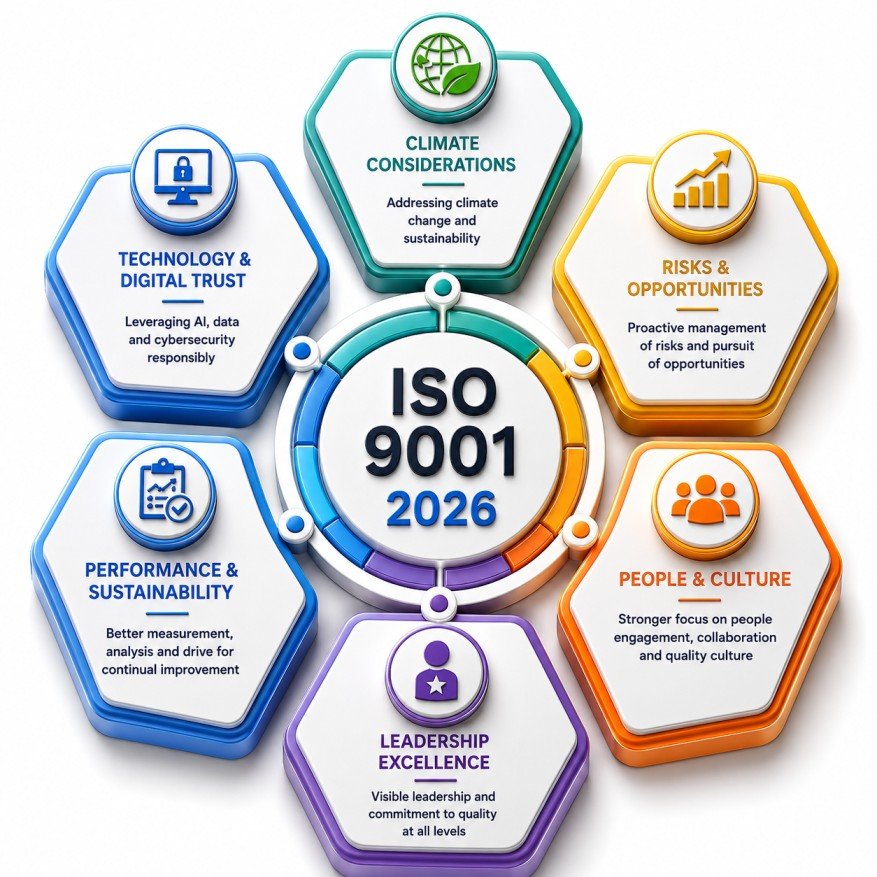
Whether you’re in manufacturing, healthcare, software, logistics, or professional services, ISO 9001:2026 provides a structured way to improve consistency, strengthen customer confidence, and drive business performance. From my perspective, the biggest shift is the recognition that quality is no longer just the responsibility of the quality department. It is increasingly shaped by leadership, culture, data, and the ability of an organization to respond to a fast-changing environment.
In short: ISO 9001:2026 keeps the foundation of quality management while pushing organizations toward stronger leadership, better decision-making, proactive improvement, and a more integrated quality culture.
🎓 Top-Rated Courses & Certifications
Try changing your filters or searching for another course.
ISO 9001:2026 Structure and Requirements
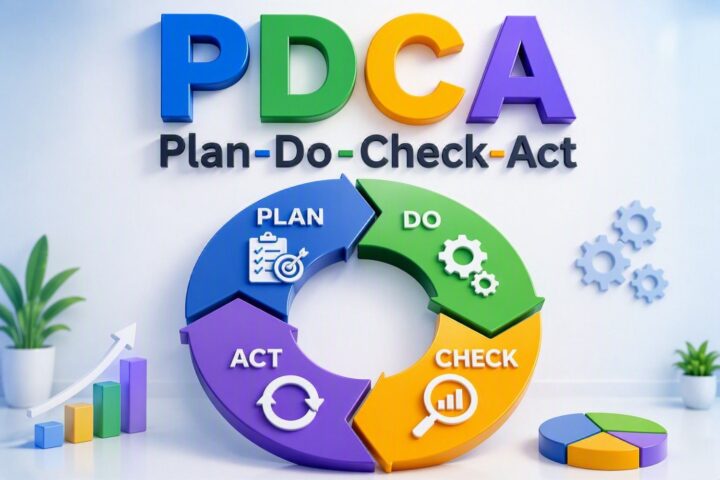
ISO 9001:2026 retains the 10-clause High-Level Structure used by ISO 9001:2015. The core requirements for establishing and operating the QMS are contained primarily in Clauses 4–10, supported by the Plan–Do–Check–Act (PDCA) approach.
| Clause | Focus | Practical Purpose |
|---|---|---|
| 1 | Scope | Defines where the standard applies |
| 2 | Normative References | Identifies referenced standards |
| 3 | Terms & Definitions | Establishes common terminology |
| 4 | Context of the Organization | Understand business context, interested parties, and QMS scope |
| 5 | Leadership | Establish leadership commitment, policy, and responsibilities |
| 6 | Planning | Address risks, opportunities, objectives, and changes |
| 7 | Support | Provide resources, competence, awareness, communication, and documented information |
| 8 | Operation | Plan and control processes for delivering products and services |
| 9 | Performance Evaluation | Monitor, measure, analyze, and evaluate QMS performance |
| 10 | Improvement | Address problems and continually improve the QMS |
Key Changes in ISO 9001:2026
From my perspective, ISO 9001:2026 is an evolution rather than a complete redesign. The core QMS structure remains familiar, but several requirements have been clarified or strengthened to better reflect how organizations operate today. These changes are generally considered moderate rather than disruptive. Organizations with a mature ISO 9001:2015 system should not need to rebuild their QMS from scratch.
ISO 9001:2026 vs. ISO 9001:2015
For organizations already certified to ISO 9001:2015, the move to ISO 9001:2026 should be viewed as a refinement rather than a complete rebuild. ISO describes the 2026 edition as the next evolution of the existing framework, while industry transition guidance characterizes the overall changes as moderate. These differences are based on the current ISO 9001:2026 revision status and published transition guidance; the 2026 edition is currently listed by ISO as under publication for September 2026.
| Area | ISO 9001:2015 | ISO 9001:2026 |
|---|---|---|
| Quality Culture | Leadership commitment emphasized primarily through the QMS and quality policy. | Greater focus on building and sustaining a quality-driven organizational culture. |
| Ethical Behaviour | Not explicitly emphasized. | Higher visibility of ethics, integrity, and responsible decision-making. |
| Risk & Opportunity | Introduced risk-based thinking. | Provides clearer distinction between risks and opportunities. |
| Climate Change | Not originally addressed. | Climate-related issues integrated into organizational context considerations. |
| Management of Change | Addressed within planning activities. | Stronger focus on planning, implementing, and controlling change. |
| Leadership Accountability | Leadership involvement required. | More explicit expectations around quality culture and continual improvement. |
| Digital Information | Generic documented information requirements. | Better alignment with digital systems, records, and electronic evidence. |
| Knowledge Management | Organizational knowledge introduced. | Expanded emphasis on preserving and sharing knowledge. |
| Guidance | Limited supporting guidance. | Enhanced Annex A guidance to support interpretation and implementation. |
📚 Recommended Books for Professionals
Try removing one or more filters.
ISO 9001:2026 Transition Roadmap
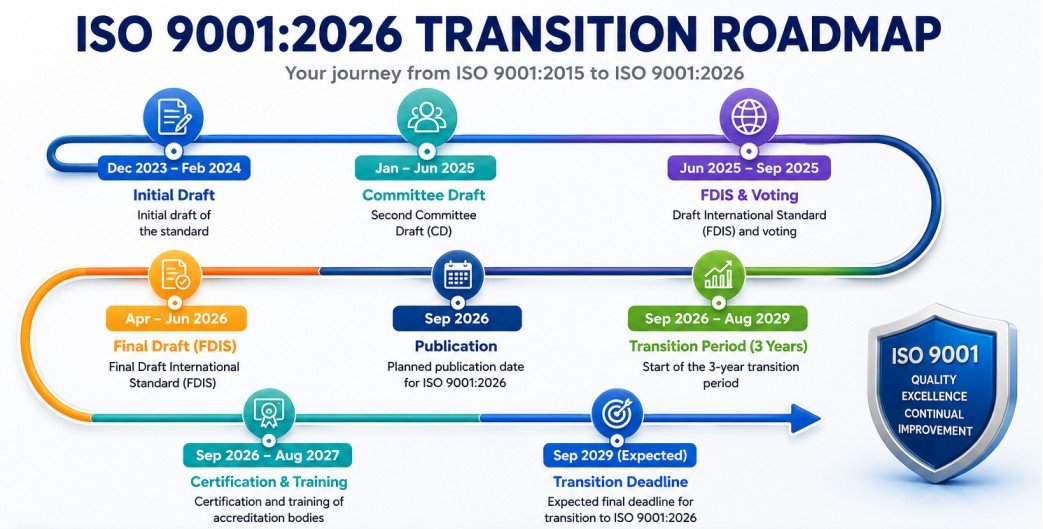
If your organization is certified to ISO 9001:2015, I would treat the transition as a controlled improvement project—not a documentation rewrite. ISO expects the revised edition in September 2026, and certified organizations will have a transition period to migrate to the new requirements. From my experience, organizations that start preparing early usually have a much smoother transition than those that wait until the last year. The good news is that ISO 9001:2026 is expected to be an evolution of ISO 9001:2015 rather than a complete redesign. Most organizations can transition successfully by following a structured roadmap. Draft information indicates publication in September 2026, with a likely transition period extending to 2029.
ISO 9001:2026 Gap Assessment: 10 Key Areas to Review
Before transitioning to ISO 9001:2026, organizations should perform a structured gap assessment to determine how well their current Quality Management System aligns with the revised expectations. Based on currently available draft information, the following ten areas deserve particular attention. A good gap assessment should not become a clause-by-clause paperwork exercise. I would use it to determine where the existing QMS may need to change, strengthen, or provide better evidence before the transition audit.
For ISO 9001:2026 readiness, I would concentrate on these ten areas:
- Quality culture: Is quality visible in everyday decisions, or only during audits?
- Ethical behaviour: Are integrity and accountability reflected in leadership and operational practices?
- Risks and opportunities: Are threats and beneficial opportunities assessed separately and acted upon?
- Climate considerations: Has the organization evaluated whether climate-related issues affect its context or interested parties?
- Management of change: Are changes planned, communicated, monitored, and reviewed systematically?
- Leadership involvement: Do leaders actively connect quality objectives with business priorities?
- Digital information: Are electronic records, automated workflows, and digital evidence properly controlled?
- Organizational knowledge: Is critical knowledge captured, shared, maintained, and protected from loss?
- Competence and awareness: Do employees understand both their responsibilities and their impact on quality outcomes?
- Audit and management review: Have internal audits and management reviews been updated to examine the revised expectations?
In practice, most organizations will not need to rebuild their QMS. The real value of the assessment is identifying a small number of meaningful gaps, assigning ownership, and closing them before the transition audit.
Accuracy Note: As of September 4, 2026, ISO 9001:2026 remains under publication, with publication scheduled for September 16, 2026. Final transition requirements and certification arrangements should be confirmed against the published standard and guidance from your certification body.
ISO 9001:2026 Readiness Checklist
In my experience, organizations rarely struggle because of new requirements. They struggle because they discover gaps too late. A simple readiness checklist can quickly reveal whether your Quality Management System is genuinely prepared for ISO 9001:2026 or if important areas still need attention. Based on the themes emerging from the 2026 revision, these are the questions I would ask first
Lean Six Sigma • Six Sigma • Statistics • Project Management • Artificial Intelligence (AI) • Operations Management • Quality Management
ISO 9001:2026 emphasizes a risk-based approach, process effectiveness, customer focus, and continual improvement. Organizations implementing a Quality Management System (QMS) often use tools such as FMEA (Failure Mode and Effects Analysis) to proactively identify risks, Control Plans to maintain process consistency, and Poka-Yoke techniques to prevent human errors. Continuous improvement requirements within ISO 9001 align closely with methodologies such as Kaizen, PDCA (Plan–Do–Check–Act), and DMAIC, which help organizations systematically improve performance and reduce variation. When quality issues occur, structured problem-solving approaches such as 5 Why Analysis, Fishbone Diagram, and 8D Problem Solving help identify root causes and implement effective corrective actions. Organizations can further monitor process performance through Process Capability (Cp & Cpk), while broader quality improvement initiatives are often supported by Six Sigma principles and data-driven decision-making practices.
Conclusion: The Future of Quality Management
In my experience, the future of quality management is not about creating more procedures or preparing for tougher audits. It is about building a QMS that helps people make better decisions, manage change, prevent problems and improve performance.
ISO 9001:2026 moves in that direction. Its emphasis on quality culture, ethical behaviour, risks and opportunities, change management and organizational context reflects how modern businesses actually operate. ISO describes the revision as an update intended to keep the standard relevant to current business needs and stakeholder expectations.
For organizations moving from ISO 9001:2015, I would not treat the transition as a compliance exercise. Use it to challenge the way your QMS works. Remove outdated practices, strengthen weak processes, improve evidence and connect quality more closely with business performance.
The future of quality is not more compliance—it is smarter, more resilient and more effective organizations.
My advice is simple: treat ISO 9001:2026 as a business improvement initiative, not a certification project. The organizations that embrace this mindset will be better positioned to respond to change, exceed customer expectations, and create sustainable long-term success. That is where I believe ISO 9001:2026 can deliver its greatest value.
Continue Your Learning Journey
Learning is a continuous process. Explore related topics, practical guides, tools, calculators, templates, and learning resources to expand your knowledge and develop new skills.
Choose a category below to explore practical tutorials, tools, calculators, templates, case studies, and learning resources.
Recommended Learning Resources
Expert-led courses to build practical skills, earn credentials, and advance your career.
Recommended professional books, certification guides, and practical study resources.
Ready-to-use templates, checklists, guides, and workbooks for practical applications.
Interactive calculators for statistics, quality, engineering, analysis, and decision-making.
Interactive Z, t, Chi-Square, and F tables with critical values and distribution curves.
Discover practical tutorials, case studies, and professional resources across Quality, Lean Six Sigma, Project Management, Statistics, AI, and Data Analytics.
Published: September 9, 2026
Last Updated: September 18, 2026