What is 5S Lean Manufacturing? Real Examples, Benefits and Implementation Guide
Many organizations focus on improving productivity, quality, and efficiency, yet often overlook the impact that workplace organization has on daily performance. Small inefficiencies, distractions, and unnecessary activities can accumulate over time, making work more difficult than it needs to be.
Organizations that successfully implement 5S often discover that the benefits extend far beyond cleanliness and organization, influencing safety, productivity, quality, employee engagement, and overall business performance.
5s Lean manufacturing
Have you ever been in a rush to leave for work. You cannot find your car keys? You know they are somewhere in the house. You spend several minutes looking through drawers, tables or bags before you finally find them. Those few minutes may not seem like a lot. They make you frustrated waste your time and make you late for work.
The same thing happens every day in a factory, warehouse, office or hospital. Employees spend time looking for tools, equipment, documents or materials instead of doing their actual work. Over time these small delays add up reduce productivity increase costs and sometimes even create safety risks for the employees.
I remember one time when I was doing an audit at a medical device factory. One of the employees joked that finding the right tool sometimes took longer than doing the job. Everyone laughed. The comment highlighted a real problem. Tools and gauges were not always kept in designated locations so people spent a lot of time looking for them of doing their work. After we implemented solutions like boards and fixed storage locations the time spent looking for things was significantly reduced and the work process became much smoother.
As a Quality Engineer, I have realized that one of the sources of wasted time is not always because of machine problems. It is because employees are looking for tools, documents, gauges or materials. These small delays often go unnoticed. When they happen many times throughout the day they can significantly impact productivity, quality and employee morale at the workplace
This is one of the reasons why I think 5S is the foundation of Lean Manufacturing. A organized workplace makes it easier to implement and maintain other improvement initiatives. This is the kind of problem that the 5S Methodology is designed to solve.
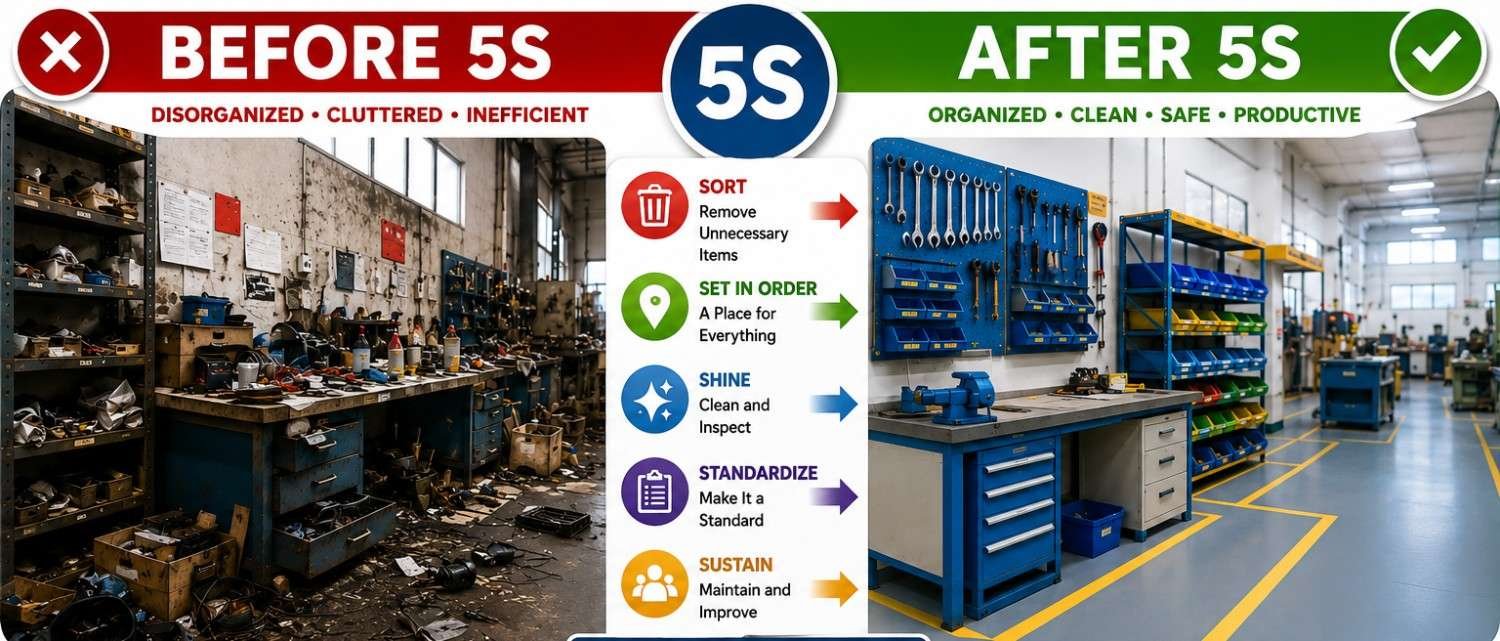
In this article we will take a dive into 5S Lean Manufacturing and understand what 5S is, why 5S is important and how 5S helps organizations create a clean organized and highly efficient workplace.
🎓 Top-Rated Courses & Certifications
Try changing your filters or searching for another course.
5’s in Lean Methodology
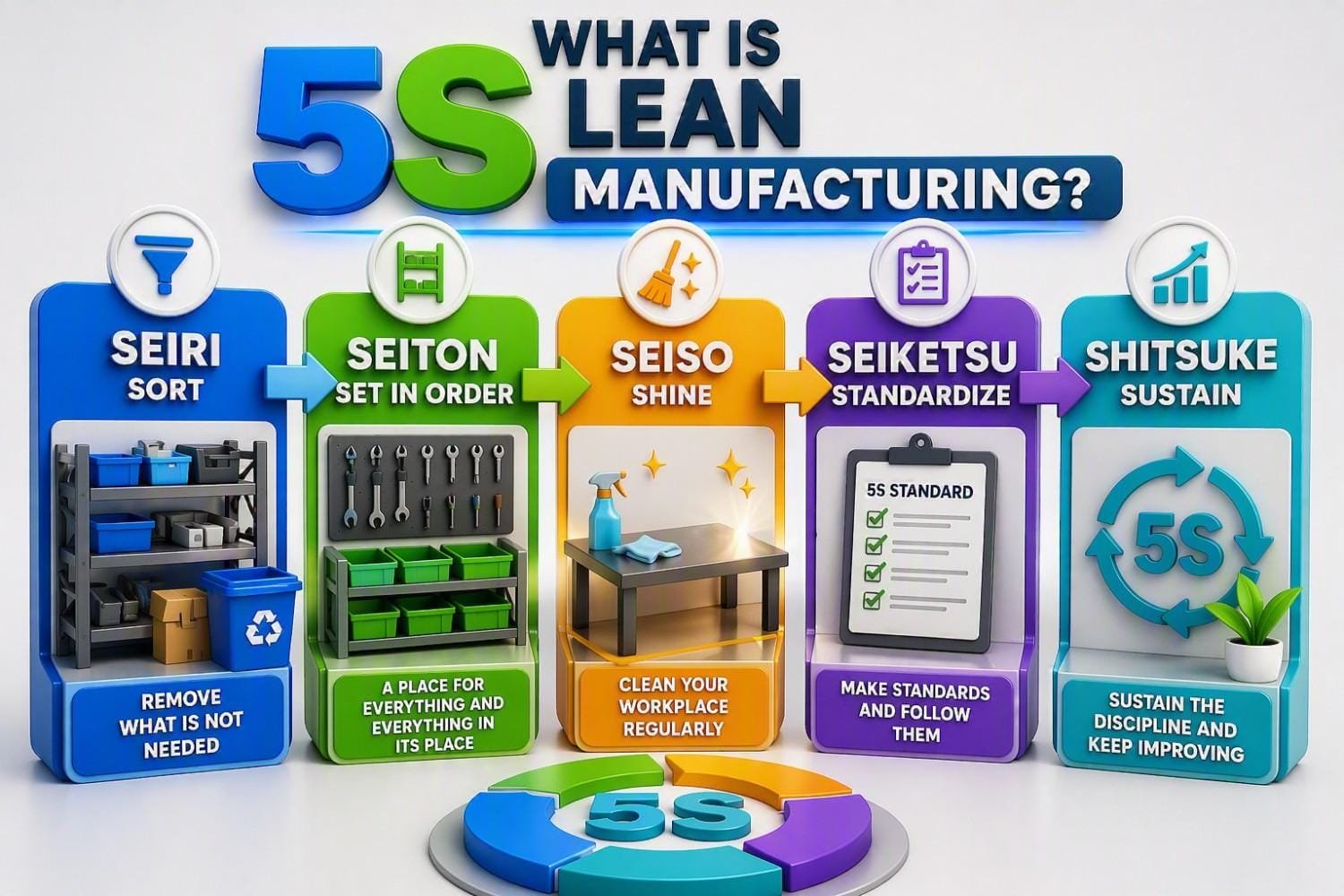
The 5S Methodology is one of the most powerful tools used in Lean Manufacturing. 5S focuses on organizing the workplace eliminating items reducing waste improving safety and increasing overall productivity of the employees. In fact 5S is often considered the foundation of Lean Manufacturing. Many Lean tools and continuous improvement initiatives, such as management, standardized work, Kaizen and Just-, in-Time become much easier and more effective when the workplace is first organized using the principles of 5S.
The concept of 5S was originally developed in Japan as part of the Toyota Production System. The name “5S” comes from five words:
Many people think that 5S is about cleaning the workplace.. That’s not true. Cleaning is one part of 5S. It’s actually much more than that. I think most companies fail at 5S because they can’t keep up the improvements over time. I’ve seen companies do a 5S event but then they go back to their old ways after a few months. This happens because they don’t do checks and don’t have leadership support.
5S is really about making a workplace where everything has its place. We get rid of things we don’t need work gets done efficiently. Employees do things the same way every day. It helps create discipline, visual management, teamwork and a culture of improving.
5S started in manufacturing. It helps many other areas too. Today companies in healthcare, IT, automotive, aviation, logistics, retail, education and even offices use 5S to work and organize their workplaces. One of the things, about 5S is that it’s easy. You don’t need software, special equipment or advanced technical knowledge. Anyone can. Do it with the right help. By following the five simple steps organizations can create a cleaner more organized and more productive workplace with 5S
Lets start with 1st S in 5s Lean manufacturing.
Sort (Seiri)
👉 Remove unnecessary items from workplace : Seiri or sort is the part of 5S Lean Manufacturing. It is used to find and get rid of things that are not needed in the workplace so only the necessary things are kept for work.
Think about your closet at home. Over time it gets filled with clothes you do not wear anymore receipts, empty boxes and other things that do no good. As the mess gets bigger it gets harder to find what you really need. But when you get rid of the things you do not need your closet becomes cleaner more organized and easier to use.
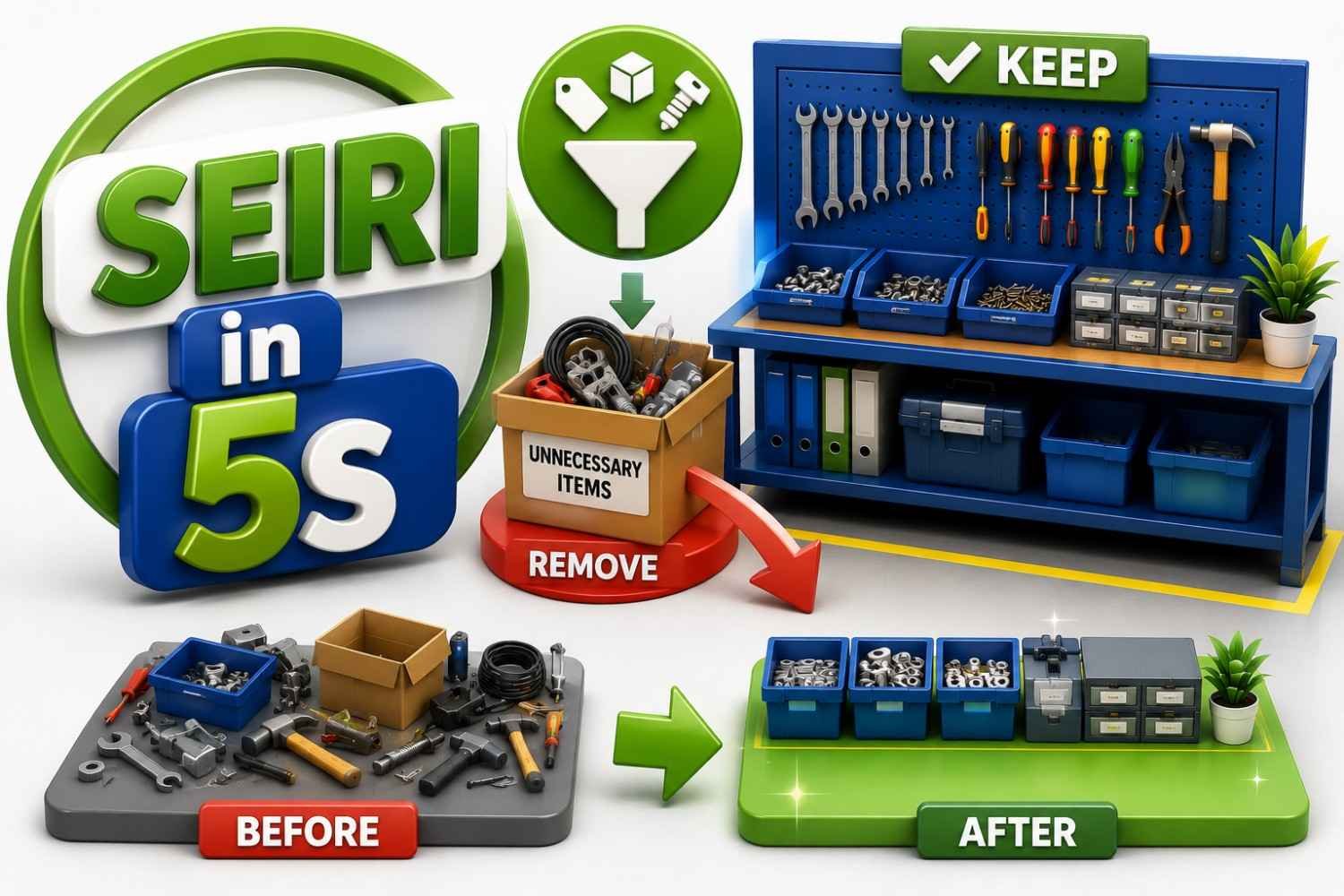
The same thing happens at work. Take a look at your desk or workstation now. Is it neat and organized. Is it covered with old papers, unused office supplies, empty boxes, broken tools or things you have not used in a long time? Be honest with yourself.
I see a lot of teams making the mistake of getting rid of tools too quickly. Instead they should use an area to hold things they are not sure about and then look at them again after a few weeks before making a final decision.
Every thing that is not needed takes up space makes it harder to find important tools or papers and increases the chance of mistakes. People often waste time looking for the thing, which makes them less productive and more frustrated. To make it simple Seiri means keeping only what is necessary and getting rid of everything. When we get rid of clutter the workplace becomes cleaner, safer and more organized. People can quickly find what they need focus on their work and finish tasks quickly.
One mistake I’ve seen during 5S implementation is that teams assume every unused item should be discarded immediately. In practice, I recommend using a Red Tag area first so items can be reviewed before making a final decision. From my experience, the purpose of Sort isn’t to throw everything away. It’s about removing anything that doesn’t help employees perform their work efficiently.
I have seen this a lot when I visit workplaces. A lot of workstations have tools, equipment or papers that have not been used in months. People often keep these things ” in case” but over time they create clutter and make it harder to find what is really needed. Getting rid of the things that are not needed can make a workstation feel more organized and improve efficiency right away.
Set in Order (Seiton)
👉 Arrange items so they are easy to find : Seiton or Set in Order is the part of 5S Lean Manufacturing. After you get rid of all the things you do not need during the Sort stage the next thing to do is to organize the things that are left in a way that makes sense.
Now let us think about your kitchen at home. What if you kept your spoons in one drawer one day and another drawer the day and sometimes even inside a cupboard. Every time you wanted a spoon you would waste a lot of time looking for it.. Most homes have a special place for each thing so it is easy for everyone to find it and put it back after they use it.
The same idea works at your workplace.
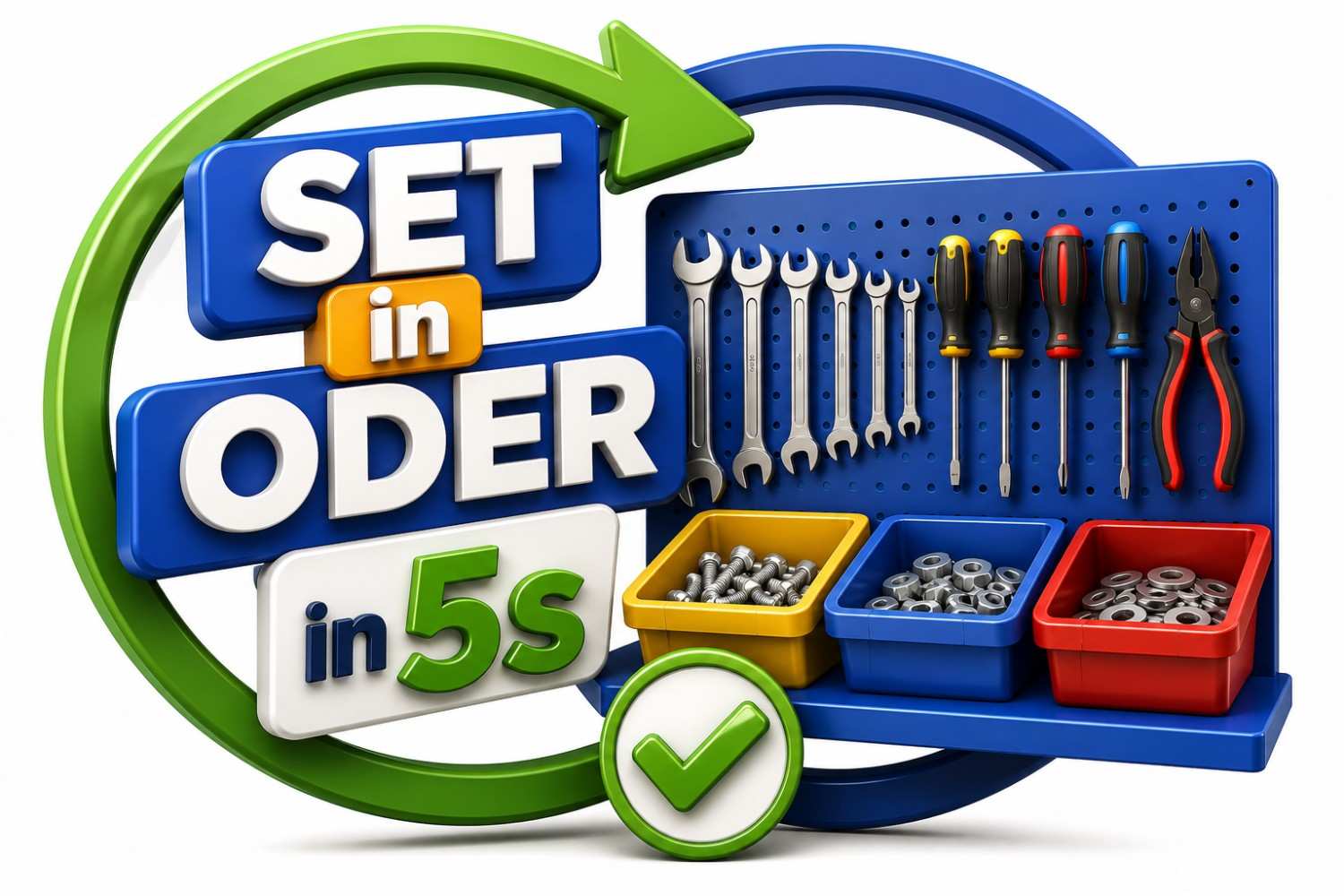
Every tool, machine, document or piece of equipment should have a place where it belongs. Your employees should know where to find something and where to put it back after they use it. This way you do not waste time looking for things you save time. You get more work done.
A clean machine is not about how it looks. When I have done inspections I have seen oil leaks that were found when the machine was being cleaned. These could have caused problems if they were not fixed.
When your workplace is organized it is easy to see when something is missing. Is not in the right place. For example if a wrench is missing from its spot on a shadow board your employees can see that right away and fix the problem before it causes any trouble or safety issues.
Set in Order does more than just help you get work done faster. It also helps keep your workplace safe and makes it look clean and professional. You can use labels, colors, lines on the floor storage bins and shadow boards to make sure everything is organized and easy to find.
Set in Order means that everything has a place. When everything is in its place your employees do not waste time looking for things. They can do their work instead.
I have seen this in places where things are made. The people who work there usually know where the tools should be. If there are no clear labels or special places for them each person puts them in a different place. If you use signs like labels, shadow boards and lines, on the floor it is much easier for everyone to find and put back things in the same place every time.
Shine (Seiso)
👉 Clean the workplace regularly : Seiso, also known as Shine is the step in 5S Lean Manufacturing.
After getting rid of things you don’t need and organizing whats left the next thing to do is to keep your workplace clean and ready to use. Lets talk about your car. If you wash it often you’re more likely to notice if a tire is flat if theres an oil leak if the windshield is cracked or if a warning light is on before it becomes a problem.
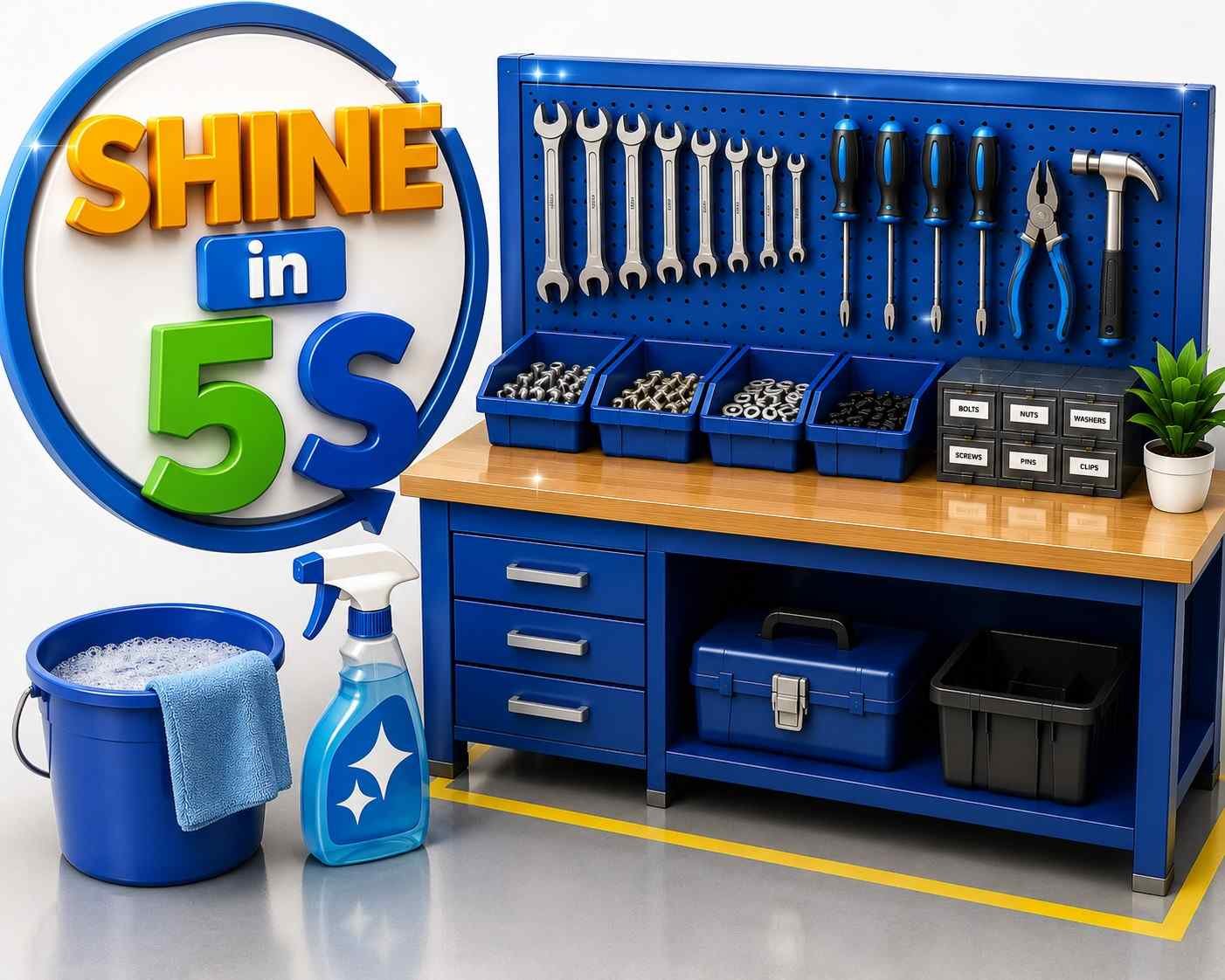
If your car is always dirty and you don’t take care of it you might not see these problems until they cost a lot of money to fix. The same thing is true for your workplace. Shine or Seiso isn’t about cleaning. It’s also about checking things while you clean. Employees machines, tools, equipment and workstations and look for signs of wear, damage, oil leaks, loose bolts, strange noises or other things that could cause problems.
A clean workplace has benefits.
* It means machines aren’t down much.
* The things you make are quality.
* It’s safer.
* Employees get more done.
It also makes it easier to find problems so you can fix them before they cost a lot of money. During inspections I’ve seen problems like oil leaks and loose screws found while cleaning equipment. Finding these problems early helps prevent problems and expensive repairs later. A clean workplace also makes an impression, on employees, customers and visitors.
It shows that you’re professional and that you care about your workplace. It makes everyone want to take care of things and do a job. Shine or Seiso means clean every day check while you clean and prevent problems before they happen.
Standardize (Seiketsu)
👉 Create rules to maintain first 3S :Seiketsu or Standardize is the part of 5S Lean Manufacturing. After you finish the three parts Sort, Set in Order and Shine you have to make sure that the good things you did keep happening all the time.
Think about cleaning your room. You might spend a weekend making it perfect.. If you do not do things every day to keep it that way it will be messy again in a few weeks. All the time you spent cleaning will be wasted.
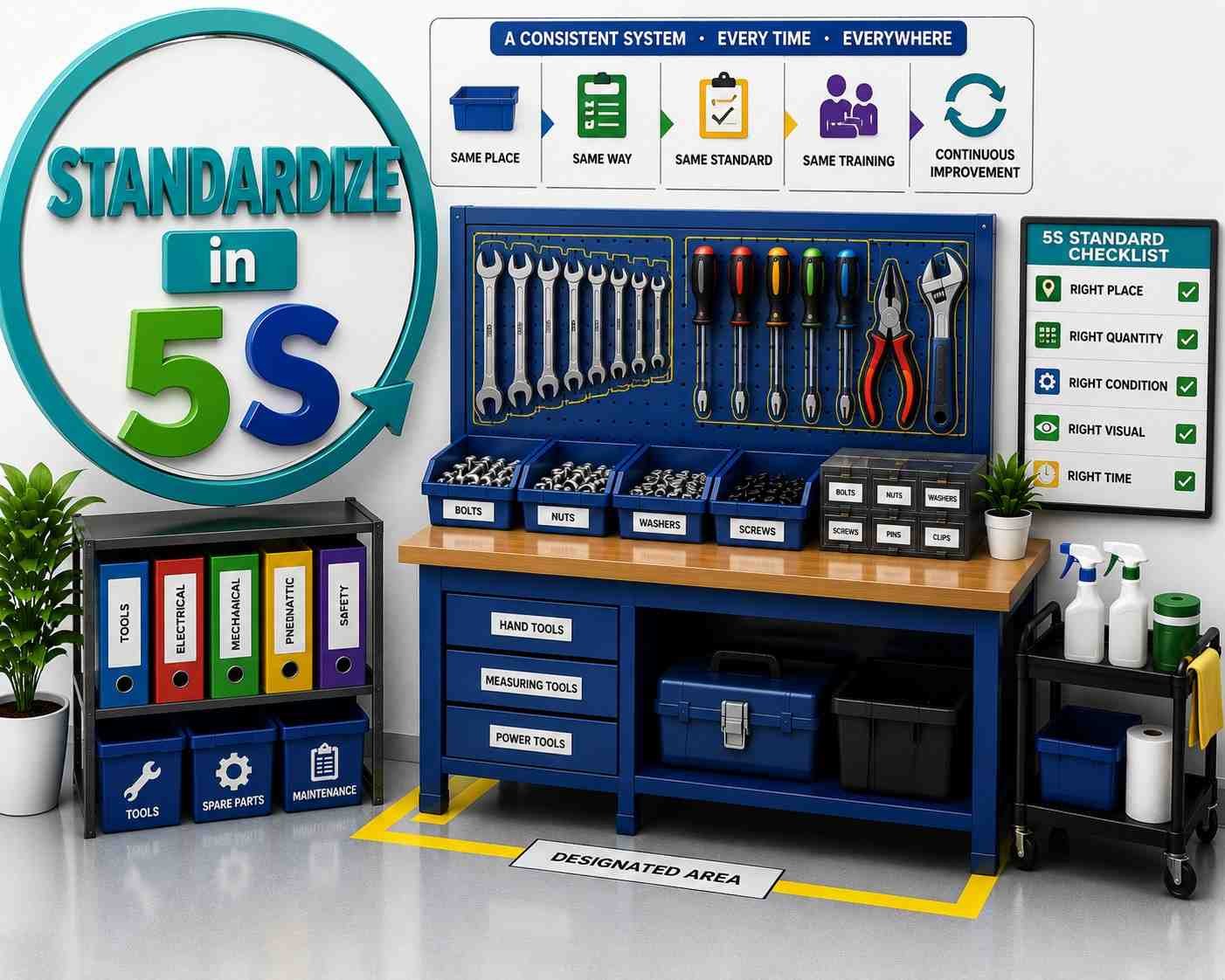
If you do not have Standardize or Seiketsu the good things you did in the three parts will start to disappear. People might start putting tools in the places things you do not need might start to pile up and cleaning might not happen as often. Eventually your workplace will be messy again.
When you Standardize you make sure everyone does things the way. You create rules that everyone follows and this helps people do their jobs better. It makes sure that every person does their tasks the way every time.
You can make your workplace follow the 5S rules by using things like:
• Daily or weekly cleaning lists
• Standard Operating Procedures or SOPs
• Pictures that show you how to do your job
• Labels and colors to help you know what things are
• Lines on the floor to show you where things go
• Lists to check if you are doing 5S correctly and checking all the time
If you do these things all the time your workplace will be organized, safe and work well instead of having to start all over again.
Standardize or Seiketsu means you create a system that makes good habits happen every day, not one time.
From what I have seen many places do a job with the first three parts of 5S but if they do not have clear rules and check to make sure people are following them the workplace starts to get messy again. Doing things the way every time is what makes 5S work in the long run and that is what Seiketsu is all about it is, about Standardize.
Sustain (Shitsuke)
👉 Maintain discipline and habit : Shitsuke or Sustain is the fifth step of 5S Lean Manufacturing. Many people find it the hardest part. This step is about keeping the changes made in the first four steps over a long time.
* What about going to a gym? Lots of people are very motivated at first. Go often. However as time goes on they start to miss workouts and then quit.
The problem is not getting started—it is keeping at it. The same thing happens with 5S. A company may do a job with Sort, Set in Order, Shine and Standardize
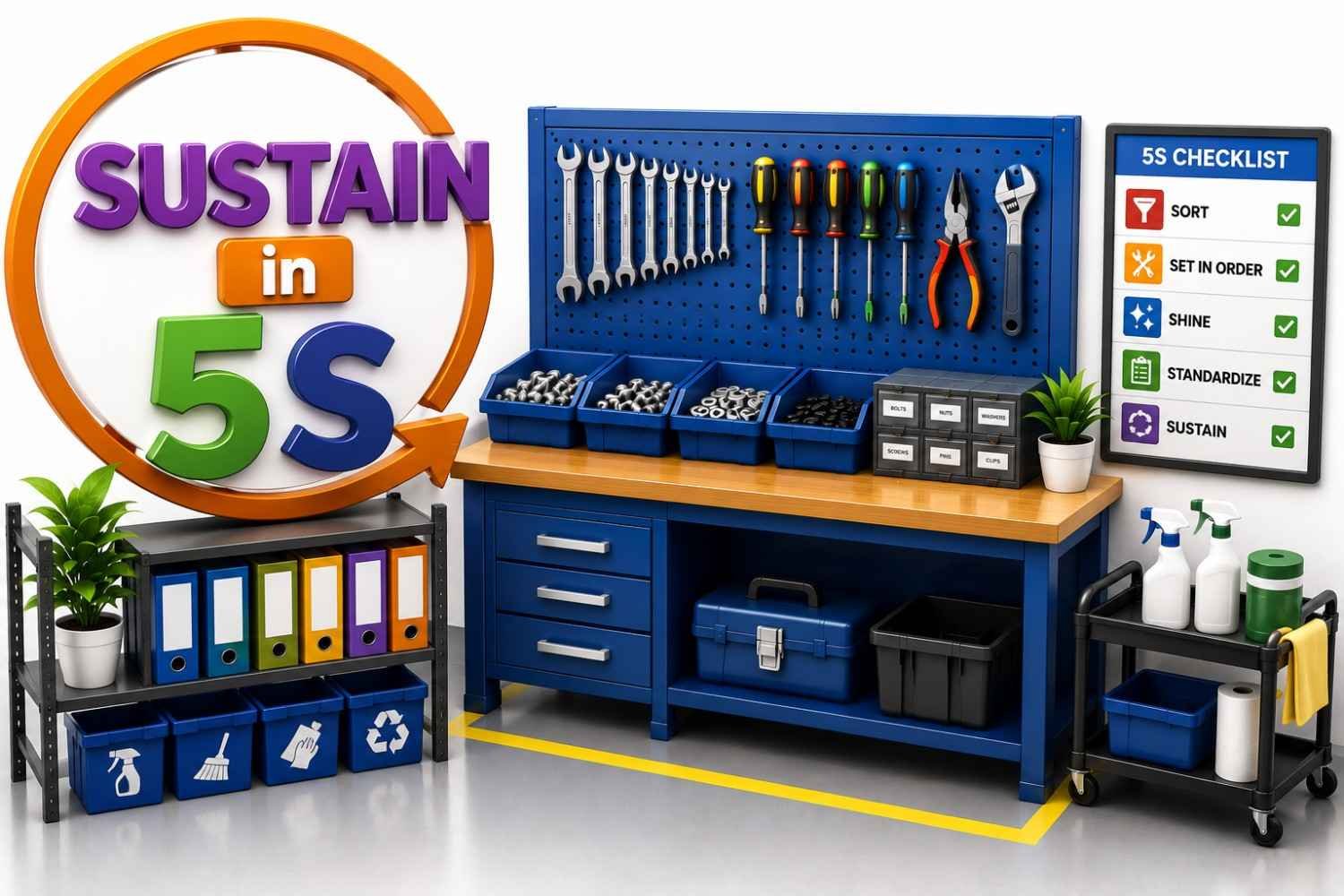
If workers slowly stop doing these things the workplace gets messy again. Sustain or Shitsuke is about being disciplined and making 5S a part of life not just a one-time thing. It encourages every person in the company from workers to managers to take charge of keeping the workplace organized.
They should always look for ways to make things better. In my view Sustain is the part. At first people are very excited. Staying just as disciplined months later needs help from leaders, regular checks and workers who really take part.
Shitsuke is key to keeping 5S going. It requires effort from everyone. Companies must make Sustain a habit. This way 5S becomes a part of work. Workers and managers must work together. They should check progress. Make changes as needed. This helps keep the workplace organized and makes it better, over time.
📚 Recommended Books for Professionals
Try removing one or more filters.
🎁 Free Download: 5S Audit Checklist & Implementation Template
Implementing 5S is easier with a structured checklist. To help you get started, we've created a free 5S Audit Checklist & Implementation Toolkit that you can download and customize for your organization.
📥 Download the FREE 5S Audit Checklist & Implementation Toolkit and start building a cleaner, safer, and more productive workplace today!

Lean Six Sigma • Six Sigma • Statistics • Project Management • Artificial Intelligence (AI) • Operations Management • Quality Management
My Experience with 5S Implementation
I have been working in Quality Engineering for the 25 years. In that time I have seen a lot of companies struggle with keeping their workplaces organized. One place that really stands out in my mind was a factory where tools and materials were over the place. The workers would spend a lot of time looking for the tools before they could even start working. This was not wasting time but it was also very frustrating and it made the workplace more dangerous.
We decided to try the 5S Lean Manufacturing method to fix these problems. We started by getting rid of things we did not need. This meant throwing away tools and materials that were just taking up space. Away the factory looked more organized and it was easier to get around. Next we made sure everything had its place. We used labels and signs to show where things went. We also used boards and racks to store things. This way everyone knew where to find what they needed. The workers were able to find tools faster.
Then we made sure everything was clean. We encouraged the workers to check the machines when they were cleaning them. This helped us find problems before they became big ones. To make sure we did not go back to the way of doing things we made some simple rules to follow. We made checklists and instructions that were easy to understand. Finally we made sure everyone was following the rules by checking on them and giving them the training they needed.
After a months the workplace was much better organized. The workers could find what they needed quickly. The workplace was cleaner and safer. The workers were also getting more work done because they were not wasting time looking for things. The best part was that the workers were taking care of the workplace themselves. They were not waiting for someone to do it.
This experience taught me a lesson. The 5S method is not about cleaning up the workplace. It is about creating a workplace where everyone is organized disciplined and always looking for ways to improve. The 5S method is about making these things a part of work. I learned that 5S is really important, for a workplace.
Frequently Asked Questions (FAQs)
What is 5S methodology?
5S is a structured system for organizing and maintaining a clean and efficient workplace.
What does 5S stand for?
Sort, Set in Order, Shine, Standardize, and Sustain.
Is 5S only for manufacturing?
No, it can be used in offices, hospitals, homes, and even digital spaces.
Why is 5S important?
It improves efficiency, safety, and productivity by reducing waste.
What is the hardest step in 5S?
Sustain, because it requires long-term discipline.
Can 5S be applied outside manufacturing?
Yes, 5S can be used in offices, hospitals, homes, and even digital workspaces.
What is ‘Seiri’ in 5S?
Seiri means sorting and removing unnecessary items from the workplace.
What is ‘Seiton’ in 5S?
Seiton means organizing items so they are easy to find and use.
What is ‘Seiso’ in 5S?
Seiso refers to cleaning the workplace while inspecting for issues.
What is ‘Seiketsu’ in 5S?
Seiketsu means standardizing processes to maintain organization.
What is ‘Shitsuke’ in 5S?
Shitsuke refers to sustaining discipline and maintaining improvements over time.
How does 5S improve productivity?
It reduces time wasted searching for tools and information, improving workflow efficiency.
Summary
👉 The 5S Lean Manufacturing approach helps create an organized and safe workplace. It involves five steps: Sort, Set in Order, Shine, Standardize and Sustain.
By following these steps organizations can get rid of waste find things faster work efficiently and make the workplace safer. This approach also helps build a culture of improvement. The 5S approach started in manufacturing. Can be used in many other places like offices, hospitals and schools. You don't need tools or software to use 5S. Just a commitment to make it work. It's also about creating a workplace where everything has a purpose and a place. The goal is for everyone to follow the way of working. 5S is not, about cleaning; it's a way to make a workplace better. The 5S approach makes sure everyone works in a way.
I hope this blog helped in understanding the basic concept in a simplified manner, watch out for more such stuff in the future.
Continue Your Learning Journey
Learning is a continuous process. Explore related topics, practical guides, tools, calculators, templates, and learning resources to expand your knowledge and develop new skills.
Choose a category below to explore practical tutorials, tools, calculators, templates, case studies, and learning resources.
Recommended Learning Resources
Expert-led courses to build practical skills, earn credentials, and advance your career.
Recommended professional books, certification guides, and practical study resources.
Ready-to-use templates, checklists, guides, and workbooks for practical applications.
Interactive calculators for statistics, quality, engineering, analysis, and decision-making.
Interactive Z, t, Chi-Square, and F tables with critical values and distribution curves.
Discover practical tutorials, case studies, and professional resources across Quality, Lean Six Sigma, Project Management, Statistics, AI, and Data Analytics.
Published: May 20, 2026
Last Updated: September 18, 2026