What is RACI Matrix in Project Management : How to Create a RACI Matrix and Eliminate Role Confusion
Projects often involve multiple teams, stakeholders, departments, and decision-makers working toward a common objective. As initiatives become larger and more complex, coordinating activities effectively requires more than technical expertise and detailed project plans. Teams must also establish clear governance, communication pathways, and decision-making structures.
Successful project execution depends on ensuring that every activity has appropriate oversight, stakeholder involvement, and accountability throughout the project lifecycle. Without a structured approach to role management, organizations often struggle to maintain consistency across workstreams, approvals, reviews, and key project decisions.
To address this challenge, project managers use responsibility assignment frameworks that provide visibility into how individuals and teams interact during project execution. These frameworks help establish clarity around participation, improve communication efficiency, support governance practices, and ensure that stakeholders are engaged at the appropriate level throughout the project.
One of the most widely used responsibility assignment tools is the RACI Matrix. By defining participation levels for project activities, the RACI framework helps organizations improve coordination, standardize decision-making, and create a more structured approach to project management across cross-functional teams.
Why Most Projects Fail (And How RACI Solves It)
Have you ever been part of a project where tasks were delayed because everyone thought someone else was responsible? Or where multiple people worked on the same task while critical activities were overlooked? If so, you’re not alone. One of the most common reasons projects fail is unclear roles and responsibilities. On several cross-functional projects, the biggest obstacle wasn’t technical complexity—it was uncertainty over who actually owned each task. Team members were committed and hardworking, yet deadlines slipped because responsibilities were assumed instead of clearly assigned.
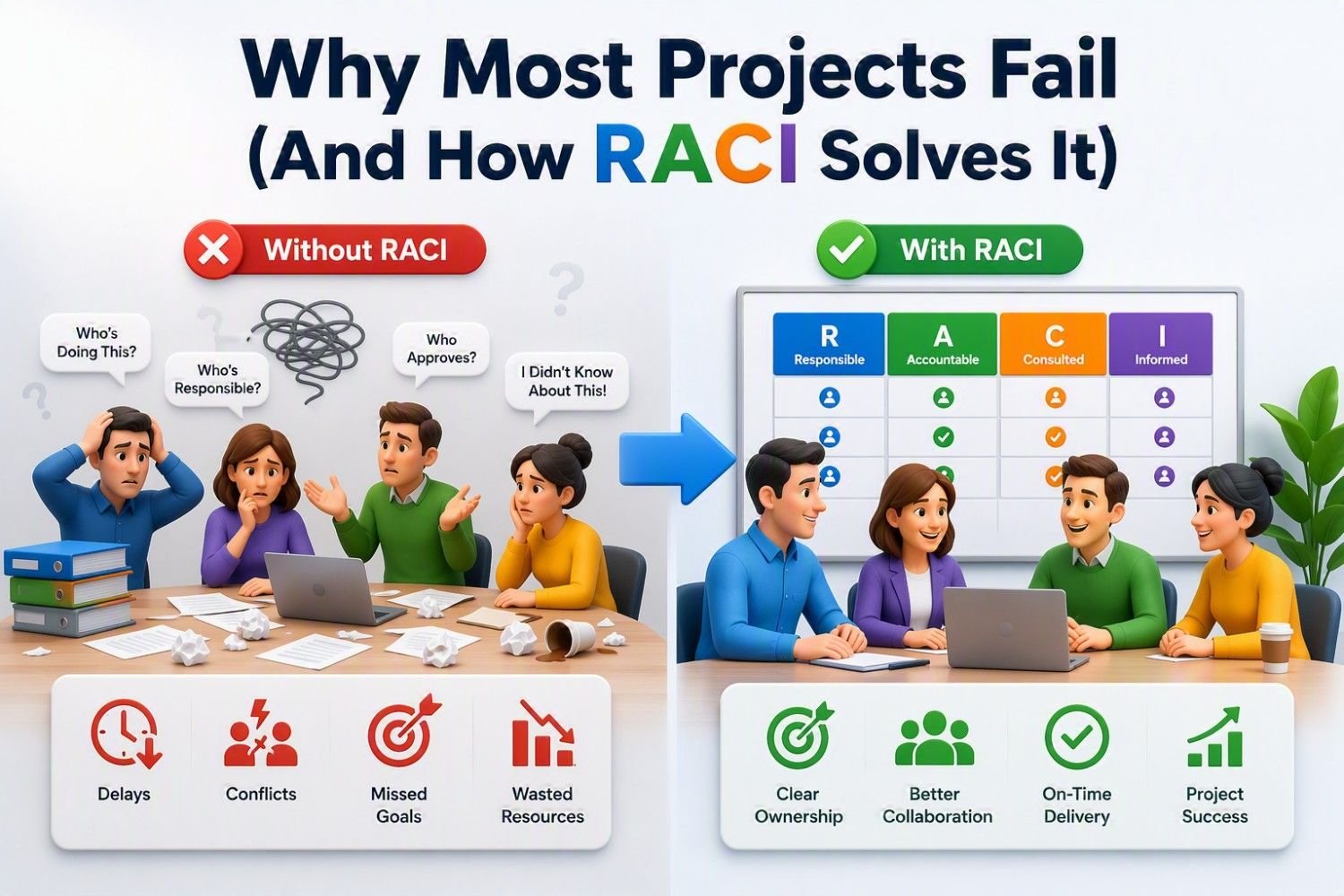
I’ve seen projects lose valuable time simply because engineering expected quality to take the lead, while quality believed the responsibility belonged to another function. Everyone was involved, but no one had clear ownership. The result was delayed decisions, duplicated effort, unnecessary meetings, and avoidable rework.
That’s why I now consider a RACI Matrix one of the simplest yet most effective project management tools. Before any major work begins, it clarifies who is Responsible, Accountable, Consulted, and Informed for every key activity. That single step removes ambiguity, improves communication, and creates accountability across the team.
Whether you’re managing a Lean Six Sigma project, a product launch, or any cross-functional initiative, a RACI Matrix helps everyone move in the same direction with confidence. In the following sections, I’ll explain how it works, how to create one correctly, and the practical lessons I’ve learned from using it in real projects.
What is a RACI Matrix? Full Form, Meaning, and Definition
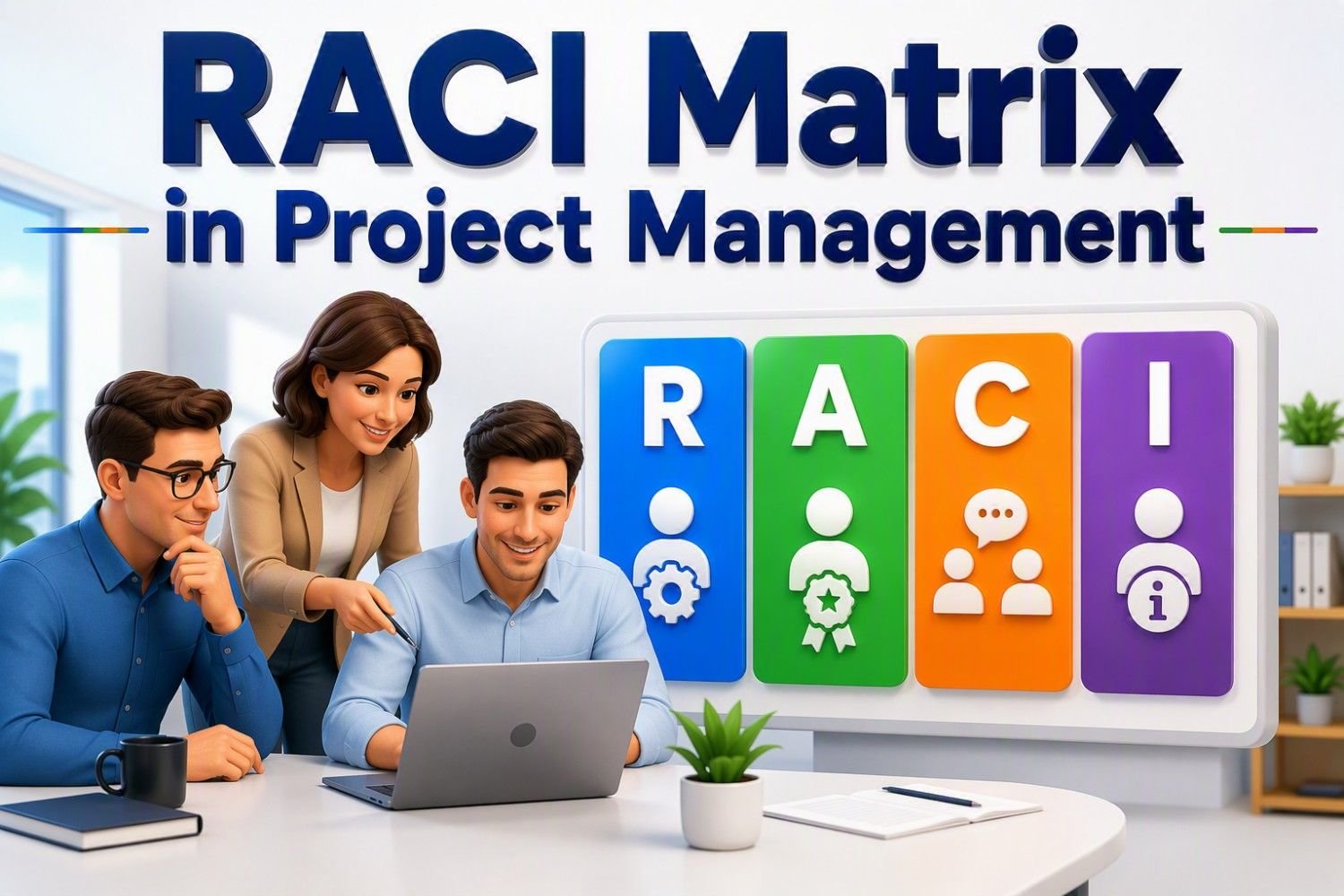
A RACI Matrix is a project management tool used to clearly define roles and responsibilities for tasks, deliverables, and decision-making activities within a project. It helps teams understand who is responsible for performing work, who has ultimate accountability, who should be consulted before decisions are made, and who needs to be kept informed about progress.
RACI stands for
A RACI Matrix is a responsibility assignment tool that clearly defines these roles for every project activity. It is usually presented as a simple table that links tasks with team members, making ownership visible at a glance. Instead of relying on assumptions, everyone knows who is responsible for execution, who makes the final decision, who should be consulted, and who only needs to be informed.
In my experience, this small step has prevented countless misunderstandings and saved hours of unnecessary discussions. Whether you’re leading a Lean Six Sigma improvement, a product development project, or any cross-functional initiative, a RACI Matrix creates clarity, strengthens accountability, and keeps the entire team aligned from day one.
🎓 Top-Rated Courses & Certifications
Try changing your filters or searching for another course.
Understanding the Four RACI Roles
The first time I introduced a RACI Matrix to a project team, I realized that simply creating the matrix wasn’t enough. The real value came when everyone understood what each role actually meant. Once those expectations were clear, discussions became more productive, decisions were made faster, and ownership was no longer a source of confusion.
Although the four RACI roles are straightforward, each serves a distinct purpose. Understanding the difference between them is essential for building an effective RACI Matrix.
Responsible (R)
The Responsible person is the one who performs the task and delivers the work. There can be one or more people responsible for completing an activity, depending on the project’s complexity.
Accountable (A)
The Accountable person owns the outcome. They approve the work, make the final decision, and ensure the task is completed successfully. For best results, each task should have only one accountable person to avoid confusion.
Consulted (C)
The Consulted role includes people whose knowledge or expertise is needed before a decision is made or a task is completed. Communication flows both ways because their input helps improve the quality of the outcome.
Informed (I)
The Informed role consists of stakeholders who need to know the project’s progress or key decisions but are not directly involved in completing the work. Keeping them informed ensures transparency without slowing execution.
When I create a RACI Matrix, I always ask four simple questions: Who does the work? Who owns the result? Who should provide input? Who needs to stay informed? Answering these questions upfront has consistently helped my teams reduce misunderstandings, improve collaboration, and keep projects moving smoothly.
📚 Recommended Books for Professionals
Try removing one or more filters.
Why the RACI Matrix is Important in Project Management
One lesson I've learned from managing cross-functional projects is that most delays aren't caused by technical challenges—they're caused by unclear ownership. I've seen capable teams spend more time figuring out who should do the work than actually doing it. When responsibilities aren't defined, decisions slow down, communication suffers, and accountability quickly becomes unclear.
That's why I make a RACI Matrix part of my project planning whenever multiple teams are involved. It sets clear expectations from the beginning by defining who is Responsible, Accountable, Consulted, and Informed for every key task. As a result, everyone knows their role before execution starts.
In my experience, a well-designed RACI Matrix improves collaboration, reduces duplicate work, speeds up decision-making, and prevents important activities from slipping through the cracks. It also minimizes unnecessary meetings because the right people are involved at the right time.
Whether you're managing a Lean Six Sigma project, a product launch, or any cross-functional initiative, a RACI Matrix creates the clarity and accountability needed to keep projects moving forward. It's a simple tool, but its impact on project success is often much greater than people expect.
How to Create a RACI Matrix (Step-by-Step Guide)
Creating a RACI Matrix is a straightforward process that can dramatically improve project accountability and communication. The goal is simple: clearly define who is responsible for doing the work, who owns the final outcome, who should be consulted, and who needs to be informed. Follow these six steps to build an effective RACI Matrix for any project.
Step 1: List the Key Project Tasks
Start by identifying the major tasks, milestones, or deliverables. Don't try to capture every small activity—the matrix should stay simple and easy to understand.
Step 2: Identify the Project Roles
List the people, teams, or departments involved in the project. I usually use roles (such as Project Manager, Design Engineer, or Quality Engineer) instead of individual names so the matrix remains useful even if team members change.
Step 3: Assign the RACI Roles
For each task, assign the appropriate Responsible (R), Accountable (A), Consulted (C), and Informed (I) roles. One practice I always follow is assigning only one Accountable (A) person to each task. It removes confusion and makes decision-making much faster.
Step 4: Review the Matrix with the Team
Before execution begins, review the matrix together. I've found this discussion often uncovers hidden assumptions and ensures everyone agrees on their responsibilities.
Step 5: Keep It Updated
A RACI Matrix isn't something you create once and forget. As projects evolve, responsibilities can change. Review and update the matrix whenever new tasks, stakeholders, or team members are added.
From my experience, the most effective RACI Matrices aren't the most detailed—they're the clearest. If every team member can quickly answer "Who does the work?", "Who owns the outcome?", and "Who needs to be involved?", you've built a matrix that will improve accountability, communication, and project execution.
RACI Matrix Rules and Best Practices
Creating a RACI Matrix is simple, but using it effectively requires following a few important rules. In my experience, most RACI problems don't happen because the tool is complicated—they happen because teams assign roles without clear guidelines. These best practices help keep the matrix practical and easy to use.
RACI Matrix Example: Planning a Family Vacation
One of the best ways to understand a RACI Matrix is through a simple, real-life example. Imagine a family of four planning a vacation. While everyone may participate in discussions, not everyone is responsible for every task. A RACI Matrix helps clarify who does the work, who makes the final decisions, whose opinions are needed, and who simply needs to stay informed.
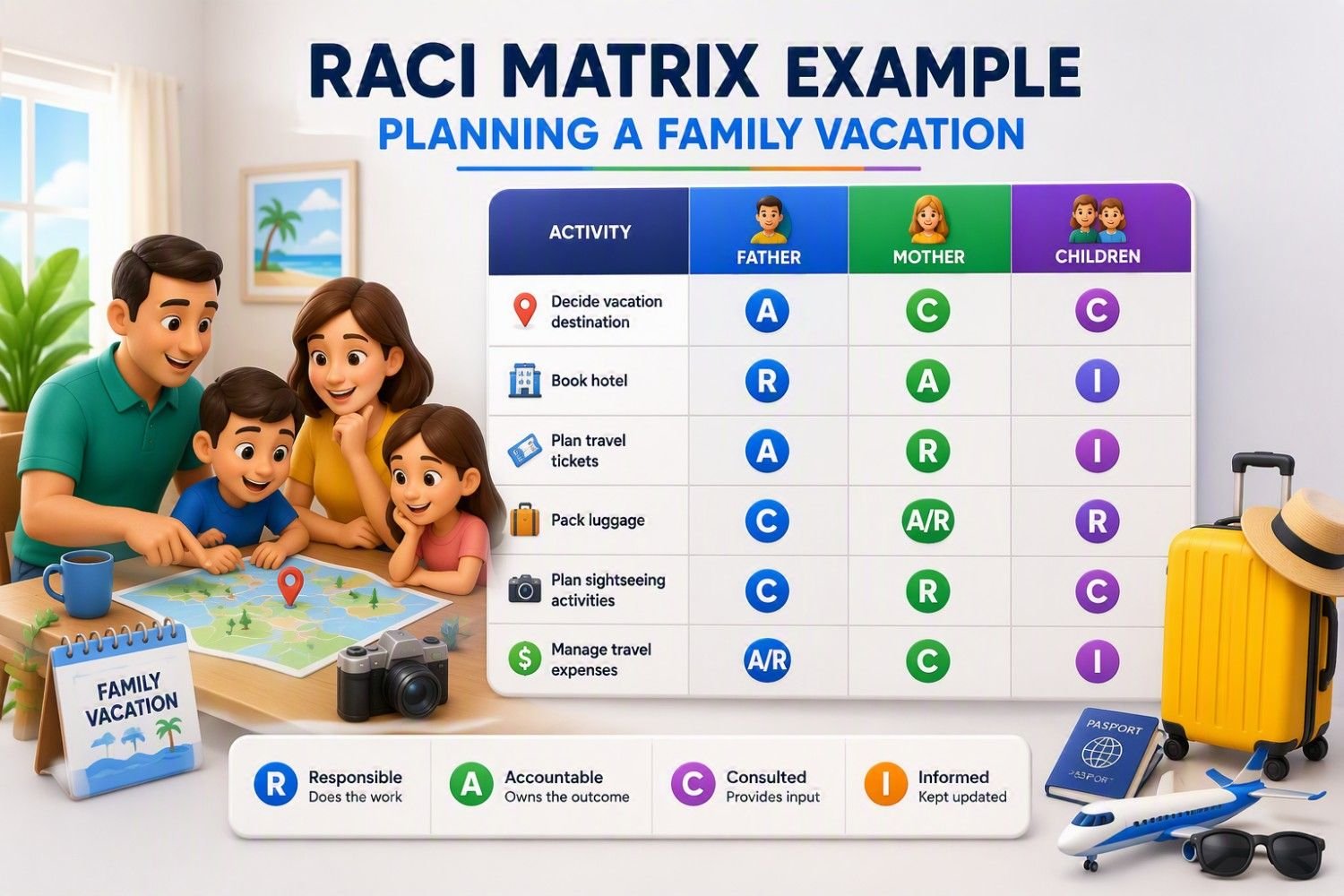
Simple RACI Matrix Example: Planning a Family Vacation
How to Understand This Example
Responsible (R) : The Responsible person is the one who actually completes the task.
Example: For booking the hotel, the Father performs the booking, so he is marked as Responsible (R).
Accountable (A) : The Accountable person owns the final outcome and has the authority to approve or make decisions.
Example: The Father is Accountable for choosing the vacation destination and managing the overall travel budget.
Consulted (C) : The Consulted role includes people whose opinions, knowledge, or preferences are considered before making a decision.
Example: The Children are Consulted when choosing the vacation destination because their interests and preferences matter.
Informed (I) : The Informed role includes people who receive updates about decisions but are not directly involved in completing the task.
Example: The Children are Informed after hotel reservations and travel tickets are finalized.
RACI Matrix Template (Free Download)
📥 Download the free RACI Matrix Toolkit to clearly define roles and responsibilities, improve accountability, and eliminate confusion in projects. This practical toolkit includes a RACI Matrix Template, Stakeholder Register, RACI Rules Audit Sheet, Communication Plan, Approval Tracker, Implementation Checklist, RACI Review Meeting Template, Change Control Form, Sign-Off Sheet, and a completed example to help you implement RACI successfully from day one.

Lean Six Sigma • Six Sigma • Statistics • Project Management • Artificial Intelligence (AI) • Operations Management • Quality Management
Frequently Asked Questions (FAQs)
What is a RACI Matrix?
A RACI Matrix is a tool that clearly defines who is Responsible, Accountable, Consulted, and Informed for each task.
What does RACI stand for?
RACI stands for Responsible, Accountable, Consulted, and Informed—four roles that define task ownership.
Who is Responsible in RACI?
The Responsible person is the one who performs or executes the task.
Who is Accountable in RACI?
The Accountable person owns the outcome and gives final approval for the task.
Can there be multiple Responsible people?
Yes, multiple people can be Responsible for a task depending on the work complexity.
Can there be multiple Accountable people?
No, there should be only one Accountable person per task to ensure clear ownership.
What is the role of 'Consulted' in RACI?
Consulted stakeholders provide input and expertise before decisions are made.
Who are 'Informed' stakeholders?
Informed stakeholders are those who need updates but are not directly involved in the work.
Why is a RACI Matrix useful?
It removes confusion by clearly defining roles and improving communication across teams.
When should you use a RACI Matrix?
It should be used in projects with multiple stakeholders where roles and responsibilities may be unclear.
Conclusion:
A successful project is not just about having the right strategy, budget, or timeline—it also depends on having clearly defined roles and responsibilities. When team members are uncertain about who owns a task, who approves decisions, or who should be kept informed, projects can quickly experience delays, communication breakdowns, duplicated effort, and accountability issues.
From my experience, some of the most effective project teams are not necessarily the largest or most experienced—they are the teams where everyone clearly understands their role and responsibilities. A RACI Matrix creates that clarity from the very beginning, helping teams focus less on ownership disputes and more on achieving project goals.
In today's fast-paced project environments, where collaboration across multiple functions is essential, the RACI Matrix remains one of the simplest and most effective tools for creating accountability, improving decision-making, and driving successful project outcomes.
Remember: If people know exactly what they are responsible for, who makes the final decisions, whose input is required, and who needs to stay informed, projects become easier to manage, teams become more efficient, and the likelihood of success increases dramatically.
Continue Your Learning Journey
Learning is a continuous process. Explore related topics, practical guides, tools, calculators, templates, and learning resources to expand your knowledge and develop new skills.
Choose a category below to explore practical tutorials, tools, calculators, templates, case studies, and learning resources.
Recommended Learning Resources
Expert-led courses to build practical skills, earn credentials, and advance your career.
Recommended professional books, certification guides, and practical study resources.
Ready-to-use templates, checklists, guides, and workbooks for practical applications.
Interactive calculators for statistics, quality, engineering, analysis, and decision-making.
Interactive Z, t, Chi-Square, and F tables with critical values and distribution curves.
Discover practical tutorials, case studies, and professional resources across Quality, Lean Six Sigma, Project Management, Statistics, AI, and Data Analytics.
Published: April 18, 2021
Last Updated: September 18, 2026