What is FMEA? Failure Mode and Effects Analysis with Examples, RPN Calculation & Free Template
In quality and product development, the most costly failures are often the ones that are discovered after a product reaches production, customers, or the field. Fixing problems at that stage can lead to rework, delays, customer complaints, warranty costs, and lost business opportunities. The key question is simple: What could go wrong, and how can we prevent it before it happens?
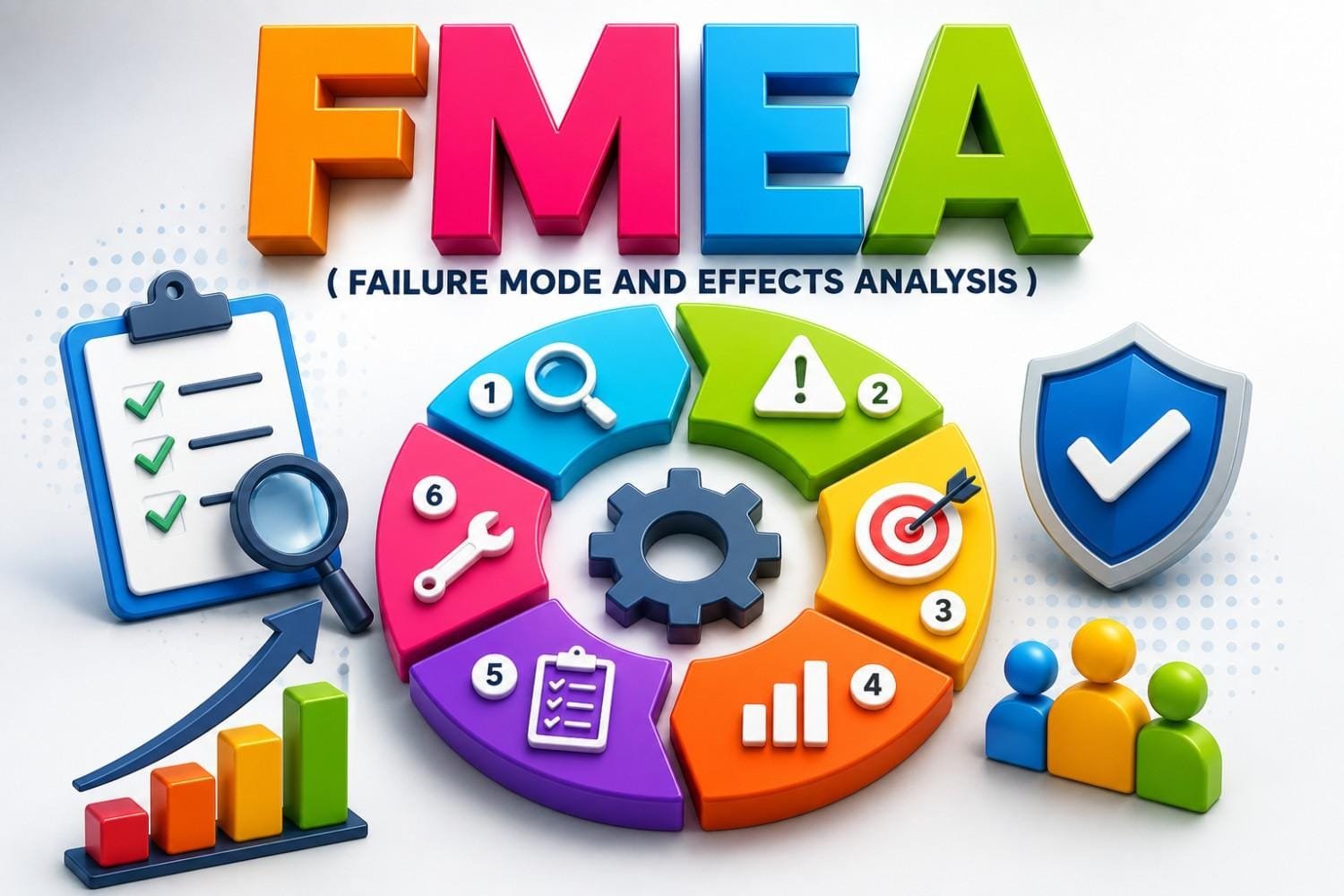
Widely used across manufacturing, automotive, aerospace, medical devices, and product development, FMEA remains one of the most powerful tools for preventing problems before they become costly failures. By systematically analyzing risks early, teams can make better decisions, focus improvement efforts where they matter most, and build more robust products and processes.
What is FMEA ?
During my 25 years experience in New product development and Quality, I’ve learned that the most expensive defects are rarely the ones you find they’re the ones your customer finds first or if I put this in another words what could go wrong before a product reaches the customer.
That’s exactly why FMEA (Failure Mode and Effects Analysis) exists.
FMEA is a structured risk assessment technique used to identify how a product or process might fail, understand the impact of those failures, determine their likely causes, and prioritize actions before problems occur. Instead of waiting for failures to happen, teams use FMEA early in product design and manufacturing to reduce risk, improve quality, enhance safety, and prevent costly rework or warranty issues.
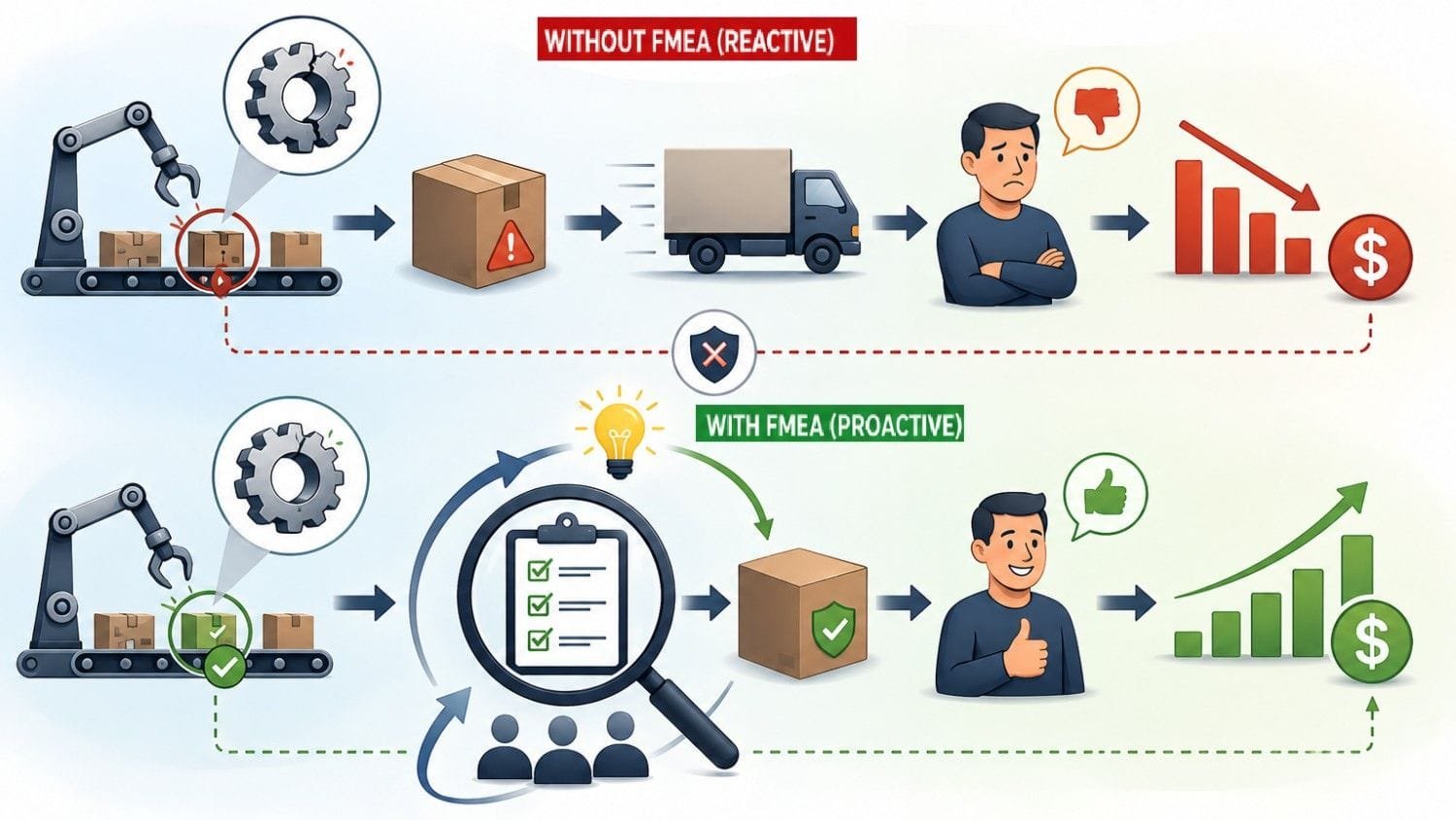
Simply put this like , FMEA helps you prevent and control problems proactively at source instead of reacting to them. By identifying and addressing potential failures early, organizations can avoid costly problems later while delivering safer, higher-quality, and more reliable products.
History & Evolution of FMEA
Although FMEA (Failure Mode and Effects Analysis) is widely used today, it’s far from a new concept. In fact, it has been around for more than 75 years and has evolved into one of the most valuable risk management tools used across engineering and manufacturing.
Over the course of my engineering career, I’ve worked with FMEA on numerous product development and process improvement projects. One thing I’ve learned is that FMEA is much more than a document created to satisfy a quality or regulatory requirement. When used correctly, it changes the way a team thinks. Instead of waiting for customer complaints or product failures, it encourages engineers to ask difficult questions right at the beginning of a project.
Questions such as:
- What could go wrong with this product design?
- What could fail during the manufacturing process?
- What risks exist within the overall system?
- How can we reduce these risks before the product reaches the customer?
These simple but powerful questions are exactly what make FMEA so effective. Rather than reacting to problems after they occur, teams identify potential failures early—when design changes are easier, faster, and significantly less expensive to implement.
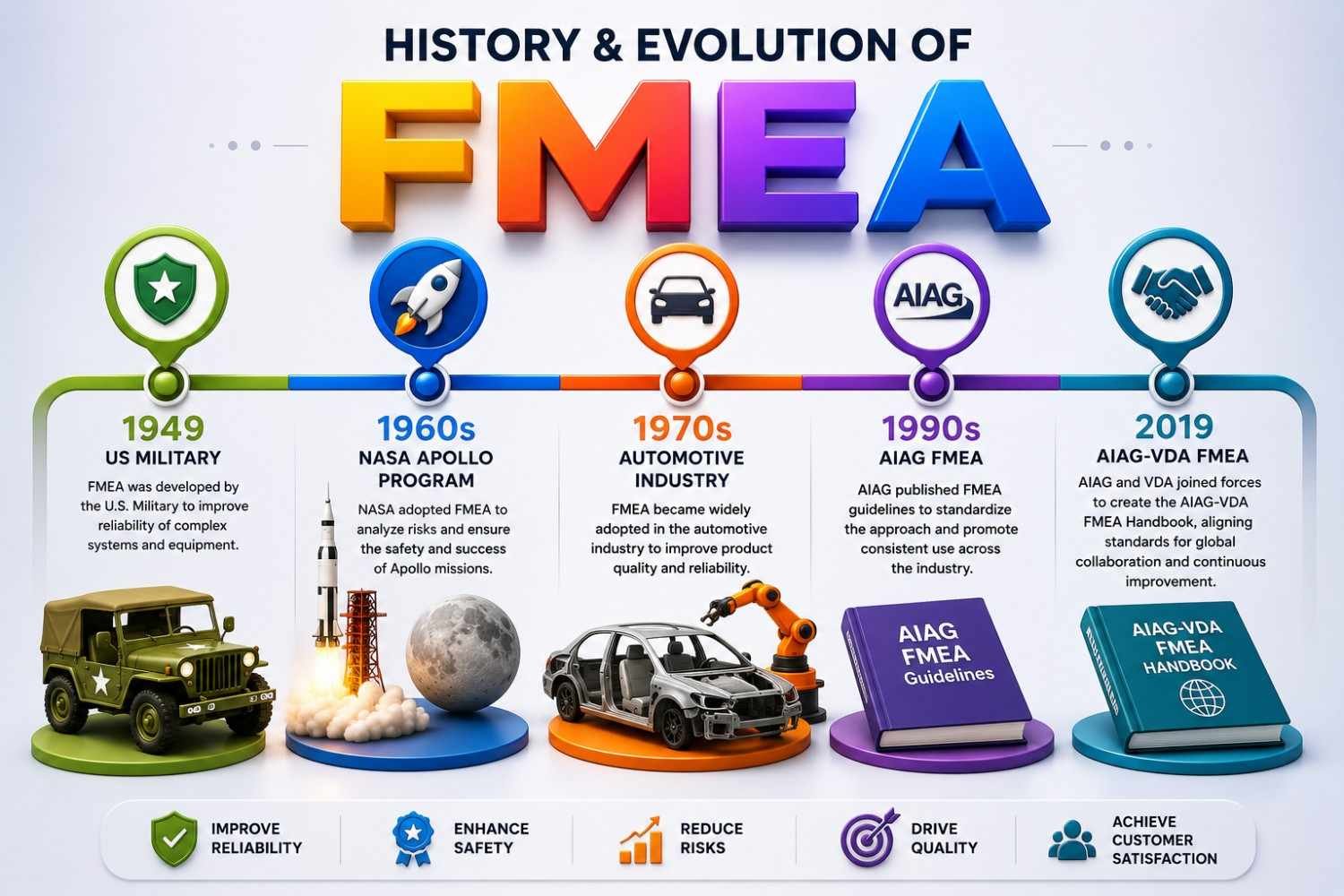
The journey of FMEA began in 1949, when the U.S. Military introduced a structured approach for identifying potential equipment failures that could jeopardize critical missions. At a time when reliability was essential, this methodology helped engineers systematically evaluate risks before equipment was deployed.
During the 1960s, NASA adopted FMEA for the Apollo space program. In space exploration, there is virtually no opportunity to repair a failed component after launch. Engineers therefore relied on FMEA to anticipate possible failure modes and eliminate as many risks as possible before the mission began.
By the 1970s, the automotive industry recognized the value of this proactive approach. Manufacturers such as Ford and General Motors incorporated FMEA into product development and manufacturing to improve quality, reduce warranty claims, increase vehicle reliability, and enhance customer safety.
As FMEA became more widely adopted, the need for a common industry standard also grew. During the 1990s, the Automotive Industry Action Group (AIAG) published standardized FMEA guidelines, allowing automotive manufacturers and suppliers around the world to follow a consistent methodology when assessing risk.
A major milestone came in 2019, when AIAG and the German Association of the Automotive Industry (VDA) jointly released the AIAG-VDA FMEA Handbook. This updated methodology introduced the 7-Step FMEA Process and shifted the focus away from relying solely on the traditional Risk Priority Number (RPN). Instead, it emphasized Action Priority (AP), helping teams focus on the failures that require immediate attention rather than simply those with the highest numerical score.
Today, FMEA is no longer limited to the automotive industry. It is widely used across medical devices, aerospace, electronics, manufacturing, energy, healthcare, defense, and many other industries where product quality, safety, and reliability are critical.
In my experience, the most successful engineering teams don’t use FMEA because a standard tells them to—they use it because it helps them build better products. A well-executed FMEA often uncovers design weaknesses, manufacturing risks, and process gaps long before they become expensive customer complaints or field failures. That’s why, even after more than seven decades, FMEA remains one of the most important preventive quality tools available to engineers.
🎓 Top-Rated Courses & Certifications
Try changing your filters or searching for another course.
Types of FMEA ?
One of the most common questions I get from engineers and students is, “Which type of FMEA should I use?” The answer is simple—it depends on where the risk originates.
Not every failure has the same root cause. A product can fail because of a poor design, a manufacturing issue, incorrect use by the customer, a software defect, or even the interaction between multiple components within a system. Since each type of risk is different, FMEA has evolved into several specialized approaches, each designed to evaluate a specific source of failure.
Over the years, while working on product development and Design Assurance projects, I’ve realized that selecting the right type of FMEA is just as important as performing the analysis itself. I’ve seen teams spend days discussing manufacturing issues when the real problem was hidden in the product design. On other occasions, the design was perfectly sound, but variation in the manufacturing process introduced defects that were never considered during development.
That’s why the first question I always ask before starting an FMEA is:
“Where is this risk most likely coming from ?”
Once you answer that question, choosing the right type of FMEA becomes much easier. Let’s look at the most commonly used types of FMEA.
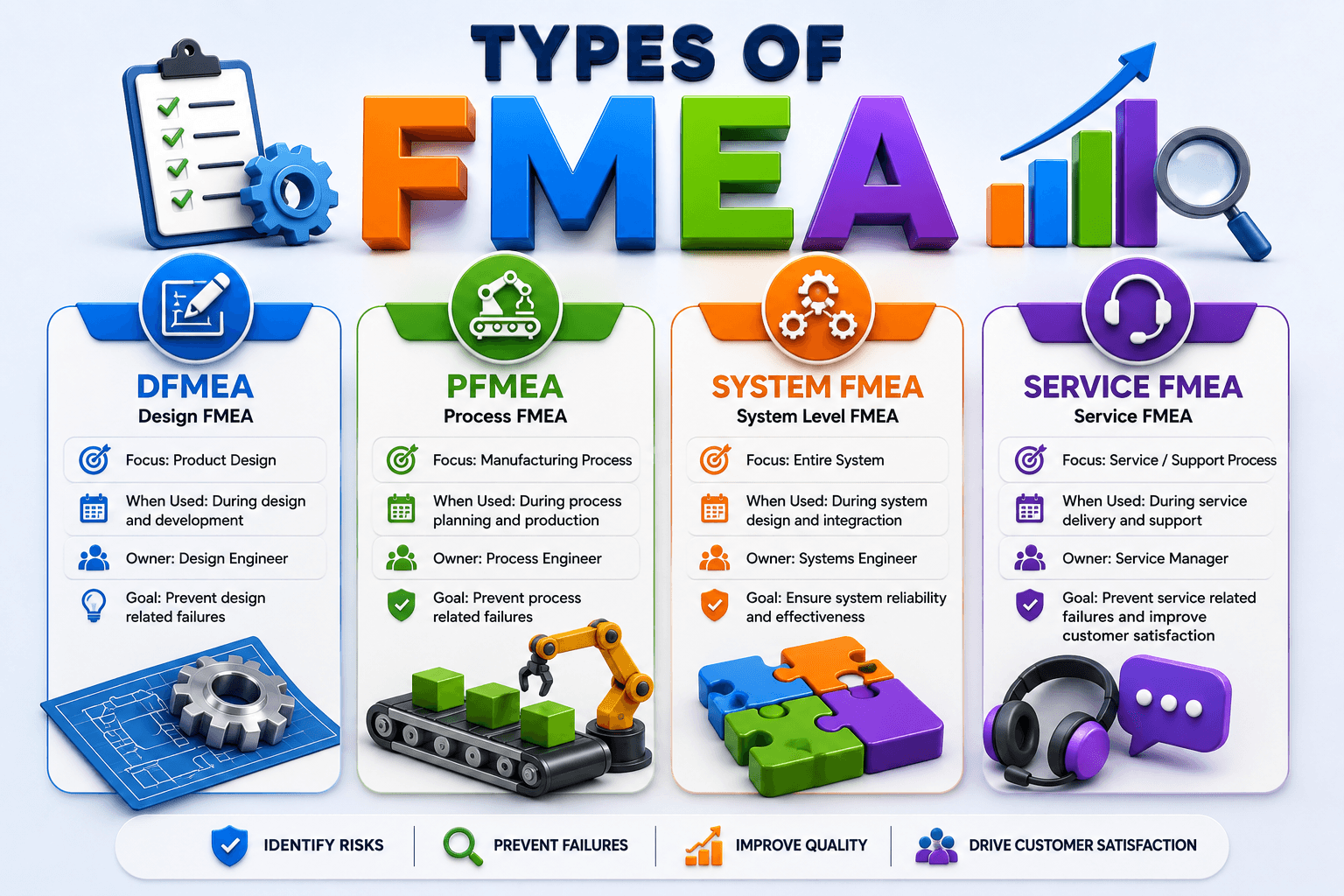
Design FMEA (dFMEA)
Design FMEA focuses on product design. The objective is to identify potential failures that could occur because of design decisions before the product enters manufacturing. When performing a DFMEA, we generally assume that the manufacturing process is capable and that the product will be used as intended. The emphasis is entirely on the design itself.
Typical design-related risks include:
- Incorrect material selection
- Poor component geometry
- Inadequate tolerances
- Weak interfaces between components
- Insufficient strength or durability
- Compatibility issues
In my experience working on new product development projects, DFMEA is one of the most valuable activities during the design phase. Finding a design weakness before production starts is significantly easier—and far less expensive—than redesigning a product after tooling has been completed or, worse, after it has reached customers.
Process FMEA (pFMEA)
Once the product design is finalized, the focus shifts to how the product will be manufactured. That’s where Process FMEA comes into play. PFMEA assumes that the product design is correct. Instead, it evaluates failures that could occur because of the manufacturing or assembly process.
Typical process risks include:
- Human error
- Machine capability
- Incorrect process parameters
- Improper tooling
- Material variation
- Environmental conditions such as temperature or humidity
A helpful way to remember PFMEA is through the 6Ms of Manufacturing:
- Mother Nature (Environment)
- Man
- Machine
- Material
- Method
- Measurement
During manufacturing, even a well-designed product can fail if the process is not properly controlled. That’s why PFMEA plays a critical role in reducing defects, improving process capability, and ensuring consistent product quality.
Use FMEA (uFMEA)
Not every failure is caused by design or manufacturing. Sometimes, products fail because users interact with them in ways that designers never expected. Use FMEA, also known as Use-Related Risk Analysis, focuses on failures that may occur during normal product use This type of analysis is particularly important in industries such as medical devices, where incorrect use can have serious consequences for patient safety.
Unlike DFMEA or PFMEA, Use FMEA assumes that the product has been designed and manufactured correctly. Instead, it evaluates questions such as:
- Could the user misunderstand the instructions?
- Is the product difficult to operate?
- Could the controls be confused?
- Is there potential for misuse?
Having worked in the medical device industry, I’ve seen how even a well-designed product can become unsafe if usability isn’t considered during development. That’s why human factors engineering and Use FMEA have become increasingly important.
System FMEA (sFMEA)
System FMEA takes a broader view by evaluating the complete system rather than individual components. While DFMEA focuses on component-level failures, System FMEA examines how different subsystems interact with one another.
Typical examples include:
- Communication failures between subsystems
- Interface incompatibility
- Functional integration issues
- Power distribution failures
- Software and hardware interaction problems
This type of FMEA is especially useful for complex products where multiple subsystems must work together seamlessly.
Service FMEA
Service FMEA applies the same principles to service delivery processes instead of physical products. It is commonly used in industries such as:
- Banking
- Healthcare
- Logistics
- Hospitality
- Customer Support
The objective is to identify failures that could negatively affect customer experience or service quality, such as delays, incorrect information, billing errors, or communication breakdowns.
Software FMEA
As products become increasingly software-driven, Software FMEA has become more important than ever. Instead of evaluating mechanical or manufacturing failures, Software FMEA focuses on risks within the software itself.
Examples include:
- Programming errors
- Logic defects
- Incorrect algorithms
- User interface issues
- Cybersecurity vulnerabilities
- Software crashes
- Integration failures
Today, Software FMEA is widely used in industries such as automotive, medical devices, aerospace, and industrial automation, where software reliability is just as critical as hardware performance.
One piece of advice I’d give to anyone starting with FMEA is this: don’t choose an FMEA because it’s the one your organization always uses. Choose the one that matches the source of the risk you’re trying to understand. Once you identify the right type of FMEA, the analysis becomes much more meaningful and the improvement actions become far more effective.
AIAG-VDA 7-Step FMEA Process
If you’ve worked with the traditional AIAG 4th Edition FMEA, you’ll notice that the modern AIAG-VDA FMEA follows a more structured and logical approach. Released in 2019, the AIAG-VDA FMEA Handbook was developed jointly by the Automotive Industry Action Group (AIAG) in North America and the German Association of the Automotive Industry (VDA). The objective was simple—to create a common FMEA methodology that could be used consistently by automotive manufacturers and suppliers worldwide.
One of the biggest changes introduced in the new handbook was the shift from relying solely on the Risk Priority Number (RPN) to using Action Priority (AP). Rather than focusing only on a numerical score, Action Priority helps engineering teams concentrate on the risks that require immediate attention based on their overall significance. Having participated in several Design FMEA and Process FMEA reviews during product development, I’ve found that this structured approach makes discussions much more productive. Instead of jumping directly into potential failures, the team first develops a common understanding of the product, its functions, and the overall system. That shared understanding often prevents important risks from being overlooked later in the analysis.
I often compare the AIAG-VDA 7-Step Process to planning a long road trip.
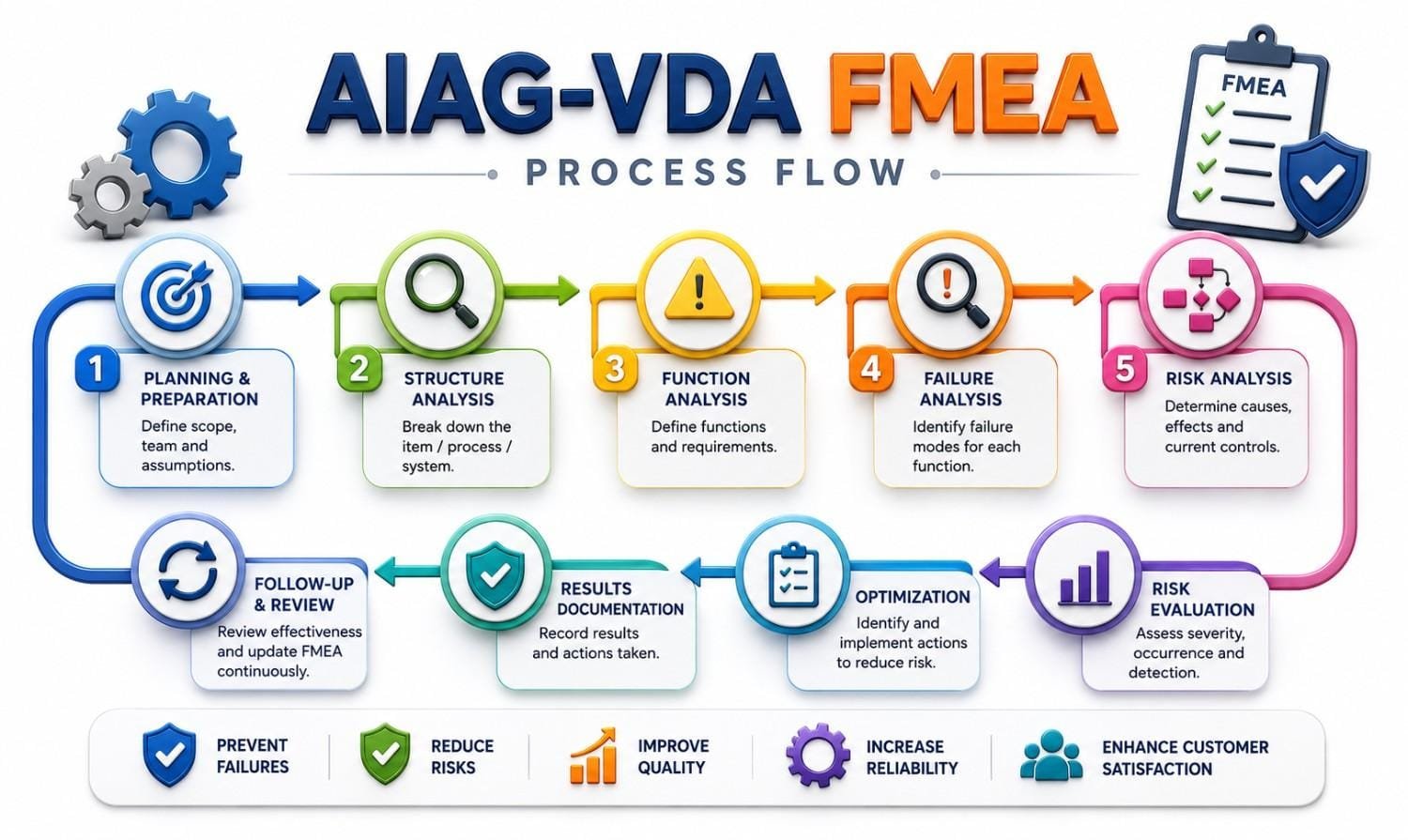
Before starting your journey, you don’t simply get into the car and hope everything goes well. You first decide where you’re going, plan your route, check the weather, inspect your vehicle, and think about what might go wrong along the way. Could you get lost? Could the car break down? Do you have enough fuel? Is there an alternative route if traffic becomes a problem? FMEA follows exactly the same philosophy.
Rather than waiting for problems to occur, it encourages teams to think ahead, identify potential risks, and address them while changes are still easy and inexpensive to implement. Let’s walk through each of the seven steps.
Step 1 – Planning & Preparation
Every successful FMEA begins with proper planning. Before identifying any risks, the team first defines the purpose of the analysis, its scope, customer requirements, assumptions, project boundaries, team members, and overall objectives.
For example, if you’re developing a new surgical instrument or an automotive braking system, you first need to decide which product, which subsystem, or which manufacturing process will be evaluated.
Think of this step as planning a vacation—you decide your destination before packing your bags.
Step 2 – Structure Analysis
Once the scope has been defined, the next step is to understand how the product or process is structured. The objective is to break down the product into logical levels such as systems, subsystems, assemblies, and individual components.
For example, if you’re analyzing a vehicle, you might divide it into:
- Braking System
- Steering System
- Engine
- Suspension
- Tires
Creating this structure helps everyone understand exactly where potential failures could occur.
Step 3 – Function Analysis
Every component, subsystem, and process step has one or more intended functions. Once the structure is clear, the next question is:
What is each part supposed to do?
For example:
- The braking system should stop the vehicle safely.
- The steering system should control vehicle direction.
- The cooling system should maintain the engine’s operating temperature.
From my experience, this step is often underestimated. However, if the team cannot clearly define the intended function, identifying meaningful failure modes later becomes extremely difficult.
Step 4 – Failure Analysis
This is where the real brainstorming begins. For every function identified in the previous step, the team asks a simple but powerful question:
How could this function fail?
Each potential failure is then analyzed by identifying:
- Failure Mode – What goes wrong?
- Failure Effect – What happens if it fails?
- Failure Cause – Why would it fail?
For example:
Function: Stop the vehicle safely
Failure Mode: Brake does not engage
Failure Effect: Vehicle cannot stop safely, increasing the risk of an accident.
Failure Cause: Hydraulic fluid leakage or damaged brake components.
At this stage, many teams also use quality tools such as the 5 Whys or Fishbone (Cause-and-Effect) Diagram to better understand the root causes behind each failure mode.
Step 5 – Risk Analysis
Not every failure carries the same level of risk. Some failures are minor inconveniences, while others may lead to serious safety issues or complete product failure. This step evaluates each failure using three important criteria:
- Severity (S): How serious would the consequence be?
- Occurrence (O): How likely is the failure to happen?
- Detection (D): How likely are existing controls to detect the problem before it reaches the customer?
These ratings help the team determine which risks require immediate attention.
Step 6 – Optimization
After identifying the highest-priority risks, the next step is simple: How can we reduce or eliminate them?
Possible improvement actions may include:
- Improving the product design
- Selecting better materials
- Adding mistake-proofing (Poka-Yoke)
- Introducing additional inspections
- Installing sensors or alarms
- Tightening manufacturing controls
- Updating work instructions
- Automating manual operations
This is where FMEA creates the greatest value. Instead of documenting risks, the team actively works to reduce them before they become customer problems.
Step 7 – Results Documentation
The final step is to document everything that has been learned throughout the FMEA.
This includes:
- Identified failure modes
- Risk evaluations
- Recommended improvement actions
- Responsibilities
- Completion dates
- Evidence of implementation
- Remaining (residual) risks after actions have been completed
A well-documented FMEA doesn’t just support compliance—it also becomes valuable knowledge for future projects and helps prevent the same mistakes from being repeated.
📚 Recommended Books for Professionals
Try removing one or more filters.
Key FMEA Terminology
Before you start creating an FMEA, it's important to understand the terminology. In my experience, many engineers struggle with FMEA not because the methodology is difficult, but because they confuse terms like Failure Mode, Effect, and Cause. Once you understand the relationship between these concepts, completing an FMEA becomes much more straightforward.
Failure Mode
A Failure Mode describes the specific way in which a product, component, system, or manufacturing process fails to perform its intended function.
During Design FMEA reviews, I always encourage teams to describe the failure mode as clearly and specifically as possible. A vague failure mode often leads to vague corrective actions.
Effect
The Effect describes what happens if the failure mode occurs. In other words, it explains the impact of the failure on the customer, the next manufacturing operation, or the overall system.
Ask yourself: "If this failure happens, what are the consequences?" The effect is what ultimately determines how serious the failure is.
Cause
The Cause explains why the failure mode occurred. It identifies the underlying reason or mechanism responsible for the failure.
One lesson I've learned over the years is that teams often jump directly to solutions before fully understanding the actual cause. Spending a little more time identifying the true cause almost always leads to better and more sustainable corrective actions.
Current Controls
Current Controls are the preventive or detection measures already in place to either stop the failure from occurring or identify it before the product reaches the customer.
The stronger your current controls, the lower the likelihood that a defective product will escape into the field.
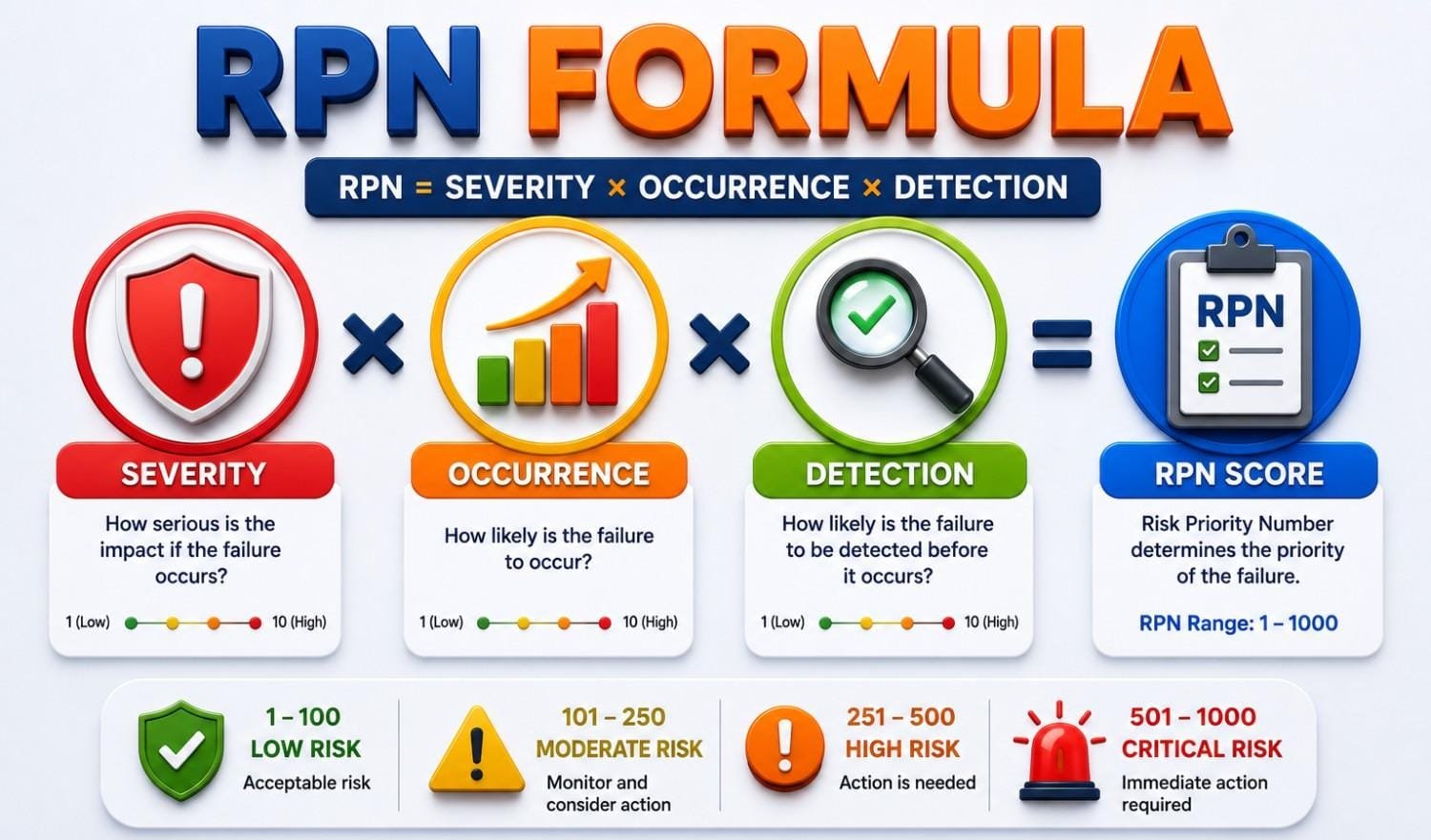
Severity (S)
Severity measures how serious the consequences would be if a failure occurred. It answers a very simple question: "If this failure reaches the customer, how severe would the impact be?"
Severity is typically rated on a scale from 1 to 10, where: 10 represents catastrophic failures involving safety or regulatory concerns. 1 represents little or no noticeable impact.
One important point that many beginners overlook is that Severity is based on the effect of the failure—not on how often it occurs.
Occurrence (O)
Occurrence estimates how likely the failure cause is to happen. Rather than evaluating the consequence, this rating focuses on the probability of the cause occurring during the expected life of the product or manufacturing process.
Occurrence is also rated from 1 to 10. Higher ratings indicate that the failure is expected to occur more frequently.
Detection (D)
Detection measures how likely your existing controls are to identify the failure before it reaches the customer.It answers the question: "How confident are we that we'll catch this problem in time?"
Detection is usually rated from 1 to 10, where: 1 means the failure is almost certain to be detected.
10 means it is very unlikely to be detected before reaching the customer.
From my experience, improving detection through better inspection methods, automated testing, or sensor-based monitoring can significantly reduce overall process risk.
Risk Priority Number (RPN)
Traditionally, FMEA used the Risk Priority Number (RPN) to prioritize risks. It is calculated using the following formula: RPN = Severity × Occurrence × Detection. The higher the RPN, the greater the overall risk and the stronger the need for improvement actions.
Although RPN remains widely used, it has some limitations because different combinations of ratings can produce the same numerical value while representing very different levels of risk.
Action Priority (AP)
To address these limitations, the AIAG-VDA FMEA Handbook introduced Action Priority (AP). Instead of relying only on a mathematical score, Action Priority evaluates the combination of Severity, Occurrence, and Detection to determine whether the risk requires High, Medium, or Low priority action.
In practice, I've found Action Priority much more useful than simply looking at the highest RPN values. It encourages engineering teams to focus first on failures with significant safety or customer impact, even if their calculated RPN isn't the highest.

Lean Six Sigma • Six Sigma • Statistics • Project Management • Artificial Intelligence (AI) • Operations Management • Quality Management
FMEA Template (Free Download)
📥 Download the FREE FMEA Excel Template to identify potential failure modes, assess risks, calculate RPN scores, and implement effective corrective actions that improve product quality, process reliability, and customer satisfaction.
FMEA Calculator (Free for Use)
📊 Use the FREE FMEA RPN Calculator to instantly calculate Risk Priority Numbers (RPN), evaluate risk levels, prioritize improvement opportunities, and identify failure modes that require corrective or preventive action to improve product quality, process reliability, and customer satisfaction.
📊 FMEA Risk Guidelines
Frequently Asked Questions (FAQ)
1. What is FMEA?
FMEA (Failure Mode and Effects Analysis) is a proactive risk assessment method used to identify potential failures, evaluate their impact, and prioritize actions to reduce or eliminate risks before they occur.
2. What does FMEA stand for?
FMEA stands for Failure Mode and Effects Analysis. It is a structured methodology used to analyze potential failure modes, their causes, and their effects on products, processes, or systems.
3. Why is FMEA important?
FMEA helps organizations prevent failures before they happen, improving product quality, safety, reliability, customer satisfaction, and reducing manufacturing costs.
4. What are the 7 steps of FMEA?
The AIAG-VDA FMEA process includes Planning & Preparation, Structure Analysis, Function Analysis, Failure Analysis, Risk Analysis, Optimization, and Results Documentation.
5. What is DFMEA?
Design FMEA (DFMEA) identifies potential design-related failures during product development to improve product reliability before manufacturing begins.
6. What is PFMEA?
Process FMEA (PFMEA) evaluates manufacturing or assembly processes to identify potential process failures and implement preventive controls.
7. What is RPN?
Risk Priority Number (RPN) is a numerical value used in FMEA to prioritize risks based on Severity, Occurrence, and Detection ratings.
8. How do you calculate RPN?
RPN is calculated using the formula: RPN = Severity × Occurrence × Detection
9. What is Severity?
Severity measures how serious the consequences of a failure are if it occurs. Higher severity ratings indicate greater impact on safety, quality, or customer satisfaction.
10. What is Occurrence?
Occurrence estimates how likely a specific failure cause is to happen. A higher occurrence rating indicates a greater probability of failure.
11. What is Detection?
Detection measures how likely existing controls are to detect a failure before it reaches the customer. Lower detection capability results in a higher detection rating.
12. What is Action Priority?
Action Priority (AP) is the AIAG-VDA method for prioritizing corrective actions based on Severity, Occurrence, and Detection instead of relying solely on the RPN value.
13. Is FMEA Lean Six Sigma?
FMEA is not a Lean Six Sigma methodology by itself, but it is a widely used quality and risk management tool within Lean Six Sigma, APQP, and continuous improvement projects.
14. Which industries use FMEA?
FMEA is widely used in automotive, aerospace, medical devices, manufacturing, electronics, defense, energy, healthcare, and industrial engineering to improve quality and reduce risk.
15. What is the difference between DFMEA and PFMEA?
DFMEA focuses on preventing failures caused by product design, while PFMEA focuses on preventing failures caused by manufacturing or assembly processes.
16. Is AIAG-VDA different from traditional FMEA?
Yes. AIAG-VDA FMEA introduces a standardized 7-step approach and replaces RPN-based decision-making with Action Priority (AP) to improve risk assessment and consistency across industries.
Conclusion
After working on numerous product development and Design Assurance projects throughout my career, one thing has become very clear to me: the earlier you identify a potential problem, the easier—and less expensive—it is to fix. That's exactly why FMEA continues to be one of the most valuable quality and risk management tools available today.
FMEA is much more than a worksheet or a compliance requirement. When used effectively, it encourages engineers, designers, manufacturing teams, and quality professionals to think proactively instead of reactively. Rather than waiting for customer complaints, product failures, or costly recalls, FMEA helps teams ask the right questions early in the design and manufacturing process, when changes are still practical and affordable.
I've participated in many FMEA reviews where a simple discussion uncovered a design weakness or process risk that could easily have gone unnoticed until much later. Those experiences reinforced an important lesson: the greatest value of FMEA doesn't come from calculating RPNs or assigning scores—it comes from the conversations, collaboration, and critical thinking that happen during the analysis.
Whether you're performing a Design FMEA (DFMEA), Process FMEA (PFMEA), System FMEA, Use FMEA, or Software FMEA, the objective remains the same—to identify potential failures before they become real problems and implement actions that improve quality, safety, reliability, and customer satisfaction.
If you're just beginning your FMEA journey, don't worry about creating the "perfect" FMEA. Focus first on understanding your product or process, asking the right questions, and involving the right people. Like many quality tools, FMEA becomes more valuable with practice and experience.
I hope this guide has helped you understand not only what FMEA is, but also why it remains one of the most widely used preventive quality tools across industries worldwide.
If you found this article helpful, be sure to download the free FMEA Excel Template and Automotive FMEA Example provided below. They're designed to help you apply these concepts in real-world projects and make your first FMEA much easier to create.
In quality engineering, success is rarely measured by the problems we solve—it's measured by the problems we prevent. FMEA gives us the opportunity to prevent those problems before they ever reach our customers, and that's what makes it such a powerful engineering tool.
Continue Your Learning Journey
Learning is a continuous process. Explore related topics, practical guides, tools, calculators, templates, and learning resources to expand your knowledge and develop new skills.
Choose a category below to explore practical tutorials, tools, calculators, templates, case studies, and learning resources.
Recommended Learning Resources
Expert-led courses to build practical skills, earn credentials, and advance your career.
Recommended professional books, certification guides, and practical study resources.
Ready-to-use templates, checklists, guides, and workbooks for practical applications.
Interactive calculators for statistics, quality, engineering, analysis, and decision-making.
Interactive Z, t, Chi-Square, and F tables with critical values and distribution curves.
Discover practical tutorials, case studies, and professional resources across Quality, Lean Six Sigma, Project Management, Statistics, AI, and Data Analytics.
Published: July 8, 2026
Last Updated: September 18, 2026