What is Quality Function Deployment (QFD) and House of Quality: From Voice of Customer to Product Design
Many organizations invest significant time, money, and engineering effort into developing new products, yet not every technically impressive product succeeds in the market. In many cases, the challenge is not technical capability but ensuring that development decisions consistently reflect what customers truly value.
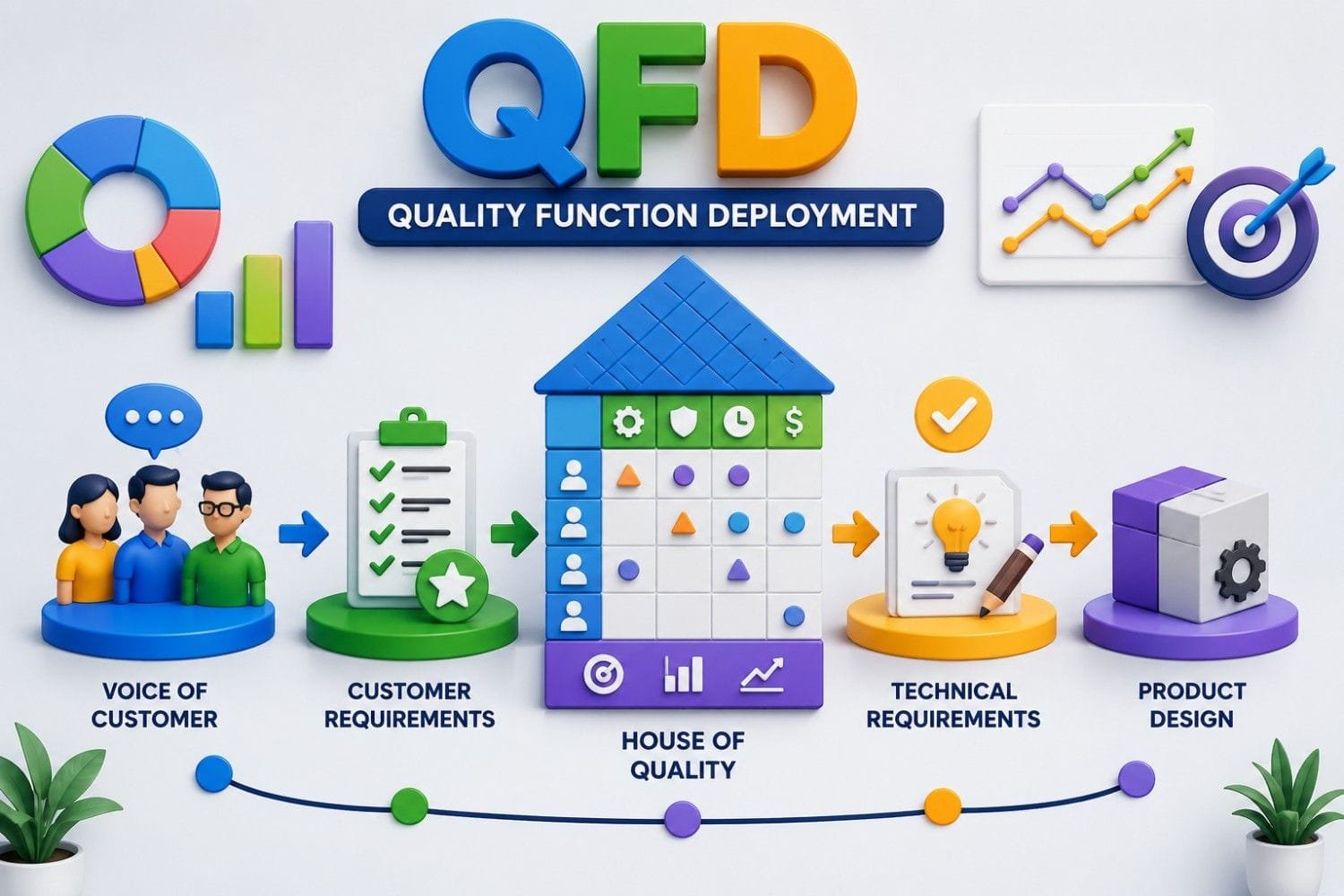
The most successful companies understand that customer expectations must remain at the center of product development from concept through launch. When customer needs, business goals, and engineering decisions are aligned, organizations are more likely to create products that deliver meaningful value and achieve long-term success.
To achieve this alignment, organizations need a structured way to translate customer expectations into actionable decisions throughout the design and development process. This is where Quality Function Deployment (QFD) becomes an important part of modern product development and quality planning.
Why Many Products Fail Despite Good Engineering
Many products fail not because of poor engineering, but because they solve the wrong problem. Over the years, while studying product development methodologies and reviewing real-world case studies, one lesson has become clear to me: a technically excellent product does not automatically become a successful product. I’ve seen projects where teams invested significant time and effort into creating products that met every technical specification, yet customers remained disappointed because the design overlooked what mattered most to them.
The root cause is often a disconnect between customer expectations and engineering decisions. Engineers naturally focus on performance, reliability, and technical excellence, while customers judge a product by how well it solves their problem and delivers value. When these perspectives are not aligned, even the most sophisticated product can struggle in the market.
This is where Quality Function Deployment (QFD) makes a real difference. Instead of relying on assumptions, QFD provides a structured approach to transform the Voice of the Customer (VOC) into measurable design and engineering requirements. Its most recognized tool, the House of Quality (HOQ), helps teams ensure that every important design decision is driven by customer priorities rather than internal opinions.
In this guide, you’ll learn how QFD and the House of Quality bridge the gap between customer expectations and product design, helping organizations develop products that are not only technically sound but also valued by the people who use them.
What is Quality Function Deployment (QFD)?
When I first learned about Quality Function Deployment (QFD), I thought it was simply another quality management technique. After exploring it in real product development and quality improvement projects, I realized that QFD is much more than a tool—it’s a way of ensuring that every important design decision begins with the customer rather than assumptions. In my experience, many product issues can be traced back to one simple mistake: teams focus on what they can build instead of what customers actually value.
Quality Function Deployment (QFD) is a structured method used to translate customer needs into product or service design requirements. Instead of relying on opinions or guesswork, QFD provides a systematic process for identifying customer priorities and converting them into technical specifications that engineering, design, manufacturing, and quality teams can all work toward. The most widely used tool in this methodology is the House of Quality (HOQ)—a matrix that visually links customer requirements with technical characteristics, helping teams prioritize features, evaluate design trade-offs, and make customer-focused decisions throughout product development.
QFD was developed in Japan in the late 1960s by quality pioneers Yoji Akao and Shigeru Mizuno. Their objective was straightforward but transformative: prevent costly design changes by understanding customer expectations before engineering work begins. Rather than treating customer feedback as something collected after a product launch, QFD made it the starting point of the entire design process. The approach proved highly successful in Japanese manufacturing, particularly in the automotive industry, and eventually became a globally recognized methodology used across manufacturing, healthcare, software, consumer products, and service organizations.
One of the biggest lessons I’ve taken from QFD is that successful products are rarely the result of better engineering alone—they are the result of better understanding. QFD helps organizations answer one fundamental question before a single design decision is made:
In most cases, the problem is not poor engineering—it’s a disconnect between what customers want and what companies build. And this is exactly the gap that Quality Function Deployment (QFD) aims to solve. QFD is not just a quality tool—it is a thinking approach that ensures:
How do we convert what customers want into a product or service they truly value?
👉 QFD answers one critical question: “How do we convert what customers want into something we can design and build?”
Why Quality Function Deployment Matters
One lesson I’ve learned from working on quality improvement and product development projects is that the costliest mistakes rarely happen during manufacturing—they happen much earlier, when teams misunderstand what customers actually need. I’ve seen technically sound products pass every design review and performance test, only to receive disappointing customer feedback because they solved the wrong problem. That experience showed me why Quality Function Deployment (QFD) is more than a quality tool; it’s a customer-focused way of making better design decisions.
QFD matters because it transforms the Voice of the Customer (VOC) into clear, measurable engineering requirements. Instead of relying on assumptions, personal opinions, or the loudest voice in the meeting, it gives every team—from design and engineering to manufacturing and quality—a shared understanding of what customers value most. This alignment reduces costly redesigns, improves collaboration, and keeps development focused on features that make a meaningful difference.
What I appreciate most about QFD is the change in mindset it creates. Rather than asking, “What can we build?”, teams begin asking, “What problem are we solving for the customer?” That simple shift often leads to smarter priorities, better products, and higher customer satisfaction. In today’s competitive market, where customer expectations evolve quickly, this ability to design with the customer in mind is one of the biggest advantages an organization can have.
What is the House of Quality (HOQ)?
When I worked with the House of Quality (HOQ), I expected it to be just another complex engineering matrix. What surprised me wasn’t the diagram itself, but how quickly it changed the discussion within the team. Instead of debating which features to add, everyone started asking a better question: Which customer requirement does this design decision support? That simple shift made our decisions far more focused and objective.
The House of Quality (HOQ) is the core planning tool used in Quality Function Deployment (QFD). It translates the Voice of the Customer (VOC) into measurable technical requirements, ensuring that customer expectations directly influence product design. Customer needs are listed on one side of the matrix, while technical characteristics appear across the top. By linking the two, the House of Quality helps teams identify which engineering efforts will have the greatest impact on customer satisfaction.
The name comes from its distinctive house-shaped layout. The triangular “roof” shows how technical requirements support or conflict with one another, helping teams recognize design trade-offs before development progresses too far. Although the matrix may appear detailed at first, its purpose is straightforward: connect every important engineering decision to a real customer need.
From my experience, the greatest value of the House of Quality is not the matrix itself—it’s the clarity it brings. It aligns engineering, quality, manufacturing, marketing, and product teams around a shared understanding of customer priorities. Rather than building the most technically impressive product, teams learn to build the product that delivers the greatest value to the customer. That’s why the House of Quality remains one of the most practical and effective tools in modern product development.
🎓 Top-Rated Courses & Certifications
Try changing your filters or searching for another course.
How to Build a House of Quality Step-by-Step
The first time I built a House of Quality (HOQ), I assumed the hardest part would be completing the matrix. I was wrong. The real challenge was understanding the customer well enough to make every entry meaningful. We initially focused on technical specifications and design ideas, but the exercise only became valuable once we stepped back and organized the Voice of the Customer (VOC). That experience taught me an important lesson: a successful House of Quality is built on customer insight, not engineering assumptions.
Although the House of Quality may look complex, the process is straightforward when approached step by step. It begins with identifying customer requirements, then translating those needs into measurable technical characteristics, evaluating their relationships, analyzing design trade-offs, and setting priorities for product development. Each stage builds on the previous one, creating a clear link between what customers expect and what engineers design.
From my experience, the House of Quality delivers the greatest value when teams use it as a decision-making framework rather than a documentation exercise. The goal is not to complete every box in the matrix—it is to ensure that every important design decision can be traced back to a genuine customer need. In the following steps, I’ll show you how to build a House of Quality from scratch using a practical, real-world approach that you can apply to any product or service.
Filling out a House of Quality involves a systematic process of gathering information, analyzing data, and translating customer requirements into technical design parameters. Here are the general steps to fill out a House of Quality:
Step 1: Identify the Voice of the Customer (VOC)
Every House of Quality (HOQ) starts with the Voice of the Customer (VOC). Before thinking about features, specifications, or technical solutions, you need to understand what customers truly value. From my experience, this is the step teams underestimate the most. I’ve worked on projects where everyone was confident they knew what customers wanted, but when we reviewed interviews, complaints, and service feedback, the real priorities were surprisingly different. That taught me a simple lesson: never design based on assumptions.
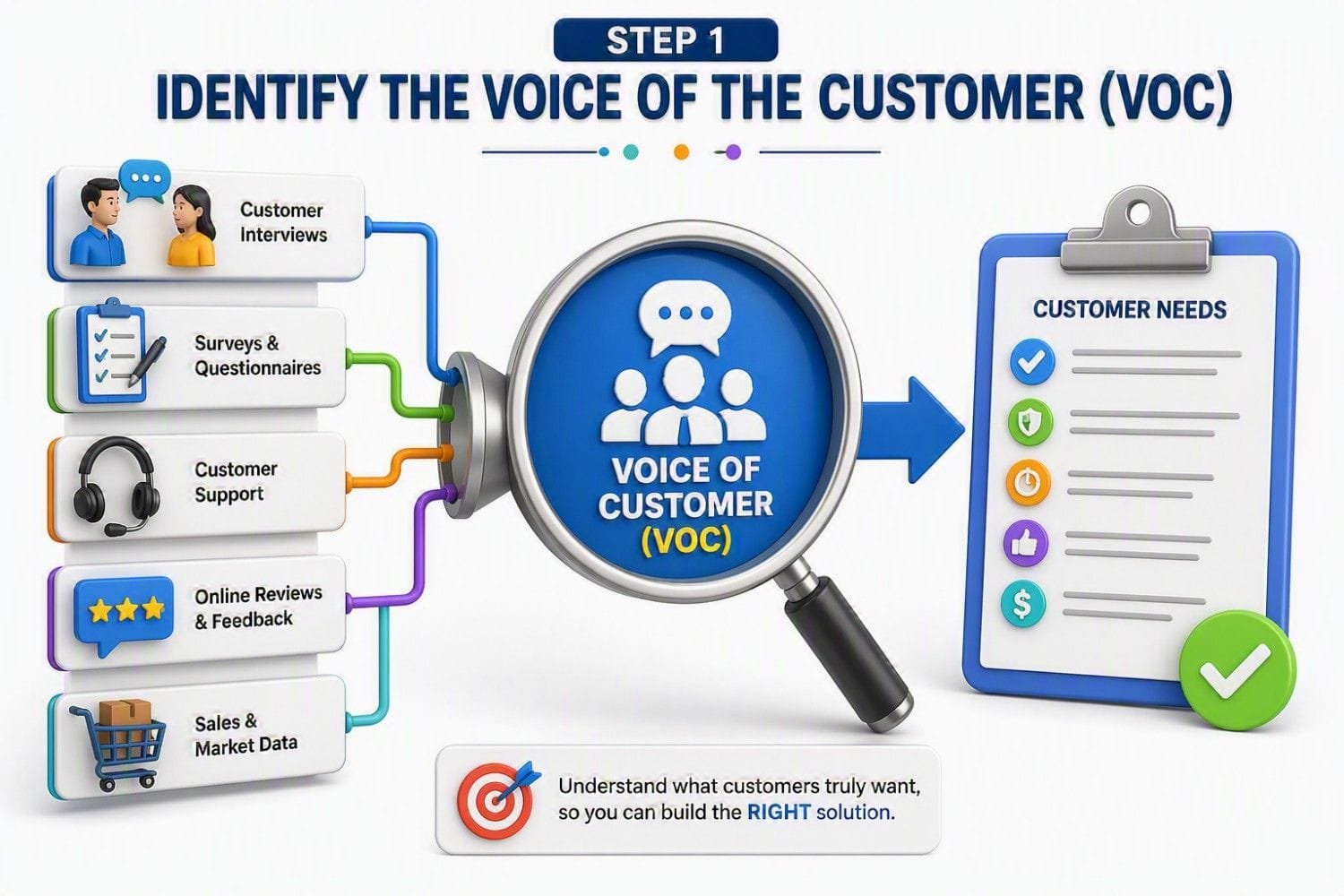
Gather customer insights from interviews, surveys, product reviews, complaints, warranty data, customer support, sales teams, or direct observation. Capture feedback in the customer’s own words rather than translating it into technical language too early. For example, a customer might say, “The product is too heavy” or “It takes too long to set up.” Those statements become the foundation for every decision that follows.
The goal of this step is straightforward: listen first, design later. The better you understand the customer at the beginning, the more effective your House of Quality will be.
Step 2: List and Prioritize Customer Requirements
After collecting the Voice of the Customer (VOC), the next step is to organize similar feedback into a clear list of customer requirements, often called the “Whats” in Quality Function Deployment (QFD). From my experience, this is where scattered comments begin to tell a meaningful story. I’ve seen teams struggle with hundreds of survey responses and customer complaints, but once similar ideas were grouped together, the priorities became much easier to understand.
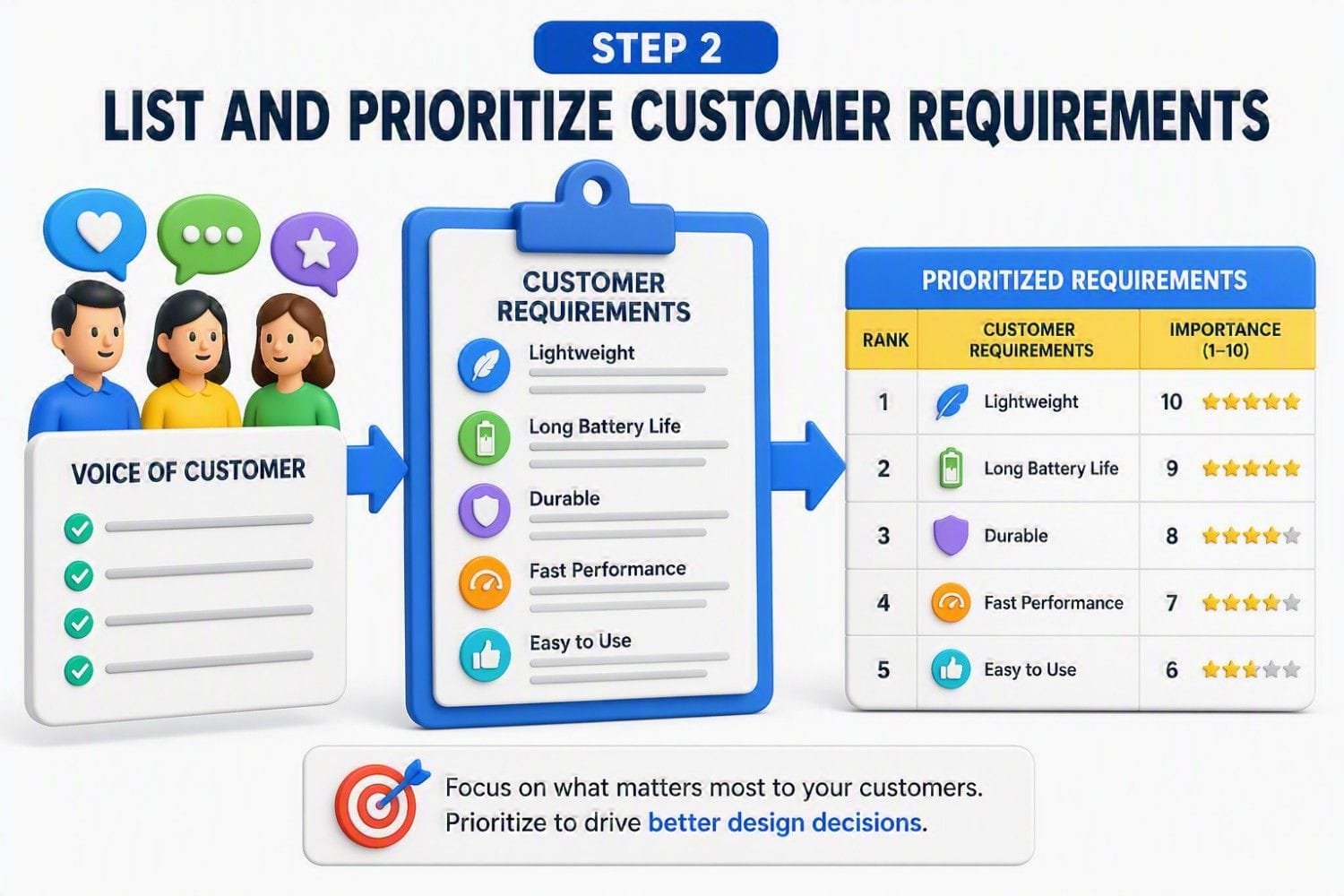
Write each requirement from the customer’s perspective rather than as a technical solution. For example, comments such as “It’s too heavy,” “It’s difficult to carry,” and “I want something more portable” can be combined into a single requirement like Portable and lightweight. This keeps the list concise while preserving what customers are really asking for.
A clear set of customer requirements provides a strong foundation for the rest of the House of Quality (HOQ). The better you organize customer feedback at this stage, the easier it becomes to translate those expectations into measurable engineering and design requirements.
Step 3: Define Technical Requirements (The “Hows”)
Once customer requirements are clearly defined, the next step is to identify how they will be achieved. In Quality Function Deployment (QFD), these are known as the “Hows”—the measurable technical characteristics that translate customer expectations into engineering actions.
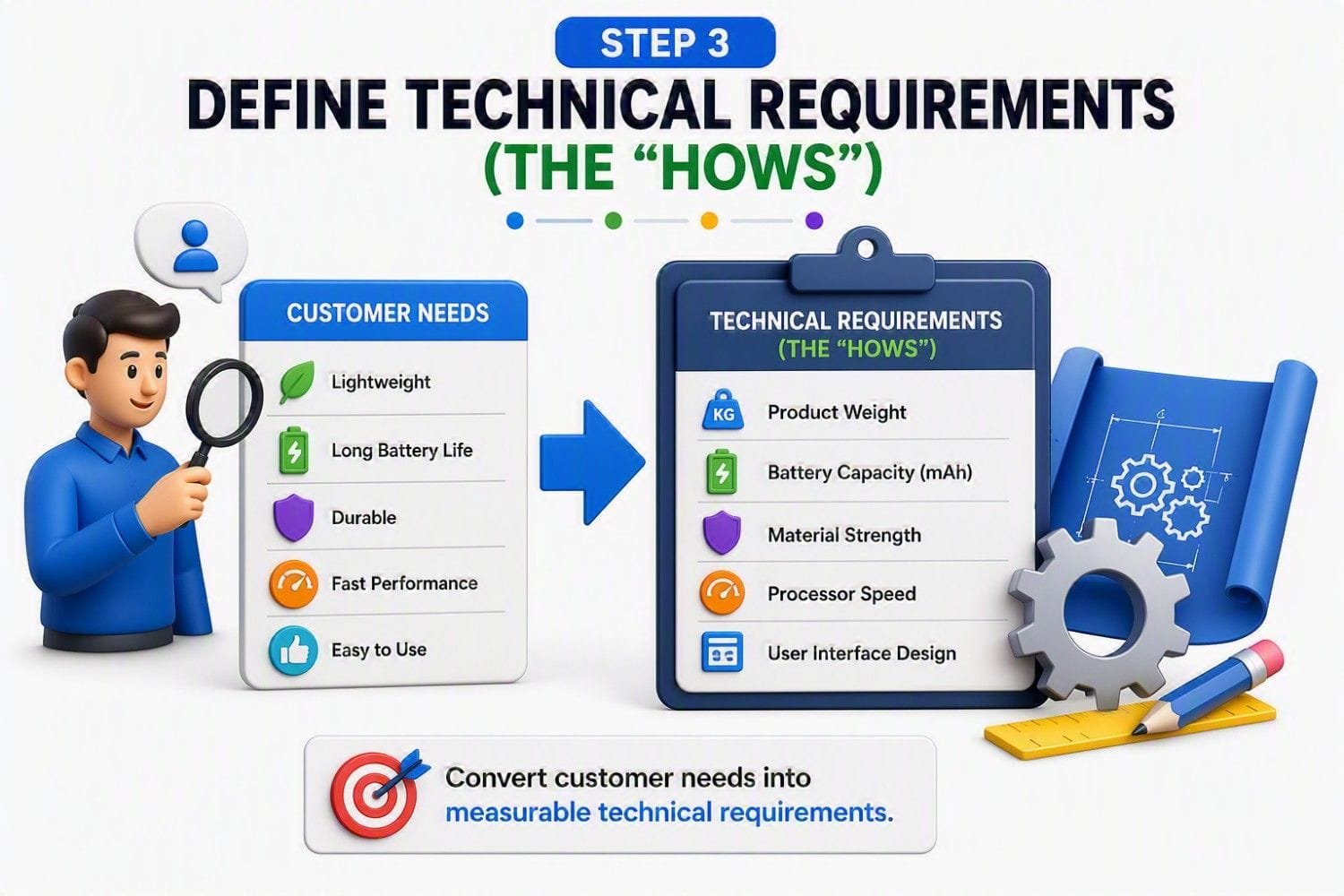
From my experience, this is where many teams rush into discussing design solutions. I’ve found it more effective to first define what can be measured. For example, if customers want a product that is lightweight, the technical characteristic might be product weight. If they expect long battery life, it could be battery capacity or power consumption. By expressing requirements in measurable terms, teams can design, test, and improve them objectively.
For example:
These requirements should be measurable whenever possible because measurable characteristics are easier to design, test, and control. The goal is to create a clear link between what customers want and how the organization will deliver it. Well-defined technical requirements provide a strong foundation for the relationship matrix in the next step of the House of Quality (HOQ).
Step 4: Build the Relationship Matrix
The Relationship Matrix is the core of the House of Quality (HOQ) because it connects customer requirements (the “Whats”) with technical requirements (the “Hows”). This is where you evaluate how strongly each technical characteristic contributes to meeting a specific customer need. From my experience, this step often changes a team’s perspective. I’ve seen features that seemed important during design discussions turn out to have very little impact on what customers actually valued.
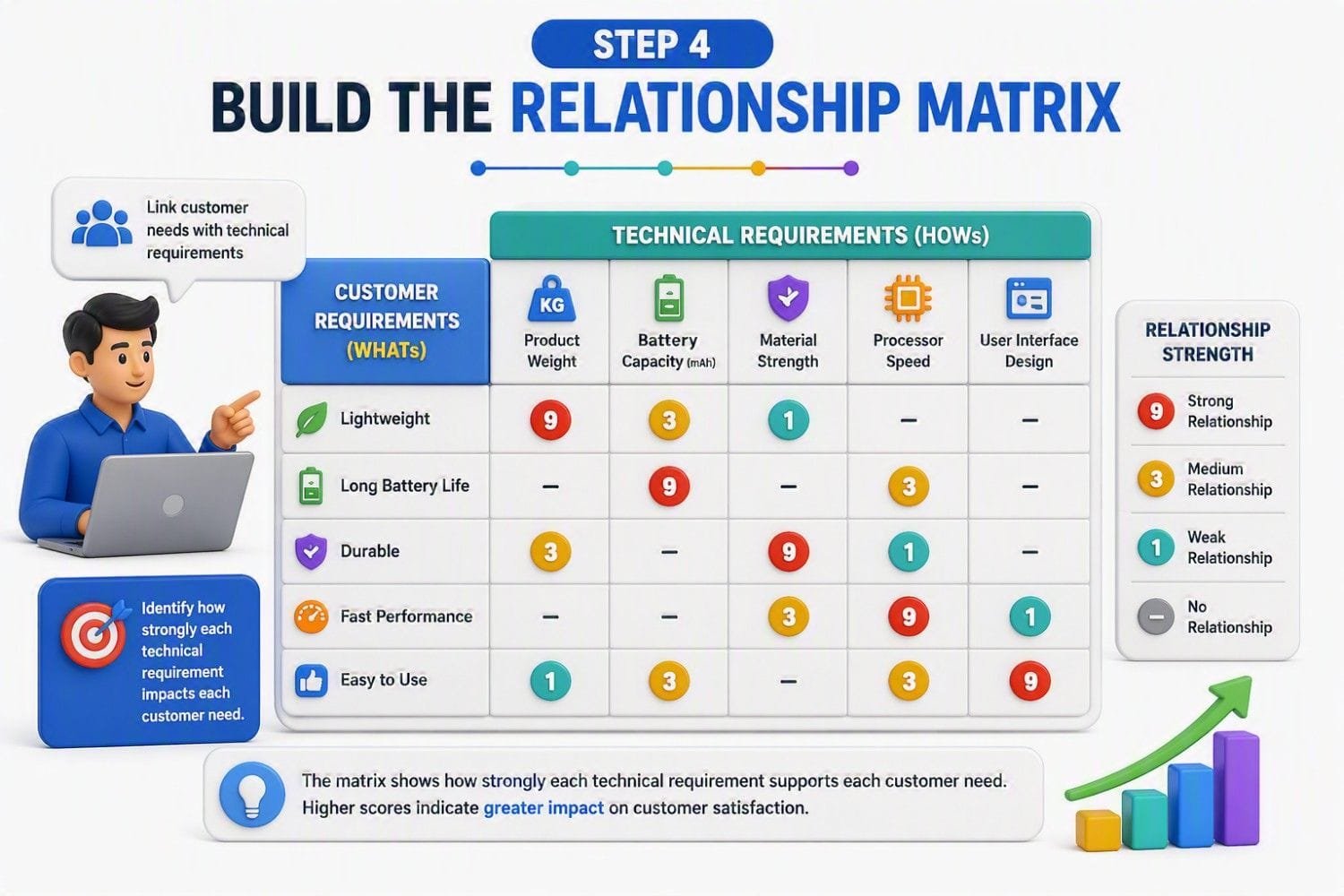
Each intersection is assigned a relationship rating—typically Strong (9), Medium (3), Weak (1), or No Relationship (blank). For example, if customers want long battery life, battery capacity would have a strong relationship, while product color might have no relationship. These ratings help identify which technical characteristics deserve the highest priority.
The real value of the relationship matrix isn’t the scores themselves—it’s the discussion behind them. It encourages cross-functional teams to justify design decisions with customer needs instead of assumptions. By the end of this step, you have a clear picture of where engineering effort will create the greatest value for the customer.
Step 5: Complete the Roof of the House
The Roof of the House is the triangular section at the top of the House of Quality (HOQ). It compares the technical requirements with one another to identify where they support or conflict with each other. From my experience, this is one of the most overlooked parts of the HOQ, yet it’s often where the biggest design risks become visible. I’ve seen teams optimize one technical characteristic, only to realize later that it negatively affected another important requirement.
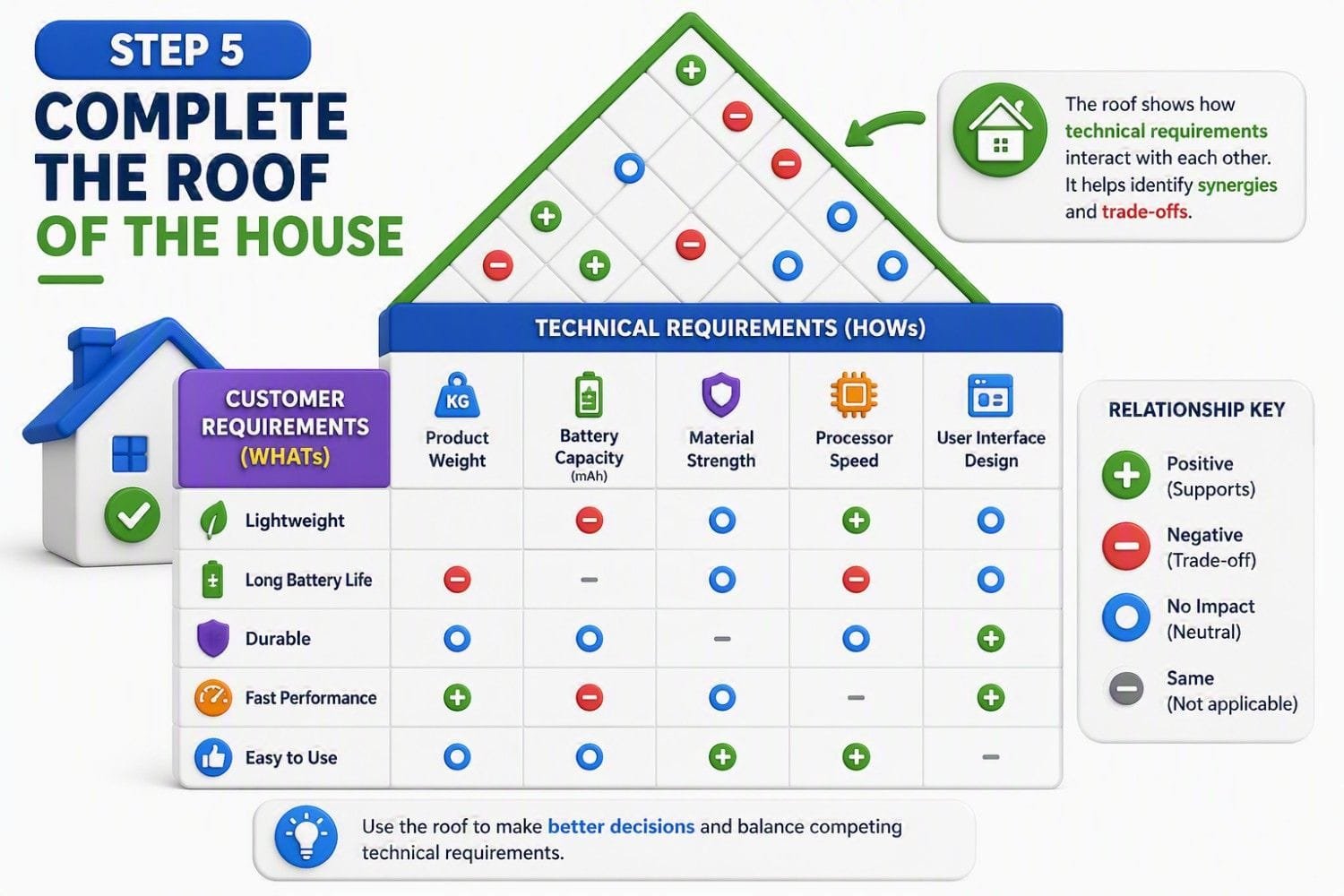
For example, increasing battery capacity may improve battery life, but it can also increase product weight. Similarly, using stronger materials may improve durability while raising manufacturing cost. By identifying these relationships early, teams can evaluate trade-offs before investing time and resources in product development.
The roof acts as an early warning system for engineering decisions. Instead of optimizing each technical requirement in isolation, it helps teams find the right balance between performance, cost, manufacturability, and customer expectations. In my experience, spending a little more time on this step often prevents expensive redesigns later in the project.
Step 6: Benchmark against Competitors
A product is never judged on its own—customers always compare it with other available options. That’s why competitive benchmarking is an essential step in the House of Quality (HOQ). The objective isn’t to copy competitors, but to understand where your product performs well, where it falls short, and where you can create meaningful value.
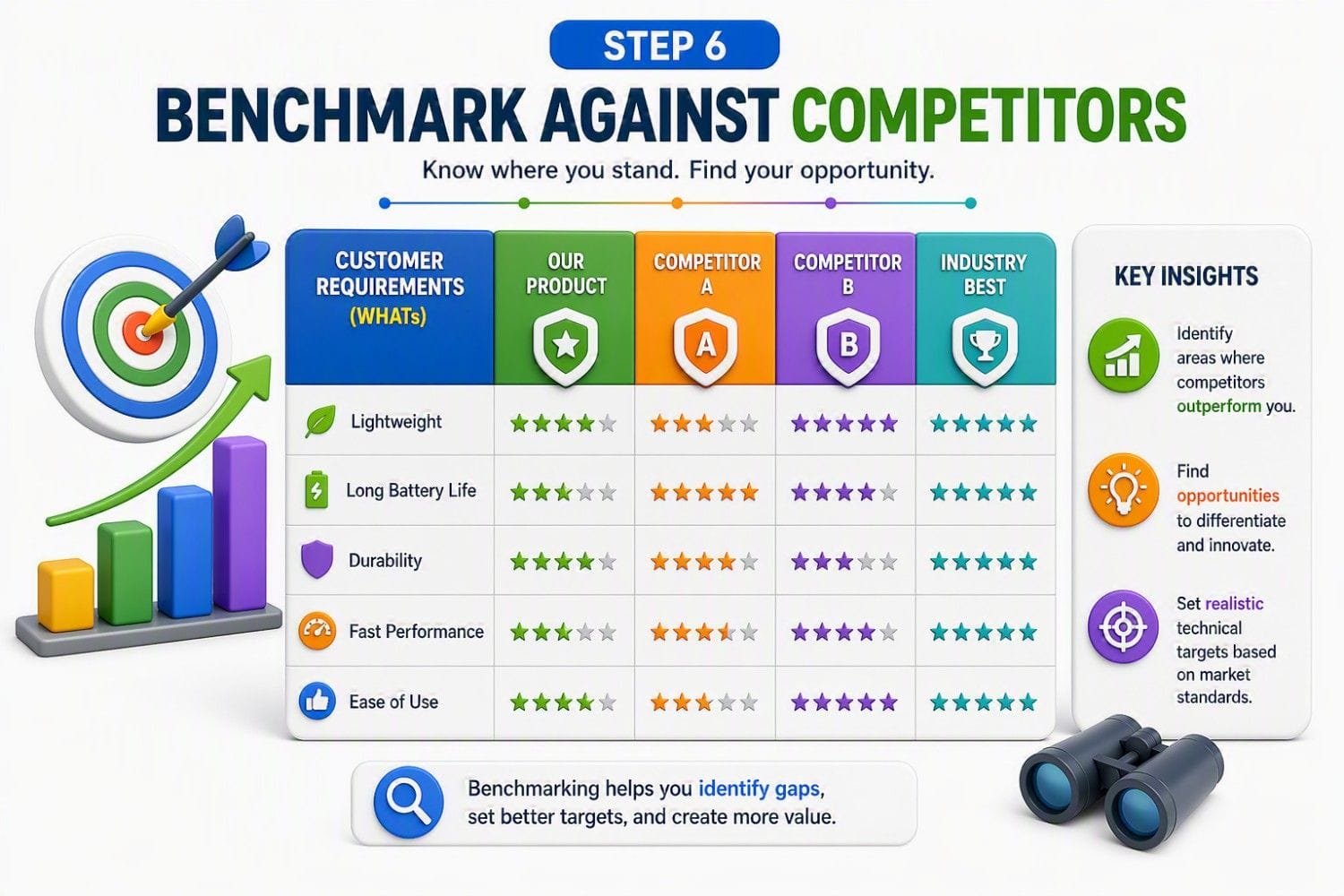
From my experience, this step has challenged many of my own assumptions. I’ve worked on projects where we were confident our product was superior because it met every internal specification. However, once we compared it with competing products using actual customer feedback, we discovered that customers cared far more about ease of use and reliability than the advanced features we had spent months developing. That insight completely changed our improvement priorities.
Compare your product and competing products against the same customer requirements, such as reliability, durability, ease of use, performance, or delivery time. The gaps you identify become opportunities for improvement, while your strengths become areas to maintain and build upon.
The biggest lesson I’ve learned is that customers don’t compare specifications—they compare experiences. Competitive benchmarking keeps product development focused on delivering a better customer experience rather than simply building more features.
Step 7: Set Technical Targets
Once the technical requirements are defined, the next step is to set clear, measurable targets for each one. This is where customer expectations become engineering goals. From my experience, I’ve seen projects struggle simply because objectives were too vague. Statements like “make it lighter” or “improve reliability” sound useful, but they leave too much room for interpretation. Clear targets give every team a common definition of success.
| 👥 Customer Requirement | ⚙️ Technical Characteristic | 🎯 Target |
|---|---|---|
| Lightweight Design | Product Weight | < 1.2 kg |
| Long Battery Life | Battery Capacity | > 12 Hours |
| High Reliability | Failure Rate | < 0.5% |
| Easy Setup | Installation Time | < 5 Minutes |
| Fast Performance | Response Time | < 2 Seconds |
For example, instead of “improve battery life,” set a target such as battery life ≥ 12 hours. Instead of “reduce product weight,” define product weight ≤ 1.2 kg. Every target should be measurable, realistic, and based on customer priorities, competitive benchmarking, and technical feasibility—not internal assumptions alone.
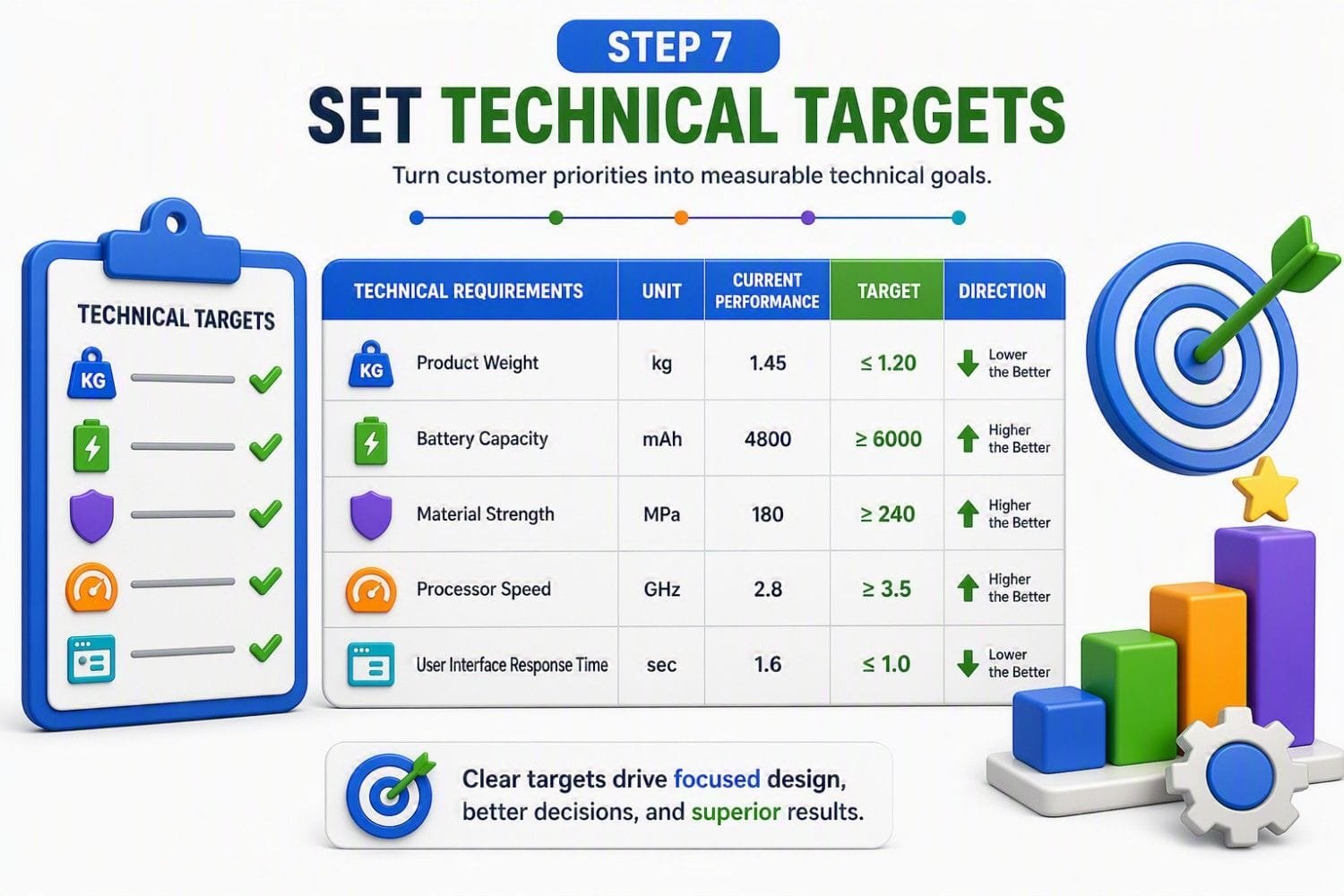
One lesson I’ve learned is that customer requirements provide direction, but technical targets provide focus. Well-defined targets help engineering, manufacturing, and quality teams make consistent decisions, monitor progress, and verify that the final product delivers the value customers expect.
Step8: Review, Prioritize, and Take Action
Completing the House of Quality (HOQ) isn’t the finish line—it’s where the real work begins. Review the completed matrix to identify the technical requirements that have the greatest impact on high-priority customer needs. Since every organization has limited time and resources, focus on the improvements that will create the biggest difference instead of trying to fix everything at once.
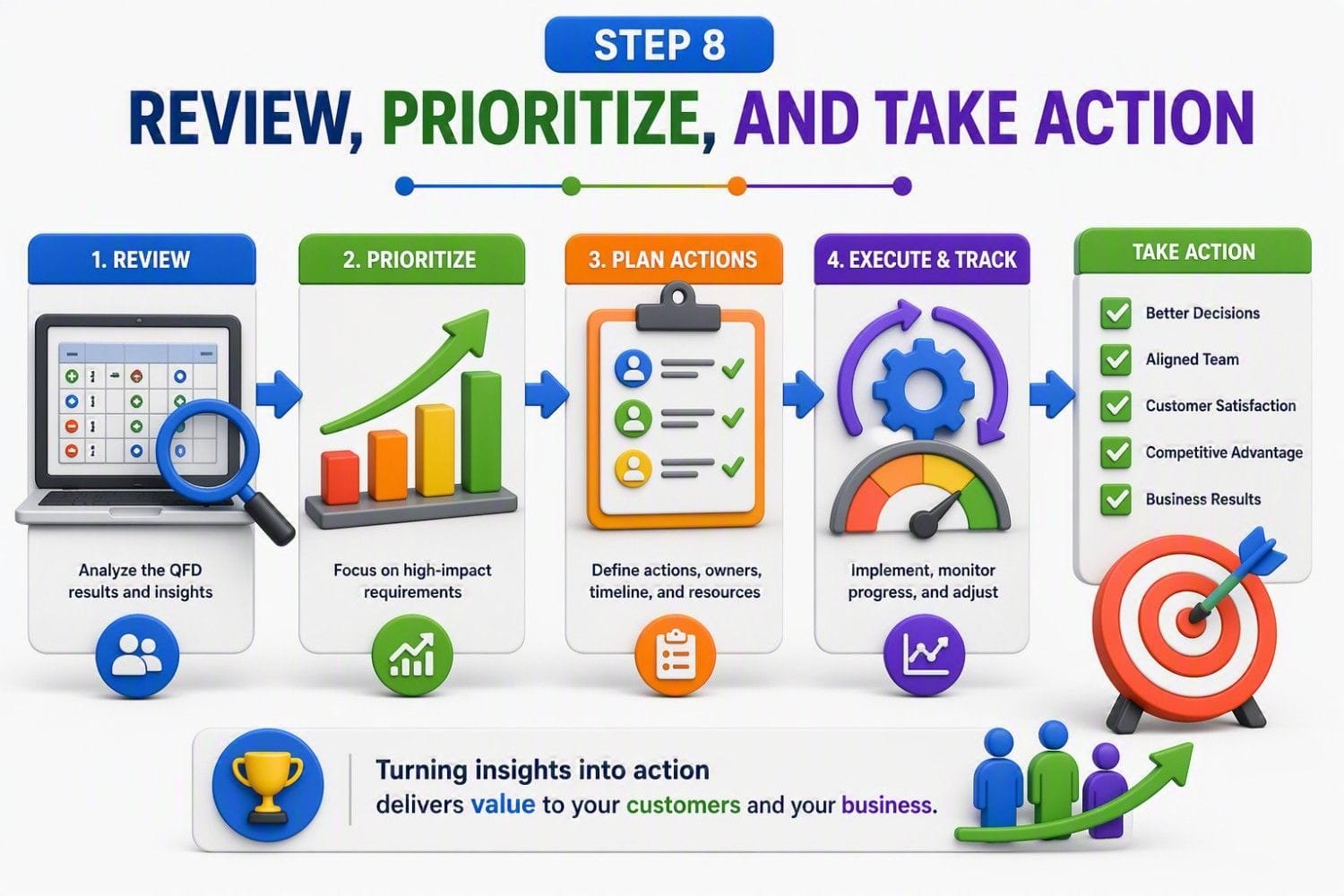
From my experience, this is the stage where QFD proves its value. I’ve worked on projects where the team generated dozens of improvement ideas, but the House of Quality showed that only a few would significantly improve customer satisfaction. That shifted our discussions from “What can we improve?” to “What will customers value most?” and helped us invest our effort where it mattered.
The final step is to turn those priorities into action. Assign ownership, set implementation plans, and use the House of Quality to guide design and business decisions. A completed matrix has little value unless it drives real improvements. The true success of QFD lies not in building the House of Quality, but in using it to create products that customers genuinely value.
📚 Recommended Books for Professionals
Try removing one or more filters.
Quality Function Deployment (QFD) and the House of Quality
When I first learned Quality Function Deployment (QFD), I assumed the House of Quality (HOQ) was the entire methodology. It wasn't until I used QFD in product improvement projects that I realized the House of Quality is just one part of a much bigger process. Building the matrix is important, but the real value comes from the discussions and decisions it drives.
Simply put, QFD is the overall methodology for translating the Voice of the Customer (VOC) into product and process requirements, while the House of Quality is the primary tool used to make that translation visible. It links customer requirements (the "Whats") with technical requirements (the "Hows"), helping teams focus their engineering effort on what customers value most.
From my experience, the best teams don't treat the House of Quality as a document to complete—they use it as a decision-making tool. I've seen it replace assumptions with facts and align engineering, quality, manufacturing, and marketing around the same customer priorities. A simple way to remember the difference is this: QFD is the strategy; the House of Quality is the tool that puts that strategy into action.
QFD Template: Translating Customer Needs into Product Design
📥 Download the Quality Function Deployment (QFD) Template Toolkit and start translating customer needs into measurable product design requirements using a practical House of Quality (HOQ), Voice of Customer (VOC), competitor benchmarking, and technical target-setting framework.

Lean Six Sigma • Six Sigma • Statistics • Project Management • Artificial Intelligence (AI) • Operations Management • Quality Management
Frequently Asked Question (FAQ)
What is QFD in simple terms?
QFD is a method to convert customer needs into product design requirements.
What is House of Quality?
HOQ is a matrix used in QFD to map customer needs to technical features.
Why is QFD important?
It ensures products meet customer expectations effectively.
What is the difference between QFD and HOQ?
QFD is the methodology, while HOQ is a tool used within QFD.
Where is QFD used?
It is used in manufacturing, product development, and service design.
Is QFD only for manufacturing?
No, it can be used in services like healthcare and banking.
What is the main objective of QFD?
The main objective of QFD is to ensure that customer needs are accurately translated into product or service design.
What are “WHATs” and “HOWs” in House of Quality?
“WHATs” represent customer requirements, while “HOWs” represent technical solutions to meet those requirements.
Why is House of Quality important in QFD?
It visually connects customer expectations with design decisions, helping teams focus on what matters most. [umbrex.com]
How does QFD improve customer satisfaction?
By directly using customer feedback in design, QFD ensures that the final product meets real expectations.
What is the role of the relationship matrix in HOQ?
It shows how strongly each technical requirement affects each customer need.
Can QFD be applied to services?
Yes, QFD can be used in services like banking, healthcare, and customer support to improve quality outcomes.
What industries commonly use QFD?
QFD is widely used in manufacturing, automotive, electronics, healthcare, and product design industries. [projectmanager.com]
What is the biggest advantage of using QFD early in design?
It reduces redesign efforts and ensures that the product aligns with customer needs from the start.
How does HOQ help in teamwork?
It provides a shared framework where different departments can collaborate and align on customer requirements.
What happens if QFD is not used?
Organizations may design products based on assumptions, leading to customer dissatisfaction and redesign costs.
Conclusion
Quality Function Deployment (QFD) and the House of Quality (HOQ) bring one very powerful idea into practical use:
👉 Build your product based on what customers truly want—not what you assume they want. In today’s competitive world, success is not just about innovation or advanced technology. It is about understanding the customer better than anyone else and delivering exactly what matters to them. QFD makes this possible by creating a clear link between Customer expectations, Product design and Technical execution.
It ensures that customer needs are not lost in translation as a product moves from idea to final output.
The House of Quality strengthens this approach by acting like a visual roadmap, helping teams:
When used correctly, QFD and HOQ: Reduce costly redesigns,Improve product quality, Align teams across functions, Increase customer satisfaction.
But the real value goes beyond tools and matrices.
👉 It changes the mindset. Instead of saying:
❌ “This is what we think is best”. Organizations start saying:
✅ “This is what our customers truly need”
Continue Your Learning Journey
Learning is a continuous process. Explore related topics, practical guides, tools, calculators, templates, and learning resources to expand your knowledge and develop new skills.
Choose a category below to explore practical tutorials, tools, calculators, templates, case studies, and learning resources.
Recommended Learning Resources
Expert-led courses to build practical skills, earn credentials, and advance your career.
Recommended professional books, certification guides, and practical study resources.
Ready-to-use templates, checklists, guides, and workbooks for practical applications.
Interactive calculators for statistics, quality, engineering, analysis, and decision-making.
Interactive Z, t, Chi-Square, and F tables with critical values and distribution curves.
Discover practical tutorials, case studies, and professional resources across Quality, Lean Six Sigma, Project Management, Statistics, AI, and Data Analytics.
Published: June 29, 2023
Last Updated: September 18, 2026