What is Push vs Pull System in Manufacturing: How Modern Manufacturing Systems Work
Walk through almost any factory, and you’ll find the same challenge: How do you produce enough to meet customer demand without creating excess inventory, long lead times, or unnecessary waste?
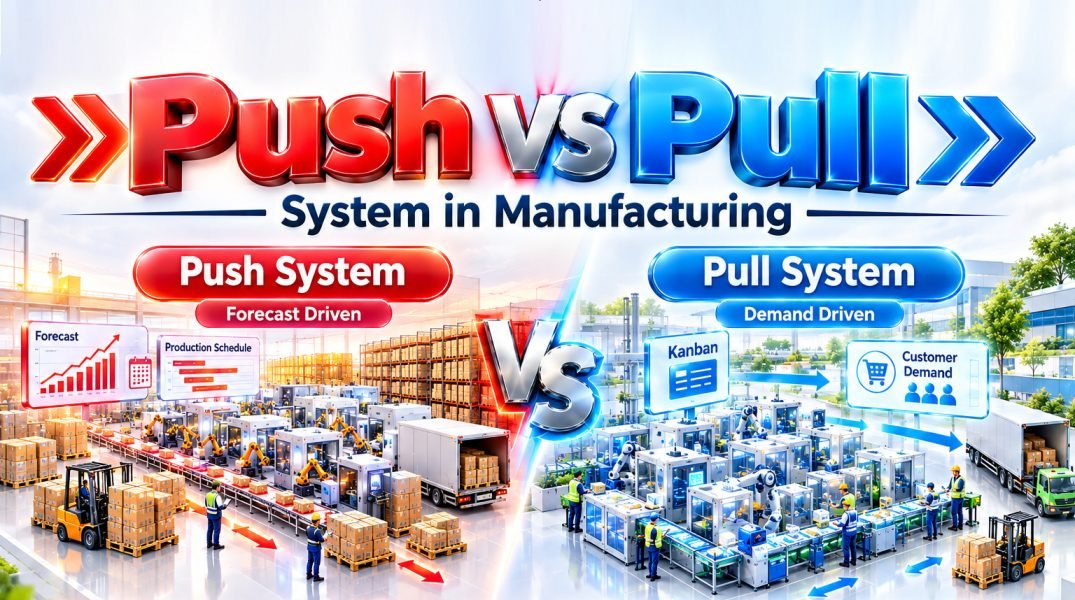
The answer often comes down to the production system a company follows. Some manufacturers build products based on demand forecasts, while others produce only when there is a real need from a customer or the next process. These two approaches are known as Push and Pull manufacturing systems.
The distinction may sound simple, but it has a significant impact on inventory levels, production planning, operational costs, customer responsiveness, and overall business performance. In my experience working with manufacturing and quality teams, many production problems, including excess inventory, stock shortages, delayed deliveries, and inefficient workflows, can often be traced back to how material and information flow through the organization.
As manufacturing continues to evolve, companies are moving beyond the traditional “produce more” mindset. The focus today is on producing the right product, at the right time, in the right quantity, while maintaining flexibility and controlling costs. This is why concepts such as Lean Manufacturing, demand-driven production, and supply chain optimization have become critical business strategies.
Understanding Push and Pull systems is not just important for production planners. It is equally valuable for engineers, operations managers, quality professionals, supply chain teams, and continuous improvement practitioners because these systems influence how effectively an organization responds to customer demand and changing market conditions.
In the following sections, we’ll explore how Push and Pull systems work, how they differ, where each approach is most effective, and why many successful manufacturers use a combination of both to achieve the best balance between efficiency and responsiveness.
What is a Push System in Manufacturing?
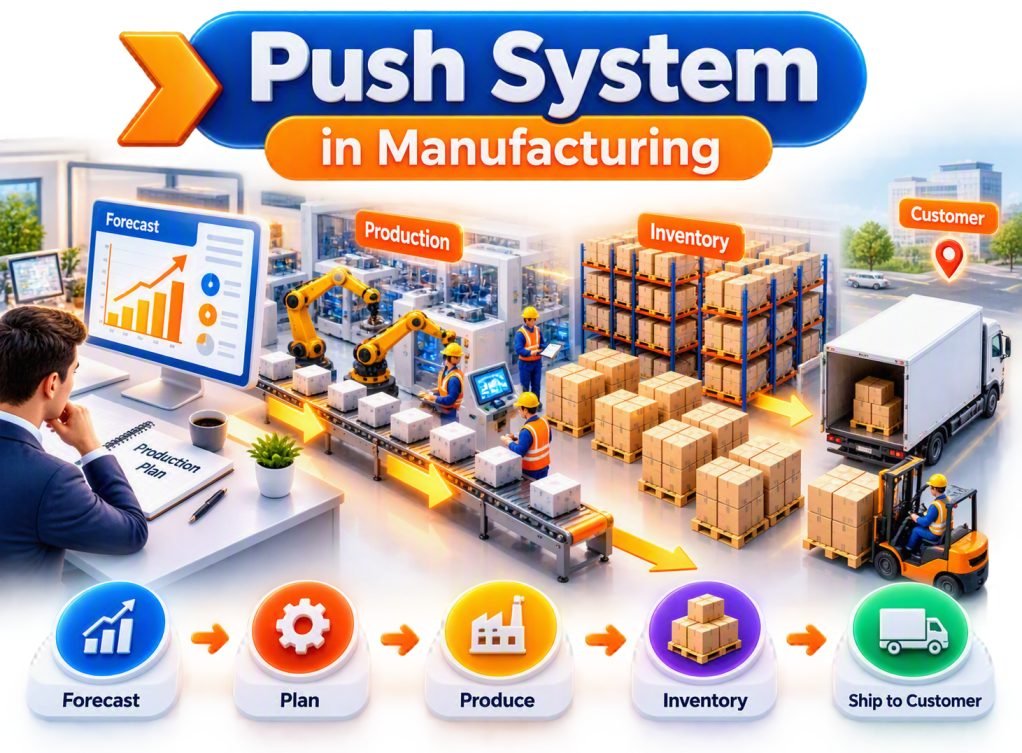
A Push System in Manufacturing is a production method where products are made based on forecasted demand rather than actual customer orders. Companies use sales forecasts, historical trends, and production plans to determine what to produce, how much to produce, and when production should begin. The flow typically follows this sequence:
In other words, products are manufactured first and then pushed through the supply chain in anticipation of future demand.
A push system starts with a demand forecast. That forecast is converted into production schedules, material requirements, machine capacity plans, and workforce allocations. Each process works according to the schedule, producing output regardless of whether the next process or customer currently needs it.
This approach is commonly supported by Material Requirements Planning (MRP), production planning, and inventory management systems. It is especially useful when production lead times are long, demand is relatively predictable, or products must be available immediately when customers place orders.
For example, a soft drink manufacturer may increase production before the summer season based on expected market demand. Likewise, electronics companies often build inventory ahead of new product launches to avoid shortages.
The biggest advantage of a push system is product availability. When forecasts are accurate, companies can meet customer demand quickly without waiting for production to start after an order arrives.
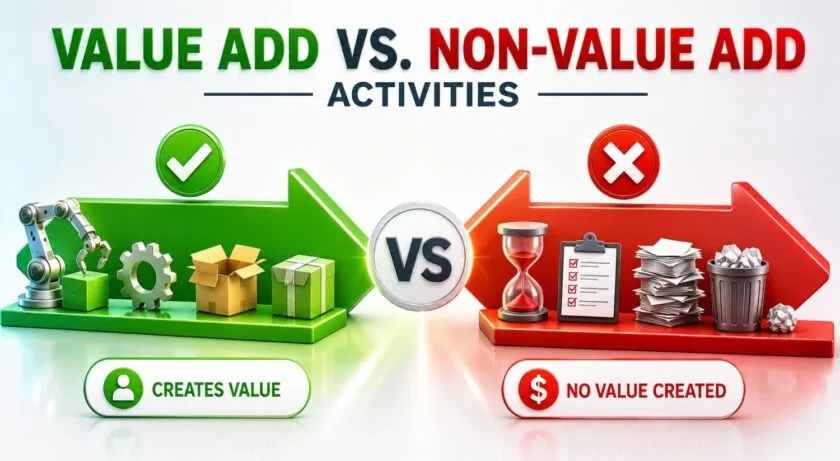
However, the system is only as good as the forecast behind it. If demand is overestimated, excess inventory can accumulate, increasing storage costs and tying up working capital. In many organizations, this excess inventory becomes a major source of waste, which is why Lean practitioners focus heavily on improving flow and eliminating non-value-added activities. For readers interested in Lean principles, our guides on Lean Manufacturing and Value-Added vs. Non-Value-Added Activities provide additional insights.
What is a Pull System in Manufacturing?
A Pull System in Manufacturing is a production approach where products are made only when there is actual demand from a customer or the next process. Instead of producing based on forecasts, production is triggered by real consumption. The basic flow is :
This demand-driven approach helps manufacturers produce only what is needed, when it is needed, and in the required quantity. As a result, inventory levels are typically lower, waste is reduced, and production stays closely aligned with customer requirements.In a pull system, production begins only after a demand signal is received. That signal may come from a customer order, a downstream workstation, or a replenishment trigger such as a Kanban card.
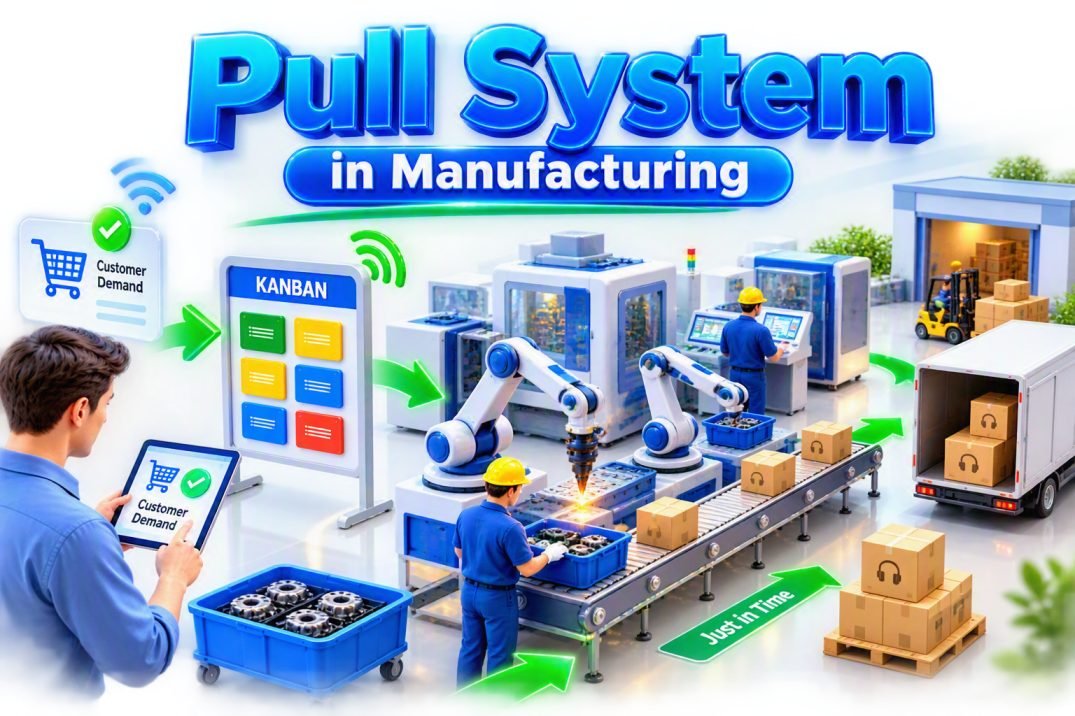
For example, when a process consumes materials, it sends a signal to the upstream process to replenish exactly what was used. This creates a continuous flow of materials based on actual consumption rather than planned forecasts.
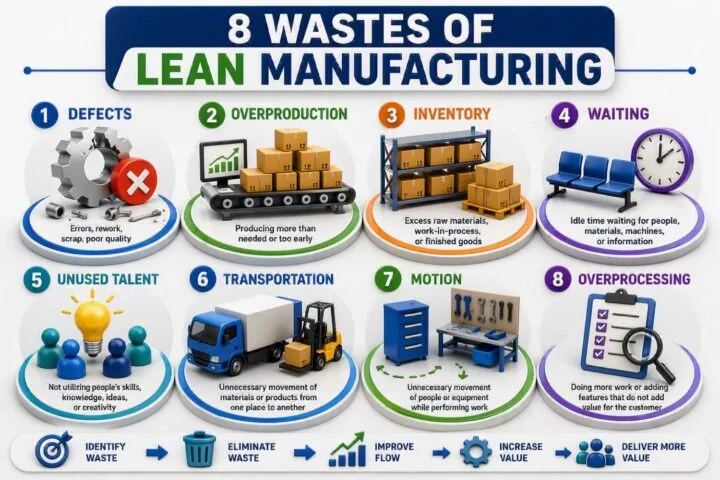
Pull systems are a core element of Lean Manufacturing and support the Just-in-Time (JIT) philosophy. Tools such as Value Stream Mapping are often used to identify bottlenecks, excess inventory, and delays that prevent smooth flow. The main benefit of a pull system is that it helps eliminate overproduction, one of the most expensive forms of waste identified in the 8 Wastes of Lean Manufacturing.
🎓 Top-Rated Courses & Certifications
Try changing your filters or searching for another course.
Push vs Pull System: Key Differences
The main difference between push and pull manufacturing is what triggers production. A push system primarily uses forecasts and planned schedules to determine what should be produced. A pull system uses actual consumption or demand signals to determine when replenishment or production should happen.
| Factor | Push Push System | Pull Pull System |
|---|---|---|
| Production Trigger | Forecast or production plan | Actual customer demand or consumption |
| Production Approach | Produce based on expected requirements | Produce or replenish based on actual need |
| Inventory | Greater potential for inventory buildup | Designed to limit unnecessary inventory |
| Planning | Forecast-driven | Demand-driven |
| Material Flow | Output is pushed to the next process | Downstream demand signals upstream activity |
| Response to Demand Changes | May require production schedule adjustments | More directly linked to current consumption |
| Typical Application | Stable or predictable demand | Variable demand and replenishment environments |
| Common Tools | Production schedules, MRP, and forecasts | Kanban and other pull signals |
| System | Details |
|---|---|
| Production Trigger | |
| Push | Forecast or production plan |
| Pull | Actual customer demand or consumption |
| Production Approach | |
| Push | Produce based on expected requirements |
| Pull | Produce or replenish based on actual need |
| Inventory | |
| Push | Greater potential for inventory buildup |
| Pull | Designed to limit unnecessary inventory |
| Planning | |
| Push | Forecast-driven |
| Pull | Demand-driven |
| Material Flow | |
| Push | Output is pushed to the next process |
| Pull | Downstream demand signals upstream activity |
| Response to Demand Changes | |
| Push | May require production schedule adjustments |
| Pull | More directly linked to current consumption |
| Typical Application | |
| Push | Stable or predictable demand |
| Pull | Variable demand and replenishment environments |
| Common Tools | |
| Push | Production schedules, MRP, and forecasts |
| Pull | Kanban and other pull signals |
When Should You Use a Push or Pull System?
Choosing between a Push System and a Pull System is not about deciding which one is better. It is about selecting the approach that best matches your demand patterns, production process, lead times, and inventory strategy.
A simple question can help guide the decision:
Are you producing based on what you expect customers to need, or replenishing what customers have already consumed?
When Should You Use a Push System?
A Push System is often the right choice when demand is predictable and production must be planned in advance. Use a Push System when:
- Demand is stable and forecast accuracy is high.
- Products require long manufacturing or procurement lead times.
- Large production batches reduce overall costs.
- Materials, equipment, and labor must be scheduled well ahead of time.
- Products must be available immediately when customers place orders.
For example, manufacturers producing seasonal products often build inventory before peak demand periods to avoid shortages.
When Should You Use a Pull System?
A Pull System works best when production can respond quickly to actual demand and inventory needs to be tightly controlled. Use a Pull System when:
- 1 Customer demand changes frequently.
- 2 Inventory carrying costs are significant.
- 3 Product variety is high.
- 4 Production processes are stable and repeatable.
- 5 The organization is implementing Lean Manufacturing or Just-in-Time (JIT) practices.
- Customer demand changes frequently.
- Inventory carrying costs are significant.
- Product variety is high.
- Production processes are stable and repeatable.
- The organization is implementing Lean or Just-in-Time practices.
Many companies use tools such as Kanban to create clear replenishment signals and Value Stream Mapping to improve flow and remove unnecessary inventory. When demand is predictable, Push can be highly effective. When demand is uncertain or inventory reduction is a priority, Pull often delivers better results. For many organizations, the optimal solution lies somewhere in between.
Can a Manufacturing System Use Both Push and Pull?
Yes. In fact, many manufacturers achieve the best results by combining Push and Pull principles within the same production system. A factory rarely operates under a pure Push or pure Pull model from end to end.
The reason is simple: different parts of the manufacturing process have different planning requirements. Long supplier lead times, material availability, and capacity constraints often require forecast-based planning, while day-to-day production can be driven by actual demand.
A simplified example might look like:
Planning
Preparation
Production
Assembly
For example, a manufacturer may purchase raw materials months in advance based on demand forecasts but use a Kanban system to trigger replenishment between workstations. This helps maintain material availability while avoiding unnecessary inventory buildup.
📚 Recommended Books for Professionals
Try removing one or more filters.
Push vs Pull Manufacturing: A Real-World Example
Imagine a company that manufactures wireless earbuds. A new product launch is approaching, and the sales team predicts demand of 50,000 units over the next month.
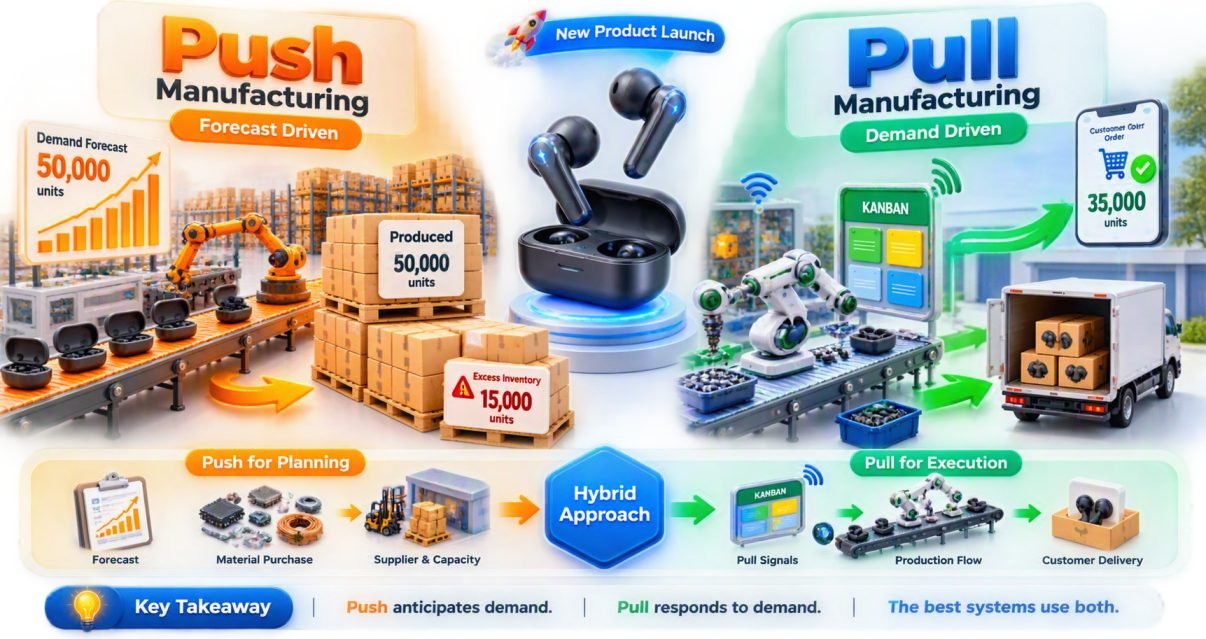
In a Push Manufacturing environment, the company acts on that forecast immediately. Raw materials are purchased, production schedules are created, and all 50,000 units are produced before customer orders arrive. If the forecast is accurate, products are ready to ship. But if actual demand reaches only 35,000 units, the remaining 15,000 units sit in inventory, tying up warehouse space and cash.
Now imagine the same factory using a Pull Manufacturing system. Instead of producing the entire forecasted quantity upfront, production begins only as inventory is consumed or customer demand triggers a replenishment signal. When stock levels reach a predefined limit, a Kanban signal authorizes the next batch. The factory produces only what is needed, helping prevent excess inventory while staying aligned with real demand.
The most successful approach often combines both methods. The company may use forecasts to purchase components, reserve supplier capacity, and plan production resources, while using Pull signals to control flow on the shop floor. This creates a balance between planning and flexibility, which is one of the key objectives of Lean Manufacturing.
The lesson is simple: A Push System tries to anticipate customer demand, while a Pull System responds to actual demand. The most effective manufacturers know when to use each approach and where they create the most value within the production process.
Frequently Asked Question (FAQs)
Q: What is Push Manufacturing?
Push Manufacturing produces products based on forecasts and expected demand before customer orders are received.
Q: What is Pull Manufacturing?
Pull Manufacturing produces products only when actual customer demand or consumption triggers replenishment.
Q: What is the main difference between Push and Pull systems?
Push is forecast-driven, while Pull is demand-driven.
Q: Which system reduces inventory more effectively?
Pull systems typically reduce inventory because production is linked to actual demand.
Q: Which system is used in Lean Manufacturing?
Lean Manufacturing primarily supports Pull systems to minimize waste and overproduction.
Q: What is an example of a Push System?
Producing seasonal products ahead of expected demand is a common Push approach.
Q: What is an example of a Pull System?
Replenishing inventory only after a Kanban signal or customer order is a Pull approach.
Q: Can a company use both Push and Pull systems?
Yes. Many manufacturers use a hybrid model that combines Push planning with Pull-based production control.
Q: What are the advantages of Push Manufacturing?
It helps ensure product availability and supports long-term production planning.
Q: What are the advantages of Pull Manufacturing?
It reduces excess inventory, improves responsiveness, and minimizes overproduction.
Q: What is the biggest risk of Push Manufacturing?
Incorrect forecasts can result in excess inventory and higher storage costs.
Q: What is the biggest challenge of Pull Manufacturing?
It requires stable processes, reliable suppliers, and timely replenishment signals.
Q: How does Kanban support a Pull System?
Kanban provides a visual or digital signal that triggers replenishment only when materials are needed.
Q: Can Pull Manufacturing eliminate all inventory?
No. Most organizations still maintain safety stock, but Pull systems help keep inventory at optimal levels.
Q: Why do many manufacturers prefer a hybrid Push-Pull approach?
A hybrid approach balances forecast-based planning with the flexibility to respond to actual customer demand.
Key Takeaways
Push Manufacturing produces products based on forecasts and expected demand, making it ideal when demand is predictable and products must be available quickly. Pull Manufacturing produces products based on actual customer demand or consumption, helping reduce inventory, overproduction, and waste. Push systems typically prioritize production efficiency and product availability, while Pull systems focus on inventory control and responsiveness.
Kanban is one of the most widely used tools for implementing a Pull System because it triggers replenishment only when materials are needed. Most modern manufacturers do not rely entirely on either approach. Instead, they use a hybrid model that combines Push planning with Pull-based execution. The right choice depends on factors such as demand variability, lead times, inventory costs, production flexibility, and customer expectations. Ultimately, the goal is not to choose Push or Pull, but to create the most effective flow of materials and information throughout the value stream.
In simple terms: Push Manufacturing produces because demand is expected, while Pull Manufacturing produces because demand already exists.

Continue Your Learning Journey
Learning is a continuous process. Explore related topics, practical guides, tools, calculators, templates, and learning resources to expand your knowledge and develop new skills.
Choose a category below to explore practical tutorials, tools, calculators, templates, case studies, and learning resources.
Recommended Learning Resources
Expert-led courses to build practical skills, earn credentials, and advance your career.
Recommended professional books, certification guides, and practical study resources.
Ready-to-use templates, checklists, guides, and workbooks for practical applications.
Interactive calculators for statistics, quality, engineering, analysis, and decision-making.
Interactive Z, t, Chi-Square, and F tables with critical values and distribution curves.
Discover practical tutorials, case studies, and professional resources across Quality, Lean Six Sigma, Project Management, Statistics, AI, and Data Analytics.
Published: September 28, 2026
Last Updated: September 28, 2026