TPM (Total Productive Maintenance): How World-Class Manufacturers Eliminate Equipment Downtime and Improve OEE
Total Productive Maintenance (TPM) is a proven approach that helps organizations maximize equipment effectiveness, reduce unplanned downtime, and improve productivity. Unlike traditional maintenance programs, TPM involves operators, maintenance teams, and management in maintaining and improving equipment performance. Its primary goal is to eliminate equipment losses and increase Overall Equipment Effectiveness (OEE).
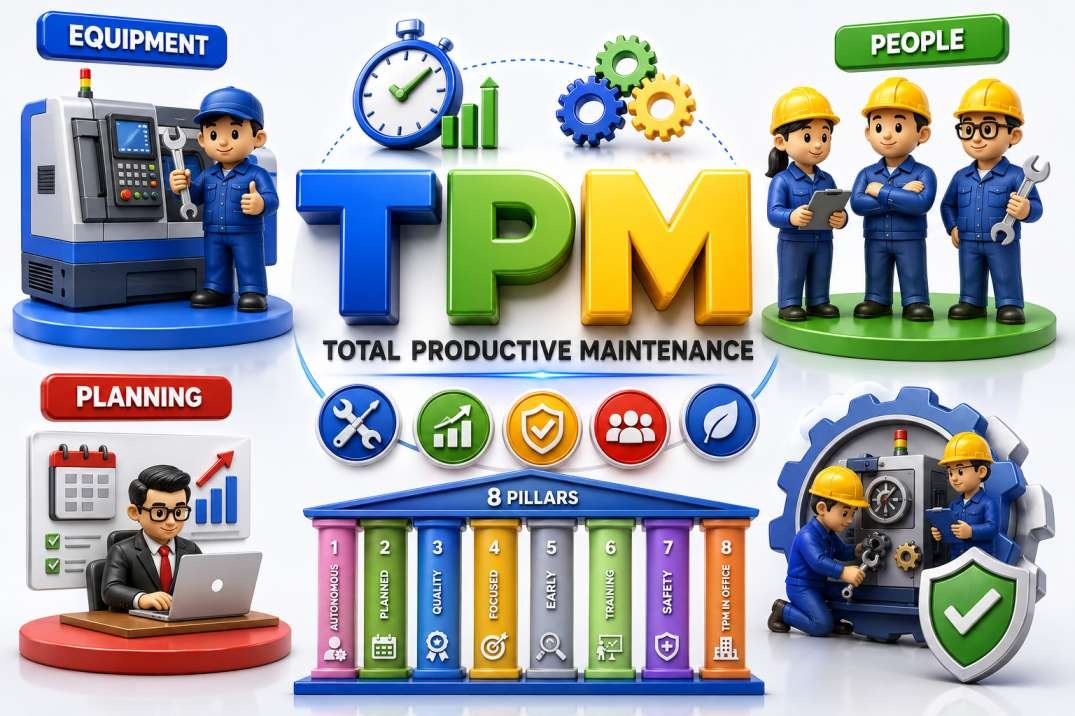
By focusing on preventive maintenance, operator ownership, and continuous improvement, TPM helps organizations achieve higher reliability, better product quality, lower maintenance costs, and safer operations. Today, TPM is widely used by world-class manufacturers to build a culture of operational excellence and sustainable performance improvement.
What is TPM (Total Productive Maintenance)?
In today’s highly competitive manufacturing environment, equipment downtime, machine breakdowns, quality defects, and production delays can significantly impact profitability. Every minute a critical machine is not operating represents lost production, reduced efficiency, and increased operational costs. To overcome these challenges, leading manufacturers around the world implement TPM (Total Productive Maintenance) as a core operational excellence strategy.
Total Productive Maintenance (TPM) is a company-wide approach to equipment maintenance that aims to maximize equipment effectiveness by involving everyone in the organization, from machine operators and maintenance technicians to engineers and senior management. Rather than treating maintenance as the sole responsibility of the maintenance department, TPM promotes shared ownership of equipment reliability and performance.
At its core, TPM focuses on preventing equipment failures before they occur. Through proactive maintenance activities, continuous improvement initiatives, operator involvement, and structured maintenance programs, organizations can significantly reduce breakdowns, improve quality, increase productivity, and create a safer workplace.
Total Productive Maintenance (TPM) is a systematic maintenance methodology designed to maximize the effectiveness and lifespan of production equipment by eliminating losses, preventing breakdowns, and engaging all employees in maintaining and improving equipment performance.
The ultimate goal of TPM is often described as achieving:
- Zero Breakdowns
- Zero Defects
- Zero Accidents
- Zero Unplanned Downtime
- Maximum Overall Equipment Effectiveness (OEE)
Understanding the Meaning of TPM
The term Total Productive Maintenance consists of three important components:
Total : “Total” refers to the involvement of everyone in the organization. TPM encourages cross-functional collaboration among operators, maintenance personnel, quality teams, production supervisors, engineers, and management.
Productive : “Productive” means maximizing production efficiency while minimizing equipment-related losses. TPM seeks to ensure that equipment consistently operates at its highest possible performance level.
Maintenance: “Maintenance” refers to all activities performed to preserve, restore, and improve equipment conditions, ensuring reliable and efficient operation throughout its lifecycle.
🎓 Top-Rated Courses & Certifications
Try changing your filters or searching for another course.
Why Equipment Downtime is One of Manufacturing’s Biggest Hidden Costs
Most manufacturers track production output, scrap rates, and delivery performance closely. However, one of the most expensive losses often remains hidden in plain sight: equipment downtime. A machine that is not running is not creating value. While the obvious cost is lost production, the actual impact is usually much larger. Downtime can trigger missed deliveries, overtime, production bottlenecks, increased maintenance expenses, and even customer dissatisfaction.
From what I have seen in manufacturing environments, major breakdowns are rarely the biggest problem. Instead, it is the accumulation of small interruptions, unexpected stoppages, start-up delays, adjustment issues, and recurring equipment problems that quietly reduce productivity day after day.
From my experience, downtime is rarely limited to the time a machine is stopped. A breakdown can quickly affect the entire operation—production falls behind, operators wait, schedules change, deliveries are pushed out, and recovery costs increase. What often gets overlooked is small, recurring downtime. A machine that stops for only a few minutes several times a shift may appear reliable, but those lost minutes can accumulate into significant capacity loss over time.
I have found that the more important question is not “How quickly can we fix the machine?” but “Why does this machine keep losing productive time?” That change in perspective is where TPM makes a difference. Instead of repeatedly reacting to failures, the focus shifts to finding the causes, eliminating recurring losses, and making equipment performance more predictable. In manufacturing, downtime becomes expensive when it becomes routine.
The Evolution of Maintenance: From Reactive to Total Productive Maintenance
Maintenance has changed significantly over the years. In many factories, the original approach was simple: wait until a machine breaks down, then fix it. While this reactive approach may seem straightforward, it often leads to production delays, higher repair costs, and unexpected downtime. As manufacturing became more competitive, organizations realized that constantly reacting to failures was neither efficient nor sustainable. This led to the adoption of preventive maintenance, where equipment is inspected and serviced at scheduled intervals to reduce the likelihood of breakdowns.
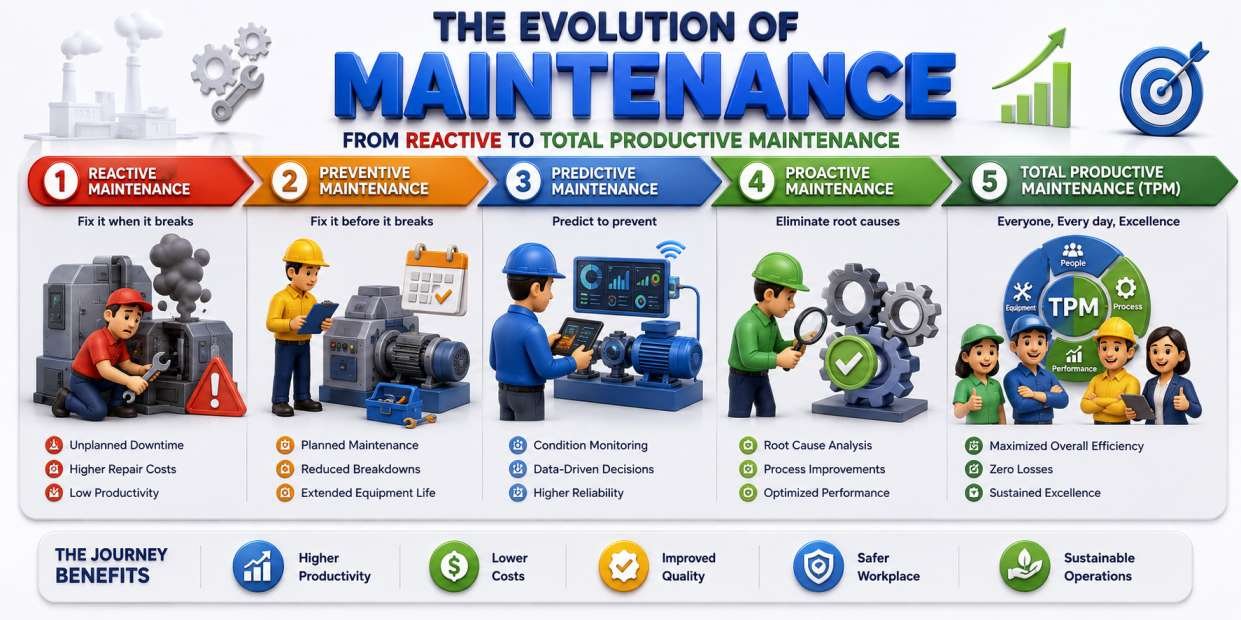
From my experience, maintenance maturity often follows a simple journey: fix the failure, prevent the failure, predict the failure, and eventually eliminate the conditions that create the loss. In the early stage, reactive maintenance dominates—equipment runs until something breaks. As repeated failures begin affecting production and cost, manufacturers move toward preventive maintenance, using planned inspections and servicing to reduce breakdowns.
In the early stage, reactive maintenance dominates—equipment runs until something breaks. As repeated failures begin affecting production and cost, manufacturers move toward preventive maintenance, using planned inspections and servicing to reduce breakdowns. With better technology and equipment data, predictive maintenance adds another layer by identifying signs of deterioration before failure occurs. But reliable equipment requires more than maintenance techniques. TPM (Total Productive Maintenance) brings operators, maintenance, engineering, quality, and leadership into the improvement process.
The evolution can be summarized simply: Reactive → Preventive → Predictive → TPM
For me, the biggest change is the question being asked. Instead of: “How quickly can we fix it?”
TPM encourages: “Why did it happen, and what can we do to stop it happening again?”
That shift—from repairing equipment to eliminating equipment losses—is the foundation of TPM.
How TPM Improves Overall Equipment Effectiveness (OEE)
One of the primary reasons organizations implement TPM (Total Productive Maintenance) is to improve Overall Equipment Effectiveness (OEE), one of the most widely used measures of manufacturing performance. TPM provides the practical framework for acting on those losses.
TPM supports each component:
- Availability: Fewer breakdowns and unplanned stops through autonomous, preventive, and planned maintenance.
- Performance: Fewer minor stoppages, speed losses, and recurring equipment problems.
- Quality: More stable equipment conditions, resulting in fewer defects, scrap, and rework.
A machine can show high availability and still deliver poor OEE if it frequently stops for a few seconds, runs below its standard speed, or produces defective parts. These are often the losses that receive the least attention but have a significant cumulative impact.
I prefer to use OEE to drive three simple questions:
Where are we losing performance?
What is causing the loss?
How do we prevent it from recurring?
That is the real connection between TPM and OEE: OEE shows where performance is being lost; TPM brings the people and methods together to recover it.
The Real Impact of TPM on OEE
In many organizations, the biggest OEE improvements do not come from purchasing new equipment. They come from improving the reliability and effectiveness of existing equipment. When breakdowns decrease, minor stops are eliminated, and equipment consistently produces quality products at the intended speed, OEE naturally improves. This is why TPM is often viewed as more than a maintenance initiative. It provides a structured approach for converting hidden equipment losses into productive manufacturing capacity and helping organizations get more value from the assets they already have.
Simply put, TPM improves OEE by increasing machine uptime, maintaining production speed, and reducing quality-related losses.
TPM Implementation Roadmap: Step-by-Step Guide
One of the biggest mistakes organizations make is treating TPM as a maintenance project. In reality, TPM is a cultural change that takes time to build and sustain. The most successful implementations start small, focus on visible improvements, and gradually expand across the organization.
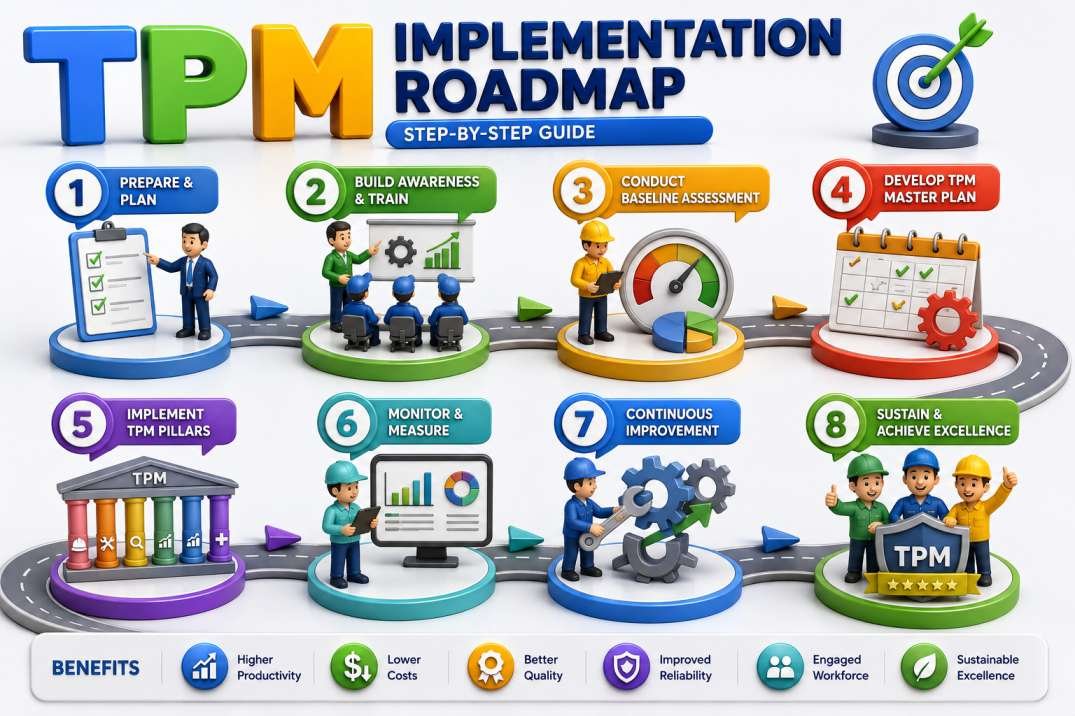
From my experience, TPM is most effective when it starts with real equipment losses—not a company-wide checklist. I prefer to begin with a critical machine, understand where performance is being lost, and build the TPM approach around those findings.
A practical roadmap is:
- Get leadership commitment – Define the purpose, ownership, targets, and resources.
- Select critical equipment – Focus first on machines with significant downtime, quality, safety, or capacity impact.
- Establish the baseline – Measure OEE, downtime, breakdowns, MTBF, MTTR, and quality losses.
- Identify the biggest losses – Use actual production data to prioritize what needs attention.
- Involve operators – Introduce basic cleaning, inspection, lubrication, and early abnormality detection.
- Strengthen maintenance – Align preventive and predictive activities with equipment criticality and failure history.
- Eliminate recurring failures – Use root-cause analysis and focused improvement rather than repeatedly repairing the same problem.
- Measure and sustain – Track results, standardize improvements, audit the process, and expand what works.
The biggest lesson for me is simple: don’t try to implement TPM everywhere at once. Start where the losses are highest, demonstrate measurable improvement, and use that success to build momentum.
TPM becomes sustainable when it moves from a maintenance initiative to the way the organization manages equipment performance.
📚 Recommended Books for Professionals
Try removing one or more filters.
TPM Audit Checklist for Manufacturing Facilities
Implementing TPM is one thing; sustaining it is another. This is where regular TPM audits become valuable. A good TPM audit helps determine whether TPM activities are truly embedded in daily operations or only being performed when an assessment is scheduled. The objective is not to score teams or assign blame. The objective is to identify gaps, reinforce good practices, and uncover opportunities for improvement before they affect equipment performance.
I recommend checking these areas:
A simple audit score can be useful, but I would never rely on the score alone. Walk the floor, observe the equipment, speak with operators, and compare what you see with the actual maintenance and OEE data.
Real TPM Case Study: Reducing Downtime and Improving OEE
Consider a CNC machining operation where recurring breakdowns were limiting production capacity. The TPM effort focused on equipment reliability, workforce involvement, and better maintenance practices. OEE increased from 39% to 45%, while productivity improved by 22%. The improvement also helped avoid a potential $250,000 equipment investment.
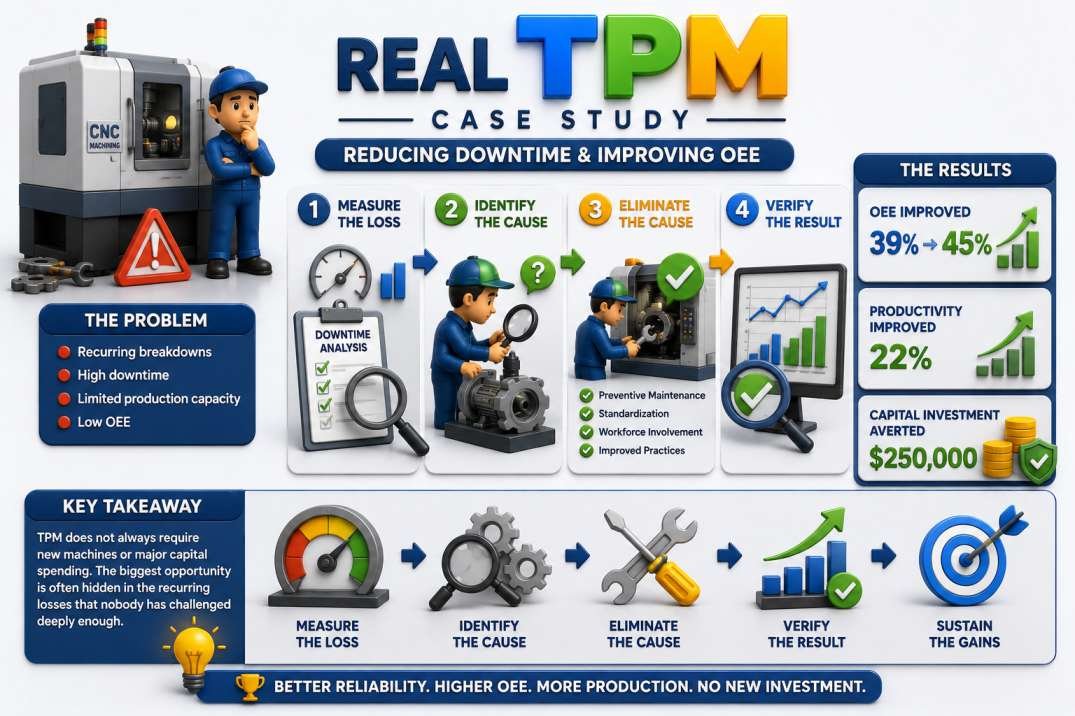
What I find most important in a case like this is the approach: measure the loss → identify the cause → eliminate it → verify the result. TPM does not always require new machines or major capital spending. Often, the opportunity is already sitting in the factory—in the recurring losses that nobody has challenged deeply enough. TPM does not always require new machines or major capital spending. Often, the opportunity is already sitting in the factory—in the recurring losses that nobody has challenged deeply enough.
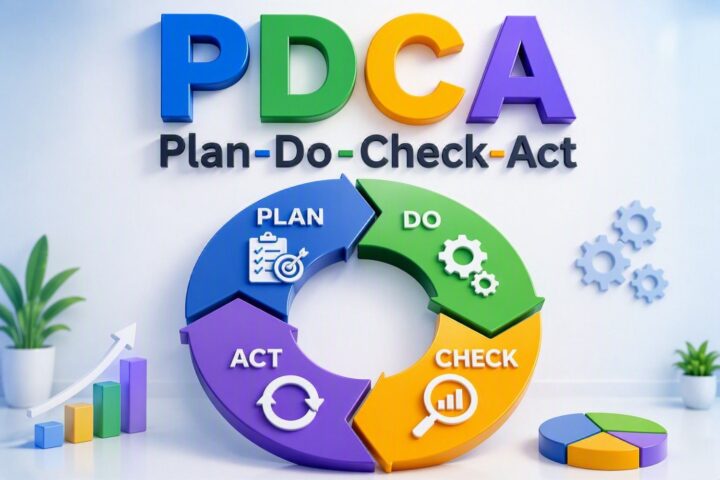
TPM is most effective when combined with other reliability, quality, and continuous improvement tools. Organizations often use Overall Equipment Effectiveness (OEE) to measure equipment performance, FMEA to identify potential failure modes, and 5 Why Analysis and Fishbone Diagram to investigate recurring breakdowns. Continuous improvement approaches such as Kaizen, PDCA, and DMAIC further help teams reduce downtime, improve equipment reliability, and sustain long-term operational excellence.
Frequently Asked Questions (FAQ)
Q: What is TPM (Total Productive Maintenance)?
A: TPM is a company-wide approach to improving equipment reliability, productivity, and overall equipment effectiveness.
Q: What is the main goal of TPM?
A: The main goal is to maximize equipment effectiveness by reducing breakdowns, downtime, defects, and other losses.
Q: What are the 8 pillars of TPM?
A: The 8 pillars are Autonomous Maintenance, Planned Maintenance, Quality Maintenance, Focused Improvement, Early Equipment Management, Training, Safety & Environment, and TPM in Administration.
Q: How does TPM improve OEE?
A: TPM improves OEE by reducing equipment downtime, performance losses, minor stoppages, and quality defects.
Q: What are the 6 Big Losses in TPM?
A: The 6 Big Losses are breakdowns, setup and adjustment, minor stoppages, reduced speed, defects and rework, and startup losses.
Q: Is TPM the same as preventive maintenance?
A: No, preventive maintenance is one component of TPM, while TPM involves the entire organization in equipment improvement.
Q: Who is responsible for TPM?
A: TPM is a shared responsibility involving operators, maintenance, engineering, quality, production, and management.
Q: How do you start implementing TPM?
A: Start with a critical machine, establish baseline performance, identify major losses, eliminate root causes, and standardize improvements.
Q: Which KPIs are used in TPM?
A: Common TPM KPIs include OEE, downtime, MTBF, MTTR, breakdown frequency, maintenance compliance, and equipment-related defects.
Q: Can TPM reduce manufacturing costs?
A: Yes, TPM can reduce costs by lowering downtime, breakdowns, scrap, rework, emergency maintenance, and lost production capacity.
Q: What is the difference between TPM and predictive maintenance?
A: Predictive maintenance focuses on predicting equipment failures, while TPM covers the broader system of equipment ownership and continuous improvement.
Q: Is TPM suitable for small manufacturers?
A: Yes, TPM can be implemented in small and medium-sized facilities by starting with critical equipment and expanding gradually.

Lean Six Sigma • Six Sigma • Statistics • Project Management • Artificial Intelligence (AI) • Operations Management • Quality Management
Conclusion: Building a Zero-Breakdown Culture With TPM
From my experience, TPM is most effective when equipment reliability becomes everyone’s responsibility, not just the responsibility of the maintenance team. The real objective is not simply to repair machines faster, but to prevent failures, eliminate recurring losses, improve OEE, and make equipment performance more predictable. A strong TPM culture brings operators, maintenance, engineering, quality, and leadership together to continuously identify problems, understand their root causes, and prevent them from recurring. A zero-breakdown culture does not mean that equipment will never fail; it means the organization learns from every failure and systematically works to make the next failure less likely. Ultimately, TPM is more than a maintenance methodology—it is a disciplined way of improving manufacturing performance through reliable equipment, engaged people, and continuous improvement.
Continue Your Learning Journey
Learning is a continuous process. Explore related topics, practical guides, tools, calculators, templates, and learning resources to expand your knowledge and develop new skills.
Choose a category below to explore practical tutorials, tools, calculators, templates, case studies, and learning resources.
Recommended Learning Resources
Expert-led courses to build practical skills, earn credentials, and advance your career.
Recommended professional books, certification guides, and practical study resources.
Ready-to-use templates, checklists, guides, and workbooks for practical applications.
Interactive calculators for statistics, quality, engineering, analysis, and decision-making.
Interactive Z, t, Chi-Square, and F tables with critical values and distribution curves.
Discover practical tutorials, case studies, and professional resources across Quality, Lean Six Sigma, Project Management, Statistics, AI, and Data Analytics.
Published: September 4, 2026
Last Updated: September 18, 2026