5W1H Problem Solving: The Simple Questions That Reveal Complex Problems
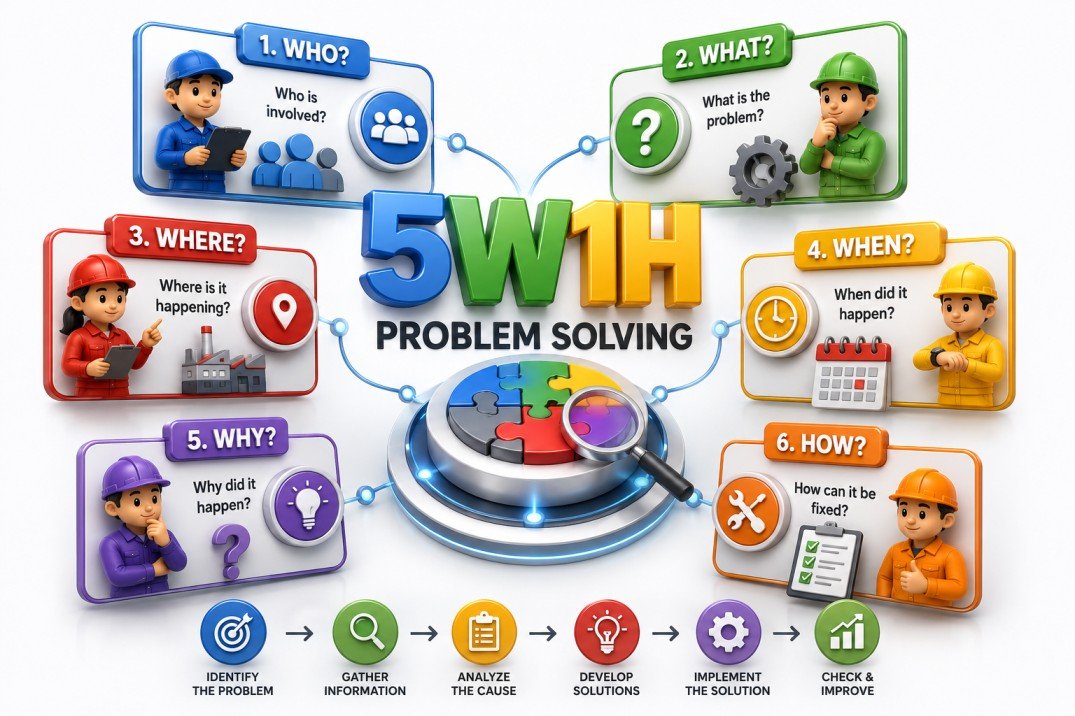
The 5W1H method is a simple yet powerful problem-solving technique that helps teams understand situations by asking six fundamental questions: What, Why, Where, When, Who, and How. Widely used in quality management, Lean Six Sigma, root cause analysis, and continuous improvement, 5W1H helps collect facts, clarify problems, and identify potential causes before jumping to solutions.
By systematically examining a problem from multiple perspectives, organizations can make better decisions, reduce assumptions, and uncover hidden issues. The simplicity of the 5W1H framework makes it suitable for manufacturing, healthcare, project management, service industries, and everyday business problem-solving. Whether you’re investigating a defect, analyzing a process issue, or planning an improvement initiative, 5W1H provides a structured approach to understanding problems and finding effective solutions.
Introduction to 5W1H Problem Solving
Every problem has a story behind it. Whether you’re dealing with a product defect, customer complaint, process delay, quality issue, or project risk, finding the real cause requires asking the right questions. This is where the 5W1H Problem Solving method becomes a powerful and practical tool.
In my experience, many problem-solving efforts go wrong before the analysis even begins. Teams often jump into solutions without first agreeing on what actually happened. I use the 5W1H method—What, Why, Who, Where, When, and How—to organize facts, challenge assumptions, and uncover information that might otherwise be missed. I have found it particularly useful when investigating quality issues, process delays, recurring defects, equipment failures, and customer complaints.
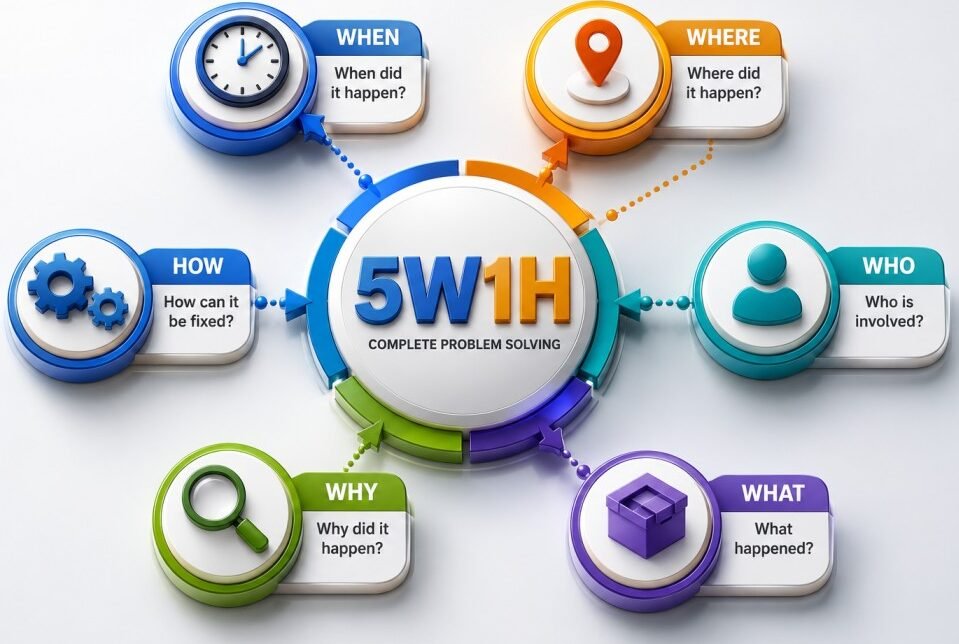
The method is simple, but its value comes from asking the right questions before deciding what to fix. It also provides a solid starting point for deeper root cause analysis and corrective action. The goal is not to ask more questions—it is to ask the right questions before solving the problem.
What is the 5W1H Method?
The 5W1H Method is a simple questioning framework I use to understand a problem before deciding what to fix. It looks at six dimensions: What, Why, Who, Where, When, and How.
In my experience, its biggest advantage is that it prevents teams from treating a symptom as the problem. By working through these questions, I can establish the facts, challenge assumptions, and see where further investigation is needed.
What happened?
Why might it be happening?
Who is involved or affected?
Where does it occur?
When does it occur?
How does it happen?
Origin and History of 5W1H
The 5W1H approach has been used for more than a century. Its roots are commonly associated with journalism, where asking What, Why, Who, Where, When, and How helped reporters build a complete, fact-based picture of an event. The six questions were notably popularized by Rudyard Kipling in his 1902 work Just So Stories.
What makes 5W1H remarkable is that its core principle has never changed. Whether you’re writing a news article, analyzing a process failure, or solving a customer complaint, success often starts with asking the right questions before searching for answers.
In my experience, the longevity of 5W1H comes from its simplicity. Many problem-solving tools have evolved over the years, but the ability to thoroughly understand a situation by asking six basic questions remains just as relevant today as it was decades ago. What makes it so useful is also what makes it last: the questions are simple, but they can expose gaps that more complicated tools sometimes overlook.
🎓 Top-Rated Courses & Certifications
Try changing your filters or searching for another course.
How does the 5W1H Method Work for Problem Solving?
In practice, the 5W1H method works by slowing down the urge to jump straight to solutions. Instead of asking, “How do we fix this?” the focus shifts to “What exactly are we trying to fix?”
What I like most about 5W1H is that it is simple enough to use in a quick team discussion yet structured enough to support complex investigations. Whether the issue is a quality defect, process delay, or customer complaint, the framework helps ensure that important details are not overlooked. The answers should be based on evidence rather than assumptions. Once the situation is clear, I can decide whether deeper tools such as 5 Whys, Fishbone Analysis, or Pareto Analysis are needed.
The key is simple: 5W1H helps define the problem before trying to solve it.
5W1H Problem-Solving Example
Problem: Recurring CNC Machine Breakdown : A CNC machine is experiencing frequent breakdowns, resulting in production delays.
| 5W1H | Investigation |
|---|---|
| What? | CNC machine stops unexpectedly during production. |
| Why? | The immediate cause appears to be overheating. |
| Who? | Operators and maintenance personnel are affected. |
| Where? | The issue occurs on one CNC machine in the machining area. |
| When? | Breakdowns occur mainly during extended production runs. |
| How? | The machine temperature rises beyond the normal operating range, triggering a shutdown. |
This gives me a clearer picture of the problem without immediately assuming the root cause. I can then use tools such as 5 Whys or Fishbone Analysis to investigate why the machine is overheating. The value of 5W1H is not in finding the final answer—it helps ensure I am investigating the right problem.
From my experience, this is where 5W1H adds the most value. It helps teams organize facts before jumping to conclusions, which often leads to faster and more effective problem solving.
Best Practices for Effective 5W1H Analysis
In my experience, 5W1H is most effective when it is treated as an investigation, not a checklist. A few simple practices can make the analysis much more useful:
- Start with facts: Use data, records, observations, and evidence rather than assumptions.
- Define the problem precisely: Avoid vague statements such as “quality is poor” or “the machine is unreliable.”
- Be specific: Include relevant details such as product, process, location, time, frequency, and magnitude.
- Keep asking until the picture is clear: One answer may reveal another question worth investigating.
- Separate symptoms from causes: Don’t treat the first explanation as the root cause.
- Involve the people closest to the process: Operators, technicians, and process owners often know details that reports miss.
- Validate the findings: Check important answers against actual data or direct observation.
- Use deeper tools when needed: Once the situation is clear, move to tools such as 5 Whys, Fishbone Analysis, or Pareto Analysis.
📚 Recommended Books for Professionals
Try removing one or more filters.
5W1H Analysis vs. 5 Whys: What’s the Difference?
One mistake I often see is treating 5W1H and 5 Whys as competing tools. In reality, they solve different problems and work best when used together. I typically start with 5W1H because it helps me understand the situation. It answers questions such as what happened, who was involved, where the issue occurred, and when it started. The goal is to build a complete picture of the problem before drawing conclusions. Once the problem is clearly defined, I use 5 Whys to dig deeper into the underlying cause. Instead of looking at the entire situation, the focus shifts to repeatedly asking "Why?" until the root cause becomes visible.
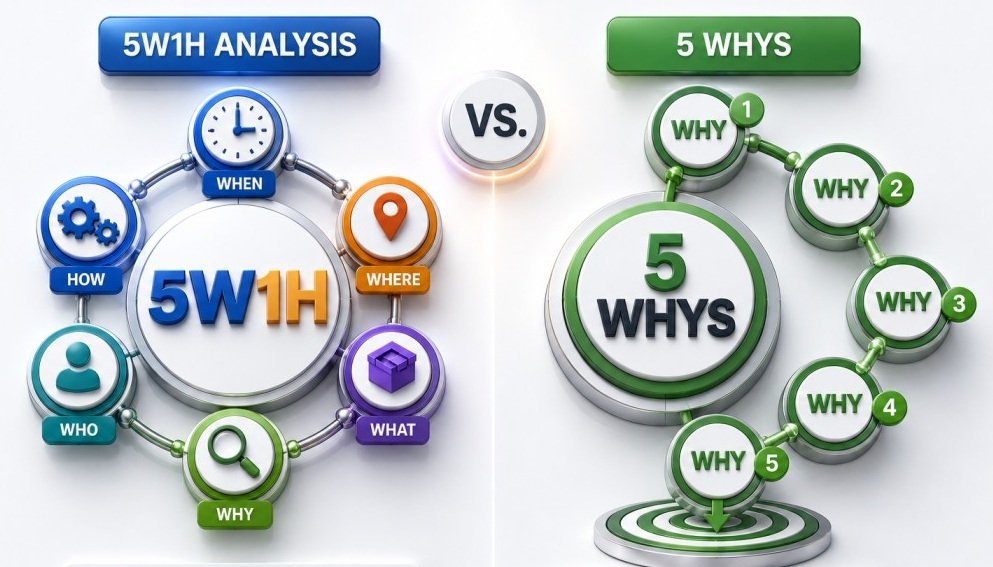
Think of it this way:
- 5W1H helps me understand the problem from multiple angles—What happened, Who was involved, Where and When it occurred, Why it may have happened, and How the issue developed.
- 5 Whys goes deeper into causation. Once the problem is clearly defined, I repeatedly ask “Why?” to move beyond the immediate symptom and uncover a potential root cause.
For example, if customers are receiving damaged products, 5W1H might reveal that the issue started recently and is linked to shipments from a specific warehouse. The 5 Whys technique can then be used to determine why the damage is occurring during packaging, handling, or transportation.
Quick Comparison
| Aspect | 5W1H | 5 Whys |
|---|---|---|
| Primary Purpose | Understand the situation | Find the root cause |
| Main Questions | What, Why, Who, Where, When, How | Why? (asked repeatedly) |
| Best Used For | Problem definition and fact gathering | Root cause investigation |
| Output | Clear understanding of the problem | Identification of underlying cause |
| Typical Stage | Beginning of an investigation | After the problem is defined |
5W1H Problem-Solving Template
📥 Download the FREE 5W1H Template to structure problem investigations, separate facts from assumptions, and clearly define What, Why, Who, Where, When, and How before moving to root cause analysis.
If you're building a complete Problem Solving Tools toolkit, 5W1H works exceptionally well alongside other proven methodologies. Techniques such as 5 Whys Root Cause Analysis, Fishbone (Ishikawa), 8D Problem Solving, and the PDCA Cycle can help teams dig deeper into causes, implement effective corrective actions, and sustain long-term improvements. I've covered each of these tools in detail in separate articles on my blog.
Frequently Asked Questions (FAQs)
Q: What is the 5W1H method? — The 5W1H method is a structured questioning technique using What, Why, Who, Where, When, and How to understand a problem before taking action.
Q: What are the 5W and 1H in problem solving? — The five Ws are What, Why, Who, Where, and When; the one H is How.
Q: How is 5W1H used in problem solving? — It helps define the problem, gather facts, identify gaps, and determine where deeper analysis is needed.
Q: Is 5W1H a root cause analysis tool? — It supports root cause analysis by clarifying the problem, but it does not replace dedicated tools such as 5 Whys or Fishbone Analysis.
Q: What is the difference between 5W1H and 5 Whys? — 5W1H examines a problem from multiple perspectives, while 5 Whys focuses on finding underlying causes.
Q: Can 5W1H be used in Lean Six Sigma? — Yes. It can support problem definition, DMAIC projects, corrective actions, and continuous improvement.
Q: What is a simple 5W1H example? — For a machine breakdown, ask what failed, why it may have failed, who was affected, where and when it occurred, and how the failure developed.
Q: What is the main benefit of 5W1H? — It helps teams develop a clear, fact-based understanding of a problem before selecting a solution.
Q: When should I use the 5W1H method? — Use it at the beginning of an investigation, especially when the problem is unclear or several explanations are possible.
Q: Can 5W1H be used for customer complaints? — Yes. It can help establish what the customer experienced, when and where it occurred, who was affected, and how the issue developed.
Q: Can 5W1H be used for quality problems? — Yes. It is useful for investigating defects, process deviations, inspection failures, and recurring quality issues.
Q: Is 5W1H the same as a problem statement? — No. 5W1H is a questioning framework that can help you develop a more precise problem statement.
Q: How do I write a 5W1H problem statement? — Describe the issue using specific facts about what happened, where and when it occurred, who or what was affected, and the extent of the problem.
Q: Can 5W1H be used in project management? — Yes. It can help clarify project requirements, responsibilities, issues, risks, and actions.
Q: What mistakes should I avoid when using 5W1H? — Avoid assumptions, vague questions, unsupported conclusions, and treating the first explanation as the root cause.
Q: Does 5W1H always require six questions? — The framework is based on six question categories, but you do not need to ask each question mechanically. Use the questions that help establish the facts.
Q: Can 5W1H and 5 Whys be used together? — Absolutely. I often see 5W1H used to understand and define the problem first, followed by 5 Whys to investigate the underlying cause.
Q: Is 5W1H useful for recurring problems? — Yes. It can reveal patterns involving time, location, people, equipment, materials, or process conditions that may otherwise be overlooked.
Q: Is there a 5W1H template for problem solving? — Yes. A simple table with What, Why, Who, Where, When, and How can be used to structure an investigation and document findings.

Lean Six Sigma • Six Sigma • Statistics • Project Management • Artificial Intelligence (AI) • Operations Management • Quality Management
Conclusion: Turning Questions into Solutions
The 5W1H method transforms vague problems into structured, actionable insights by systematically asking What, Why, Who, Where, When, and How. Instead of relying on assumptions, teams gather facts, identify root causes, and develop a clear understanding of the issue before taking corrective action.
Whether you're working on Lean Six Sigma projects, Root Cause Analysis (RCA), CAPA investigations, quality improvement initiatives, or everyday business challenges, 5W1H provides a simple yet powerful framework for effective problem solving. By answering the right questions, organizations can make better decisions, eliminate waste, improve processes, and achieve sustainable results.
Continue Your Learning Journey
Learning is a continuous process. Explore related topics, practical guides, tools, calculators, templates, and learning resources to expand your knowledge and develop new skills.
Choose a category below to explore practical tutorials, tools, calculators, templates, case studies, and learning resources.
Recommended Learning Resources
Expert-led courses to build practical skills, earn credentials, and advance your career.
Recommended professional books, certification guides, and practical study resources.
Ready-to-use templates, checklists, guides, and workbooks for practical applications.
Interactive calculators for statistics, quality, engineering, analysis, and decision-making.
Interactive Z, t, Chi-Square, and F tables with critical values and distribution curves.
Discover practical tutorials, case studies, and professional resources across Quality, Lean Six Sigma, Project Management, Statistics, AI, and Data Analytics.
Published: September 5, 2026
Last Updated: September 18, 2026