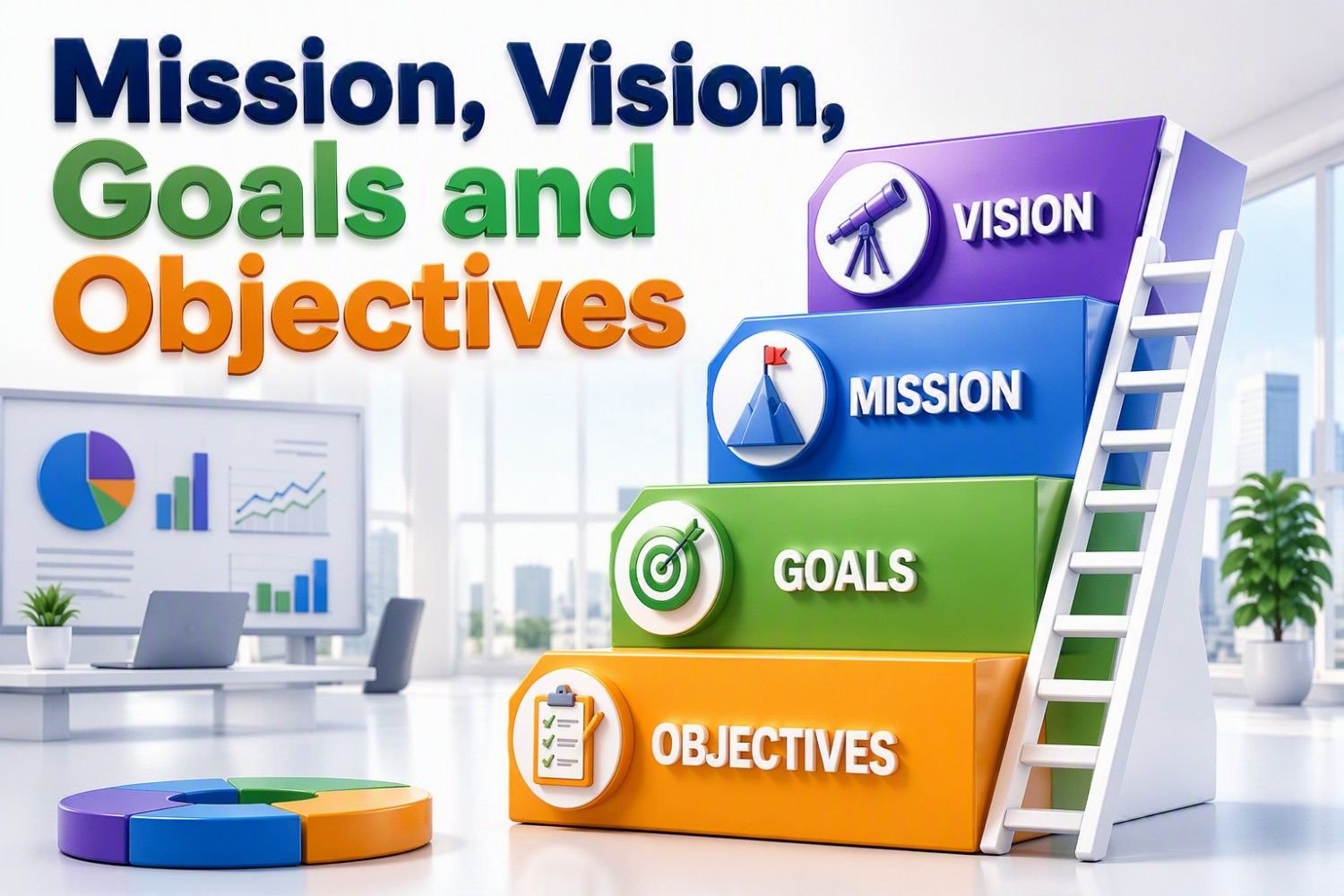
What Are Mission, Vision, Goals and Objectives in Strategic Management?
Organizations rarely achieve sustainable success through individual projects or short-term initiatives alone. Long-term growth requires a clear strategic framework that helps guide decision-making, align resources, and ensure that day-to-day activities contribute to a larger purpose. Without a structured approach, it becomes difficult to connect operational efforts with future aspirations.
Strategic management provides that structure by establishing a clear direction for where an organization wants to go and how progress will be measured. It helps leaders translate broad ambitions into meaningful priorities, align teams around common goals, and create consistency across departments, projects, and business functions.
Whether in business, healthcare, manufacturing, education, government, or nonprofit organizations, strategic frameworks help organizations focus their efforts, allocate resources effectively, and maintain alignment between long-term direction and operational execution. They provide a common language that enables leaders and employees to work toward shared outcomes.
Among the most important building blocks of strategic management are Mission, Vision, Goals, and Objectives. Together, these elements create a roadmap that helps organizations define their purpose, establish future aspirations, set priorities, and measure progress toward strategic success.
Why Most Strategies Fail ?
Most strategies do not fail because people lack intelligence, ambition, or good intentions. In my experience, strategies usually fail because they remain beautiful words on a slide but never become daily decisions, measurable actions, and disciplined follow-up. Many organizations spend weeks writing impressive mission and vision statements, but when the real work starts, employees are not always clear about what those statements mean for their day-to-day priorities. A strategy may sound powerful in a boardroom, but if the shop floor team, project team, sales team, quality team, or customer support team cannot connect their work with that direction, the strategy slowly loses meaning.
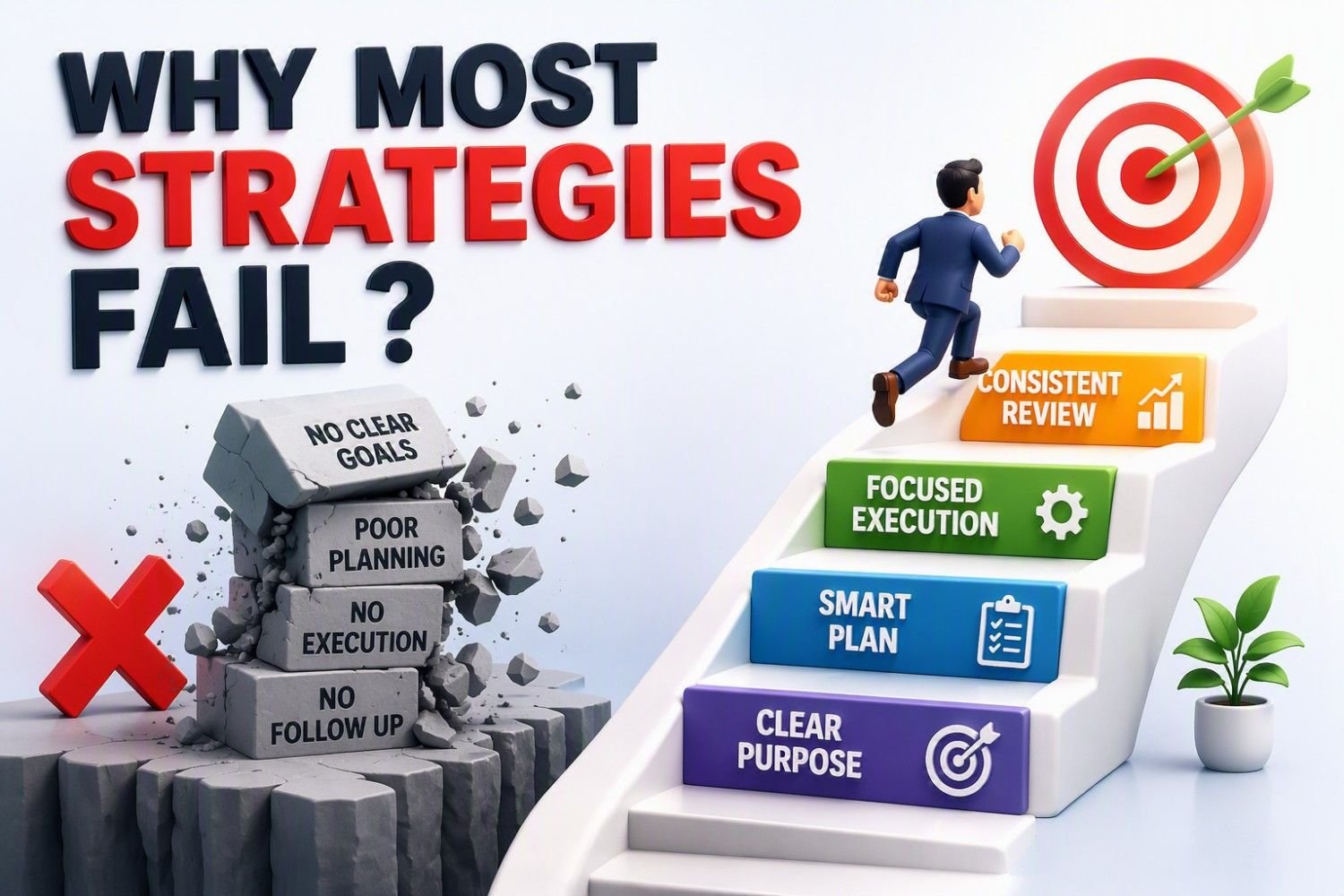
After more than 25 years in manufacturing, quality, and continuous improvement, I’ve learned that most strategies don’t fail because they’re poorly designed—they fail because they’re never translated into everyday actions. I’ve seen organizations invest significant time creating impressive mission and vision statements, yet employees remain unsure how those statements relate to their daily work. When people don’t understand the bigger picture, strategy becomes a document rather than a way of working.
I’ve also found that communication plays a critical role. A strategy should be simple enough that every employee—not just senior leaders can explain where the organization is heading and why. When everyone understands the purpose and priorities, decision-making becomes more consistent, accountability improves, and execution follows naturally.
This is why mission, vision, goals, and objectives are the foundation of strategic management. They provide a clear sense of purpose, define the desired future, establish priorities, and turn strategy into measurable results. When these elements work together, strategy stops being a presentation and becomes part of the organization’s everyday decisions.
What is Strategic Management?
When people hear the term strategic management, they often think about corporate plans, executive meetings, or lengthy business documents. However, in reality, strategic management is much simpler and far more practical. It is the process of deciding where an organization wants to go in the future and then ensuring that every major decision, resource, and activity supports that direction. In other words, strategic management helps transform an organization’s vision from an idea into measurable results.
When I started my career, I used to think strategic management was something discussed only in boardrooms. After more than 25 years in manufacturing, quality, and continuous improvement, my perspective changed completely. I realized that a strategy creates value only when it guides everyday decisions. If employees don’t understand where the organization is heading and how their work contributes to that direction, even the best strategy is unlikely to deliver meaningful results.
Strategic management is the continuous process of defining an organization’s long-term direction and aligning its people, resources, and decisions to achieve that vision. I often compare it to a GPS—it doesn’t just set the destination; it keeps you on the right path, adjusts when conditions change, and ensures every step moves you closer to your goal.
One lesson I’ve learned is that organizations rarely fail because people aren’t working hard. More often, they struggle because different teams pursue different priorities. Strategic management brings everyone together around a shared mission, vision, goals, and objectives, creating a common direction for the entire organization. This alignment improves decision-making, reduces confusion, and helps turn long-term plans into measurable business results.
At its core, strategic management answers four simple questions: Where are we today? Where do we want to go? How will we get there? How will we measure success? The answers to these questions form the foundation for building a clear strategy that can adapt to change while keeping the organization focused on sustainable growth.
What are Mission, Vision, Goals and Objectives?
If strategic management is the roadmap that guides an organization toward success, then mission, vision, goals, and objectives are the key components that make that journey possible. Together, they provide direction, purpose, focus, and measurable milestones. Yet, despite their importance, these terms are often used interchangeably, which can create confusion and weaken strategic planning. Understanding what each one means and how they work together is essential for building a successful organization.
From my experience working on business improvement and strategic initiatives, I have seen many teams struggle not because they lacked talent or resources, but because they were unclear about where they were heading and why certain priorities mattered. The most successful organizations are usually the ones where everyone understands the bigger picture and how their daily work contributes to long-term success. That clarity typically starts with a well-defined mission, vision, goals, and objectives.
A mission defines the organization’s fundamental purpose—its reason for existing today. It answers the question, “Why do we exist?” A strong mission statement explains who the organization serves, what value it provides, and what it stands for. While markets, technologies, and products may change over time, an organization’s mission often remains relatively stable because it reflects its core purpose and identity.
A vision describes the future the organization wants to create. It answers the question, “Where do we want to be in the future?” Unlike a mission, which focuses on the present, a vision is future-oriented and inspirational. It paints a picture of success and gives employees, leaders, and stakeholders something meaningful to work toward. A compelling vision creates excitement, drives innovation, and helps maintain focus during periods of change or uncertainty.
Goals are the broad outcomes an organization wants to achieve to move closer to its vision. They provide strategic direction and establish priorities for the business. Goals are typically long-term and focus on major achievements such as increasing market share, improving customer satisfaction, expanding into new markets, or becoming an industry leader. While goals define what success looks like, they do not always specify exactly how progress will be measured.
Objectives are the specific, measurable actions that turn goals into reality. If goals represent the destination, objectives represent the checkpoints along the way. Effective objectives are usually measurable, time-bound, and clearly assigned to teams or individuals. For example, instead of setting a goal to “improve customer satisfaction,” an organization might establish an objective to “increase customer satisfaction scores from 85% to 92% within the next twelve months.” Objectives create accountability and allow organizations to track progress objectively.
In practical terms, organizations that clearly define their mission, vision, goals, and objectives are often better equipped to make decisions, allocate resources, prioritize projects, and respond to challenges. Rather than acting based on short-term pressures alone, they have a strategic framework that guides every major decision. This alignment is one of the key reasons why companies with strong strategic foundations are more likely to achieve sustainable growth and long-term success.
🎓 Top-Rated Courses & Certifications
Try changing your filters or searching for another course.
Strategic Hierarchy: From Mission to Vision, Goals and Objectives
I often compare strategic hierarchy to building a house. Before construction begins, you need a clear picture of what the finished house should look like. Then you need a purpose for the building, followed by a plan for completing it and measurable milestones to track progress. The same principle applies in strategic management. Each level of the hierarchy serves a different purpose, but together they create a logical pathway from aspiration to achievement.
At the top of the hierarchy sits the Vision. The vision represents the future state the organization wants to achieve. It is ambitious, inspirational, and focused on the long term. A strong vision provides a destination and answers the question: “What do we ultimately want to become?” It creates a sense of purpose that motivates employees, stakeholders, and leaders to work toward a shared future.
Supporting the vision is the Mission. While the vision focuses on the future, the mission focuses on the present. It explains why the organization exists, whom it serves, and the value it provides. The mission transforms an inspiring future into a meaningful purpose that guides daily operations. Whenever strategic decisions are made, leaders should be able to connect those decisions back to the organization’s mission.
Once the mission and vision are established, organizations define their Goals. Goals are broad strategic outcomes that help bridge the gap between current performance and the desired future state. Goals provide direction and establish priorities. They answer the question: “What major achievements must we accomplish to fulfill our mission and reach our vision?” Unlike objectives, goals are usually broad and long-term rather than highly specific.
The final level of the hierarchy consists of Objectives. Objectives translate strategic intentions into measurable actions. They specify exactly what will be achieved, by when, and how success will be measured. Objectives create accountability and provide a practical roadmap for execution. Without clear objectives, organizations often struggle to convert strategy into results because employees lack clarity about expectations and priorities.
The strategic hierarchy can be visualized as follows:
From my own experience working on process improvement and organizational initiatives, the highest-performing teams are usually the ones where employees understand this connection. People are far more motivated when they can see how their individual objectives contribute to a larger goal and how that goal supports the organization’s mission and vision. When this alignment is missing, teams often become busy with activities that generate little strategic value.
Ultimately, strategic hierarchy is what transforms strategy from a collection of ideas into a structured framework for action. It ensures that an organization’s vision inspires the future, its mission guides the present, its goals establish priorities, and its objectives drive measurable results. When these elements are aligned and consistently communicated, organizations are far more likely to execute successfully and achieve sustainable long-term growth.
Mission vs Vision vs Goals vs Objectives (Comparison Table)
📚 Recommended Books for Professionals
Try removing one or more filters.
How to Develop Mission, Vision, Goals and Objectives
Over the years, I've learned that developing mission, vision, goals, and objectives isn't about writing impressive statements—it's about creating a direction that people can understand and act on. I've seen organizations spend weeks refining strategy documents, only to struggle because employees couldn't connect them to their daily work. The best strategies are simple, practical, and aligned from top to bottom.
Step 1: Define Your Vision
Start with the future you want to create. A clear vision answers "Where do we want to be?" and provides long-term direction that inspires the entire organization.
Step 2: Create Your Mission
Next, define why the organization exists and the value it delivers. A strong mission should clearly explain who you serve, what you do, and why it matters.
Step 3: Set Strategic Goals
Once the mission and vision are clear, identify the key outcomes needed to achieve them. Goals provide focus and help everyone understand what success looks like.
Step 4: Develop SMART Objectives:
Turn each goal into specific, measurable, achievable, relevant, and time-bound (SMART) objectives. In my experience, this is where strategy becomes actionable. Clear objectives create accountability and make it easy to measure progress.
Step 5: Align and Communicate:
Finally, ensure everything is connected. Every objective should support a goal, every goal should support the mission, and the mission should move the organization toward its vision. Just as importantly, communicate the strategy clearly so every employee understands how their work contributes to the bigger picture.
From my experience, organizations don't succeed because they have the most polished strategy documents—they succeed because their mission, vision, goals, and objectives are aligned, understood, and consistently reflected in everyday decisions. That's what transforms strategy from words on paper into measurable business results.
Lean Six Sigma • Six Sigma • Statistics • Project Management • Artificial Intelligence (AI) • Operations Management • Quality Management
Frequently Asked Questions (FAQs)
- What is the difference between mission and vision?
A mission explains what an organization does today and why it exists, while a vision describes what it aims to become in the future. - Why are mission and vision statements important?
They provide direction, align teams, and guide decision-making across the organization. - What are goals in a business context?
Goals are broad outcomes an organization intends to achieve to move toward its vision. - What are objectives and how are they different from goals?
Objectives are specific, measurable steps designed to achieve broader goals. - Can mission and vision statements be the same?
No, mission focuses on present purpose, while vision focuses on future aspirations, so both serve different roles. - How do mission, vision, goals, and objectives work together?
They form a strategic hierarchy where vision defines direction, mission defines purpose, and goals and objectives convert them into action. - Who should create mission and vision statements?
Typically, leadership defines them with input from employees and stakeholders to ensure alignment and clarity. - How often should mission and vision statements be updated?
They should be reviewed periodically, especially during major strategic changes or business transformations. - What makes a good mission statement?
A good mission statement is clear, concise, purpose-driven, and explains what the organization does and for whom. - What makes a strong objective?
A strong objective is specific, measurable, achievable, relevant, and time-bound (SMART). - Can individuals use mission and vision statements?
Yes, individuals can use them for personal growth, career planning, and goal setting. - What is the biggest mistake when defining goals and objectives?
The most common mistake is creating goals without clear, actionable objectives to support them.
Conclusion
In today's competitive and rapidly changing business environment, success rarely happens by accident. Organizations that consistently achieve their goals are usually those that have a clear understanding of why they exist, where they want to go, what they need to accomplish, and how they will measure progress along the way. This is exactly why mission, vision, goals, and objectives are at the heart of effective strategic management.
After more than 25 years in manufacturing, quality, and continuous improvement, I've found that organizations rarely fail because they lack ideas or talented people. More often, they struggle because everyone isn't moving toward the same destination. That's why mission, vision, goals, and objectives are far more than management buzzwords—they provide the clarity and alignment needed to turn strategy into action.
In my experience, the most successful organizations don't have the longest strategic plans—they have the clearest ones. Their strategy is understood by everyone, from senior leaders to frontline employees, and it guides everyday decisions rather than sitting unused in a presentation.
Continue Your Learning Journey
Learning is a continuous process. Explore related topics, practical guides, tools, calculators, templates, and learning resources to expand your knowledge and develop new skills.
Choose a category below to explore practical tutorials, tools, calculators, templates, case studies, and learning resources.
Recommended Learning Resources
Expert-led courses to build practical skills, earn credentials, and advance your career.
Recommended professional books, certification guides, and practical study resources.
Ready-to-use templates, checklists, guides, and workbooks for practical applications.
Interactive calculators for statistics, quality, engineering, analysis, and decision-making.
Interactive Z, t, Chi-Square, and F tables with critical values and distribution curves.
Discover practical tutorials, case studies, and professional resources across Quality, Lean Six Sigma, Project Management, Statistics, AI, and Data Analytics.
Published: October 3, 2020
Last Updated: September 18, 2026
Very good initiative I am impressed.
Sir, This is an excellent post! The concise explanation of the principles reveal both personal and professional application. Thank you for your YouTube channel and this website.
How can i know the company vision mision and so on, do i need to ask in personal like interview? for example like, secret recipe cake and cafe sdn bhd.
Truly commendable job sir, It is very simple & clear to understand.