Why Lean Manufacturing Initiatives Fail: 10 Common Mistakes That Prevent Long-Term Success
Lean Manufacturing has helped some of the world’s most successful organizations improve quality, reduce waste, shorten lead times, and increase customer value. Yet despite these proven benefits, many Lean initiatives struggle to deliver lasting results.
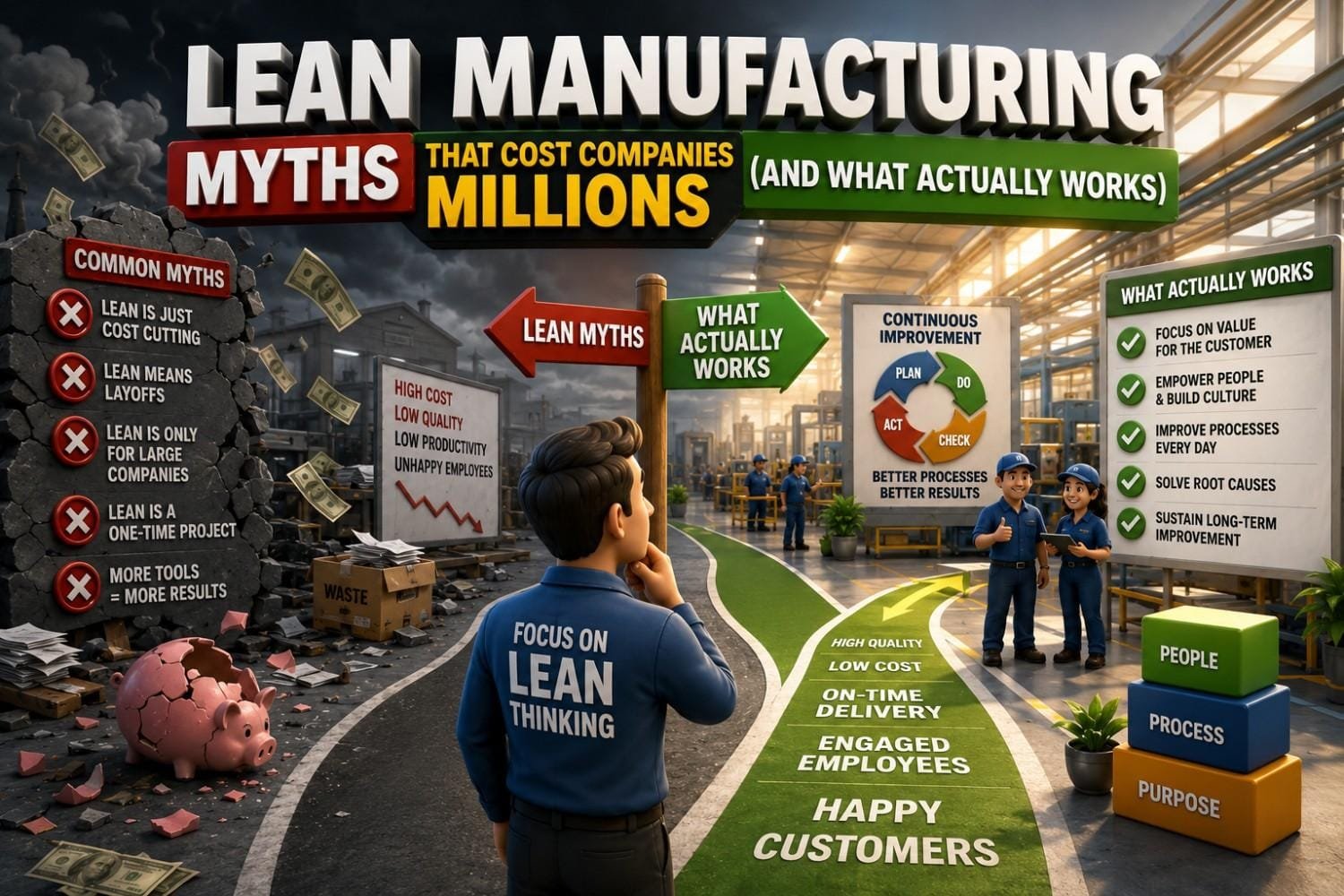
The reason is rarely the Lean methodology itself. More often, organizations focus on implementing Lean tools while overlooking the culture, leadership, and mindset needed to sustain continuous improvement. True Lean success requires more than eliminating waste or applying a collection of tools. It requires leadership commitment, employee engagement, problem-solving discipline, and a culture that continuously seeks better ways of working. Understanding why Lean initiatives fail is often the first step toward building a sustainable improvement journey that delivers measurable results year after year.
Why do so many Lean Manufacturing Initiatives Fail ?
If Lean Manufacturing has helped companies like Toyota build world-class operations, why do so many Lean initiatives fail to deliver the same results? In most cases, the problem isn’t Lean itself—it’s how organizations approach it. Too often, Lean is introduced as a short-term cost-cutting program, a collection of tools, or a project with a fixed end date, rather than a long-term management philosophy focused on continuously creating value for customers.
Throughout my career in quality engineering, working across manufacturing, medical devices, automotive, and new product development, I’ve seen this pattern repeat itself. Organizations launch Lean with enthusiasm, introducing 5S, Kaizen events, visual management boards, and employee training. Initially, everything appears to be moving in the right direction. However, a few months later, many of the same issues resurface—production delays, excess inventory, recurring quality problems, and teams constantly firefighting instead of preventing problems. The Lean tools are still there, but the improvement culture never truly took root.
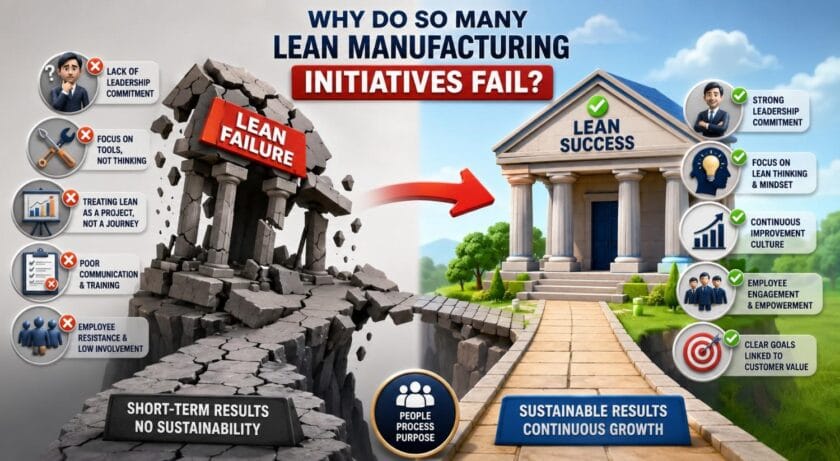
The biggest mistake is believing that implementing Lean tools automatically creates a Lean organization. In reality, most companies already know about 5S, Value Stream Mapping, Standard Work, and the 8 Wastes. What they often overlook is the mindset behind those tools. When leadership continues rewarding short-term output instead of long-term process improvement, employees quickly recognize that Lean is just another management initiative rather than a new way of working.
The organizations I’ve seen succeed didn’t necessarily have the largest budgets or the latest technology. They had leaders who were committed, employees who were encouraged to solve problems, and a culture where continuous improvement became part of everyday work. They understood that reducing costs is a result of better processes—not the primary objective. Lean succeeds when people are empowered to identify waste, improve their own work, and make decisions based on data rather than assumptions.
This is why Lean Manufacturing myths are so costly. They shift attention away from the real purpose of Lean and toward quick fixes that rarely last. Companies invest significant time, money, and effort implementing tools while overlooking the leadership, culture, and employee engagement needed to sustain meaningful change. The goal of this article is to separate those myths from reality, helping you understand what truly drives successful Lean transformations and how to avoid the mistakes that prevent so many improvement initiatives from reaching their full potential.
Quick Answer: Why Do Lean Manufacturing Programs Fail?
Lean Manufacturing programs often fail because organizations treat Lean as a set of tools instead of a long-term management system. Many companies focus on 5S audits, cost-cutting, training certificates, or short-term Kaizen events without building leadership discipline, employee involvement, standard work, problem-solving habits, and daily improvement culture.
🎓 Top-Rated Courses & Certifications
Try changing your filters or searching for another course.
Understanding Lean Manufacturing Beyond the Myths
Ask ten people what Lean Manufacturing means, and you’ll likely get ten different answers. Some will describe it as cost reduction, others will mention 5S, Kaizen, or the Toyota Production System, while a few may even believe it’s about getting the same work done with fewer people. Although these ideas are common, they only capture a small part of what Lean truly represents.
At its heart, Lean Manufacturing is a management philosophy focused on creating greater value for customers by continuously improving processes and eliminating activities that do not add value. It’s not about making people work harder or faster; it’s about making work smarter, simpler, and more reliable. When waste is removed from a process, quality improves, lead times become shorter, costs naturally decrease, and employees can focus on meaningful work instead of constantly solving the same problems.
One lesson I’ve learned throughout my career in quality engineering is that poor performance is rarely caused by a lack of effort. In almost every manufacturing environment I’ve worked in, people were already working incredibly hard. Operators, engineers, supervisors, and quality teams were busy every day, yet production delays, recurring defects, material shortages, and last-minute firefighting continued. The issue wasn’t the people—it was the process. Time was being lost to waiting, unnecessary movement, rework, excess inventory, poor communication, and inefficient workflows. Lean helps expose these hidden obstacles so they can be eliminated rather than accepted as part of daily operations.
I’ve also seen organizations invest significant time in Lean tools such as 5S, visual management boards, and Kaizen events without achieving lasting results. The tools were visible, but the culture remained unchanged. Teams continued reacting to problems instead of preventing them, and improvement activities gradually lost momentum. Those experiences reinforced an important lesson for me: Lean doesn’t create transformation because of the tools it uses—it succeeds because it changes the way people think about work, solve problems, and improve processes together.
The most successful Lean organizations I’ve encountered share one common characteristic. Instead of asking, “How can we make people work harder?” they ask, “What is preventing our people from doing their best work?” That shift in thinking changes everything. The focus moves from blaming individuals to improving the system, creating an environment where continuous improvement becomes part of everyday work rather than an occasional initiative.
Before exploring the most common Lean Manufacturing myths, remember this simple principle: Lean is not about doing more with less—it is about creating more value with less waste. That distinction may seem subtle, but it is often the difference between a Lean program that delivers sustainable results and one that quietly fades away after the initial enthusiasm.
Common Lean Manufacturing Myths at a Glance
One of the biggest reasons Lean Manufacturing initiatives fail is that organizations begin with assumptions instead of understanding the principles behind Lean. These misconceptions often sound logical, which is why they’re so widely accepted. Unfortunately, acting on them can lead to poor decisions, wasted investments, frustrated employees, and improvement programs that lose momentum before delivering meaningful results.
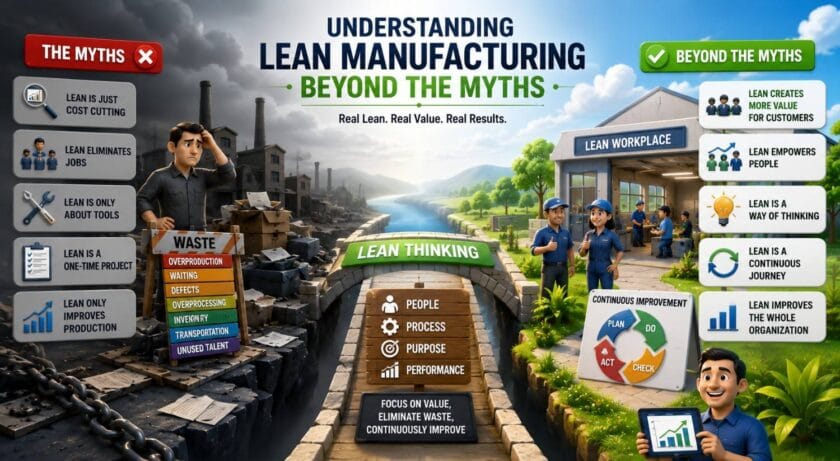
Throughout my career in quality engineering, I’ve found that the most successful Lean transformations didn’t depend on using more tools—they depended on challenging long-held beliefs about how work should be managed. Before exploring each myth in detail, the table below provides a quick overview of the most common misconceptions and the reality behind them.
🏭 10 Lean Manufacturing Myths vs Reality Misconceptions that prevent sustainable Lean success
Why Lean Manufacturing Myths are Dangerous
Many Lean Manufacturing myths sound reasonable at first, which is exactly what makes them so dangerous. When organizations accept these misconceptions as facts, they often solve the wrong problems, invest in the wrong initiatives, and become frustrated when Lean fails to deliver the expected results. In reality, Lean rarely fails because of the methodology itself. More often, it fails because companies begin their transformation with an incomplete or incorrect understanding of what Lean is meant to achieve.
Throughout my career in quality engineering, I’ve noticed that unsuccessful Lean programs rarely suffer from a lack of effort. Employees attend training, conduct 5S audits, organize Kaizen events, and display visual management boards across the factory. Yet despite all this activity, production delays, recurring quality issues, excess inventory, and daily firefighting continue. The problem isn’t the absence of Lean tools—it’s that the organization is improving individual activities instead of improving the entire value stream. Lean becomes something people do rather than a way the business operates.
These misconceptions also influence how employees and leaders respond to change. When Lean is presented primarily as a cost-cutting initiative, employees may associate it with job reductions instead of process improvement, making them less willing to share ideas or participate in change. Likewise, leaders who expect immediate financial returns often lose patience before meaningful improvements have time to take root. Sustainable Lean transformations are built on trust, leadership commitment, disciplined problem-solving, and continuous learning—not quick wins or isolated improvement events.
One lesson I’ve learned is that world-class Lean organizations ask different questions. Instead of asking, “Which Lean tool should we implement next?”, they ask, “What prevents our people from delivering greater value to customers?” That shift in thinking changes everything. It moves the focus from implementing tools to solving problems, improving processes, and developing people.
Understanding these myths is therefore much more than correcting misconceptions—it’s the foundation of a successful Lean journey. Once organizations replace assumptions with a deeper understanding of Lean principles, they stop chasing short-term improvements and begin building a culture of continuous improvement that delivers lasting business results.
Key Takeaway: Lean Manufacturing doesn’t fail because organizations lack tools—it fails when they misunderstand the purpose behind those tools. Separating Lean myths from Lean reality is often the first and most important step toward achieving sustainable operational excellence.
What Makes Lean Manufacturing Successful in Real Companies?
After spending more than two decades working in manufacturing, quality, and continuous improvement, I’ve realized that successful Lean organizations rarely stand out because of larger budgets, advanced technology, or impressive presentations. What truly sets them apart is a culture where continuous improvement is part of everyday work. They don’t treat Lean as a project with a start and finish date—they treat it as an ongoing commitment to solving problems, improving processes, and delivering greater value to customers.
One pattern I’ve consistently observed is that successful Lean transformations begin with leadership, not tools. The best leaders don’t manage Lean from meeting rooms or dashboards alone. They spend time where the work happens, ask thoughtful questions, listen to employees, and remove obstacles that prevent teams from succeeding. This visible commitment creates trust and reinforces that improvement is everyone’s responsibility, not just the job of a Lean team.
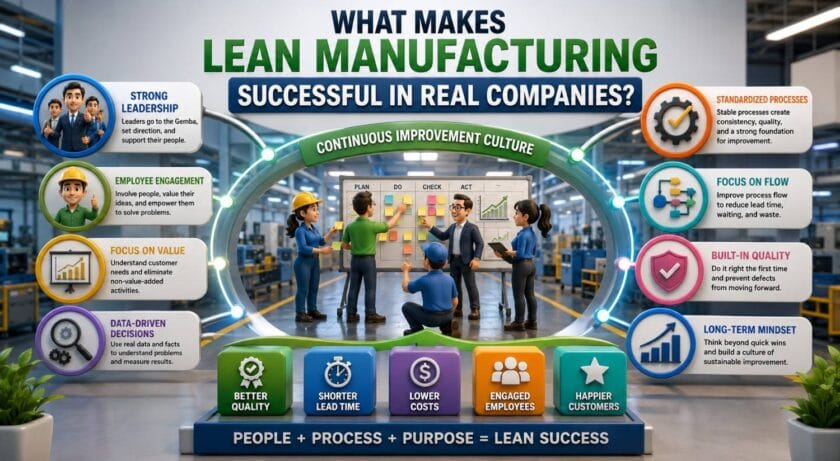
Employee involvement is another defining characteristic. In my experience, the people closest to the process often have the clearest understanding of where waste exists and how it can be eliminated. Operators, technicians, engineers, quality professionals, and maintenance teams see inefficiencies that may never appear in reports or presentations. Organizations that encourage these ideas and act on them improve faster because they solve problems at their source instead of relying solely on top-down decisions.
Successful companies also measure Lean differently. Rather than celebrating the number of 5S audits completed or Kaizen events conducted, they focus on meaningful business outcomes—safer workplaces, improved quality, shorter lead times, better customer satisfaction, and more stable processes. They understand that Lean tools are valuable only when they create measurable improvements, not when they simply demonstrate activity.
Perhaps the most important lesson I’ve learned is that Lean never reaches a finish line. The organizations that sustain operational excellence continue learning, refining processes, and challenging yesterday’s best practices. They understand that lasting success isn’t built through one major breakthrough but through hundreds of small improvements that, over time, transform the way the business operates.
📚 Recommended Books for Professionals
Try removing one or more filters.
Lean Manufacturing Case Studies: What Successful Companies Do Differently
One of the biggest misconceptions about Lean Manufacturing is that successful companies achieve better results because they use more Lean tools. In my experience, the opposite is often true. The organizations that consistently improve performance aren't the ones running the most Kaizen events or displaying the most visual boards. They succeed because they spend more time understanding their processes, solving root causes, and removing barriers that prevent people from doing their best work.
I remember working with a manufacturing team that struggled with recurring quality issues and missed production targets. The initial response was familiar—increase inspections, generate more reports, and schedule additional meetings. Despite the extra effort, the problems remained. Once the team stepped back and observed the process on the shop floor, they discovered that unnecessary movement, unclear work instructions, and repeated rework were driving most of the delays. By simplifying the workflow and addressing these underlying issues, defects decreased, productivity improved, and daily firefighting became far less common. The improvement didn't come from introducing another Lean tool; it came from understanding the process before trying to fix it.
Saw a similar pattern during a workplace organization initiative. At first, management believed productivity was limited by employee performance. However, a closer look revealed that operators were spending valuable time searching for tools, locating materials, and walking between poorly organized workstations. Simple changes such as point-of-use storage, better workplace layout, and standardized workstations removed these frustrations. Nobody had to work harder—the process simply worked better.
The same philosophy can be seen in world-class organizations such as Toyota and Danaher. Although their industries and business models differ, both have built cultures where continuous improvement is part of everyday work rather than an occasional project. Their success isn't based on using more Lean tools than everyone else; it's built on leadership commitment, employee involvement, disciplined problem-solving, and a relentless focus on creating value for customers.
Looking back at the projects I've been involved in, the most successful improvements were rarely the most expensive or technically complex. They came from cross-functional teams taking the time to understand the process, challenge long-standing assumptions, and make practical changes that could be sustained. Whether the goal was improving quality, reducing lead time, or simplifying workflow, the principle was always the same: improve the process first, and the business results will follow.
Key Takeaway: The companies that excel at Lean Manufacturing don't succeed because they implement more tools. They succeed because they build a culture where leaders support improvement, employees solve problems together, and every change is measured by the value it creates for the customer. That's the difference between practicing Lean activities and truly living Lean principles.
Common Warning Signs That Your Lean Program is Failing
Lean transformations rarely fail overnight. In my experience, they lose momentum gradually, and the warning signs often appear long before performance begins to decline. Teams continue holding meetings, updating improvement boards, completing 5S audits, and tracking KPIs, yet the same production delays, quality issues, and recurring problems keep resurfacing. When Lean activities continue but business results remain unchanged, it's often a sign that the organization is focusing on the process of Lean rather than the purpose of Lean.
One of the earliest warning signs is declining employee engagement. At the beginning of a Lean journey, people are usually eager to suggest improvements and eliminate waste. However, when those ideas are ignored or never implemented, participation quickly fades. I've found that operators, technicians, engineers, and quality professionals often have the best understanding of everyday process challenges. When they stop contributing, the organization loses one of its greatest sources of continuous improvement.
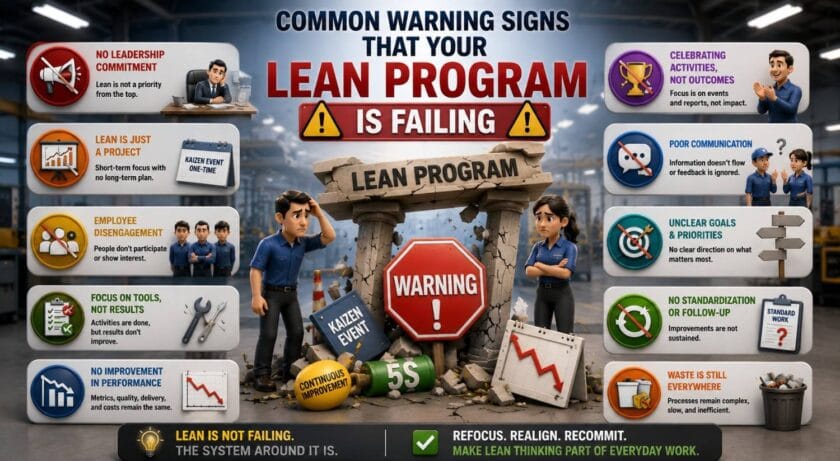
Another common mistake is measuring activity instead of impact. I've visited facilities with impressive visual boards, excellent audit scores, and regular Kaizen events, yet customer complaints, rework, and production bottlenecks remained unchanged. Lean should be measured by improvements in quality, safety, delivery, lead time, and customer value—not by the number of meetings held or checklists completed. If performance isn't improving, more Lean activities won't solve the problem.
Recurring firefighting is another clear indicator that a Lean program is struggling. When the same issues appear week after week, teams often become trapped in reacting to symptoms instead of eliminating root causes. Over time, temporary fixes become standard practice, valuable improvement opportunities are missed, and frustration grows across the organization. Sustainable Lean organizations invest more time preventing problems than repeatedly solving the same ones.
I've also learned that Lean loses credibility when leadership becomes disconnected from the workplace. The most effective leaders don't rely solely on dashboards or presentations—they regularly spend time where the work happens, observe processes firsthand, and listen to the people performing them. Many of the best improvement opportunities I've encountered were discovered during simple conversations on the shop floor, not in conference rooms.
The encouraging news is that these warning signs are usually visible before a Lean initiative completely stalls. Organizations that recognize them early can reset their approach, re-engage employees, and refocus on what Lean is truly designed to achieve: creating better processes, delivering greater customer value, and building a culture of continuous improvement.

Lean Six Sigma • Six Sigma • Statistics • Project Management • Artificial Intelligence (AI) • Operations Management • Quality Management
What Actually Works: The Principles Behind Successful Lean Transformations
After more than two decades of working in manufacturing, quality, and continuous improvement, I've reached a simple conclusion: successful Lean transformations are rarely driven by better tools—they're driven by better thinking. Organizations don't become Lean because they implement 5S, Kanban, or Value Stream Mapping. They become Lean when everyone, from leadership to the shop floor, shares a commitment to solving problems, eliminating waste, and improving the way work is done every single day.
The first principle is leadership commitment. The most effective leaders I've worked with didn't manage Lean from reports or presentations. They spent time on the shop floor, observed processes firsthand, listened to employees, and removed obstacles that slowed teams down. Their involvement made continuous improvement a business priority rather than another initiative delegated to the quality or Lean department.
The second principle is empowering the people closest to the process. Some of the most practical improvement ideas I've seen came from operators, technicians, inspectors, and maintenance teams—not because they knew Lean terminology, but because they understood the work better than anyone else. When employees are encouraged to question existing practices and suggest improvements, Lean becomes part of the organization's culture instead of a management program.
Another principle that consistently delivers results is eliminating root causes rather than repeatedly treating symptoms. I've worked with teams that spent months reacting to the same quality issues until they finally stepped back to understand why the problems kept returning. Once the underlying causes were addressed and the improved process was standardized, the repeated firefighting largely disappeared. That experience reinforced an important lesson: sustainable improvement comes from preventing problems, not becoming faster at fixing them.
One project, in particular, changed the way I think about Lean. The team was working hard, yet customer orders were still delayed. After mapping the process, we discovered that the biggest losses weren't caused by slow operators—they came from waiting, unnecessary movement, multiple handoffs, and unclear responsibilities. Removing those barriers improved flow without increasing workload or adding resources. It was a powerful reminder that being busy isn't the same as creating value.
Perhaps the most important principle is understanding that Lean is never finished. The organizations that sustain operational excellence don't wait for major transformation projects. They make small improvements every day, measure the results, learn from failures, and continuously refine their processes. Over time, these incremental changes create a level of performance that occasional large initiatives rarely achieve.
In my experience, successful Lean transformations all have one thing in common: they make it easier for people to do good work. When organizations remove unnecessary complexity, improve process flow, and develop employees' problem-solving capabilities, improvements in quality, cost, delivery, safety, and customer satisfaction naturally follow. That's the difference between companies that use Lean tools and those that truly embrace Lean thinking.
Practical Checklist to Avoid Lean Manufacturing Failure
Before launching or evaluating a Lean Manufacturing initiative, use the checklist below to assess whether your organization is building a sustainable Lean culture or simply implementing Lean tools.
🏭 Lean Manufacturing Success Checklist Four foundations for building sustainable Lean performance
Leadership & Strategy
- Define Lean as a long-term business strategy, not a short-term cost-cutting project.
- Ensure senior leaders actively participate in improvement activities and regularly visit the workplace, or Gemba.
- Align every Lean initiative with customer value and business objectives.
- Set realistic expectations. Continuous improvement is a journey, not a one-time event.
Employee Engagement
- Involve operators, technicians, engineers, and support teams in identifying waste and solving problems.
- Encourage employees to suggest improvements without fear of blame or criticism.
- Recognize and celebrate implemented improvement ideas, not just completed activities.
- Invest in Lean training so employees understand why changes are being made, not only what to do.
Process Improvement
- Focus on eliminating root causes instead of repeatedly fixing symptoms.
- Standardize successful improvements to prevent old problems from returning.
- Reduce waiting, unnecessary movement, excess inventory, overprocessing, and other non-value-added activities.
- Improve process flow before investing in automation or new technology.
Performance Measurement
- Measure business outcomes such as quality, delivery, lead time, safety, customer satisfaction, and productivity.
- Avoid judging Lean success solely by the number of Kaizen events, 5S audits, or completed action items.
- Review recurring problems regularly and verify that corrective actions remain effective.
- Use data to support decisions, but validate findings by observing the process firsthand.
Lean Manufacturing Myth vs Reality Matrix
Give yourself 1 point for every item you can confidently check.
Throughout my career, I've found that successful Lean organizations don't try to check every box overnight. They focus on improving one process, one team, and one problem at a time. Consistent, incremental improvements almost always outperform large-scale initiatives that lose momentum after the initial excitement. That's the real essence of Lean Manufacturing.
What World-Class Lean Organizations Do Differently
After more than 25 years in manufacturing, quality, and continuous improvement, I've noticed that world-class Lean organizations don't succeed because they use more Lean tools—they succeed because they think differently. Most companies have access to the same methods, whether it's 5S, Kaizen, Kanban, Standard Work, or Value Stream Mapping. The real difference lies in how consistently these principles are practiced and how deeply they become part of the organization's culture.
One characteristic that stands out is how these organizations respond to problems. Instead of asking, "Who made the mistake?", they ask, "What allowed this to happen, and how can we prevent it from happening again?" That simple shift changes the entire culture. Employees become more willing to report issues, discuss mistakes openly, and participate in finding permanent solutions rather than temporary fixes.
I've also found that world-class Lean companies spend far more time understanding the process than discussing it. Their leaders regularly visit the workplace, observe operations firsthand, and make decisions based on facts instead of assumptions. During several improvement projects I've supported, the actual bottleneck was often very different from what everyone initially believed. Those experiences reinforced an important lesson: the process always tells the truth if you're willing to observe it carefully.
Another difference is their relentless commitment to continuous improvement. They don't wait for annual Lean events or major transformation projects. Small improvements are encouraged every day, and successful changes are standardized so they become the new way of working. Over time, hundreds of incremental improvements create far greater results than a handful of large initiatives.
Perhaps the biggest distinction is their long-term mindset. World-class organizations understand that Lean isn't about delivering impressive quarterly numbers—it's about building capable people, stable processes, and a culture where learning never stops. As waste is systematically removed and employees are empowered to improve their work, better quality, shorter lead times, lower costs, and higher customer satisfaction become natural outcomes rather than isolated achievements.
Whether you look at Toyota, Danaher, or other high-performing manufacturers, the underlying philosophy is remarkably consistent. They don't strive to look Lean by implementing more tools or conducting more audits. They strive to think Lean—making every decision with the customer, the process, and continuous improvement in mind. In my experience, that's what truly separates organizations that achieve temporary success from those that sustain operational excellence for decades.
Free Lean Manufacturing Templates, Checklists and Resources
📥Download the FREE FMEA Excel Template : 👉 Download
📥 Download the FREE 8D template : 👉 Download
📥 Download the FREE 5S template : 👉 Download
Frequently Asked Questions (FAQs)
1. What is Lean Manufacturing?
Lean Manufacturing is a methodology that maximizes customer value by eliminating waste and continuously improving processes.
2. What are the 5 principles of Lean Manufacturing?
The five principles are Value, Value Stream, Flow, Pull, and Perfection, which help organizations improve efficiency and reduce waste.
3. What are the 8 wastes in Lean Manufacturing?
The 8 wastes are Defects, Overproduction, Waiting, Non-utilized Talent, Transportation, Inventory, Motion, and Extra Processing (DOWNTIME).
4. What is the difference between Lean Manufacturing and Six Sigma?
Lean focuses on eliminating waste, while Six Sigma focuses on reducing process variation and defects.
5. Is Lean Manufacturing only for manufacturing?
No. Lean is widely used in healthcare, IT, logistics, banking, retail, construction, and other service industries.
6. Does Lean Manufacturing eliminate jobs?
No. Lean aims to eliminate waste, not people, by improving processes and increasing employee productivity.
7. What is the difference between Lean and Kaizen?
Lean is the overall philosophy, while Kaizen is a continuous improvement method used to implement Lean.
8. Is 5S the same as Lean Manufacturing?
No. 5S is one Lean tool for workplace organization, whereas Lean Manufacturing is a complete management philosophy.
9. Why do Lean Manufacturing initiatives fail?
Most Lean initiatives fail because organizations focus on tools instead of culture, leadership, and continuous improvement.
10. How long does it take to implement Lean Manufacturing?
Initial improvements can appear within months, but building a sustainable Lean culture typically takes several years.
11. What are the benefits of Lean Manufacturing?
Lean improves productivity, quality, safety, delivery performance, customer satisfaction, and overall operational efficiency.
12. Can small businesses implement Lean Manufacturing?
Yes. Lean works for organizations of all sizes and often delivers faster results in smaller businesses.
13. Can AI replace Lean Manufacturing?
No. AI enhances Lean by improving data analysis and automation, but it cannot replace Lean thinking or continuous improvement.
14. What industries use Lean Manufacturing?
Lean is used in automotive, medical devices, aerospace, electronics, healthcare, logistics, software, and many other industries.
15. What are the most common Lean Manufacturing tools?
Popular Lean tools include 5S, Kaizen, Kanban, Value Stream Mapping (VSM), Poka-Yoke, SMED, and Standard Work.
16. How do you measure Lean Manufacturing success?
Lean success is measured by improvements in quality, lead time, productivity, cost, safety, and customer satisfaction.
17. What is the Toyota Production System (TPS)?
TPS is the foundation of Lean Manufacturing, built on continuous improvement, Just-in-Time production, and built-in quality.
18. Is Lean Manufacturing a cost-cutting strategy?
No. Lean focuses on creating customer value by eliminating waste, with cost reduction being a natural outcome.
19. Can Lean Manufacturing improve product quality?
Yes. By reducing variation, standardizing processes, and solving root causes, Lean helps improve product quality and consistency.
20. Why is Lean Manufacturing still relevant today?
Lean remains relevant because organizations continue to seek higher efficiency, lower waste, better quality, and faster response to customer needs—even in the AI era.
Final Thoughts: Focus on Lean Thinking, Not Lean Myths
If there's one lesson I hope you take away from this article, it's this: Lean Manufacturing is not about implementing more tools—it's about building better thinking. Throughout my career in manufacturing and quality engineering, I've seen organizations achieve remarkable results not because they conducted more Kaizen events or scored higher in 5S audits, but because they consistently focused on solving problems, eliminating waste, and improving the way work gets done every day.
The companies that succeed with Lean don't blame people—they improve processes. They don't chase quick wins—they build a culture of continuous improvement. Most importantly, they understand that Lean isn't about doing more with less; it's about creating more value with less waste.
If this article helps you challenge even one common Lean myth, then it has served its purpose. Focus on Lean thinking, empower your people, improve one process at a time, and let the results speak for themselves. That's the approach I've seen deliver sustainable success across every manufacturing environment I've worked in.
Continue Your Learning Journey
Learning is a continuous process. Explore related topics, practical guides, tools, calculators, templates, and learning resources to expand your knowledge and develop new skills.
Choose a category below to explore practical tutorials, tools, calculators, templates, case studies, and learning resources.
Recommended Learning Resources
Expert-led courses to build practical skills, earn credentials, and advance your career.
Recommended professional books, certification guides, and practical study resources.
Ready-to-use templates, checklists, guides, and workbooks for practical applications.
Interactive calculators for statistics, quality, engineering, analysis, and decision-making.
Interactive Z, t, Chi-Square, and F tables with critical values and distribution curves.
Discover practical tutorials, case studies, and professional resources across Quality, Lean Six Sigma, Project Management, Statistics, AI, and Data Analytics.
Published: July 9, 2026
Last Updated: September 18, 2026