Introduction: From Reactive Inspection to Predictive Quality
For decades, control plans have been a cornerstone of quality management systems, helping organizations define how critical product and process characteristics are monitored, measured, and controlled throughout production. They provide a structured approach to ensuring consistency, reducing variation, and maintaining compliance with customer and regulatory requirements.
In my experience working with manufacturing quality, Control Plans have always been one of the most practical tools for keeping critical process and product characteristics under control. They define what to monitor, how to measure it, how often to check it, and what to do when something goes wrong. But there is a limitation I have seen repeatedly: by the time a control shows a problem, the process may have already started drifting.
That is where the next evolution of Control Plans becomes interesting.
Today’s manufacturing processes generate data from machines, sensors, inspection equipment, MES, and other connected systems. The opportunity is no longer simply to collect more data—it is to recognize the signals that appear before a quality problem occurs. This is where Artificial Intelligence (AI) can add real value. Instead of only asking:
“Did the process produce a defect?”
we can start asking:
“Is the process showing signs that a defect could occur next?”
AI and machine learning can analyze patterns across process conditions, measurements, equipment behavior, and historical quality results to identify early signs of process drift or increased quality risk.
I don’t see this as replacing traditional quality tools. PFMEA, SPC, Control Plans, measurement systems, and the experience of Quality Engineers remain the foundation. AI adds another layer—one that can help us move from detecting problems to anticipating them.
That is the real shift: Reactive Quality → Predictive Quality
What is a Control Plan?
A Control Plan is one of the most practical tools in quality engineering. It defines what needs to be controlled, how it will be monitored, how often it will be checked, and what to do when the process does not behave as expected.
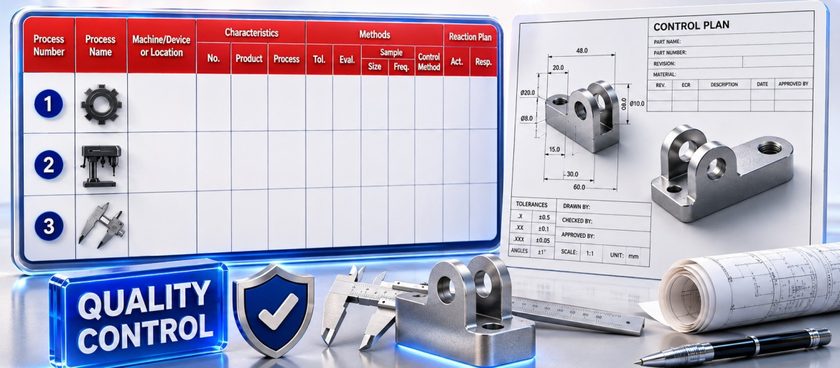
In my experience, a good Control Plan should answer five simple questions:
- What could affect product quality?
- How will we measure or monitor it?
- How often should we check it?
- Who is responsible?
- What happens when the result is not acceptable?
For example, if a machining process produces a shaft with a critical diameter of 25.00 ± 0.05 mm, the Control Plan might specify the measurement method, sampling frequency, SPC approach, and reaction plan if the process moves outside the defined limits. The real value, however, is not the document itself. A Control Plan connects identified process risks—often through PFMEA—to the controls people actually use on the shop floor.
I have seen Control Plans that look excellent during a document review but add little value during production. The most effective ones are different: they reflect the actual process, focus on meaningful risks, and give operators and engineers a clear response when something starts going wrong. Traditionally, the Control Plan follows a simple cycle:
Process → Monitor → Detect → React → Correct
That approach remains essential. But with today’s connected manufacturing data, there is an opportunity to take it further. What if the Control Plan could recognize early signs of process deterioration before a specification is violated? That is where AI-powered Control Plans—and the move toward predictive quality—become particularly interesting.
How Traditional Control Plans Work
A traditional Control Plan follows a simple principle: define the risk, establish the control, monitor the process, and react when something changes.
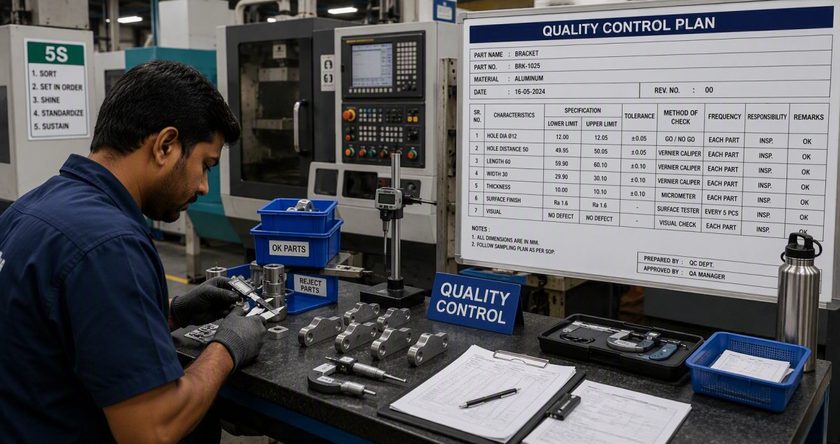
From my experience, the best Control Plans are practical rather than complicated. They make it clear:
- What needs to be controlled
- How it will be measured
- How often it will be checked
- Who is responsible
- What to do when the result is not acceptable
For example, if a shaft has a critical diameter of 25.00 ± 0.05 mm, the Control Plan might require measurement at a defined frequency using a calibrated instrument, with SPC used to monitor the process. If the process shows an out-of-control condition, the reaction plan may require containment, investigation, and verification before production continues.
The strength of this approach is its consistency. Everyone knows what matters and how to respond. But there is a gap I have seen in real manufacturing environments. A process can begin drifting between scheduled checks. A cutting tool can gradually wear. Temperature or vibration can change. Individual measurements may still meet specification while the overall process is heading in the wrong direction.
That means a traditional Control Plan is often answering: “Is the process acceptable right now?”
What it may not answer is: “Is the process showing signs that it could become unacceptable soon?”
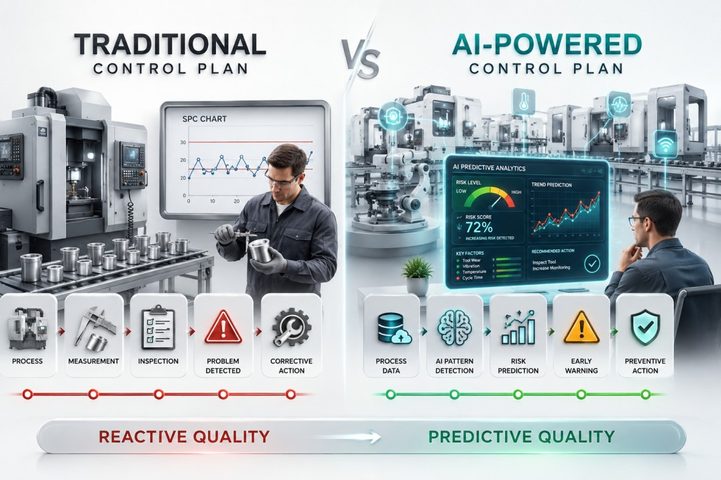
That distinction is important. Traditional Control Plans remain essential for process control and compliance. But with real-time data and advanced analytics, there is an opportunity to move beyond simply detecting variation toward anticipating it. And that is where the story of AI-powered Control Plans begins.
Problems with Traditional Reactive Control Plans
Traditional Control Plans do a good job of standardizing process controls. But from my experience, their biggest limitation is simple: they often tell us about a problem after the process has already started moving in the wrong direction.
- Periodic Checks Can Miss the Drift
A characteristic checked every 30 minutes can change significantly between inspections. Tool wear, temperature, vibration, or other process conditions may shift before the next measurement is taken.
- Within Specification Doesn’t Always Mean Stable
This is one of the most important lessons in process control. A measurement can remain within specification while the process is gradually drifting:
25.01 → 25.03 → 25.04 → 25.05 mm
Each result may look acceptable on its own. The trend is what deserves attention.
- Too Much Data, Not Enough Insight
Modern equipment generates data from sensors, inspection systems, MES, SPC, and other sources. Yet these data streams are often separated, making it difficult to see relationships that could signal an emerging quality issue.
- Control Plans Can Become Static
I have seen Control Plans that are technically complete but no longer reflect how the process actually behaves. Equipment changes, suppliers change, process conditions change—and the document may not evolve at the same pace. A Control Plan should be a living process-control tool, not something updated only when an audit or major change requires it.
- The Cost Comes Before the Reaction
Once a defect is detected, the organization may already be dealing with:
Scrap or rework
Production downtime
Containment
Investigation
Customer impact
The reaction may be effective, but the opportunity to prevent the event has already passed. This doesn’t mean replacing PFMEA, SPC, or Control Plans. It means using better data and analytics to recognize warning signs earlier. For me, that leads to the most important question. Instead of asking whether we detected the problem, can we identify that it was coming? That is where AI-powered Control Plans become genuinely interesting.
Top-Rated Courses & Professional Certifications
🧭 How to Choose: Use the filters to browse by category and provider. Click View Course to review course details, curriculum, pricing, and enrollment options.
Try changing your filters or search for another course.
What is an AI-Powered Control Plan?
An AI-powered Control Plan is essentially a traditional Control Plan with a predictive layer. From my experience, the real opportunity is not replacing the controls we already trust. It is using AI, machine learning, and real-time process data to spot patterns that may be difficult to see through routine inspection alone.
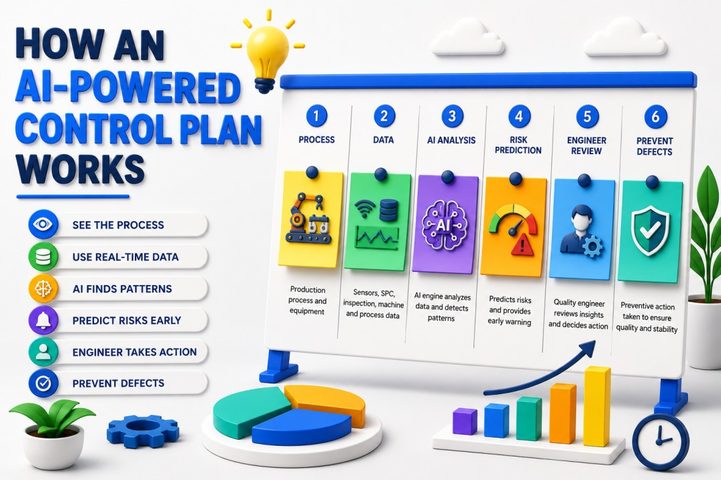
A traditional Control Plan might say: “Check this characteristic every 30 minutes and react if it exceeds the limit.”
An AI-enabled approach can go a step further: “The measurement is still acceptable, but is the process showing signs that it may fail soon?”
That prediction could use data from SPC trends, machine conditions, temperature, vibration, tool wear, inspection results, material lots, and other process variables. For example, a dimension may still be within specification, but a gradual combination of tool wear + temperature increase + dimensional drift could indicate growing process risk. Instead of waiting for the next failed measurement, the system can flag the pattern for investigation.
The fundamental shift is:
Traditional: Measure → Detect → React
AI-enabled: Monitor → Predict → Prevent
Importantly, I don’t see AI as replacing PFMEA, SPC, Control Plans, or Quality Engineer judgment. Those remain the foundation. AI adds another capability: recognizing emerging risk earlier and helping the team decide when action may be needed.
In simple terms: An AI-powered Control Plan uses data and predictive analytics to help identify quality risks before they become defects.
That is what makes it more than just a digital version of a traditional Control Plan.
How AI Transforms the Traditional Control Plan
The biggest change AI can bring to a Control Plan is simple: moving quality teams from reacting to signals to recognizing them earlier. From my experience, traditional controls work well when the process is stable and the right characteristics are being monitored. The challenge comes when a process starts changing between inspections—or when several small changes occur together.
AI can add value in four practical ways:
- From Periodic Checks to Continuous Insight
Instead of relying only on scheduled measurements, AI can analyze real-time information from machines, sensors, SPC, and inspection systems to identify unusual behavior earlier.
- From Single Readings to Patterns
A single measurement may look perfectly normal. But increasing temperature, tool wear, vibration, and dimensional drift occurring together may tell a different story. AI can evaluate these relationships far faster than manual review.
- From Detection to Prediction
The goal is to identify increasing risk before a specification is violated or nonconforming product is produced.
- From More Data to Better Decisions
Manufacturing already generates plenty of data. What matters is whether that data helps a Quality Engineer decide where to focus and when to act. That, in my view, is the real promise of AI-powered Control Plans. AI doesn’t replace PFMEA, SPC, established controls, or engineering judgment. It adds another layer of intelligence that can help us see what traditional inspection may miss.
How Predictive Quality Works
Predictive quality is about recognizing early signs that a process may be heading toward a quality problem. From my experience, it starts with connecting the right data—not simply collecting more of it. Useful information can come from SPC results, machine sensors, inspection systems, process parameters, equipment condition, and production history. When these signals are brought together, they provide a much clearer picture of how the process is behaving.
The real value comes from identifying relationships that may not be obvious from individual measurements. A dimension may still be within specification, for example, while temperature is increasing, vibration is changing, and tool usage is approaching a known limit. Individually, these signals may not require action. Together, they could indicate that the process is beginning to drift. AI and machine learning can help recognize these patterns by comparing current process behavior with historical outcomes.
This changes the quality question from “Is the part acceptable?” to “Is the process showing signs that it may become unacceptable?” If the risk increases, the quality team can investigate while there is still time to act. Depending on the process, that could mean checking equipment, replacing a worn tool, increasing monitoring, or reviewing an approved process parameter.
The important point is that AI provides the signal; quality expertise determines the response. The result can then be fed back into the improvement cycle, helping teams understand which predictions were useful and which controls may need refinement.
For me, that is the real promise of predictive quality. It does not replace Control Plans, PFMEA, SPC, or Quality Engineers. It gives them something extremely valuable: an earlier view of what may be coming, while there is still an opportunity to prevent the problem.
Recommended Books for Professionals
🇮🇳 India: Click in India | International: Click 🌐 Global
Try removing one or more filters.
AI Technologies Enabling Predictive Quality
From my experience, predictive quality does not come from one AI technology. It comes from combining good quality data with the right analytical tools to identify risks early.
Machine learning is one of the key technologies. It can learn from historical process and quality data to identify patterns associated with defects, process drift, or equipment problems. As new data becomes available, models can help estimate whether current conditions resemble situations that previously resulted in a quality issue.
Computer vision is particularly useful where visual inspection is involved. AI-based vision systems can detect surface defects, dimensional differences, assembly issues, or other abnormalities faster and more consistently than manual inspection in suitable applications.
Predictive analytics helps connect current process conditions with likely future outcomes. For example, changes in temperature, vibration, cycle time, or tool condition may provide early indications that process performance is deteriorating.
Real-time data and IoT technologies provide the foundation for all of this. Sensors and connected equipment can continuously capture process information instead of relying only on periodic manual measurements.
The final piece is data integration. When information from SPC, MES, inspection systems, equipment, and quality records can be connected, AI has a much better picture of what is happening across the process.
The important lesson is that technology alone does not create predictive quality. Reliable data, sound process knowledge, validated models, and Quality Engineer judgment still matter. AI becomes valuable when it turns those inputs into an earlier and more actionable understanding of quality risk.
Reactive vs. Predictive Quality: What’s the Difference?
From my experience, the biggest difference between reactive and predictive quality is timing. Reactive quality works after a problem becomes visible. A measurement fails, a nonconformance is identified, and the team contains the issue, investigates the cause, and takes corrective action. This approach is still essential—and a well-defined Control Plan should always provide a clear response when something goes wrong.
Predictive quality tries to move that response earlier. Instead of waiting for a limit to be exceeded, it looks at process trends, equipment behavior, inspection results, and other relevant data to identify early signs of increasing risk.
The difference can be summarized simply:
Reactive: Problem → Detect → Investigate → Correct
Predictive: Signal → Assess Risk → Prevent
For example, a traditional Control Plan may detect a dimensional problem during a scheduled inspection. A predictive system might recognize that tool wear, vibration, temperature, and dimensional drift are developing in a pattern associated with previous failures. I don’t see these as competing approaches. The best quality systems use both. Traditional controls provide the safety net; predictive analytics can provide an earlier warning.
AI-Powered Control Plan: A Real-World Example
Consider a CNC machining process where a critical shaft diameter is 25.00 ± 0.05 mm. n a traditional Control Plan, the operator checks the dimension at a defined frequency and uses SPC to monitor process behavior. If the result moves outside the defined limits, the reaction plan takes over—contain the product, investigate the cause, and correct the process.
Now imagine adding a predictive layer. The system continuously looks at dimensional results alongside tool usage, vibration, temperature, cycle time, and historical quality data. The dimension is still within specification, but several signals begin moving in a pattern previously associated with tool wear.
Nothing has failed yet. Instead of waiting for the next bad measurement, the system flags the process for review. The Quality Engineer can then inspect the tool, increase monitoring, or take another appropriate preventive action.
The difference is simple:
Traditional: Defect detected → Reaction
AI-powered: Early signal → Risk identified → Prevention
From my perspective, this is where AI can genuinely strengthen a Control Plan. The AI does not make the quality decision—the Quality Engineer does. It simply provides an earlier, data-driven warning while there is still an opportunity to prevent the defect. That is the real promise of predictive quality: more time to act, less time spent reacting.
How to Implement an AI-Powered Control Plan
Implementing an AI-powered Control Plan does not mean replacing your existing quality system with AI overnight. From my experience, the better approach is to start with one meaningful process problem and build from there.
First, identify a process where early prediction could make a measurable difference—such as recurring defects, high scrap, tool wear, or process drift. Then determine what data already exists through SPC, inspection systems, machines, MES, maintenance records, or other quality systems.
Next, make sure the data is reliable. AI cannot compensate for poor measurements, inconsistent data, or an unstable process. Your existing Control Plan, PFMEA, measurement system, and process controls should provide the foundation.
Once the foundation is sound, select a specific prediction to test. For example:
Can we predict dimensional drift before the part goes out of specification?
Train and validate the model using historical process and quality data, then test how accurately it identifies genuine risk without creating excessive false alarms. The next step is integration. A useful prediction should lead to a defined quality response—perhaps increased monitoring, equipment inspection, tool replacement, or an engineering review. The AI should support the decision, not bypass established quality controls. Finally, measure the results. Look at practical outcomes such as defect reduction, scrap, rework, downtime, false alerts, and response time. If the pilot demonstrates real value, expand it to other characteristics or processes.
The implementation path I recommend is: Identify the problem → Validate the data → Build the prediction → Validate the model → Define the response → Pilot → Measure → Scale
The important lesson is simple: start with the quality problem, not the AI technology. A sophisticated model that does not improve a real quality decision is just another piece of software.
Lean Six Sigma • Six Sigma • Statistics • Project Management • Artificial Intelligence (AI) • Operations Management • Quality Management
Frequently Asked Questions (FAQs)
Q. Can AI replace traditional control plans?
No, AI enhances traditional control plans by adding predictive insights rather than replacing them.
Q. What is the biggest advantage of an AI-powered control plan?
Its biggest advantage is identifying quality risks early so teams can prevent defects before they occur.
Q. Do companies need large amounts of data to implement predictive quality?
Not always; many organizations can start with existing quality, process, and inspection data.
Q. Can AI be used alongside SPC and control charts?
Yes, AI complements SPC by detecting patterns and risks that may not be immediately visible on control charts.
Q. Which industries benefit most from AI-powered control plans?
Manufacturing, medical devices, automotive, aerospace, electronics, and pharmaceutical industries can all benefit.
Q. Is implementing an AI-powered control plan expensive?
Costs vary, but many organizations start with small pilot projects using existing data and systems.
Q. What skills should quality professionals develop for predictive quality?
A strong foundation in quality tools, combined with basic knowledge of data analytics and AI concepts, is increasingly valuable.
Q. Will AI eliminate the need for quality engineers?
No, AI supports quality engineers by improving decision-making rather than replacing human expertise.
Q. What is the future of AI-powered control plans?
Future control plans are likely to become more dynamic, adaptive, and capable of recommending preventive actions automatically.
Q. How can organizations start their predictive quality journey?
Start by identifying a high-risk process, ensuring reliable data collection, and testing AI on a focused pilot application.
Conclusion
From my experience, the strongest quality systems are built on proven fundamentals: PFMEA, SPC, sound measurement systems, clear reaction plans, and Quality Engineer judgment. AI does not replace these foundations. It can make them more powerful by adding an earlier view of what is happening inside the process.
The real opportunity is to move beyond simply detecting defects. By connecting process data with AI and predictive analytics, Quality Engineers can identify patterns, recognize emerging risks, and act while there is still time to prevent a failure.
The shift is simple:
Reactive: Detect → Contain → Correct
Predictive: Monitor → Anticipate → Prevent
The technology will continue to improve, but the quality principle remains the same: prevent problems whenever possible rather than finding them after they happen.
For me, that is the future of the Control Plan—not a smarter document, but a smarter way of managing process risk.
Continue Your Learning Journey
Learning is a continuous process. Explore related topics, practical guides, tools, calculators, templates, and learning resources to expand your knowledge and develop new skills.
Choose a category below to explore practical tutorials, tools, calculators, templates, case studies, and learning resources.
Accelerate your learning with carefully selected courses, books, templates, and practical tools.
Expert-led courses to build skills and advance careers.
Explore CoursesRecommended books and professional study guides.
Explore BooksReady-to-use templates, guides, workbooks, and checklists.
Browse TemplatesPractical calculators for analysis and data-driven decisions.
Open CalculatorsPublished: August 26, 2026
Last Updated: August 26, 2026