DMAIC Master Guide: Complete Six Sigma Framework with Real Projects, Free Templates, Calculators, AI Tools, Case Studies & Expert Lessons
What is DMAIC and why it Matters today ?
In today’s fast-changing business environment, solving problems by guesswork is no longer enough. Organizations are expected to deliver higher quality, reduce costs, improve efficiency, and meet increasing customer and regulatory expectations—all at the same time. That’s why DMAIC (Define, Measure, Analyze, Improve, and Control) continues to be one of the most trusted problem-solving frameworks in Six Sigma. Instead of relying on assumptions or quick fixes, DMAIC provides a structured, data-driven approach that helps teams identify the real causes of problems, implement effective solutions, and sustain improvements over the long term.
What makes DMAIC especially valuable is its ability to work across almost every industry. While it was originally developed for manufacturing, I’ve successfully applied the same principles in quality engineering and medical device projects where the stakes are much higher than improving productivity alone. Whether the objective is reducing defects, improving process capability, shortening lead times, strengthening regulatory compliance, or enhancing customer satisfaction, the methodology remains remarkably effective because it focuses on understanding the process before changing it.
One lesson that has stayed with me throughout my career is that the best improvement projects don’t begin with solutions—they begin with better questions. I’ve seen teams spend weeks discussing possible fixes, only to discover later that they were solving the wrong problem. In contrast, projects that invested time in clearly defining the problem, understanding customer requirements, and validating data consistently produced more sustainable results. That experience reinforced my belief that DMAIC is not just a collection of quality tools—it’s a disciplined way of thinking that helps teams make better decisions with greater confidence.
Today, organizations have access to more data than ever before, but data alone doesn’t create improvement. It needs a structured framework to transform information into action. That’s exactly what DMAIC provides. Decades after its introduction, it remains one of the most practical and proven methodologies for achieving operational excellence, driving continuous improvement, and building a culture where decisions are based on evidence rather than opinion.
DMAIC Roadmap at a Glance
At its core, DMAIC is a structured roadmap for solving problems—not just a collection of quality tools. It takes teams from identifying a problem to implementing a solution that delivers measurable and sustainable results. Instead of relying on assumptions or jumping to conclusions, DMAIC provides a logical sequence of steps that ensures every decision is supported by data. Each phase builds on the previous one, creating a disciplined approach that reduces risk and increases the likelihood of long-term success.
My experience in leading quality improvement projects is that the pressure to “fix the problem quickly” often causes teams to skip the most important work. It’s natural to want immediate solutions, but the projects that delivered the best results were the ones where we slowed down, clearly defined the problem, collected reliable data, and validated the root causes before implementing any changes. Spending more time on the early phases almost always reduced rework and made the improvements easier to sustain.
The word DMAIC stands for:
- D – Define
- M – Measure
- A – Analyze
- I – Improve
- C – Control
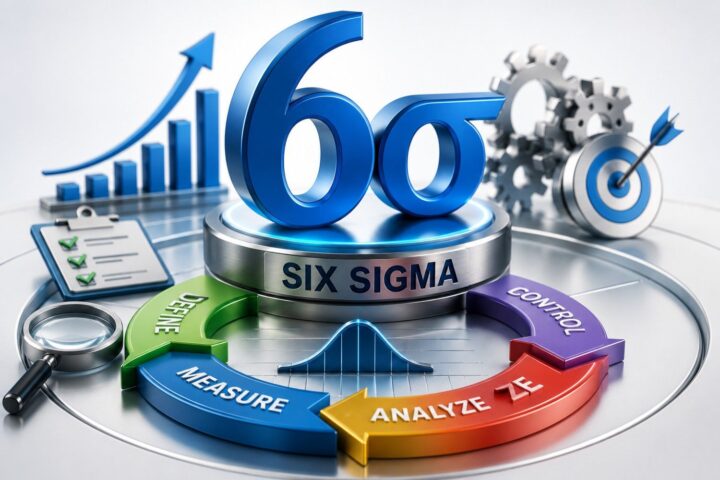
DMAIC is like a roadmap where every phase answers a critical question. Define clarifies what needs to be improved, Measure establishes the current performance, Analyze uncovers the true causes of the problem, Improve implements effective solutions, and Control ensures the gains are maintained over time. Following this sequence helps teams solve the right problem instead of simply treating the symptoms.
The roadmap below provides a high-level overview of how the five DMAIC phases fit together. In the following sections, we’ll explore each phase in detail, including its objectives, key deliverables, commonly used tools, practical examples, and lessons I’ve learned from applying DMAIC in real-world quality engineering projects.
5 Phases of DMAIC Six Sigma Methodology
Phase 1: Define Phase– Clearly Understanding the Problem
DEFINE phase is the 1st phase of Six sigma .Its primary purpose is to develop a clear understanding of the problem, establish the project scope, identify customer requirements, and ensure everyone is working toward the same objective. Before discussing solutions, the team must first agree on what problem needs to be solved and why it matters.
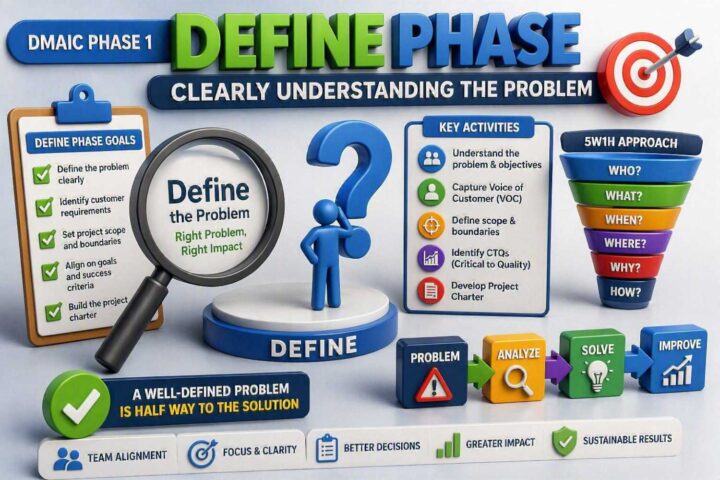
One of the biggest mistakes I’ve seen in improvement projects is the tendency to jump straight into solutions. When customer complaints increase or process performance declines, it’s easy to assume the cause and start implementing changes immediately. I remember a project where the initial recommendation was to add more resources because deliveries were consistently late. However, once we stepped back and applied the 5W1H approach to understand the problem, the data revealed that the real issue wasn’t capacity—it was an inefficient scheduling process. Solving the actual problem required a process improvement, not additional people or equipment. That experience reinforced an important lesson: a well-defined problem is often halfway to the solution.
The Define phase lays the foundation for everything that follows in DMAIC. If the problem statement is vague or based on assumptions, the analysis may focus on the wrong causes, leading to ineffective solutions and wasted effort. Investing time in clearly defining the problem at the beginning helps the team make better decisions, avoid costly rework, and significantly improve the chances of a successful project.
👉 It answers a simple question: “What problem are we solving ?”
🎓 Recommended Courses & Certifications
Looking to start or advance your Lean Six Sigma journey? The courses below have been carefully selected to help learners build practical problem-solving, quality improvement, DMAIC, and process optimization skills.
🥇 White Belt – Ideal for Beginners
🥈 Green Belt – Best for Practitioners
🥉 Black Belt – Advanced Continuous Improvement Leadership
| Course | About This Course | 🌍 Global |
|---|---|---|
| Lean Six Sigma White / Yellow Belt (Accredited) from Udemy (SSAA) ⭐⭐⭐⭐⭐ (4.6/5) | Best for beginners: A practical introduction to Lean Six Sigma fundamentals, quality improvement, and process excellence. A good starting point for learners with little or no prior experience. | 🔗View Course |
| Lean Six Sigma Yellow Belt & Green Belt [🏆 Recommended] from Udemy (go4sixsigma) ⭐⭐⭐⭐⭐ (4.5/5) | Best for aspiring Lean Six Sigma practitioners: Covers Yellow and Green Belt methodologies, DMAIC, quality improvement tools, and practical process improvement concepts. Suitable for learners looking to build skills beyond the fundamentals. | 🔗View Course |
| Lean Six Sigma Green Belt (Accredited) from edX from (Technical University of Munich) ⭐⭐⭐⭐ (4.2/5) | Best for intermediate learners: Focuses on applying Lean Six Sigma through a structured improvement project using the DMAIC methodology. A strong option for learners seeking university-backed Green Belt training. | 🔗View Course |
| Lean Six Sigma Black Belt Training & Certification Program [🏆 Recommended] from edX (JuranX) ⭐⭐⭐⭐⭐ (4.5/5) | Best for advanced Lean Six Sigma practitioners: Provides advanced training in Lean Six Sigma methodology, supported by self-paced learning and instructor-led webinars. Suitable for professionals preparing to lead more complex improvement initiatives. | 🔗View Course |
| JuranX: Daily Problem Solving (Root Cause Analysis) from edX (JuranX) ⭐⭐⭐⭐ (4.0/5) | Best for quality and problem-solving professionals: Teaches a structured approach to identifying, analyzing, and eliminating root causes rather than repeatedly addressing symptoms. Useful for developing practical problem-solving skills. | 🔗View Course |
📚 Recommended Books
Looking to strengthen your knowledge beyond online courses? These carefully selected books can help you master Lean Six Sigma, Project Management, Statistics, and Operations Management through practical examples, proven methodologies, and expert guidance.
| Book | About The Book | 🇮🇳 India | 🌍 Global |
|---|---|---|---|
| Lean Six Sigma For Dummies | Best for beginners: A practical introduction to Lean Six Sigma concepts, quality improvement, and process optimization. A good starting point for readers new to Lean Six Sigma. | 🔗 View on Amazon | 🔗 View on Amazon |
| Lean Six Sigma QuickStart Guide | Best for beginners: A straightforward introduction to Lean Six Sigma principles, methodologies, and improvement tools. Useful for readers who want to quickly build a foundation in Lean Six Sigma. | 🔗 View on Amazon | 🔗 View on Amazon |
| Project Management All-in-One For Dummies | Best for project managers and beginners: Covers essential project management concepts including planning, scheduling, risk management, Agile practices, and team leadership. A useful all-in-one reference for building practical project management skills. | 🔗 View on Amazon | 🔗 View on Amazon |
| Head First PMP | Best for PMP exam candidates: Uses an engaging, visual, and practical approach to explain project management concepts and PMP exam topics. Helpful for learners who prefer examples and interactive-style learning. | 🔗 View on Amazon | 🔗 View on Amazon |
| Rita Mulcahy’s PMP® Exam Prep | Best for PMP exam candidates: A comprehensive PMP exam preparation resource covering key project management concepts, exam strategies, practice questions, and essential PMP topics. Useful for structured preparation for the PMP certification exam. | 🔗 View on Amazon | 🔗 View on Amazon |
| PMBOK® Guide) – 7th Edition | Best for project management professionals: Provides a foundational reference for modern project management principles, performance domains, and approaches to delivering project outcomes. Useful for professionals and PMP candidates seeking an authoritative project management reference. | 🔗 View on Amazon | 🔗 View on Amazon |
| Introduction to Probability and Statistics | Best for students and statistics beginners: Introduces fundamental concepts in probability and statistics with applications across engineering, science, finance, and other fields. A useful foundation for developing statistical and analytical thinking. | 🔗 View on Amazon | 🔗 View on Amazon |
| Head First Statistics | Best for beginners: Makes statistics easier to understand through engaging explanations, visual examples, puzzles, and real-world applications. A good choice for readers who find traditional statistics textbooks difficult to follow. | 🔗 View on Amazon | 🔗 View on Amazon |
| Operations Management For Dummies | Best for operations and business professionals: Introduces key operations management concepts including process improvement, bottlenecks, Lean production, supply chain management, and operational efficiency. Useful for understanding how organizations improve processes and performance. | 🔗 View on Amazon | 🔗 View on Amazon |
Phase 2: Measure – Understanding Current Performance
Measure phase is the 2nd phase of Six sigma. Once the problem has been clearly defined, the next step is to understand how the process is actually performing today. This is the purpose of the Measure phase. Before making improvements, you need reliable data that establishes the current baseline. Without it, there’s no way to know whether a process is truly improving or whether changes are simply based on assumptions.
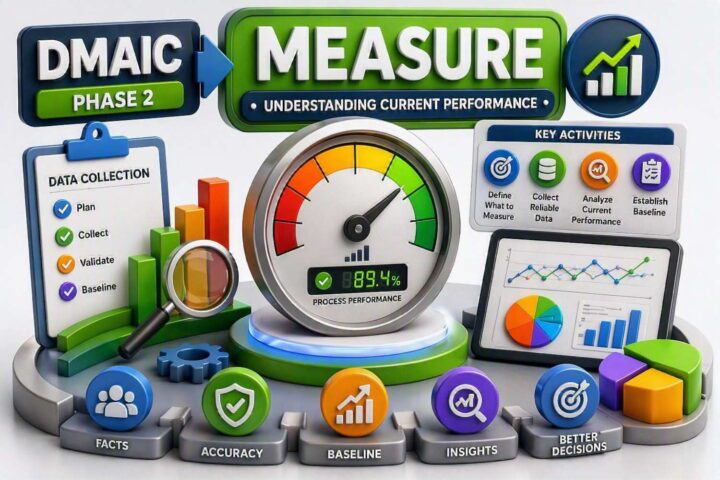
One of the biggest lessons I’ve learned from quality improvement projects is that teams often think they already know the problem. Someone might say, “Our defect rate is too high,” or “Customers are complaining more than ever.” But when the data is collected and analyzed, the story is often very different. In one project, the team initially believed the entire production process was underperforming. After measuring the data, we discovered that most defects came from a single shift operating under specific conditions. Instead of investing in unnecessary equipment or redesigning the process, we focused on the real source of variation. That simple shift in thinking saved both time and money.
This experience reinforces one of the most important principles of Six Sigma:
You cannot improve what you do not measure.
The Measure phase replaces opinions with facts. It focuses on collecting accurate, trustworthy data, validating the measurement system, and establishing a clear picture of current performance. This baseline becomes the benchmark for the rest of the DMAIC project, making it possible to quantify improvements and demonstrate measurable business results. In the next sections, we’ll explore the key activities, tools, and metrics used during the Measure phase to ensure decisions are driven by data—not guesswork.
👉 It answers a simple question: “How bad is the problem?”
Phase 3: Analyze – Finding Root Causes
Analyze phase is the 3rd phase of Six sigma. The Analyze phase is where the real detective work begins. After defining the problem and collecting reliable data, the next challenge is to answer one critical question: Why is this problem happening? The objective isn’t to confirm assumptions—it’s to uncover the true root cause using facts and data.
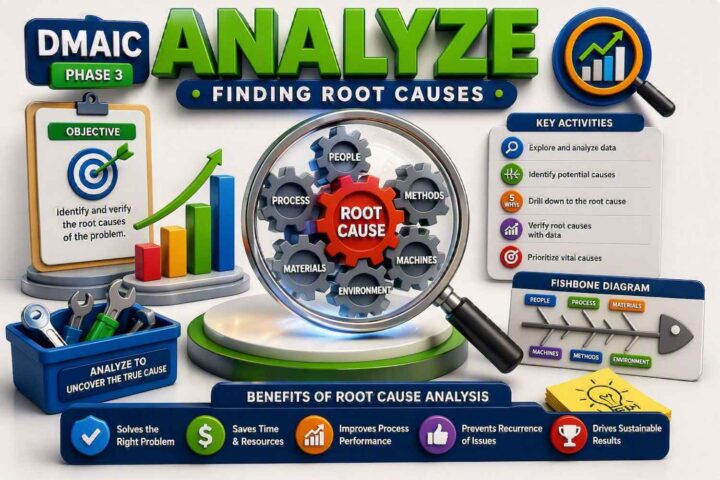
Many improvement teams jump to conclusions because the cause seemed obvious. In one manufacturing project, recurring defects were immediately blamed on operator performance, and additional training was rolled out. Weeks later, nothing had changed. When we dug deeper into the data, the actual culprit turned out to be an improperly calibrated machine that introduced variation during a specific operation. Once the equipment was corrected, the defects dropped dramatically. That experience reinforced a lesson I still share with Green Belts and project teams today: fixing symptoms may make a problem look smaller, but only eliminating the root cause prevents it from returning.
The Analyze phase helps teams move beyond opinions and identify the factors that truly influence process performance. Using process maps, Value Stream Mapping (VSM), Fishbone Diagrams, Pareto Charts, the 5 Whys, statistical analysis, and other problem-solving tools, the team validates potential causes instead of relying on guesswork. By the end of this phase, you should have clear, data-backed evidence of what is causing the problem—not just what appears to be causing it. That confidence makes the Improve phase far more effective because you’re solving the right problem instead of chasing symptoms.
Treating symptoms may provide temporary relief, but only eliminating the root cause can solve the problem permanently.
👉 It answers a simple question: “Why is this problem happening?”
Phase 4: Improve – Implementing Solutions
Now comes the action phase. Improve phase is the 4th phase of Six sigma. After clearly defining the problem, measuring the current performance, and identifying the root cause, it’s time to turn insights into action. This is the purpose of the Improve phase—the stage where ideas become measurable results. Rather than making random changes, the team develops, evaluates, tests, and implements solutions that directly address the validated root causes identified during the Analyze phase.
👉 “How can we fix the problem?”
The real challenge is implementing a solution that works consistently in the real world. I’ve seen teams rush into full-scale changes without piloting their ideas, only to create new problems or shift the issue somewhere else in the process. In contrast, the most successful projects were the ones where we tested solutions on a small scale, gathered feedback, refined the approach, and then rolled it out with confidence. That disciplined approach reduced implementation risks and improved team buy-in.
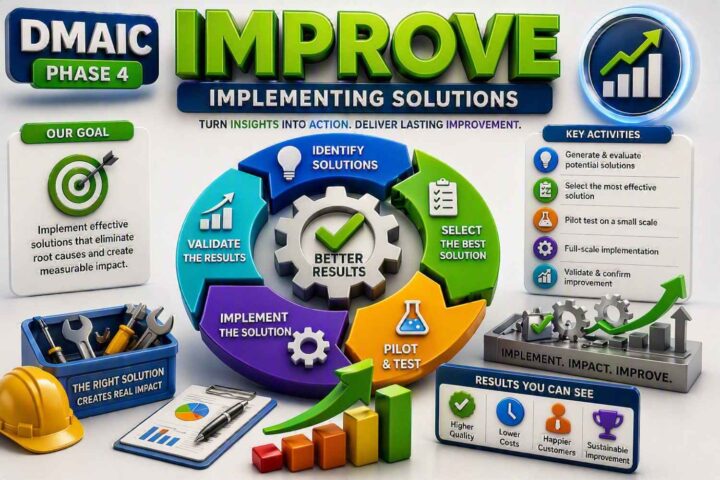
The Improve phase answers one simple but critical question: “What is the best way to eliminate the root cause?” Whether the solution involves redesigning a workflow, optimizing machine settings, simplifying a process, eliminating waste, or introducing automation, every improvement should be supported by data and validated before full implementation. The goal isn’t just to fix today’s problem—it’s to create a process that performs better, more consistently, and delivers lasting value to both the business and its customers.
👉 It answers a simple question: “How can we fix the problem?”
Phase 5: Control – Sustaining the Improvement
The Control phase is the final step in the DMAIC journey, but it’s where long-term success is determined. After investing time in defining the problem, analyzing data, and implementing effective solutions, the focus now shifts to ensuring those improvements become part of everyday operations. The goal isn’t just to fix a problem once—it’s to prevent it from returning.
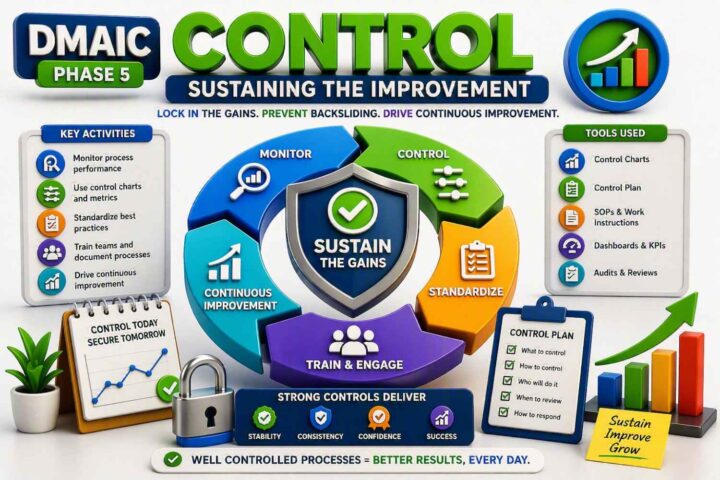
Most projects deliver impressive results during implementation, only to lose those gains a few months later because standard operating procedures weren’t updated, process owners weren’t clearly assigned, or no one was monitoring performance. In one project, regular process reviews and simple control charts helped us detect early signs of variation before they became customer issues. That experience reinforced an important principle: a successful Six Sigma project doesn’t end when the solution is implemented—it ends when the improvement becomes the new standard.
The Control phase answers a critical question: “How do we ensure the problem doesn’t come back?” This is achieved by standardizing the improved process, updating documentation, training employees, assigning ownership, and continuously monitoring key performance indicators (KPIs). Tools such as Control Plans, Control Charts, Visual Management, SOPs, and Process Audits help organizations maintain consistent performance and build a culture of continuous improvement.
Ultimately, the Control phase transforms short-term project success into lasting business value. When improvements are monitored, standardized, and embedded into daily operations, organizations not only sustain the gains they’ve achieved but also create a stronger foundation for future improvement initiatives.
👉 It answers: “How do we ensure the problem doesn’t return?”
DMAIC vs DMADV – Understanding the Difference
One of the questions I’m asked most often during Six Sigma training and project mentoring is, “Should I use DMAIC or DMADV?” It’s a fair question because both are core Six Sigma methodologies, but they’re designed for different situations. Choosing the right one at the start of a project can save weeks—or even months—of unnecessary work.
A simple way to remember the difference is this: DMAIC improves an existing process, while DMADV designs a new one. If your manufacturing process, service workflow, or business operation already exists but isn’t consistently meeting quality, cost, or customer expectations, DMAIC is usually the right choice. If no suitable process exists—or the current design simply cannot meet customer requirements—DMADV provides a structured approach to build a better solution from the ground up.
I’ve seen this decision make a significant difference in real projects. In one medical device development project, our team initially assumed the existing process could be improved using DMAIC. However, as we reviewed the data, customer requirements, and design constraints, it became clear that the process itself was fundamentally limited. Continuing to optimize it would only have produced incremental gains. Instead, we shifted our approach toward redesigning the process, which ultimately delivered a more robust and sustainable solution. That experience reinforced an important lesson: sometimes the biggest improvement comes from recognizing that a process needs to be redesigned—not continuously optimized.
As a practical rule, I encourage project teams to ask one question before selecting a methodology: “Can the current process realistically achieve the desired performance?” If the answer is yes, DMAIC is the right approach because it focuses on reducing variation, eliminating defects, and improving process performance. If the answer is no, or the process must be created from scratch, DMADV is usually the better choice because it focuses on designing quality into the product or process from the beginning.
The table below summarizes the key differences between DMAIC and DMADV.
| Feature | DMAIC | DMADV |
|---|---|---|
| Full Form | Define, Measure, Analyze, Improve, Control | Define, Measure, Analyze, Design, Verify |
| Starting Point | Existing process | New process or product |
| Purpose | Improve an existing process | Design a new product or process |
| Best Used When | Performance needs improvement | Existing design cannot meet customer needs |
| Focus | Reduce variation and eliminate defects | Build quality into the design from the start |
| Typical Outcome | Better efficiency, quality, and cost | New process or product that meets customer expectations |
| Common Industries | Manufacturing, healthcare, finance, service | Product development, engineering, medical devices, R&D |
| Typical Tools | SIPOC, Process Mapping, MSA, Pareto Chart, Fishbone Diagram, Hypothesis Testing, Control Charts | VOC, CTQ Tree, QFD, Risk Analysis, DOE, Simulation, Design Verification |
| Common Industries | Manufacturing, Healthcare, Finance, Logistics, Service | Product Development, Medical Devices, Automotive, Aerospace, R&D |
Case Studies: How the Methodology Delivers Results in the Real World
One of the reasons DMAIC has remained the gold standard for process improvement is that it consistently delivers results across industries. I’ve applied the same structured approach in manufacturing and medical device quality engineering projects, and while every challenge was different, the pattern was remarkably similar. Teams often started with assumptions about the problem, but once we collected reliable data and followed the DMAIC methodology, the real root cause was frequently something entirely different. That experience has taught me that successful improvement projects aren’t driven by intuition—they’re driven by evidence.
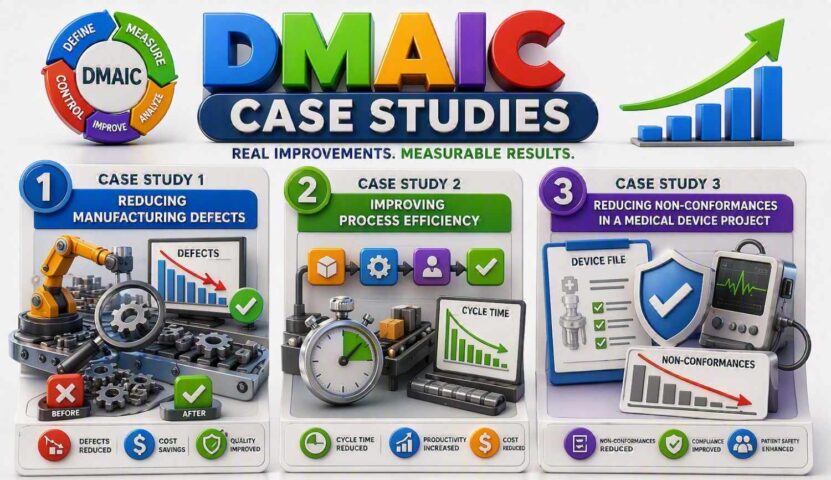
Case Study 1: Reducing Manufacturing Defects
In one manufacturing improvement project, customer complaints related to product quality had been increasing for several months. The initial belief was that operators required additional training. However, after collecting process data and analyzing defect patterns, we discovered that the variation originated from an unstable process parameter that wasn’t being monitored consistently. Instead of investing in extensive retraining, the team strengthened process controls, standardized machine settings, and introduced routine monitoring. The result was a significant reduction in defects and more consistent product quality.
Lesson Learned: Never assume people are the problem until the data proves it. More often than not, the process—not the operator—is driving the variation.
Case Study 2: Improving Process Efficiency
In another project, delayed deliveries were creating frustration for both customers and internal teams. Many stakeholders believed the organization simply needed additional equipment and resources. Rather than approving a costly investment, we mapped the entire workflow and measured each step of the process. The analysis revealed that the biggest delays came from scheduling bottlenecks and unnecessary handoffs between departments. By simplifying the workflow, clarifying responsibilities, and removing non-value-added activities, delivery performance improved without purchasing any new equipment.
Lesson Learned: Before investing in new resources, understand how the current process actually works. Improving the process is often more effective than increasing capacity.
Case Study 3: Reducing Non-Conformances in a Medical Device Project
One quality improvement initiative focused on recurring non-conformances during medical device development. At first, the team believed the issue required broad corrective actions across the entire process. However, detailed analysis showed that most deviations stemmed from inconsistent documentation practices rather than technical failures. By standardizing documentation, simplifying templates, and strengthening review controls, recurring issues were significantly reduced while maintaining regulatory compliance.
Lesson Learned: Effective improvements don’t always require major process changes. Sometimes small, well-targeted improvements produce the greatest long-term impact.
Although these projects involved different industries and business challenges, they all reinforced the same principle: DMAIC helps teams replace assumptions with facts. The most successful projects weren’t the ones that used the most sophisticated statistical tools—they were the ones that clearly defined the problem, relied on reliable data, validated the root cause, and implemented solutions that could be sustained over time. In my experience, that disciplined approach is what transforms DMAIC from a quality methodology into a practical framework for solving real business problems.
Free DMAIC Templates and Calculators
🧮 DMAIC Calculators
🧮 Sigma Level & DPMO Calculator – Calculate DPO, DPMO, Yield %, and Sigma Level.
🧮 Process Capability Calculator (Cp & Cpk) – Calculate process capability instantly.
🧮 Control Chart Calculator (coming soon)
🧮 Sample Size Calculator (coming soon)
Frequently Asked Questions (FAQs)
What is DMAIC in simple words?
DMAIC is a five-step method for improving existing processes by solving problems using data.
What does DMAIC stand for?
DMAIC stands for Define, Measure, Analyze, Improve, and Control.
What is the purpose of DMAIC?
Its purpose is to reduce defects, eliminate inefficiencies, and improve process performance.
Which methodology uses DMAIC?
DMAIC is the core problem-solving methodology of Six Sigma.
What type of processes is DMAIC used for?
DMAIC is used to improve existing processes rather than create new ones.
What is the Define phase?
The Define phase identifies the problem, project goals, and customer requirements.
What is the Measure phase?
The Measure phase collects data and establishes the current process performance.
What is the Analyze phase?
The Analyze phase identifies and validates the root causes of the problem.
What is the Improve phase?
The Improve phase develops, tests, and implements effective solutions.
What is the Control phase?
The Control phase ensures that improvements are maintained over the long term.
What is the main goal of the Analyze phase?
The main goal is to find the true root causes of the problem.
Why is data important in DMAIC?
Data helps teams make objective decisions based on facts instead of assumptions.
Can DMAIC be used outside manufacturing?
Yes, DMAIC is widely used in healthcare, banking, IT, logistics, and service industries.
Is DMAIC only for large organizations?
No, businesses of all sizes can benefit from DMAIC.
What is baseline data in DMAIC?
Baseline data represents the current performance before improvements are implemented.
What is process variation?
Process variation is the natural difference or inconsistency in process outputs.
Why is root cause analysis important?
It ensures that solutions eliminate the actual cause rather than just the symptoms.
What is the biggest benefit of DMAIC?
It provides a structured and data-driven approach to continuous improvement.
Can DMAIC reduce costs?
Yes, DMAIC helps reduce waste, defects, rework, and operational costs.
Does DMAIC improve customer satisfaction?
Yes, by improving quality and consistency, DMAIC enhances customer satisfaction.
What tools are commonly used in DMAIC?
Common tools include 5 Why Analysis, Fishbone Diagram, Pareto Chart, SIPOC, and Control Charts.
What is a SIPOC diagram?
A SIPOC diagram provides a high-level overview of a process from suppliers to customers.
What is the role of a Six Sigma Green Belt in DMAIC?
A Green Belt leads or supports improvement projects using the DMAIC methodology.
Can DMAIC be combined with Lean?
Yes, Lean and DMAIC are often combined in Lean Six Sigma projects.
What is Lean Six Sigma?
Lean Six Sigma combines waste reduction with variation reduction to improve processes.
How long does a DMAIC project usually take?
Depending on complexity, DMAIC projects may take from a few weeks to several months.
What is a project charter in DMAIC?
A project charter defines the project’s objectives, scope, timeline, and team members.
Why should solutions be tested before implementation?
Pilot testing reduces risk and verifies that the solution is effective.
What happens after improvements are implemented?
The process is monitored and controlled to sustain the gains.
How does DMAIC support continuous improvement?
It promotes ongoing measurement, analysis, and optimization of business processes.
Can DMAIC improve service processes?
Yes, DMAIC is highly effective for improving both manufacturing and service operations.
What is a defect in Six Sigma?
A defect is any output that fails to meet customer or process requirements.
What is a Critical to Quality (CTQ) characteristic?
A CTQ is a measurable feature that directly impacts customer satisfaction.
What is the Voice of the Customer (VOC)?
VOC represents customer needs, expectations, and preferences.
Why is the Measure phase considered challenging?
Because collecting accurate and reliable data is essential for successful analysis.
What is the purpose of process mapping in DMAIC?
Process mapping helps visualize workflows and identify improvement opportunities.
What is a Fishbone Diagram used for?
It helps identify potential causes contributing to a specific problem.
What is the 5 Why technique?
It is a root cause analysis tool that repeatedly asks “Why?” until the fundamental cause is identified.
What is a Pareto Chart?
A Pareto Chart highlights the few causes responsible for the majority of problems.
Why is the Control phase essential?
Because it prevents the process from returning to its previous inefficient state.
Can DMAIC improve productivity?
Yes, DMAIC streamlines processes and eliminates unnecessary activities.
Who should be involved in a DMAIC project?
Cross-functional teams with relevant process knowledge should participate.
What is process capability in DMAIC?
Process capability measures how well a process meets specification limits.
Can DMAIC be used for administrative processes?
Yes, it can improve HR, finance, procurement, and other office functions.
What is the difference between DMAIC and PDCA?
DMAIC is more data-intensive, while PDCA focuses on iterative continuous improvement.
What is the difference between DMAIC and 8D?
DMAIC improves processes systematically, while 8D primarily focuses on structured problem-solving.
Does DMAIC require statistical knowledge?
Basic projects may not, but advanced DMAIC projects often use statistical analysis.
What is the final deliverable of DMAIC?
A stable, improved process with controls in place to sustain performance.
Why is teamwork important in DMAIC?
Cross-functional collaboration leads to better analysis and more effective solutions.
What is the ultimate objective of DMAIC?
To create sustainable process improvements that enhance quality, efficiency, and customer satisfaction.
Conclusion
DMAIC is much more than a Five-Step Six Sigma methodology—it’s a practical framework for solving problems with confidence. By following the structured sequence of Define, Measure, Analyze, Improve, and Control, organizations replace assumptions with facts, identify the real causes of problems, implement effective solutions, and ensure those improvements are sustained over time.
Throughout my career in quality engineering and medical device development, one lesson has remained consistent: the best projects weren’t always the ones with the most advanced statistical analysis—they were the ones that asked the right questions, trusted the data, and followed the DMAIC process with discipline. Time and again, I’ve seen teams avoid costly mistakes simply by slowing down to define the problem correctly and validating decisions with evidence instead of assumptions.
What makes DMAIC so valuable is its ability to deliver results across industries. Whether you’re improving a manufacturing process, streamlining a healthcare workflow, enhancing a service operation, or leading a digital transformation initiative, the same principles apply. When used correctly, DMAIC doesn’t just solve today’s problem—it builds a repeatable approach for continuous improvement and better decision-making.
If there’s one takeaway from this guide, let it be this: successful improvement isn’t about finding quick fixes—it’s about solving the right problem, using reliable data, and creating solutions that last. That’s why, decades after its introduction, DMAIC continues to be one of the most trusted and effective problem-solving frameworks in the world.
I hope this guide, along with the real-world examples, downloadable templates, calculators, AI tools, and practical lessons, helps you apply DMAIC with greater confidence in your own projects. Remember, continuous improvement isn’t a one-time initiative—it’s a mindset. Every well-executed DMAIC project is another step toward building more capable processes, stronger teams, and better outcomes for customers.
📖 Where should I go after learning the DMAIC?
Once you understand the DMAIC methodology, the next step is learning the tools and techniques used within each phase of a real improvement project. While DMAIC provides the overall roadmap, successful projects depend on selecting the right problem-solving, statistical, and process improvement tools at the right time. On Digital E‑Learning, you can continue building your Six Sigma and Continuous Improvement skills with the following practical guides:
- What is Six sigma
- DMAIC Methodology
- FMEA (Failure Mode and Effects Analysis)
- 5S Methodology
- 8D Problem Solving
- Poka-Yoke Master Guide
- Pareto Analysis (80/20) Principle
- Process Capability (Cp, Cpk)
- Statistical Process Control (SPC)
- Root Cause Analysis
- Lean Manufacturing
Once you understand the DMAIC methodology, the next step is learning the tools and techniques used within each phase of a real improvement project. While DMAIC provides the overall roadmap, successful projects depend on selecting the right problem-solving, statistical, and process improvement tools at the right time. On Digital E‑Learning, you can continue building your Six Sigma and Continuous Improvement skills with the following practical guides:
👤About the Author
Aman is the Founder of Digital E-Learning and a Quality & Continuous Improvement professional with more than 25 years of experience across the Automotive, Medical Device, Manufacturing, and Consulting industries. Throughout his career, he has led and contributed to numerous initiatives in Lean Six Sigma, Quality Engineering, Risk Management, Design Assurance, Process Improvement, Problem Solving, and Operational Excellence, helping organizations enhance quality, improve efficiency, and deliver greater customer value.
Drawing on extensive real-world industry experience, Aman focuses on simplifying complex concepts into practical, easy-to-understand learning resources. His content combines proven methodologies, industry best practices, and hands-on examples to help students, engineers, quality professionals, and business leaders apply these concepts effectively in their day-to-day work.
In addition to his professional experience, Aman is the creator of the Digital E-Learning YouTube channel, a trusted learning platform followed by over 125,000 subscribers worldwide. Through his articles and videos, he shares practical knowledge in Lean Manufacturing, Six Sigma, Quality Management, Statistics, Microsoft Excel, Project Management, and Continuous Improvement.
🏆 25+ Years Industry Experience
🎓 125,000+ YouTube Learners
📚 Practical Templates & Calculators
🌍 Serving Learners Worldwide
📧: contact@digitalelearnings.com
Published: September 11, 2021
Last Updated: August 11, 2026